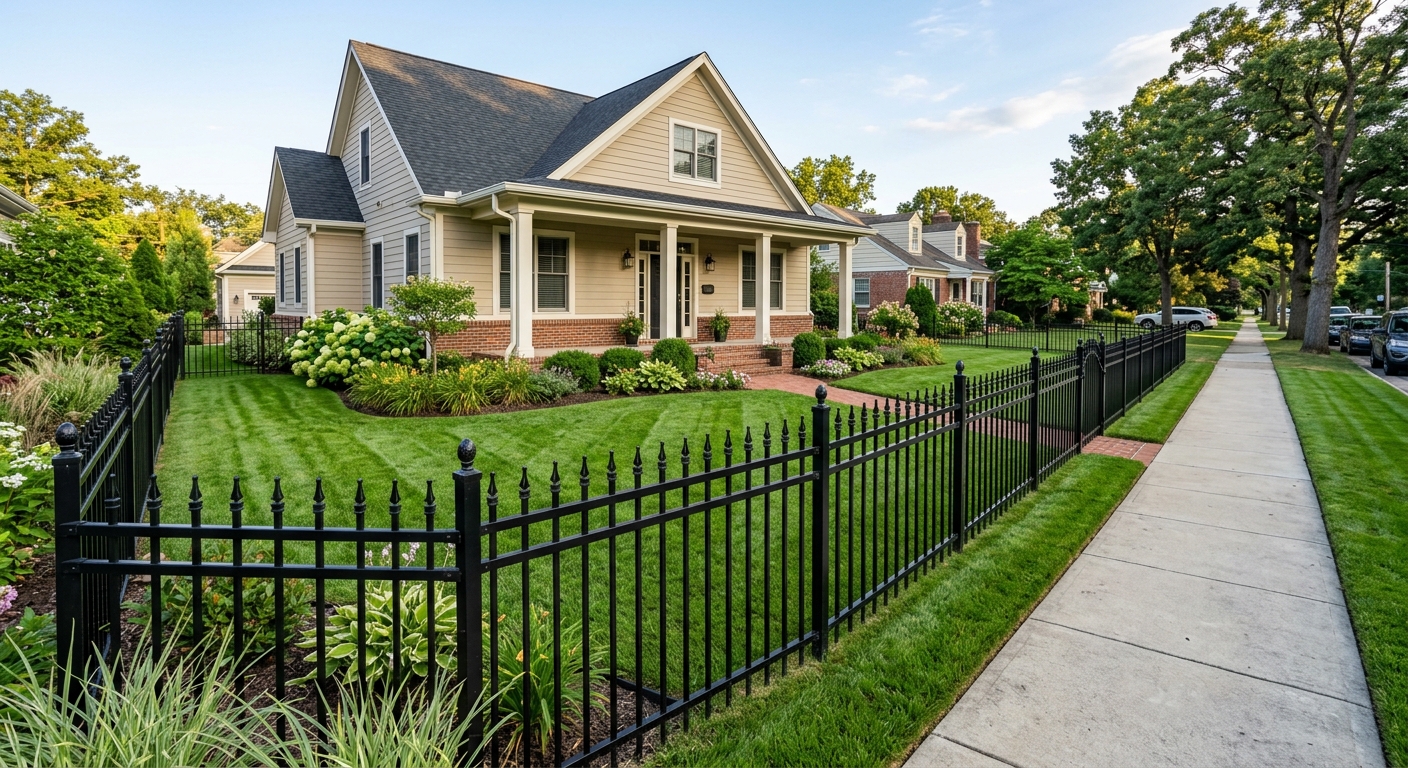
Fencing options and costs in Deseronto
Deseronto homeowners typically start by comparing practical options—pressure-treated wood, cedar, vinyl/PVC, chain-link, and ornamental aluminium—then narrow down based on privacy and maintenance. With 73.8% of local dwellings being single-detached homes and 70.1% of households owning their homes (Statistics Canada, 2021 Census), demand for perimeter upgrades is steady: every detached property can become a fencing project when families add pets, gardens, or backyard privacy.
In the Kingston–Pembroke economic region, fencing pricing is heavily shaped by frost and ground conditions. Post holes must generally be planned deeper to reduce freeze–thaw heaving, especially where clay and silty soils hold water along the St. Lawrence and Bay of Quinte. That means more augering, concrete setting for structural runs and gates, and labour time—factors that can push wood and vinyl installs toward the mid-to-upper end of Ontario’s provincial pricing bands. Wind exposure also matters near the waterfront areas, where gusts can increase the need for stronger posts and tighter spacing, particularly for taller privacy fences.
In Deseronto, fencing contractors are especially busy around residential pockets close to the waterfront and along main corridors where yards are longer and access can be tighter—these jobs often involve heavier panels and more careful layout to keep posts below frost. Next, here’s a quick side-by-side view of typical material lifespans, maintenance expectations, privacy performance, and installed price ranges you can use to compare quotes.
| Material |
Lifespan |
Maintenance |
Privacy Rating |
Price per Linear Foot |
| Pressure-treated pine (standard wood) |
10–18 years |
Stain/seal every 2–3 years to slow grey weathering |
7–9 / 10 (solid boards) |
$55–$95 |
| Cedar (natural rot resistance) |
15–25 years |
Clean and re-stain every 2–4 years |
8–10 / 10 (solid cedar pickets/boards) |
$75–$125 |
| Vinyl / PVC (no-maintenance) |
20–30 years |
Rinse as needed; occasional panel/trim fixes |
7–10 / 10 (solid privacy styles) |
$75–$140 |
| Chain-link (galvanized steel) |
20–40 years |
Rinse/inspect; tension adjustments over time |
2–4 / 10 (security-focused) |
$40–$80 |
| Aluminum ornamental |
25–40 years |
Wash seasonally; touch up minor scuffs |
3–6 / 10 (semi-open) |
$80–$160 |
| Composite / recycled material |
20–30 years |
Low maintenance; occasional cleaning |
7–10 / 10 (solid infill options) |
$95–$165 |
Prices are estimates only and vary by project scope, site access and material selection.
What affects the price of fencing in Deseronto
In Deseronto and the wider Kingston–Pembroke region, it’s normal to see the same fence concept price vary by 30–50% between quotes. The biggest reasons are usually (1) post depth and ground difficulty, (2) how gates and corners are engineered, and (3) whether crews can access the yard easily or have to hand-dig and carry materials in. Labour and materials in Ontario also swing with lumber, PVC resin, and steel costs—so two contractors using different brands or hardware packages can land in different parts of the price band (often within a small window of time).
Frost line depth is the controlling factor. Southern and eastern Ontario are commonly planned around 1.2 m (4 ft) of frost penetration, so contractors typically set posts about 4–6 inches below that design frost depth to prevent heaving. Practically, that often means posts are pushed roughly 36–48 inches deep, and in wetter clay/silty zones it can be deeper or require more concrete to stabilize the footing. Longer posts and more concrete mean higher material and labour cost, even if the fence looks “simple” on paper.
Wind exposure also changes engineering choices. While Deseronto isn’t the windiest region in Ontario, gusts near the Lake Ontario/Bay of Quinte can make privacy fences behave like a sail. Contractors may tighten post spacing or upsize posts, which pushes privacy installs toward the upper end of wood and PVC ranges (for example, moving into the upper portion of the $75–$140 PVC band for taller solid styles).
Concrete examples from Kingston–Pembroke backyards: (1) a yard with clay that holds water often needs extra auger time and thicker concrete-set footings, raising quotes; (2) a lot with rocky subsoil can require coring or careful hand-digging, increasing per-post cost; (3) shorter runs with easy truck access can lower labour hours, keeping you closer to the $55–$95 wood band for standard pressure-treated installs. Finally, housing age matters—around 73.6% of Deseronto homes were built before 1981 (Statistics Canada, 2021 Census), which often means older property layouts, mature trees, and buried services that increase locating and careful post placement.
| Price Factor |
Why It Matters |
Cost Impact |
| Fence length in linear feet |
Most materials and labour scale directly with total run length |
Primary driver; expect the largest portion of the total quote |
| Post depth required |
Frost protection dictates hole depth and post length |
Deeper posts increase material cost and auger time |
| Post setting method |
Concrete vs. gravel pack vs. driven posts affects stability |
Concrete-set sections typically cost more but reduce heaving risk |
| Material choice |
Vinyl/Cedar/wood differ in hardware, installation approach, and waste |
Can shift projects between Ontario bands (e.g., wood vs. PVC) |
| Gate count and type |
Gates need heavier posts, hinges, and tighter alignment |
One double drive-through gate can add substantial labour and steel |
| Grade and terrain |
Slopes require raked panels or stepped rails and extra layout time |
More framing cuts and labour; less waste with careful planning |
| Old fence removal and disposal |
Demolition adds time, hauling, and disposal costs |
Often increases the quote beyond “new build” pricing |
| Permit fees and survey / property line locate |
Some fences require permitting; accuracy prevents encroachment disputes |
Possible adders, especially for taller privacy installs |
Permits & regulations in Ontario
In Ontario, whether you need a permit often depends on fence height and placement. As a practical rule of thumb, fences above a height threshold—commonly 2.0 m (6.5 ft) for the rear and about 1.0–1.2 m (3–4 ft) for the front yard or corner—may require a building permit. You also must respect property lines and any municipal setback requirements for fences and accessory structures.
Before digging any post hole, call for utility locates through Ontario One Call to protect against buried electrical, gas, and telecom lines. Then consider getting a survey or at least a property line locate so your posts land correctly—this matters in older Deseronto neighbourhoods where fence lines may have been shifted over decades. Shared fence ownership rules are governed by Ontario’s line-fences legislation, so it’s smart to clarify responsibility for future repairs, maintenance, and replacement with your neighbour in writing.
Permit “yes” vs “typical no”: a permit is more likely if you’re planning a taller fence, a fence that changes drainage/grade at a service corridor, or you’re in a situation requiring review (for example, corner visibility concerns). Routine replacement in like-for-like height and location usually avoids permitting, but you should still confirm with the municipality before starting.
To verify a contractor, ask for their Ontario licence details (if applicable), a current Certificate of Insurance showing general liability, and proof of WSIB coverage where required. For coverage, request the certificate directly and check the named insured, policy effective dates, and that it lists fencing-related work. If a contractor can’t provide documents quickly, treat it as a risk.
Choosing the right fence material for Deseronto
Choosing a fence material in Deseronto comes down to matching your priorities—privacy, low maintenance, budget, and lifespan—to how this region behaves in freeze–thaw cycles. Pressure-treated pine is usually the best starting point for cost, but it typically needs staining or sealing every 2–3 years to reduce grey weathering and improve water resistance. Cedar offers better natural rot resistance and an attractive finish, yet it still benefits from periodic cleaning and re-staining. Vinyl/PVC is the low-maintenance option most homeowners want; however, in extreme cold it can become more brittle, so proper post spacing and quality brackets matter.
Chain-link is the budget-friendly security fence with the longest service life, but it doesn’t deliver privacy unless you add slats, lattice, or landscaping. Aluminum ornamental is corrosion-resistant and looks sharp, making it popular for front and side yards; the trade-off is lower privacy because of its open design.
For Kingston–Pembroke frost performance, post depth design is the same regardless of finish material: contractors typically set posts below the design frost depth so the footing doesn’t heave. In many Southern/Eastern Ontario installations, that means roughly 36–48 inches deep plus concrete-set posts for structural sections and gates. Concrete-set work is often necessary when gates are involved because hinges and latch loads concentrate force at the posts.
Wind and snow loads also affect material choice. Taller privacy fences in gustier waterfront-adjacent areas may need tighter post spacing or stronger rails, and that can narrow the gap between “cheap” and “premium” designs—especially when you price a vinyl privacy style near the upper $75–$140 band. As a concrete comparison, if a standard pressure-treated privacy run quotes closer to $55–$95 per linear foot, upgrading to cedar or vinyl may be justified when you want fewer maintenance visits or longer appearance stability through Ontario winters and wet shoulder seasons.
| Material |
Cold Tolerance |
Lifespan |
Annual Maintenance |
Best For |
Price Band |
| Pressure-treated pine |
Good (with proper sealing) |
10–18 years |
Low to moderate: typically 1–2 hours of spot work; stain every 2–3 years |
Budget privacy with acceptable upkeep |
$55–$95 |
| Cedar |
Very good |
15–25 years |
Moderate: clean and re-stain every 2–4 years |
Better look and rot resistance |
$75–$125 |
| Vinyl / PVC |
Good (quality hardware matters in cold) |
20–30 years |
Very low: rinse and inspect annually |
Low maintenance privacy |
$75–$140 |
| Chain-link |
Excellent |
20–40 years |
Low: occasional tension/fastener checks |
Security, pets, and long-term value |
$40–$80 |
| Aluminum ornamental |
Excellent |
25–40 years |
Low: wash seasonally |
Front curb appeal with secure boundaries |
$80–$160 |
| Composite / recycled |
Good (installed with correct clearance) |
20–30 years |
Low: periodic cleaning; minimal repairs |
Solid infill privacy with reduced upkeep |
$95–$165 |
How to choose a fencing contractor in Deseronto
When you’re hiring in Deseronto, start by verifying insurance and work coverage—because fencing failures are usually expensive to fix after posts heave or gates sag. For Ontario requirements, ask for proof of general liability insurance (a Certificate of Insurance) showing the fencing work is covered, and confirm WSIB coverage status where required for workers. You can check the certificate details directly: confirm policy effective dates, that the contractor is named as the insured, and that the coverage type matches the work (not just generic personal coverage). Many reputable contractors will also provide a WSIB clearance letter on request.
Next, get 2–3 written, itemised quotes—not one lump sum. Each quote should separate labour vs. materials, clearly list the post type and depth plan (especially the concrete-set sections and gate posts), and specify the fence height, panel spacing, hardware brand, and whether old fence removal/disposal is included. Scope gaps are a common reason for surprises later; for example, “fence supply only” or “disposal not included” can shift cost quickly.
Warranty matters: request the workmanship warranty length and what it covers (posts, rails, gate hardware alignment), plus the manufacturer warranty for the product itself. Ask whether the warranty is transferable to future owners if you sell your home.
For payment, keep it controlled. Never pay more than 10–15% upfront, and hold back the final amount until the job is complete and cleaned up. Also insist on a start date and completion estimate in writing.
- Ask what post depth they install in Kingston–Pembroke frost conditions and whether concrete is used for gate sections.
- Confirm they include utility locates coordination before digging.
- Request an itemised labour/material breakdown (posts, rails, fasteners, hardware).
- Ensure quotes specify fence height, exact style, and whether it’s solid-board privacy or spaced pickets.
- Verify they show corner and end-post bracing design for structural sections.
- Check that gates include the correct heavier hinge and latch hardware—not “standard” panels.
- Confirm disposal/removal of old fencing and debris is included or clearly excluded.
- Ask about whether they will re-landscape/grade around posts after installation.
- Make sure the quote lists who is responsible for permits (if required) and any locate/survey costs.
- Get the workmanship warranty in writing, including what failures trigger repairs.
- Set expectations on timeline and weather stoppages; request dates in the contract.
- Verify insurance documents before work starts and keep copies.
In Deseronto, common red flags include: a contractor who won’t provide insurance or WSIB proof; quotes that don’t state post depth or setting method; vague line items like “materials to be confirmed later”; and crews asking for large deposits (over 10–15% upfront) without a signed contract that spells out scope, warranty, and schedule.
Frequently asked questions — fencing in Deseronto
How much does a fence cost in Deseronto?
Fence costs in Deseronto typically land within Ontario’s provincial ranges once you include posts, gates, and proper frost-depth installation planning. For a budget baseline, chain-link often comes in around $40–$80 per linear foot, while standard pressure-treated wood installations commonly fall near $55–$95. Vinyl/PVC is usually higher, with many privacy styles tracking toward $75–$140, especially when taller panels require stronger post spacing. Your final number depends on linear footage, gate count, and ground conditions (clay/silty soils that hold water can increase auger time and concrete-set footing needs). If your yard is accessible and the run is straightforward, you’ll usually be closer to the low end of the band; difficult access or lots of gates pushes pricing upward.
How deep should fence posts be for Deseronto's frost?
In Deseronto and the Kingston–Pembroke region, frost considerations generally mean posts should be set below the design frost depth to reduce heaving. A commonly used southern/eastern Ontario planning value is about 1.2 m (4 ft) of frost penetration, and many contractors set posts roughly 4–6 inches below that design frost depth. In practical terms, that typically results in around 36–48 inches of embedment, with concrete-set posts often used for structural runs and especially for gates. Where soil is wet and silty or clay holds water, contractors may adjust hole depth and footing mass to improve stability through freeze–thaw cycles. Always ask your contractor to state the post depth and setting method (concrete vs. gravel pack) in writing.
Wood vs vinyl vs aluminum fence — which is best?
“Best” depends on what you value most. Wood (pressure-treated pine) is usually the most affordable path, often referenced around $55–$95, but it needs periodic staining/sealing to keep it looking good and to slow weathering in Ontario’s wet freeze–thaw seasons. Cedar improves appearance and rot resistance, though it still needs maintenance. Vinyl/PVC is usually the lowest-effort option; it’s commonly priced higher (often near $75–$140 for many installed privacy styles) but typically needs only rinsing and occasional inspection. Aluminum ornamental is durable and corrosion-resistant with minimal upkeep, but privacy is limited due to its open design, so it’s usually best for curb-appeal boundaries rather than full backyard privacy. If wind is a concern near the waterfront, ensure whichever material you choose is paired with correct post spacing and gate bracing.
Do I need a permit to build a fence in Ontario?
In Ontario, permits can be required depending on height and location. A common guideline is that fences above roughly 2.0 m (6.5 ft) at the rear and about 1.0–1.2 m (3–4 ft) in front or at corners may require a building permit. Even when a permit isn’t required for basic replacements, you still must follow property line requirements and municipal setback rules. Before digging post holes in Deseronto, you should also arrange utility locates through Ontario One Call to avoid hitting underground services. For shared fence situations, clarify maintenance and ownership responsibilities under Ontario’s line-fences legislation. Because rules can be specific to your lot and fence location, your contractor should confirm the requirement based on your exact plan before installation starts.
How long does a wood fence last in Deseronto?
A wood fence lifespan in Deseronto is largely driven by post setting quality, how deep posts are embedded for frost, and how well the fence is sealed/maintained. When posts are set below frost and the fence uses proper bracing, pressure-treated pine often lasts around 10–18 years; cedar typically lasts longer, commonly 15–25 years. Maintenance matters in Ontario’s shoulder seasons: sealing/staining every 2–3 years for pine helps slow grey weathering and water absorption. If the fence is installed with insufficient embedment depth or weak gate bracing, you may see earlier sagging or heaving through freeze–thaw cycles. If you want a clear durability picture, ask your contractor to describe the concrete-set plan (especially at gate posts and end posts) and the schedule you can follow to keep the wood protected.
Who owns and maintains a shared fence?
In Ontario, shared fence ownership and maintenance responsibilities are addressed under provincial line-fences legislation, and your specific situation depends on how the fence is positioned relative to the property line and any shared agreement between neighbours. In practice, many “shared fence” arrangements come down to which side of the boundary the fence is built on, who benefitted from the original installation, and whether there’s an existing understanding about repairs. For homeowners in Deseronto, the best approach is to confirm the fence location with a property line locate or survey if there’s any uncertainty, then discuss who pays for repairs and replacement when panels or posts fail. Put the agreement in writing—especially for major repairs—so costs and responsibilities are clear if freeze–thaw damage or wind-related shifting occurs.