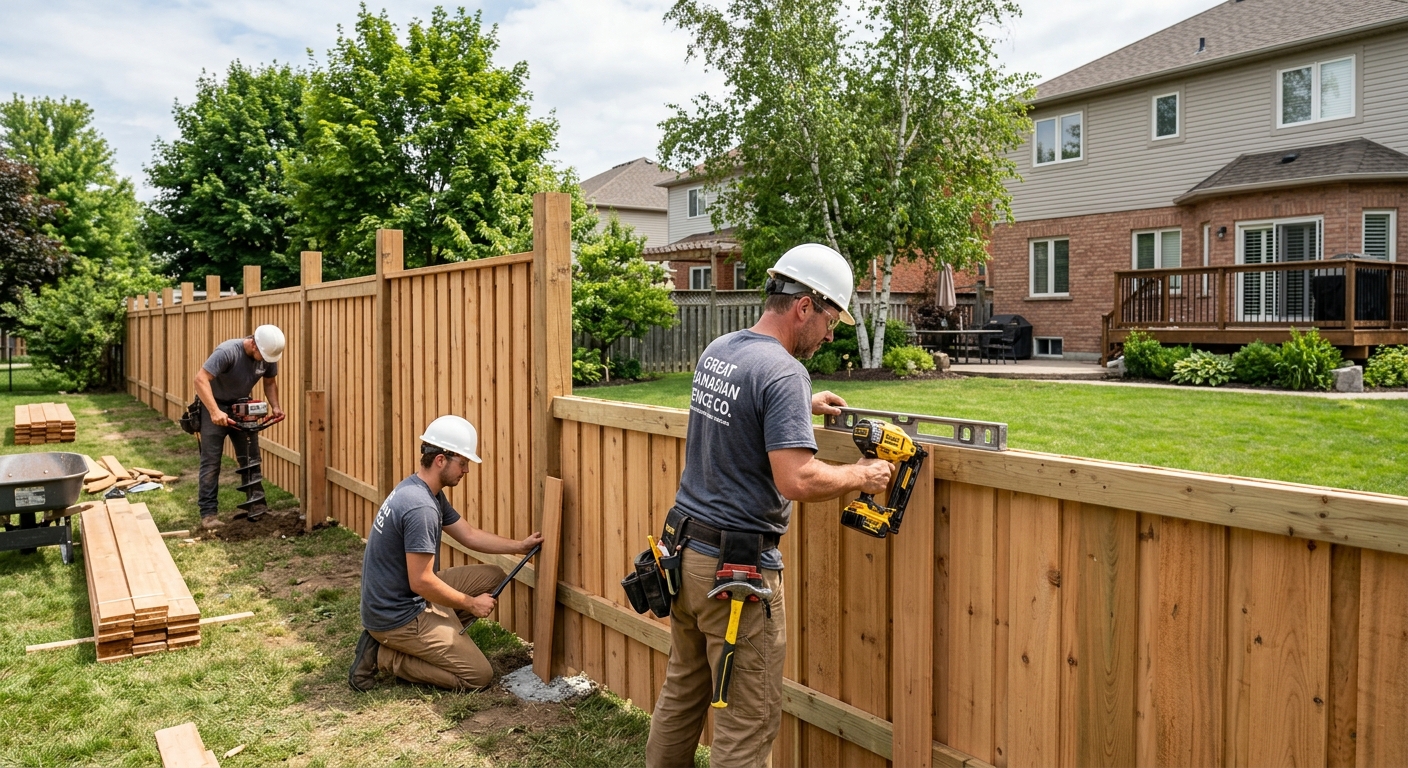
Fencing options and costs in Ignace
Ignace is a small community where most homeowners tend to think long-term about property comfort and privacy. With 92.7% of dwellings being single-detached houses (Statistics Canada, 2021 Census), many lots are effectively “standalone yards,” so fencing demand comes from both boundary marking and real day-to-day needs like separating pets, keeping wind-blown snow under control around yards, and defining outdoor spaces. Ownership is also strong—435 homeowner households, or 79.1% of all households (Statistics Canada, 2021 Census)—which usually translates into steadier repair and replacement cycles rather than short-lived rentals.
In Northwest Ontario, installed fence cost is shaped less by “style” and more by climate exposure. Frost penetrates deeper than in southern Ontario, so posts typically need to be set close to 4 ft (1.2 m+) below grade, often with concrete, to reduce the risk of frost heave and leaning panels. Wind matters too: open stretches and highway-adjacent properties in the Northwest can behave like other wind-exposed regions, pushing contractors toward heavier panels, tighter post spacing, and more robust footings. That’s one reason you’ll see higher labour time (more holes, more concrete, longer set-up) and stronger structural recommendations compared with sheltered urban lots.
Demand is especially noticeable around the town’s main residential corridors near the downtown area and along frequently accessed side streets—when storms damage sections, repairs and re-fencing typically follow quickly. Below is a practical comparison of common materials to help you benchmark your next quote, before we get into what moves prices up or down.
| Material |
Lifespan |
Maintenance |
Privacy Rating |
Price per Linear Foot |
Price Range |
| Pressure-treated pine (standard wood) |
10–15 years |
Stain/seal every 2–3 years; fastener checks |
Medium–High (solid board styles) |
$11–$18 |
$55–$90 |
| Cedar (natural rot resistance) |
15–25 years |
Occasional staining; inspect for warping |
High (solid privacy boards) |
$14–$24 |
$65–$110 |
| Vinyl / PVC (no-maintenance) |
20–30 years |
Rinse as needed; check caps/posts |
Medium–High (solid panels) |
$16–$28 |
$70–$110 |
| Chain-link (galvanized steel) |
20–40 years |
Minimal; occasional tightening |
Low (see-through) |
$9–$14 |
$35–$65 |
| Aluminum ornamental |
25–40 years |
Light cleaning; inspect at gates |
Low–Medium (open pickets) |
$18–$32 |
$80–$140 |
| Composite / recycled |
20–30 years |
Minimal; periodic cleaning |
Medium–High (privacy slats/panels) |
$17–$30 |
$75–$125 |
Prices are estimates only and vary by project scope, site access and material selection.
What affects the price of fencing in Ignace
In Ignace, two quotes for what looks like the same fence can easily land 30–50% apart. The most common reasons are the “hidden” structural differences contractors recommend for deep frost, and how much excavation and concrete setting your site requires. Northwest Ontario’s deeper frost penetration means posts are not a shallow install: crews often set posts close to 4 ft (1.2 m+) down, and in practice that can translate to drilling deeper holes and buying longer posts plus additional concrete. That pushes both labour time and material costs upward compared with milder southern Ontario lots.
Wind exposure also changes the build. In exposed stretches, contractors may tighten post spacing and use heavier panels to prevent rattling and panel warping—similar to how Prairies-style conditions influence fence design. On the flip side, if you have a sheltered property line with windbreak trees, you may be able to use lighter framing or standard spacing without compromising durability.
Local examples that routinely raise cost in the Ignace area: (1) clay or mixed soils that don’t drain cleanly can make hole excavation slower and may require additional preparation for stability; (2) older properties—80.0% of homes built before 1981 (Statistics Canada, 2021 Census)—often have more buried debris (old posts, stones, roots) that adds time to clear and set; and (3) gates across uneven ground that require racking and more careful alignment. Examples that lower cost: shorter fence runs around a courtyard, straightforward access for a skid-steer, or replacing a small damaged section instead of reinstalling an entire line. These differences are also why you might see a wood installation quote that starts near $55–$90 but moves toward vinyl-style pricing when deep post setting and heavier build details are included—sometimes closer to $70–$110.
| Price Factor |
Why It Matters |
Cost Impact |
| Fence length in linear feet |
Most materials and labour scale directly with length. |
Often the biggest driver; longer runs can multiply excavation and posts. |
| Post depth required |
Frost line dictates post length and hole depth to prevent heaving. |
Deeper installs add concrete, longer posts, and extra labour time. |
| Post setting method |
Concrete vs. gravel pack vs. driven posts changes stability in freeze-thaw. |
Concrete-set posts usually cost more but reduce movement in cold winters. |
| Material choice |
Vinyl, cedar, and chain-link behave differently in cold and wind. |
Higher material costs for vinyl/cedar; structural build-up may increase labour. |
| Gate count and type |
Gates require heavier hardware, posts, and alignment. |
Drive-through double gates often raise cost beyond a straight fence line. |
| Grade and terrain |
Slopes require stepped or raked panels and more measuring. |
More cuts, more labour, and sometimes more hardware/extra posts. |
| Old fence removal and disposal |
Demolition time + hauling depend on debris and access. |
Can add a noticeable line item, especially with mixed materials. |
| Permit fees and survey / property line locate |
Locates avoid costly boundary disputes and may be required for higher fences. |
Small to moderate add-on; prevents major rework if lines are corrected early. |
Permits & regulations in Ontario
In Ontario, fences above a height threshold—often around 2.0 m (6.5 ft) at the rear and about 1.0–1.2 m (3–4 ft) in the front or at corners—commonly trigger the need for a building permit. The exact trigger and any local setback rules are set through your municipality, but the practical takeaway for homeowners in Ignace is the same: if you’re planning a tall privacy fence, don’t assume it’s “just a fence.” You must also stay within property lines and respect municipal setback bylaws.
Before any post holes get dug, call for utility locates using Ontario One Call to reduce the risk of hitting underground services. Also get a survey or property pin locate before installing—fence encroachment disputes are harder and more expensive to resolve after posts are already concreted in. Where there is shared fence ownership or a line fence situation, Ontario’s line-fences rules govern responsibilities between neighbours, including how costs and disputes are handled.
About verification: you can confirm a contractor’s credibility by checking (1) their Ontario business licence (if applicable locally), (2) liability insurance certificate of insurance naming you as certificate holder/with proper wording, and (3) their WSIB coverage (or applicable clearance) to confirm they’re compliant for work on site. Ask for a WSIB clearance letter number or proof of coverage, then verify the certificate details match the company name on the quote.
Choosing the right fence material for Ignace
Choosing a fence in Ignace is really choosing the right balance between privacy, maintenance, budget and cold-weather performance. Northwest Ontario winters are long, and frost movement is a real design constraint—so your material choice has to pair with the correct post depth and setting method. With many homes built before 1981 (Statistics Canada, 2021 Census), upgrades often happen in neighbourhoods with mature landscaping and established property lines, meaning you’ll want a durable fence that doesn’t require frequent re-tensioning.
Pressure-treated pine is the budget-friendly route, but it still needs regular care: most homeowners plan to stain or seal roughly every 2–3 years to slow grey weathering and protect against moisture cycling. Cedar offers better natural rot resistance and a warmer look, but it still benefits from maintenance to keep colour even and boards from drying unevenly. Vinyl/PVC brings no-paint convenience and resists rot, but in extreme cold it can become brittle at thin edges if the system isn’t installed correctly—especially at posts and fence corners—so hardware quality and proper post embedment matter. Chain-link is usually the cheapest and can last decades, but it won’t deliver privacy without additions like slats or screening. Aluminum ornamental gives a clean, rust-resistant look and usually needs minimal upkeep, but it’s typically decorative rather than private.
On cold frost requirements: deeper post setting is common, so the “cost” difference between materials often isn’t just the panel—it’s the total installed system. For example, a wood privacy fence can come in around $55–$90, while vinyl privacy may land closer to $70–$110; that extra can be justified if you want to avoid repeated staining and reduce maintenance work during busy seasons. Wind and snow load also push better panel stiffness—solid board privacy styles often perform better than thin pickets in exposed lines when built with appropriate post spacing.
| Material |
Cold Tolerance |
Lifespan |
Annual Maintenance |
Best For |
Price Band |
| Pressure-treated pine |
Good when installed on deep concrete-set posts |
10–15 years |
Inspect spring/summer; stain/seal every 2–3 years |
Lower upfront cost, traditional look |
$55–$90 |
| Cedar |
Good; performs well with proper sealing and fasteners |
15–25 years |
Inspect annually; stain as needed (often 2–4 years) |
Appearance + rot resistance with moderate maintenance |
$65–$110 |
| Vinyl / PVC |
Good with quality posts/hardware; avoid brittle fit-up |
20–30 years |
Light rinse; check caps/posts after freeze-thaw cycles |
Low-maintenance privacy in cold climates |
$70–$110 |
| Chain-link |
Very good (steel resists freeze movement when set correctly) |
20–40 years |
Minimal; re-tension as needed |
Security + budget, pets/livestock containment |
$35–$65 |
| Aluminum ornamental |
Excellent (powder-coat resists corrosion) |
25–40 years |
Wash and inspect gates/hardware |
Front-yard aesthetics with clean lines |
$80–$140 |
| Composite / recycled |
Good; depends on quality and panel design |
20–30 years |
Light cleaning; check alignment and fasteners |
Maintenance-light privacy panels |
$75–$125 |
How to choose a fencing contractor in Ignace
In Ignace, the contractor you choose can make or break the performance of your fence in freeze-thaw. Start by verifying Ontario compliance: request a copy of their liability insurance certificate (COI) and confirm it includes fencing-related work and has proper coverage limits; ask for their WSIB coverage proof or clearance letter—this matters for worker safety and protects you if something goes wrong on site. If the contractor uses subcontractors, make sure the coverage applies to the actual workers on your property. Then confirm the company details on the quote match the company name shown on the COI and WSIB documents.
Get 2–3 itemised written quotes, not a single lump-sum number. You want line items for labour, excavation/post installation method (concrete-set vs alternative), materials (posts, rails, panels, hardware), gates, and removal/disposal if applicable. Read the scope carefully: what’s excluded (rock removal, property line locating, permit pull, snow/ice removal around the site, or restoring lawn/grade)? Warranty clarity matters too: ask for the workmanship warranty length and confirm the product manufacturer warranty, and whether it’s transferable to future homeowners if you sell.
Payment schedules should be conservative: never pay more than about 10–15% upfront, and hold back a portion until the fence is complete, cleaned up, and you’ve confirmed gates and alignment. Also ask for a written start date and a realistic completion estimate—deep frost-zone work and concrete curing can affect timelines, especially during wet or thawing periods.
- Ask for WSIB clearance/proof and verify dates and company name.
- Request liability insurance COI and confirm you’re listed as certificate holder (as required by your agreement).
- Get quotes broken into labour, posts/rails, panels, gates, and concrete/setting.
- Confirm the post-depth plan (below local frost zone requirements) in writing.
- Ensure the quote states whether removal and disposal of old fencing is included.
- Ask if utility locates are handled by the homeowner or contractor (and confirm responsibility).
- Check how gates are framed and what hardware brand/style is used.
- Verify that materials match the proposed grade (e.g., galvanized vs coated thickness).
- Clarify warranty: workmanship duration, exclusions, and how claims are processed.
- Confirm payment schedule, holdback amount, and when milestone payments are due.
- Review site protection: grass restoration, stone/soil disposal, and cleanup responsibilities.
- Ask for a project timeline and how delays due to weather or curing are communicated.
Red flags to watch for in Ignace: (1) contractors who refuse to put post-depth and setting method in writing; (2) quotes that are far below typical bands without explaining reduced scope (often missing concrete setting or gate framing); (3) no proof of WSIB/COI or mismatched company names on documents; (4) insisting on large upfront payments beyond 15%; and (5) vague scope wording like “materials as required” with no specifics for rails, hardware, or disposal.
Frequently asked questions — fencing in Ignace
How do I handle a fence dispute with a neighbour in Ontario?
In Ontario, fence disputes usually start with a practical conversation and a clear factual baseline: where the property line is and what the current fence represents (a shared line fence versus a fence on one property). For Ignace homeowners, don’t rely on “what it looks like”; get a property pin locate or survey confirmation before making changes, because moving posts after concrete sets can become very expensive. Keep everything documented—photos, dates, and any written messages. If the fence is shared, Ontario’s line-fences rules are the framework for responsibilities and cost sharing. If you can’t agree, consider mediation options through your community or legal advice before proceeding. Avoid unilateral removal or major alteration until boundaries are confirmed.
What fence style offers the best wind resistance in Ignace?
For wind resistance in Ignace, the key is how your fence is built to handle freeze-thaw and gust loads—not just the “look.” Solid-board privacy styles (or heavy slat systems with solid sections) generally resist gust impacts better than lightweight, open pickets when they’re installed with correct post embedment and tight post spacing. In Northwest Ontario, posts are often set close to 4 ft (1.2 m+) below grade with concrete to reduce frost heave that can loosen alignment over time. Also consider framing quality: thicker rails and properly braced gate openings reduce racking. If you’re on a more exposed line (open yard facing a corridor), budgeting for a sturdier system within the typical wood or vinyl ranges (for example, $55–$90 for wood systems or $70–$110 for vinyl) often saves money later by limiting repairs.
How much does a fence cost in Ignace?
Fence costs in Ignace vary mainly by length, height, gate count, and—locally most importantly—post setting depth for frost. For a quick homeowner benchmark, chain-link often comes in lowest, commonly around $35–$65. Wood fences typically land in the middle, commonly $55–$90, while vinyl/PVC privacy fences tend to be higher due to material cost and the need for solid installation details in cold weather, often $70–$110. Aluminum ornamental is usually higher because of materials and styling, often in $80–$140. If you tell your contractor whether you need deep concrete-set posts, gate framing, and old fence disposal, the quote can be more accurate and easier to compare.
How deep should fence posts be for Ignace's frost?
Ignace sits in a cold, deep-frost environment typical of Northwest Ontario, so fence posts usually need to go substantially below grade to prevent heaving. In practice, many installations target around 4 ft (1.2 m+) below grade or deeper depending on local soil conditions and frost depth design; contractors often translate this into setting posts close to 4–6 inches below the design frost depth for your specific situation. That depth requirement is why fence quotes here can include more concrete and longer posts than homeowners expect from southern Ontario. Concrete setting is commonly used in colder zones because it helps reduce movement during freeze-thaw cycles. The best way to confirm your exact requirement is to ask the contractor to state the post depth and setting method in writing, including whether they’re bellying footings or adjusting for soil.
Wood vs vinyl vs aluminum fence — which is best?
“Best” depends on what you value most. Wood (especially pressure-treated pine) is often the best budget choice in Ignace, commonly aligning with $55–$90, but it needs periodic staining/sealing to maintain appearance in wet-dry cycles. Vinyl/PVC usually wins for low maintenance and long-term convenience, but it’s typically higher upfront and performs best when installed with proper deep post embedment; pricing often lands around $70–$110 for privacy styles. Aluminum ornamental is great for rust resistance and curb appeal, usually mid-to-high cost, often around $80–$140, but it’s usually not as private as solid wood or vinyl panels. For wind exposure, heavier, well-framed privacy sections usually outperform decorative open styles.
Do I need a permit to build a fence in Ontario?
In Ontario, permits are commonly required for fences over certain height thresholds—often around 2.0 m (6.5 ft) at the rear and about 1.0–1.2 m (3–4 ft) in the front or at corners—plus any applicable setback requirements. The exact trigger can vary by municipality, so Ignace homeowners should confirm with the local permitting authority before scheduling excavation. Regardless of permit needs, you should always complete utility locates before digging and consider a survey/property pin locate to confirm the fence line. If you’re hiring a contractor, ask whether the permit pull is included in the quote; if it’s excluded, make sure you know who is responsible for approvals and what documentation they’ll provide. For shared boundary situations, Ontario line-fences rules can also affect what you’re allowed to install and who pays.