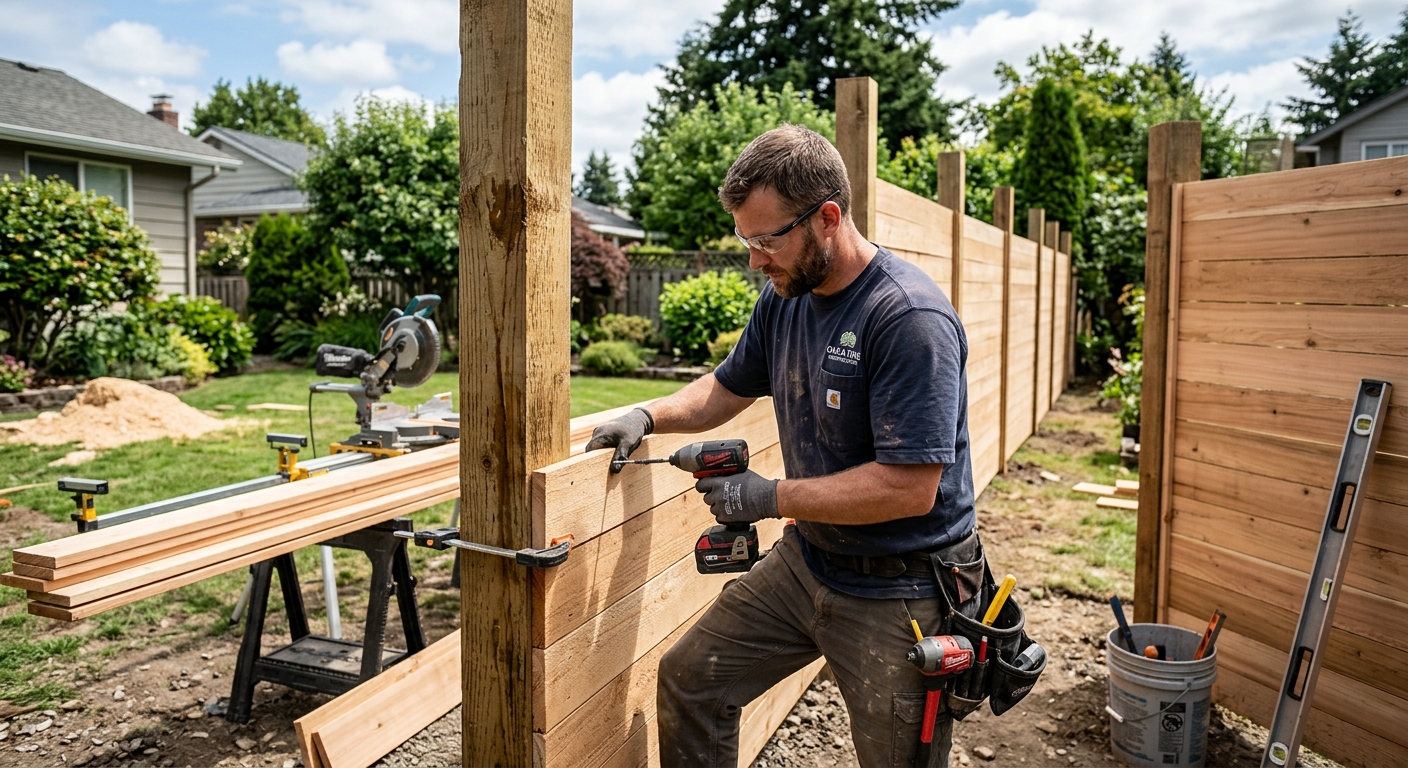
Fencing options and costs in Mimico
Mimico is a neighbourhood where homeowners tend to upgrade fencing alongside landscaping and driveway work, especially as lots change hands and backyards get reconfigured. With a population of 33,964 (Statistics Canada, 2021 Census), demand is steady, and the local housing stock means many properties can benefit from privacy and boundary upgrades. In Toronto’s market, fencing contractors also stay busy because weather-driven wear shows up quickly—mouldy summers, wet springs, and freeze-thaw cycles that stress weak post bases.
In the Toronto area, your biggest cost driver is rarely the pickets themselves; it’s the ground work. The commonly used Southern Ontario frost-line rule of thumb (about 42"–48") pushes recommended post depths to roughly 3.5–4 feet for many 6–8 ft privacy fences. On mixed clay and heavier soils common in the GTA, that depth almost always favours concrete-set posts over simple driven posts for long-term stability. The Toronto economic region also has moderate wind exposure compared to the Prairies, but taller solid fences can still rack in gusts, so we frequently size posts and spacing conservatively.
In Mimico, fencing installs are especially in demand near the lake-adjacent edges and the more built-up residential pockets around Superior Shores, where yards are busy year-round and replacement timelines are tight. If you’re comparing options, the next table gives typical material lifespans, maintenance effort, privacy performance, and cost-per-linear-foot ranges you’ll see in Mimico-area quotes.
| Material |
Lifespan |
Maintenance |
Privacy Rating |
Price per Linear Foot |
Price Range |
| Pressure-treated pine (standard wood) |
10–15 years |
Stain/seal every 2–3 years; inspect for rot at bases |
High (solid/close-board) |
$18–$30 |
$65–$120 |
| Cedar (natural rot resistance) |
15–25 years |
Stain every 3–5 years (or allow greying); keep bottoms dry |
High (solid/close-board) |
$22–$38 |
$75–$130 |
| Vinyl / PVC (no-maintenance) |
20–30 years |
Wash as needed; inspect posts/hardware; avoid impact |
High (solid privacy styles) |
$25–$42 |
$75–$130 |
| Chain-link (galvanized steel) |
20–35 years |
Occasional rinse; tighten/re-tension if it sags |
Low (semi-visual; privacy screens optional) |
$12–$22 |
$45–$85 |
| Aluminum ornamental |
25–40 years |
Wash periodically; check fit after storms |
Medium (ornamental pickets) |
$20–$40 |
$90–$160 |
| Composite / recycled material |
20–30 years |
Minimal; occasional cleaning; avoid heavy impact |
High (solid panels) |
$23–$45 |
$85–$150 |
Prices are estimates only and vary by project scope, site access and material selection.
What affects the price of fencing in Mimico
In Mimico and across the Toronto economic region, it’s common to see quotes for the “same” fence range by 30–50%. The difference usually comes down to how the contractor accounts for ground conditions, post installation depth, wind-ready hardware, and how many gates or removals are included. Even with similar materials, a job that needs stepped panels, heavy concrete setting, and careful disposal can price very differently from a straightforward backyard run.
Frost-line depth is the technical piece that drives real labour and material cost. In cold Ontario winters, posts typically need to sit about 4–6 inches below the design frost depth to reduce heaving risk during freeze-thaw cycles. In practical terms, that often means 1.5–2.0 m into the ground, especially for 6–8 ft privacy fencing. When posts are this deep, concrete-set installation becomes the norm (not the exception), which increases ready-mix and labour time. Wind also shapes design: while Toronto isn’t as wind-abusive as the Prairies, taller solid fences can rack under gusts, so crews may increase post size or tighten spacing. And compared to inland Ontario, Mimico’s wet spells mean wood protection and base detailing matter more—poor drainage at post bases can shorten service life.
Two concrete examples from local pricing behaviour: (1) A 60 ft run of cedar privacy with two gates can land closer to the $75–$130 band if it uses concrete-set posts and a proper panel bracing strategy; skipping concrete can reduce the short-term bill but increases the chance of settlement. (2) A chain-link front fence may fit the $45–$85 band, but if it requires extra corner bracing and tension hardware on uneven ground, labour can creep upward even when material cost stays low. Lastly, labour and crew availability can tighten in busier spring and early fall windows, affecting scheduling and the final installed total.
| Price Factor |
Why It Matters |
Cost Impact |
| Fence length in linear feet |
The labour hours scale directly with every additional foot of run |
Major (often the biggest line item) |
| Post depth required |
Frost line determines post length and hole depth to prevent heaving |
Major (more excavation, more materials) |
| Post setting method |
Concrete vs. gravel pack vs. driven posts changes labour and stability |
High (concrete-set costs more upfront) |
| Material choice |
Vinyl/cedar typically cost more; chain-link is usually lower |
Medium to high |
| Gate count and type |
Double drive-through gates need heavier frames and hardware |
High (hardware and extra framing) |
| Grade and terrain |
Sloped yards require stepped or raked panels and extra layout time |
Medium |
| Old fence removal and disposal |
Demolition, haul-away, and prep can add significant labour |
Medium to high |
| Permit fees and survey / property line locate |
Locates prevent encroachment; permits add processing steps |
Low to medium (but project-dependent) |
Permits & regulations in Ontario
In Ontario, fence rules are tied to height thresholds, property-line compliance, and local setback bylaws. As a practical guide in Mimico, fences above a height threshold—often around 2.0 m (6.5 ft) for rear yards and closer to 1.0–1.2 m (3–4 ft) near the front or corners—commonly trigger a building permit requirement. Exact thresholds can vary by location, so treat this as the baseline and confirm with your municipal requirements before you dig.
Before installing any posts, you must get utility locates: Ontario One Call should be arranged so crews can identify buried services. Also, obtain a survey or at least locate the pins/property markers before you start. This protects you from boundary disputes, especially in older Mimico lots where property lines can be unclear or fences were previously placed informally. Where fences are shared, line-fence responsibilities are governed by Ontario’s provincial legislation for boundary fencing and maintenance.
What usually DOES require a permit: taller fences near or above the commonly used 2.0 m rear threshold, fences in corner/visibility areas that fall into height restrictions, and projects that involve structural or safety-related complexity. What typically does NOT require a permit: modest-height fences that stay under the local thresholds and don’t alter major structures or encroach on setbacks.
For contractor verification in Ontario: (1) confirm the contractor’s Ontario licence through the appropriate online registry used in your trade category, (2) ask for a Certificate of Insurance showing liability coverage, and (3) request proof of WSIB coverage (or a clearance letter where applicable) before work begins. Don’t rely on verbal statements—collect the documents, keep copies, and match the names to the quote.
Choosing the right fence material for Mimico
Choosing a fence in Mimico is less about what looks best on day one and more about what survives freeze-thaw, wet seasons, and winter salt spray. Pressure-treated pine is the budget-friendly option, but it typically needs staining or sealing every 2–3 years to slow grey weathering and protect the wood fibres. Cedar generally holds up better with natural rot resistance and usually looks cleaner for longer, but it still benefits from periodic staining to reduce surface drying and splitting. Vinyl/PVC offers the low-maintenance appeal, yet in extreme cold it can become brittle if the wrong product and hardware are used or if panels are installed with insufficient support. Chain-link is the longest-running value fence for secure boundaries, but it won’t give real privacy unless you add slats, privacy fabric, or a screen system. Aluminum ornamental gives a crisp, rust-resistant look with minimal upkeep—great for visibility and curb appeal, but privacy will be limited by design.
Post depth matters for all fence types. In the Toronto area, frost considerations typically push crews to concrete-set posts for many privacy installations: posts often need to go roughly 3.5–4 feet down, aligning with the design frost line approach to prevent heaving. For solid wood or vinyl privacy fences, this stability helps the panels resist racking in gusts and reduces the chance of seasonal sag. For chain-link, the post depth still matters, but it’s usually less sensitive to “panel racking” because the mesh flexes more easily.
A dollar example: if you’re choosing between standard treated pine and vinyl privacy, the upfront difference can be several dollars per linear foot. In Mimico, that gap can be justified if you want “wash-and-forget” maintenance for 20+ years, especially if you’d rather spend your weekends enjoying the backyard than restaining. If you’re comfortable with periodic staining, treated pine can still be a solid value, and many homeowners choose it when budgets are tighter and replacement timelines can be planned.
| Material |
Cold Tolerance |
Lifespan |
Annual Maintenance |
Best For |
Price Band |
| Pressure-treated pine |
Good with proper base protection; seals recommended |
10–15 years |
Light: 1–2 site checks; stain/seal every 2–3 years |
Budget privacy with planned upkeep |
$65–$120 |
| Cedar |
Very good; handles wet-cold cycles better than many softwoods |
15–25 years |
Moderate: inspect and stain every 3–5 years |
Natural look and stronger rot resistance |
$75–$130 |
| Vinyl / PVC |
Good; requires correct post spacing and impact-rated hardware |
20–30 years |
Very light: rinse/clean as needed |
Low-maintenance privacy |
$75–$130 |
| Chain-link |
Excellent; stays flexible through freeze-thaw |
20–35 years |
Light: periodic tension check |
Security and boundary definition |
$45–$85 |
| Aluminum ornamental |
Excellent; no rot and doesn’t rust like iron |
25–40 years |
Light: wash/inspection after storms |
Curb appeal with limited privacy |
$90–$160 |
| Composite / recycled |
Good; performs well if installed with proper support |
20–30 years |
Low: occasional cleaning |
Privacy with wood-like look and less upkeep |
$85–$150 |
How to choose a fencing contractor in Mimico
Start by verifying the contractor is properly set up for Ontario work. Ask for their current insurance certificate (liability coverage) and confirm they can handle fencing-related site risks like buried utilities, lawn damage, and material delivery. For workers’ protection, request proof of WSIB coverage (or a clearance letter where applicable). If the quote is missing these documents or they can’t be produced quickly, that’s a warning sign.
Then get 2–3 itemised written quotes instead of one lump sum. A strong quote breaks out labour versus materials, specifies post size and spacing, and clearly states the post setting approach (concrete-set vs. gravel pack vs. driven). Pay close attention to what’s excluded: permit pull responsibilities, utility locate coordination, old fence removal and disposal, and any landscaping restoration (sod, topsoil, or regrading). If disposal is excluded, haul-away can become a surprise expense.
Warranty matters. Look for a workmanship warranty stated in writing (often a set number of years), plus the manufacturer’s product warranty details and whether it’s transferable to future owners. For payments, avoid paying more than 10–15% upfront; a holdback until substantial completion is a healthy approach. Finally, timeline everything: get a written start date and a completion estimate so you can plan around deliveries and weather windows in Mimico.
- Confirm Ontario licence details applicable to the contractor’s work scope and trade.
- Collect a current Certificate of Insurance showing liability coverage.
- Request WSIB coverage proof (or clearance letter) before work begins.
- Get quotes that list post size, spacing, and depth assumptions.
- Ensure post installation method is specified (concrete-set where needed).
- Ask whether permits are included or whether you’ll be responsible for permit pull.
- Verify who orders utility locates and how that’s handled on the jobsite.
- Check whether old fence removal and disposal are included.
- Confirm gate type and hardware quality (latches, hinges, bracing) in writing.
- Make sure slope handling is defined (stepped vs. raked panels).
- Require a workmanship warranty term in the contract.
- Use a payment schedule with a holdback until completion and cleanup.
Red flags I frequently see in Mimico: contractors who won’t provide insurance/WSIB paperwork, quotes that omit post depth and setting method, “too good to be true” pricing that doesn’t include removal/disposal, vague scopes that don’t mention permits or property line assumptions, and requests for large upfront payments without a clear schedule or contract terms.
Frequently asked questions — fencing in Mimico
Should fence posts be set in concrete here?
In Mimico and the broader Toronto area, concrete-set posts are usually the safer choice for privacy fences because frost heave risk is real during freeze-thaw winters. The common Southern Ontario approach sets posts roughly 3.5–4 feet down (about 42"–48" design frost line), which often translates to deeper holes and concrete to lock the base in place. For a solid wood or vinyl fence (especially 6–8 ft), I typically recommend concrete-set posts because panel racking and settlement issues become visible quickly. For chain-link, some contractors may use a gravel pack approach if conditions are excellent, but you still need correct hole depth and proper bracing. If a quote is priced at the low end of a band like $45–$85 without explaining post depth or setting method, ask what’s being cut. A stable base is what prevents repairs later.
What's the best fence for privacy?
For privacy in Mimico, the most effective options are solid-panel styles: vinyl/PVC privacy, cedar privacy, or pressure-treated boards installed close together. These styles block sightlines and reduce wind penetration through the yard, which helps the fence feel more “closed” during breezy days near the lake. If you want a balance of appearance and durability, cedar privacy often performs well because it resists rot better than standard softwoods, while vinyl can be attractive if you prefer minimal maintenance. Pressure-treated pine can be the budget option, but it needs staining/sealing every 2–3 years to keep it looking good and to slow weathering. On cost, privacy jobs commonly land around the $75–$130 band depending on gate count and whether you’re concrete-setting posts. If your yard has slopes, ask about stepped installation so the privacy performance doesn’t degrade at the low end.
How do I compare fencing quotes?
To compare quotes in Mimico fairly, make sure they describe the same scope and the same build details—not just the final total. Start by checking post depth and setting method (concrete-set versus gravel pack), post size and spacing for solid privacy fences, and panel type (solid versus spaced). Confirm gate count and hardware—double drive-through gates and walk gates can swing pricing dramatically. Review whether old fence removal and disposal are included, and whether permits are included or handled by you. Also compare site restoration: sod/topsoil and cleanup time should be stated. Finally, check warranty language and workmanship coverage. If one quote is in the $65–$120 range and another is in the $90–$160 range, the higher one may include deeper concrete-set footings, better materials, or additional bracing for wind stability. Don’t decide until the scopes line up item by item.
How long does fence installation take in Mimico?
Typical installation timelines in Mimico depend on length, gate count, slope complexity, and whether there’s old fence removal. For straightforward backyard runs on level ground, many crews can complete a basic install in a day to two, assuming material delivery is scheduled and utilities are located. Add a few days if you’re doing multiple gates, extensive removal, or stepped/raked panel work on a sloped yard. Concrete-set posts can also affect schedule planning: while we don’t always “wait forever” to build, concrete placement and alignment steps require careful setup time. Weather can delay excavation in heavy rain or frozen ground conditions, which matters in Southern Ontario freeze-thaw seasons. If your quote is priced closer to the low end of $45–$85 (often chain-link), it can still take comparable time if the site is difficult—so rely on the written schedule in the contract, not just the material type.
Can I install a fence on a slope in Mimico?
Yes, but the installation method matters. In Mimico, many residential lots have gentle grade changes, and the correct approach is usually stepped panels (keeping a consistent panel height while the fence “stair-steps” up/down) or raked panels (where the top rail follows the slope). Stepped installation is often the cleanest choice for privacy fences because it maintains stronger visual coverage and easier alignment with pickets/rails. Raked panels can look good, but the layout and fastening need to be carefully engineered so the bottom edge doesn’t leave excessive gaps. Slopes can also increase labour and layout time, which is why quotes can vary. Before installing, confirm your property line and setback requirements, especially near front corners where local rules may be stricter. If you’re using solid materials like vinyl privacy, ask about support bracing so panels don’t rack as grade changes.
What is the most weather-resistant fence for Mimico's climate?
“Most weather-resistant” usually means the fence that resists rot, stays stable in freeze-thaw, and tolerates moisture without failing at the post bases. In Mimico’s Toronto climate, concrete-set posts and proper drainage details are what make the biggest difference for most material types. For the fence itself, vinyl/PVC and aluminum ornamental are excellent for resisting rot and corrosion, and chain-link is extremely durable because it’s flexible and galvanized. Cedar is also strong because it’s naturally rot-resistant, though it still benefits from maintenance so it doesn’t dry out and split. Standard pressure-treated pine can perform well, but it requires periodic staining/sealing to reduce surface breakdown. In terms of typical pricing, vinyl privacy often falls within the $75–$130 band, while aluminum can be more like $90–$160 depending on panel density and gate hardware. The most weather-resistant outcome usually comes from pairing the right material with correct post depth and wind-ready installation.