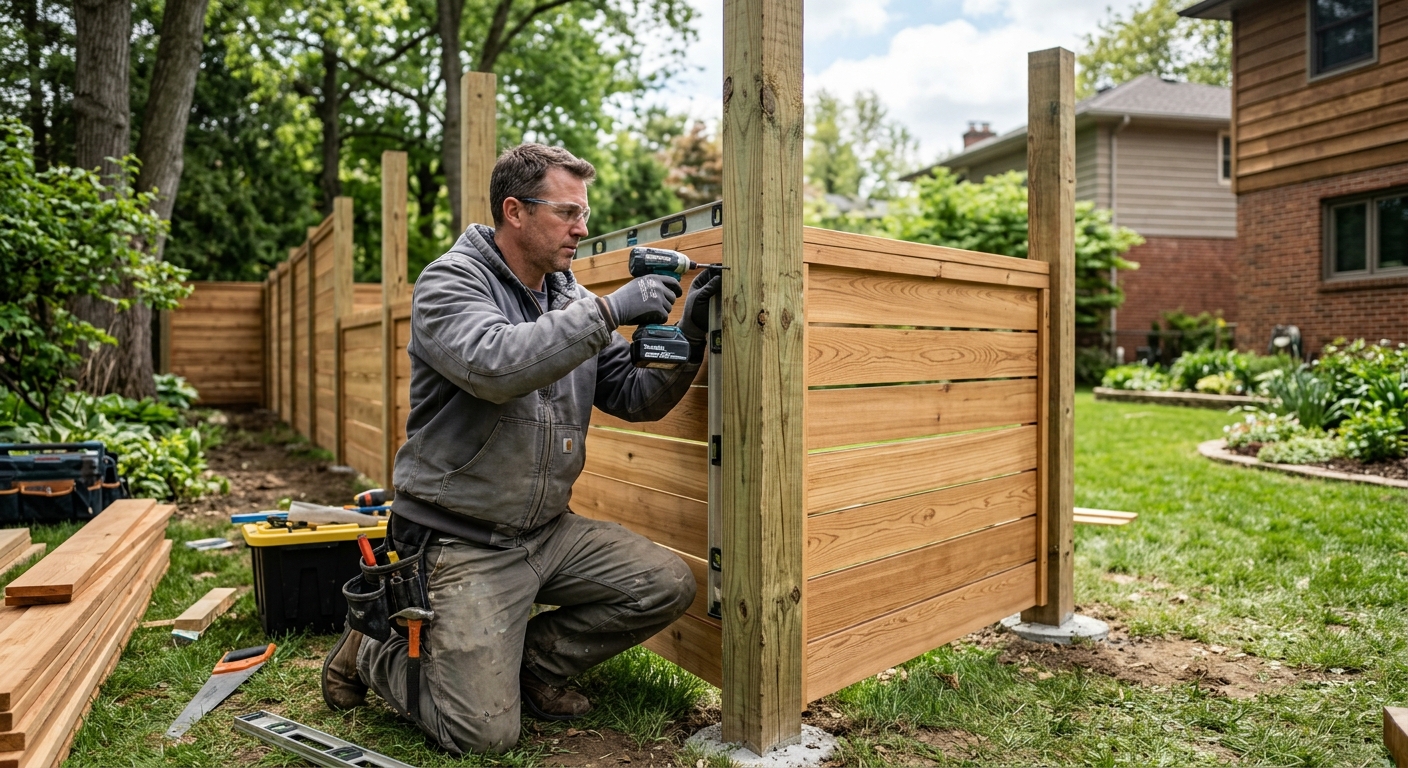
Fencing options and costs in Henry Farm
In Henry Farm, fencing choices are shaped by both homeowner demand and local weather. With a population of 15,723 residents in the 2021 Census area and a strong mix of family properties in the Toronto economic region (Statistics Canada, 2021 Census), there’s steady turnover of fence upgrades as yards get refreshed for privacy, pets, and kids. Every detached and semi-detached property is effectively a potential fence project, which is why you’ll see lots of quoting variety even for “the same height” fence.
Toronto-area costs are also influenced by how frost affects post stability. Southern Ontario’s frost line is commonly treated as roughly 42"–48" down, and contractors typically set fence posts about 3.5–4 feet deep to reduce frost heave risk—especially for taller 6–8 ft privacy fences. That means more digging, more concrete, and longer posts than you might expect from driven-post installs. Availability of experienced crews matters too: neighbourhoods with frequent back-yard work, like the North York lanes around Finch Avenue East and nearby sections of Henry Farm, often see faster scheduling for standard materials and longer lead times for specialty gates or heavy-panel designs.
Use the table below as a practical starting point for Henry Farm, then we can narrow it down once we confirm line length, gate count, and whether you want privacy or an open look.
| Material |
Lifespan |
Maintenance |
Privacy Rating |
Price per Linear Foot |
Price Range |
| Pressure-treated pine (standard wood) |
10–15 years |
Stain/seal every 2–3 years |
High |
$65–$95 |
$65–$95 |
| Cedar (natural rot resistance) |
15–25 years |
Seal/stain every 2–4 years |
High |
$80–$120 |
$80–$120 |
| Vinyl / PVC (no-maintenance) |
20–30 years |
Wash only; check for impact cracks |
High |
$75–$130 |
$75–$130 |
| Chain-link (galvanized steel) |
20–35 years |
Minimal; occasional tension/repair |
Low–Medium |
$45–$85 |
$45–$85 |
| Aluminum ornamental |
25–40 years |
Wash; touch up hardware if needed |
Low–Medium |
$90–$160 |
$90–$160 |
| Composite / recycled material |
20–30 years |
Low; inspect for warping after impacts |
High |
$95–$155 |
$95–$155 |
Prices are estimates only and vary by project scope, site access and material selection.
What affects the price of fencing in Henry Farm
In Henry Farm and across Toronto, fence quotes for the same overall look can vary by 30–50% because the “hidden” cost drivers aren’t visible from the street. Two contractors might both quote a 6 ft privacy fence, but one may build with heavier posts set deep in concrete, while another uses lighter framing or a faster post method that’s less stable in freeze-thaw cycles. Labour availability also plays a role: busy North York periods can push scheduling costs up, especially where crews need to haul materials through narrow side yards.
Frost line depth is the biggest reason Toronto pricing differs from milder climates. In cold Ontario, posts usually need to be set roughly 1.5–2.0 m into the ground (about 4.9–6.6 ft) to avoid frost heaving, and that typically means concrete-set posts rather than simple gravel packs or driven posts. In practice, longer posts and more ready-mix increase both materials and labour time. Wind exposure is less extreme than the Prairies, but tall solid fences still need appropriate post size, spacing (often 6–8 ft centres), and hardware to prevent racking. For comparison, BC’s coastal wet climate tends to accelerate wood rot when treatment and detailing aren’t done right, which can also shift what “maintenance-ready” materials cost.
Concrete examples in Henry Farm: (1) A clay-mixed soil yard usually takes more excavation time, raising labour compared to sandier lots; (2) a sloped back yard often requires stepped or raked panels, increasing framing and offcuts; and (3) adding two gates (especially a double drive-through) increases hinge, latch, and bracing cost. If you’re comparing a chain-link line at roughly the $45–$85 band versus a vinyl privacy fence at about $75–$130 per linear foot, the difference often comes from both solid-panel engineering and the deeper concrete footing approach required for stable installations in freeze-thaw conditions.
| Price Factor |
Why It Matters |
Cost Impact |
| Fence length in linear feet |
More posts, rails, and fasteners needed |
Major driver of total cost |
| Post depth required |
Frost line determines hole depth and post length |
Higher material + labour when concrete-set |
| Post setting method |
Concrete vs. gravel pack vs. driven posts affects stability |
Concrete-set typically costs more but performs better |
| Material choice |
Vinyl/cedar often cost more than chain-link; aluminium varies |
Moves project between mid-range and higher bands |
| Gate count and type |
Drive-through double gates require heavier frames |
Can add a meaningful fixed cost per gate |
| Grade and terrain |
Slopes require steps, racking, or custom panel adjustments |
Increases labour and reduces material efficiency |
| Old fence removal and disposal |
Haulage, dumping fees, and extra demo time |
Often adds time and truck costs |
| Permit fees and survey / property line locate |
Some fence heights/locations require permitting and verification |
Varies; can add a few hundred to over $1,000+ |
Permits & regulations in Ontario
In Ontario, fence rules are tied to both municipal bylaws and, in many cases, permit requirements based on height and location. A common threshold many homeowners run into is fences above about 2.0 m (6.5 ft) at the rear and around 1.0–1.2 m (3–4 ft) at the front or corner areas. When that threshold is exceeded, a building permit is often required even when you’re simply replacing like-for-like. Regardless of height, fences must stay within property lines and follow any local setback requirements.
Before anyone digs a post hole in Henry Farm, you should confirm utility locates. In Ontario, call Ontario One Call (formerly One Call does locates for underground utilities) so you don’t hit gas, hydro, or telecom lines. Also, get a survey or at least a property-pin locate before installing if pins are unclear—fence disputes are expensive, and a small encroachment can force costly rework.
Shared fence ownership and maintenance generally follow provincial line-fences principles: you may be responsible for your side, but details depend on whether it’s a mutual boundary fence and the circumstances (for example, who built or replaced it). To protect yourself, verify your contractor properly. Ask for (1) an Ontario business licence or relevant trade registration where applicable; (2) a Certificate of Insurance showing general liability; and (3) proof of worker coverage—typically WSIB for most employers in Ontario. You should be able to view credentials through the contractor’s website or public business registry listings, and they should provide an insurance certificate with your jobsite name and dates. If anything won’t be provided in writing, that’s a red flag.
Choosing the right fence material for Henry Farm
The right fence material in Henry Farm depends on what you value most: privacy, low maintenance, lifespan, or budget—and the Toronto freeze-thaw cycle pushes you toward better-built systems. Pressure-treated pine is usually the most budget-friendly starting point, but it typically needs staining or sealing about every 2–3 years to prevent grey weathering and slow surface checking. Cedar looks great and has natural rot resistance, yet it still benefits from periodic sealing to keep the finish even. Vinyl/PVC is the classic low-maintenance choice: you mainly wash it, but in extreme cold it can be more prone to impact cracking, so you want solid posts and good installation. Chain-link offers the longest life per dollar in many cases, but it won’t give you privacy unless you add slats or fencing screening. Aluminium ornamental fencing is rust-resistant and long-lived, but it’s not a privacy solution.
For Toronto, post stability is non-negotiable. With a frost line around 42"–48", many contractors set posts about 3.5–4 feet deep using concrete-set footings to reduce heaving for 6–8 ft privacy fences. That deeper work affects every material, but it matters especially for solid panels that catch wind and accumulate snow load. If you’re in a more exposed back yard or open corner, we often adjust post size and spacing to limit racking.
Dollar reality example: if you’re choosing between wood at roughly the $65–$95 band and vinyl privacy at about the $75–$130 band, paying the extra upfront can be justified when you want to avoid recurring staining and you’re planning to stay in the home long enough to recover maintenance costs.
| Material |
Cold Tolerance |
Lifespan |
Annual Maintenance |
Best For |
Price Band |
| Pressure-treated pine |
Good (with proper post depth) |
10–15 years |
Light inspection; stain/seal every 2–3 years |
Budget privacy with acceptable upkeep |
$65–$95 |
| Cedar |
Good (finishing helps) |
15–25 years |
Inspect and seal every 2–4 years |
Better look, natural rot resistance |
$80–$120 |
| Vinyl / PVC |
Very good in cold (impact care needed) |
20–30 years |
Wash; check for impact cracks |
Low-maintenance privacy |
$75–$130 |
| Chain-link |
Excellent (less seasonal movement) |
20–35 years |
Minimal; tension/repair as needed |
Security and long service life |
$45–$85 |
| Aluminum ornamental |
Excellent (no rust) |
25–40 years |
Wash; tighten hardware if required |
Curb appeal with light visibility control |
$90–$160 |
| Composite / recycled |
Good (installed with proper supports) |
20–30 years |
Low; inspect for panel impacts |
Privacy with reduced upkeep |
$95–$155 |
How to choose a fencing contractor in Henry Farm
Choosing a contractor the right way matters more in Henry Farm than many homeowners expect, because Toronto-area fence performance is driven by post depth, concrete setting, and hardware choices—not just how the fence looks on day one. Start by verifying Ontario licensing and business standing. Then check liability insurance: ask for a Certificate of Insurance showing general liability coverage and confirm the effective dates cover the work window. For worker protection, request proof of WSIB coverage (typically WSIB for Ontario employers). If they use subcontractors, you’ll want their coverage confirmed too—don’t assume. Where to look: the contractor’s own website should show licence/registration details, and insurance certificates are typically provided on request; for public registration, check the relevant business listing/registry and confirm the certificate issuer aligns with the contracting entity on your contract.
Next, get 2–3 itemised written quotes rather than lump sums. You want labour and materials broken out: posts, rails, concrete, hardware, gate frames, and any demolition/haul-away. Carefully read what’s excluded: is permit pulling included (if required), is utility locate included, and how is old fence disposal handled? Confirm workmanship warranty length in writing. Also ask whether product/manufacturer warranties are supported for your fence type and whether they transfer to future owners.
For payment, never pay more than about 10–15% upfront. Use a holdback until the fence is completed and inspected. Finally, insist on a written start date and a realistic completion estimate that accounts for curing time when concrete-set posts are used.
- Provide a signed contract with fence line length, height, and material specs (not “equivalent” wording).
- State post depth approach (Toronto-area frost considerations) and whether posts are concrete-set.
- List concrete and hardware allowances (bracing, hinges, latches for gates).
- Show whether they include utility locates and mark-outs before digging.
- Confirm old fence removal and dump fees are included—or itemised separately.
- Use itemised pricing for labour and materials (no single “mystery total”).
- Include permit pulling only if they’re responsible for it; otherwise note who will apply.
- Confirm gate hardware type and whether closures/latches are included.
- Ask for a workmanship warranty and define what defects are covered.
- Verify WSIB (Ontario) and request the insurance certificate before work starts.
- Agree on payment schedule: small deposit, holdback until completion.
- Get a schedule: start date, expected duration, and curing considerations for concrete.
In Henry Farm, common red flags include: (1) quotes that don’t specify post depth or skip concrete-set where it’s needed; (2) refusal to provide insurance/WSIB documentation; (3) “lump sum only” pricing with unclear inclusions for gates or disposal; (4) vague warranty wording; and (5) asking for large upfront payments beyond 10–15% without a clear staged plan.
Frequently asked questions — fencing in Henry Farm
Wood vs vinyl vs aluminum fence — which is best?
In Ontario (including Henry Farm), “best” usually comes down to your priorities and how much maintenance you’re willing to do. Wood (pressure-treated pine) is typically the most budget-friendly, often aligning with the $65–$95 band, but it needs staining or sealing every 2–3 years to keep it looking good and reduce weathering. Vinyl/PVC tends to sit in the $75–$130 range and is popular for privacy because it’s low-maintenance—just periodic washing and occasional impact checks. Aluminum ornamental is usually higher at about $90–$160, but it’s a great rust-free option for curb appeal when full privacy isn’t the goal. For tall privacy fences in Toronto, whichever material you choose, ensure posts are set deep enough for frost heave resistance (commonly 3.5–4 feet deep) and that the spacing matches wind and panel height.
Do I need a permit to build a fence in Ontario?
Often, yes—Ontario permits can apply when fence height exceeds common thresholds, especially at rear versus front/corner areas. A typical guideline many homeowners run into is around 2.0 m (6.5 ft) at the rear and roughly 1.0–1.2 m (3–4 ft) near the front or corners. If you’re planning a tall privacy fence in Henry Farm, ask your contractor to confirm whether the proposed height and location trigger a permit. Also remember: even when a permit isn’t required, you still must respect property lines and municipal setback rules. Before digging, utility locates are essential (Ontario One Call), and if pins are uncertain, obtain a survey or locate property markers to avoid encroachment disputes. Your contractor should tell you what they include—permit pull or not—in the written scope.
How long does a wood fence last in Henry Farm?
In Henry Farm, a well-built wood fence lifespan is strongly tied to installation quality, especially post setting depth and how water is managed at the bottom. With proper concrete-set posts designed for Toronto’s frost conditions, pressure-treated pine commonly lasts about 10–15 years, while cedar can reach 15–25 years with appropriate sealing. The freeze-thaw cycle and Ontario winters accelerate movement if posts are shallow or if holes were backfilled without considering heaving. Maintenance is the other big factor: if you don’t stain or seal on a schedule (often every 2–3 years for pine), you’ll typically see faster greying, cracking, and hardware loosening. If you’re budgeting, consider whether you’ll maintain it; otherwise, many homeowners shift to vinyl or cedar to reduce recurring work.
Who owns and maintains a shared fence?
Shared fence rules in Ontario generally depend on the specific boundary situation—whether it’s on the shared property line and how the fence was established. In practice, you’ll usually see two scenarios: (1) a fence that sits clearly on a boundary may be treated as a shared/mutual structure, with responsibilities split in line with line-fences principles; or (2) a fence built entirely on one owner’s land, even if it’s located near the boundary, is typically maintained by that property owner. Because details matter, it’s wise to check your survey/location pins and discuss ownership in writing. For Henry Farm homeowners, the best next step is to confirm where the fence is relative to property pins before spending money on repairs. If neighbours disagree, having your survey and contractor documentation of the work (photos, post depth, materials used) helps clarify what was actually done and where.
How do I find my property line before fencing?
Before you build or replace a fence in Ontario, you need a reliable property line reference. Start with your property documents: if you have a survey, use it to locate boundary pins and confirm where the fence line should run. If you don’t have a recent survey, request a property-pin locate from a qualified professional or have your pins marked based on the survey plan. This matters because even a small encroachment can require changes after installation. In Henry Farm, narrow side yards and older lot layouts can make assumptions risky. Also schedule utility locates through Ontario One Call before any digging so you can safely place post holes. Once the line is confirmed, ask your contractor to measure and mark the proposed fence layout on-site before concrete is poured.
What's the most low-maintenance fence?
For low-maintenance, vinyl/PVC is usually the top choice for Henry Farm homeowners who want privacy without recurring staining. Vinyl typically sits in the $75–$130 band and can last 20–30 years, with routine cleaning and occasional checks after impacts. Aluminium ornamental can also be low-maintenance (roughly $90–$160), but it’s not private like a solid fence, so it depends on your goals. Chain-link is very durable and low-effort, but it doesn’t offer privacy unless you add slats or a privacy screening layer. Wood can be manageable, but in Ontario’s winter cycle you’ll usually need to re-stain or re-seal about every 2–3 years to slow weathering. No matter the material, the biggest “maintenance reducer” is correct installation—especially deep, stable post setting for Toronto’s frost considerations.