Fencing options and costs in Laurentian Hills
Laurentian Hills is a smaller community in the Kingston–Pembroke economic region, and that shapes fencing demand and pricing. With about 90.0% of households owning their homes and 92.8% of dwellings being single-detached, most fence projects are tied to private backyards and side lot lines—exactly where people notice wear, privacy gaps, and gate issues first. The local housing stock is also older, with 68.8% of homes built before 1981, so it’s common to see replacement of aging boards, posts, and sagging sections rather than entirely new builds.
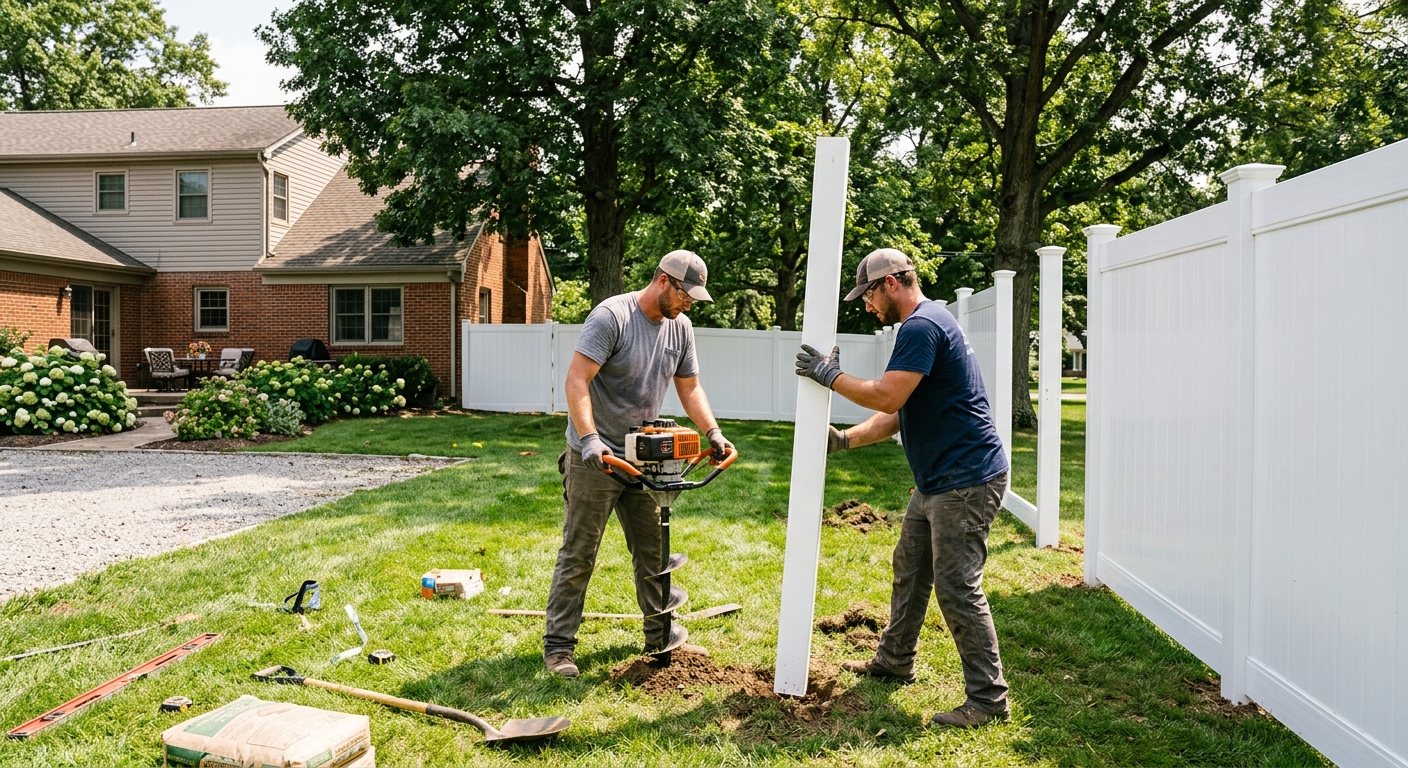
Costs in this region tend to move with frost-depth conditions. Contractors generally plan for posts set below the freeze line (often in the 36–48 inch range), and where the ground is silty or holds moisture, they typically use deeper augered holes and concrete-set posts in structural areas like corners and gates. You’ll also see pricing reflect accessibility; tighter rural driveways and wider yards around the Laurentian Hills area can increase time spent hauling materials and setting alignment.
Trade demand is especially high in family-heavy pockets such as the Laurentian Hills–area residential subdivisions where backyards commonly need privacy and pet-proofing. If you’re comparing options, the easiest way is to line up materials, expected upkeep, and typical installed budgets—then match the fence to your site conditions. Here’s a practical comparison table to start your quote conversations.
| Material |
Lifespan |
Maintenance |
Privacy Rating |
Price per Linear Foot |
| Pressure-treated pine (standard wood) |
10–15 years |
Stain or seal every 2–3 years |
7/10 (with solid boards) |
$28–$42 |
| Cedar (natural rot resistance) |
15–25 years |
Light sealing or staining every 2–4 years |
8/10 (solid/close pickets) |
$34–$58 |
| Vinyl / PVC (no-maintenance) |
20–30 years |
Rinse as needed; inspect posts occasionally |
8/10 (solid panels) |
$38–$65 |
| Chain-link (galvanized steel) |
25–40 years |
Occasional rinse; tighten hardware |
3/10 (limited privacy) |
$22–$35 |
| Aluminum ornamental |
25–35 years |
Wash; touch up minor damage if needed |
4/10 (decorative pickets) |
$36–$72 |
| Composite / recycled material |
20–30 years |
Minimal cleaning; replace rare damaged boards |
7/10 (solid-style boards) |
$42–$78 |
Prices are estimates only and vary by project scope, site access and material selection.
What affects the price of fencing in Laurentian Hills
In Kingston–Pembroke, it’s normal to see quotes for the “same fence” differ by 30–50% once you account for ground conditions, fence height, gate hardware, and how far posts must be set. Even within Southern/Central Ontario, crews can price differently based on whether they expect deeper excavation, how they handle wet clay or silty soil, and how many labour hours it takes to keep everything level and square. Material costs also swing with lumber, PVC resin, and steel—so a quote that’s fair today can drift later if your install date changes.
The biggest structural driver is frost and post depth. Local practice generally assumes frost penetration around 1.2 m (4 ft), so posts are often set about 4–6 inches below the frost depth. In practical terms, that frequently means 1.5–2.0 m of total post length with deeper holes and longer carriers, plus concrete setting for corners and gates. That’s a major reason pressure-treated wood (often in the $55–$95 installed range) can climb when you need “structural” post specs, not just fence rails.
Wind and winter conditions can also influence design decisions. While this region isn’t as exposed as the most open prairie sites, sections near Lake Ontario and the Bay of Quinte can experience stronger gusts, which encourages tighter post spacing and sturdier rails—especially for 6–8 ft privacy fences. Meanwhile, the presence of old fencing and the need for removal/disposal can add significant labour time.
Two common local examples: (1) if your yard has water-holding clay, crews may use deeper augers plus concrete-set posts at every corner and gate hinge side; that pushes you toward the top of wood or vinyl price bands. (2) if rock or roots slow excavation, you may see costs rise by the foot for hand-digging or coring, even when the fence length is modest. Considering many homes in Laurentian Hills are older (built before 1981), replacement work is frequent, which often includes old post removal before new installs can start. Use these factors to interpret why vinyl/private builds (often $75–$140 installed) can price close to premium wood when both require the same deep structural footing.
| Price Factor |
Why It Matters |
Cost Impact |
| Fence length in linear feet |
Every added foot requires posts, rails, and fasteners—plus mobilization time. |
Largest driver; can scale total cost linearly. |
| Post depth required |
Frost line determines hole depth and post length to prevent heaving. |
Deeper holes increase concrete, excavation time, and lumber length. |
| Post setting method |
Concrete vs gravel pack changes labour and material use. |
Concrete-set corners/gates typically raise cost most. |
| Material choice |
Vinyl, cedar, and chain-link differ in labour intensity and material price. |
Switching from chain-link can add moderate-to-high premiums. |
| Gate count and type |
Gates need heavier hardware, bracing, and more precise alignment. |
Each gate can add a substantial fixed labour/material premium. |
| Grade and terrain |
Slope requires stepped panels or raked rails to keep tops consistent. |
More measuring, extra rails, and custom cutting increase cost. |
| Old fence removal and disposal |
Demo, haul-off, and stump/post extraction are labour-heavy. |
Often adds 10–30% depending on complexity. |
| Permit fees and survey / property line locate |
Locates reduce encroachment disputes and rework. |
Can add small-to-moderate costs plus scheduling time. |
Permits & regulations in Ontario
In Ontario, fences may require a building permit depending on height and location. A common rule of thumb used across many municipalities is that fences above about 2.0 m (6.5 ft) at the rear and about 1.0–1.2 m (3–4 ft) at the front or corner often fall into “permit/approval required” territory. Even when a permit isn’t required, you still need to comply with property line rules and any municipal setback bylaws that apply to your lot.
Before any digging, get utility locates. Use Ontario One Call to mark gas, hydro, telecom, and other underground services so your post holes and concrete don’t create hazards. Also confirm your property line—ideally via a survey or locate your property pins—before installation. This matters because shared fence boundaries and line-fence expectations can create disputes if the fence ends up on a neighbour’s side.
For contractor verification in Ontario (for a homeowner in Laurentian Hills), check: (1) the contractor’s licence/registration status where applicable through provincial/industry directories, (2) liability insurance certificate naming you as an additional insured (request a current Certificate of Insurance), and (3) WSIB/WCB coverage where required by the type of work and employer status. Ask for the documents before signing. Step-by-step: request the insurance certificate first, confirm WSIB/WCB clearance wording or account status, then obtain a written quote and a signed scope showing who pulls any permits if one is required. If the contractor refuses documentation, delays certificates, or can’t clearly describe the permitting responsibility, treat it as a red flag.
Choosing the right fence material for Laurentian Hills
Choosing the right fence material in Laurentian Hills is about matching your priorities—privacy, low maintenance, budget, and lifespan—to the realities of cold Ontario winters, freeze–thaw movement, and the local demand for sturdy gates and structural posts. Pressure-treated pine is usually the budget entry point, but it performs best when you plan to stain or seal roughly every 2–3 years to avoid grey weathering and early board surface failure. Cedar often costs more upfront, yet it holds up well in damp cycles and typically resists rot better, which is helpful where wet clay can increase freeze–thaw stress around post bases.
Vinyl/PVC delivers genuinely low maintenance—no staining—and typically looks consistent over time. The trade-off is higher upfront cost and the need for proper installation so panels don’t warp or crack in extreme cold. Chain-link is the longest-lasting low-cost option (and usually doesn’t require frequent upkeep), but it won’t provide real privacy unless you add slats, mesh, or planting. Aluminum ornamental offers a clean look and won’t rust like steel can, but it’s mainly a decorative boundary; privacy is moderate at best.
Post-depth matters no matter what you pick in Kingston–Pembroke. With typical frost around 1.2 m (4 ft), you still plan for deep footings and longer posts—often concrete-set at corners and gates—because it’s the ground movement that causes the visible problems: leaning, sagging gates, and gaps. In a wet-then-freeze site, concrete-set posts are often the difference between “stable for years” and “repeat repairs.”
As a budgeting example, if wood and vinyl both need the same deep structural post specs and a gate, the price difference can shrink. In practice, homeowners may find wood installed around the middle of the $55–$95 range, while vinyl lands in the higher $75–$140 band; paying the premium can be justified when you want to stop annual maintenance and reduce call-backs for board replacement—especially with older fence lines that are already deteriorating.
| Material |
Cold Tolerance |
Lifespan |
Annual Maintenance |
Best For |
Price Band |
| Pressure-treated pine |
Good with proper staining and deep post setting |
10–15 years |
1–2 hours (inspection); stain every 2–3 years |
Budget-friendly boundaries with traditional look |
$55–$95 |
| Cedar |
Very good in damp freeze–thaw cycles |
15–25 years |
1–2 hours; seal/stain every 2–4 years |
Natural appearance and better rot resistance |
$70–$120 |
| Vinyl / PVC |
Good if installed with correct spacing and anchoring |
20–30 years |
Rinse/inspect 10–20 minutes |
Low maintenance and consistent curb appeal |
$75–$140 |
| Chain-link |
Excellent; metal handles winter well |
25–40 years |
Minimal; tighten and rinse as needed |
Security with maximum durability per dollar |
$40–$80 |
| Aluminum ornamental |
Excellent; won’t rust like steel |
25–35 years |
Wash and check fittings 10–20 minutes |
Front-yard aesthetics and neat boundary lines |
$80–$160 |
| Composite / recycled material |
Good; stable boards with proper framing |
20–30 years |
Minimal; occasional cleaning |
Modern solid look without frequent staining |
$85–$150 |
How to choose a fencing contractor in Laurentian Hills
Choosing the right fencing contractor is less about who quotes fastest and more about who can prove they’re equipped for the ground conditions we see around Laurentian Hills. First, verify Ontario licensing or required registration for the contractor type—then confirm liability insurance. Ask for a current Certificate of Insurance (COI) and ensure it lists adequate coverage and names you as an additional insured. Next, confirm WSIB/WCB coverage: request either a WSIB clearance letter (or proof of coverage/account status) and review it for current validity, plus the employer name matches the contractor performing the work.
Get 2–3 itemised written quotes. Ideally, your quote should break down labour (excavation, set, rail installation, alignment), materials (posts, rails, boards/panels, fasteners, gate hardware), and site work (removal and disposal). Avoid lump-sum quotes without clarity—fences often change in cost based on whether posts are concrete-set, whether holes are deeper due to frost-proofing, and whether rock/root obstructions require coring.
Read the scope carefully: confirm whether permits (if needed), property line locate/survey assistance, and waste disposal/haul-off are included. Check warranty terms: workmanship warranty length (often 1–2 years or longer), product/manufacturer warranty details, and whether the warranty is transferable to you as the homeowner. For payment schedule, never pay more than 10–15% upfront; hold back until the fence is complete and gates are aligned and operating smoothly. Require a start date and estimated completion timeline in writing.
- Provide insurance COI and WSIB/WCB proof before you sign.
- Show past projects nearby in Kingston–Pembroke or similar frost-ground conditions.
- Use a site visit and measure fence length and gate openings on the property.
- Confirm post depth plan (frost-set depth) and which posts are concrete-set.
- Get a written post spacing and rail spec—don’t accept vague “standard” language.
- Ask how they handle rock/roots (hand-dig vs coring) and price the contingency.
- Ensure gate hardware is included (hinges, latches, bracing, and alignment steps).
- Confirm whether old fence removal and disposal are included and how it’s hauled.
- Verify permit responsibility and whether they will apply if required.
- Require a warranty in writing for workmanship and for the materials.
- Set payment milestones tied to measurable completion (set posts, then rails, then finish).
- Require final walkthrough and punch-list sign-off before the last payment.
Local red flags I see around Laurentian Hills: contractors who won’t show a COI or WSIB/WCB proof, quotes that omit whether gates are braced and concrete-set, promises to “keep it cheap” by reducing post depth, vague scopes that exclude disposal or permit handling, and crews who pressure you into paying more than 10–15% upfront without a written schedule.
Frequently asked questions — fencing in Laurentian Hills
Should fence posts be set in concrete here?
In Laurentian Hills and across Ontario’s Kingston–Pembroke region, concrete-set posts are commonly recommended for structural locations—especially corners, gate hinge sides, and any run where the fence has to stay perfectly aligned through freeze–thaw. Frost depth drives the real issue: posts must be set below the design frost line (often around 36–48 inches deep for the hole depth planning), so you end up drilling deeper holes and using enough stable material to resist heaving. For some yards with well-draining soil, crews may use a gravel pack approach for non-structural sections, but in wet clay or silty areas that hold water, concrete setting often improves long-term stability. This is one reason two quotes can differ even when materials are similar, with wood projects typically spanning $55–$95 installed depending on the exact post and setting plan.
What's the best fence for privacy?
For privacy in Laurentian Hills, a solid-panel privacy fence (wood with close boards, vinyl/PVC with solid panels, or composite boards) generally performs best. Privacy isn’t only about the material—it’s also about picket spacing, panel height, and gate placement. If you’re building around family yards where visibility is high, solid designs reduce sightlines and also help with wind gusts by providing a continuous barrier. Keep in mind local winter performance: solid fences need proper post depth and bracing so panels don’t rack when the ground moves. Vinyl/PVC is popular because it’s typically low maintenance, often priced in the $75–$140 installed range, while wood privacy fences can fall into the $55–$95 band when excavation and concrete-set structural posts are still planned.
How do I compare fencing quotes?
Start by comparing apples-to-apples. Ask each contractor to quote the same fence height, same material grade, same post depth plan (and which posts are concrete-set), and the same gate type and number. Ensure the quote is itemised: labour for excavation and alignment, material lists for posts/rails/boards or panels, and hardware for latches and hinges. Also compare exclusions—does the quote include old fence removal and disposal, utility locates scheduling, and any permit pull if a fence exceeds local thresholds? In Ontario, fences above common height cutoffs (often about 2.0 m at the rear and 1.0–1.2 m at the front/corner) may require a permit, so you want that responsibility clear. If one quote is much lower than the rest, it’s often because the post setting depth, gate bracing, or removal scope is reduced.
How long does fence installation take in Laurentian Hills?
Typical installs in Laurentian Hills range from a single day for short chain-link runs to several days for privacy fences with multiple sections and gates. The biggest timeline drivers are excavation (especially when soils are wet and deeper post holes are required), access for equipment, and whether you’re removing an existing fence. If your project includes concrete-set posts in frost-protected holes and precise gate alignment, expect more time for measuring, setting, and final adjustments. Weather matters too: rain and frozen ground can slow excavation or curing schedules. A contractor should provide a written start date and completion estimate, with a realistic plan for cure time if concrete is used. If a quote doesn’t mention how they handle frost-depth hole prep or removal haul-off, it often leads to schedule surprises.
Can I install a fence on a slope in Laurentian Hills?
Yes, sloped yards are common, and fences can be installed successfully in Laurentian Hills with either stepped panels or raked rails. The right approach depends on your fence style and how you want the top line to look. Stepped panel systems create a staircase effect following the grade; raked rails keep the fence top at a consistent angle. Either way, the layout needs extra measuring and more custom cutting, and that’s part of why slope can affect pricing. In many cases, posts still must be set below frost depth, but the hole depth and post length may vary section by section. To avoid future issues, choose a contractor who plans the grading method and uses correct spacing for rails and pickets—especially around gates where the alignment must remain functional even on uneven ground.
What is the most weather-resistant fence for Laurentian Hills's climate?
“Most weather-resistant” depends on what you mean by resistance. For long life through cold and damp, chain-link has excellent durability and often stays reliable for decades, but it won’t provide privacy without add-ons. For a balance of cold performance, rot resistance, and day-to-day durability, cedar and properly installed vinyl/PVC are strong options; they handle moisture swings better when post bases are set correctly below frost and the design avoids trapped water. Wood can last, but pressure-treated pine needs maintenance to keep its surface protected—plan for staining or sealing periodically. In terms of typical installed budgets, chain-link often sits around $40–$80, while vinyl/PVC is frequently $75–$140 installed. A “weather-proof” result comes more from correct post depth and bracing than from material alone, especially in Ontario’s freeze–thaw cycles.