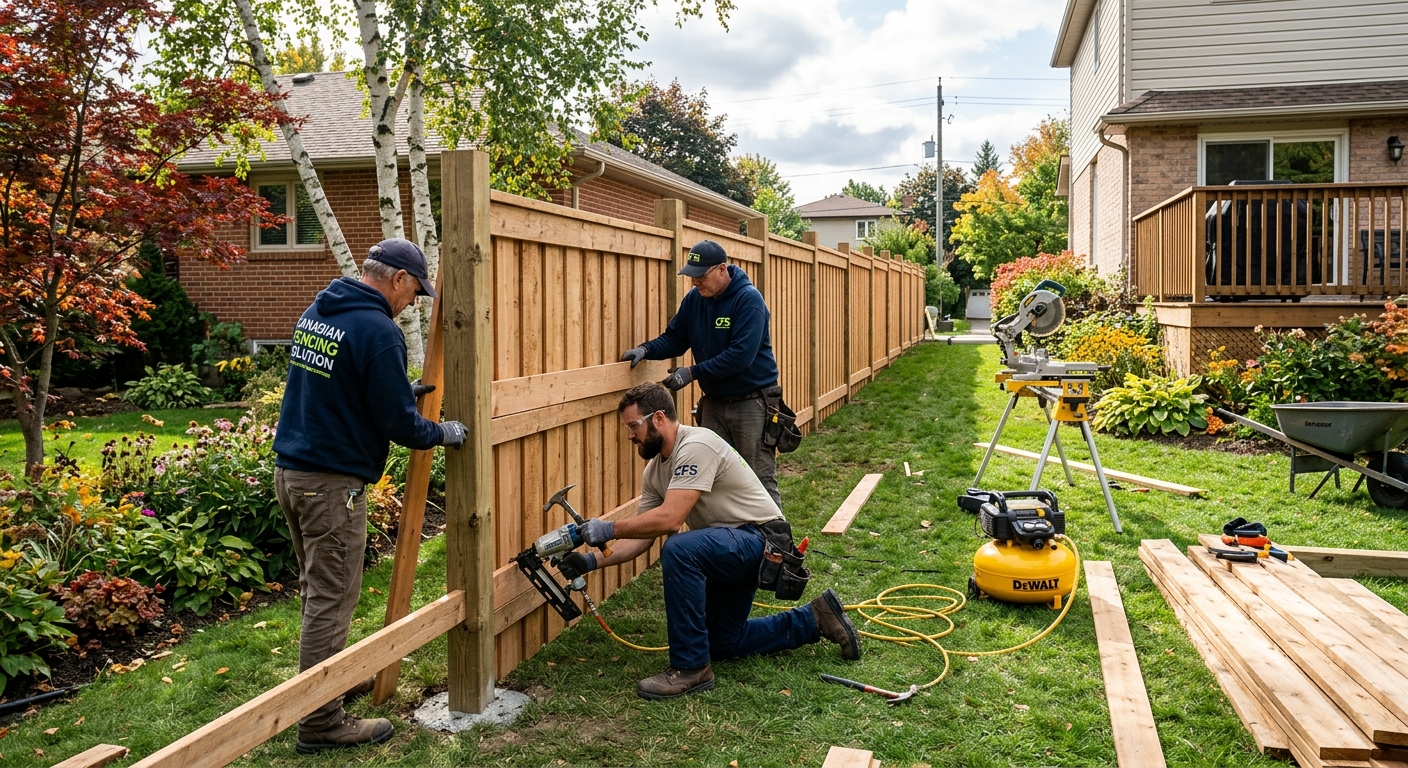
Fencing options and costs in King
King, Ontario is a popular choice for homeowners who want privacy, safe yards for kids and pets, and a clean boundary line around detached properties. With single-detached houses making up 87.2% of dwellings and 88.2% of households owning their homes (Statistics Canada, 2021 Census), demand for residential fencing tends to be steady—especially when neighbourhoods see more backyard upgrades. In the Toronto economic region, fencing costs are shaped by the combination of clay-heavy soils, freeze-thaw cycles, and the practical way most local crews build for long-term stability. For example, the design frost line in Southern Ontario is commonly treated around 42"–48", and posts are typically set 3.5–4 feet deep or more for 6–8 ft privacy fences to reduce frost heave risk. That depth often means concrete-set posts and longer materials, which can push total labour and ready-mix costs higher than what people expect from “surface” fence installation.
Another cost driver in King is access and wind-related panel design. While the GTA doesn’t face the extreme open-field wind loads found on the Prairies, local best practice still sizes posts and spacing to limit racking and uplift, particularly for solid wood, vinyl, and PVC privacy fences. Contractors are also busiest in areas like Schomberg, where many homes built before 1981 (37.9%) are now being renovated with new yard boundaries and gate upgrades. With that context, the table below compares common material choices by lifespan, maintenance expectations, privacy performance, and typical installed price bands so you can benchmark quotes.
| Material |
Lifespan |
Maintenance |
Privacy Rating |
Price per Linear Foot |
Price Range |
| Pressure-treated pine (standard wood) |
10–15 years |
Stain/seal every 2–3 years |
8/10 |
$65–$120 per linear foot |
$65–$120 |
| Cedar (natural rot resistance) |
15–25 years |
Wash/reattach stain every 2–4 years |
9/10 |
$75–$130 per linear foot |
$75–$130 |
| Vinyl / PVC (no-maintenance) |
20–30 years |
Occasional rinse; avoid abrasive cleaners |
9/10 |
$75–$130 per linear foot |
$75–$130 |
| Chain-link (galvanized steel) |
20–35 years |
Minimal; rinse and check tension |
2/10 |
$45–$85 per linear foot |
$45–$85 |
| Aluminum ornamental |
25–40 years |
Minimal; occasional cleaning |
3/10 |
$90–$160 per linear foot |
$90–$160 |
| Composite / recycled material |
20–30 years |
Light cleaning; inspect hardware |
8/10 |
$75–$130 per linear foot |
$75–$130 |
Prices are estimates only and vary by project scope, site access and material selection.
What affects the price of fencing in King
In King, it’s common to see the “same” fence quoted with 30–50% swings across the Toronto area because the scope is never truly identical—especially around post depth, concrete quantities, hardware, and how crews handle old fencing and terrain. The Toronto economic region pricing also reflects that Southern Ontario winters demand real frost protection. The design frost line is often treated around 42"–48", and best practice is to set posts about 4–6 inches below that frost depth to reduce frost heave. In practical terms, many King projects end up with post hole depths in the 1.5–2.0 m range, which means longer posts, more auger time, and commonly concrete-set footings rather than gravel packs alone. That combination increases both material cost and labour time.
Wind also affects design even though the GTA isn’t as punishing as open Prairie conditions. Solid panel fences (wood, vinyl/PVC, and some composites) typically need heavier posts and closer spacing (often 6–8 ft centres) to limit racking and uplift, which increases hardware and post counts. Two concrete examples we see in King: first, a 6 ft privacy fence on clay where the homeowner wants concrete-set posts typically lands closer to the upper end of the wood band—roughly $65–$120 per linear foot installed—because of ready-mix and deeper holes. Second, a chain-link yard fence around a corner lot with good access might price closer to $45–$85 per linear foot because posts can be installed efficiently with less heavy panel bracing.
Local housing stock matters too. Older lots often have irregular property edges, older fence remnants, or mature shrubs that force extra layout work—especially when homes built before 1981 (37.9%) are being upgraded. If your yard has a slope or requires stepped panels, you may pay more for custom alignment rather than extra material alone. Those design and site variables are why it’s smart to compare quotes line-by-line using the factors below.
| Price Factor |
Why It Matters |
Cost Impact |
| Fence length in linear feet |
Most labour and materials scale directly with linear footage |
High (primary driver) |
| Post depth required |
Frost line determines hole depth and post length to prevent heaving |
Medium to high |
| Post setting method |
Concrete vs. gravel pack vs. driven posts changes labour and material cost |
High when concrete-set is required |
| Material choice |
Vinyl, cedar, and chain-link differ in price, hardware, and installation pace |
Medium to high |
| Gate count and type |
Walk-through gates are simpler; double drive gates need stronger frames |
Medium to very high for drive gates |
| Grade and terrain |
Sloped yards often require stepped or raked panel systems |
Medium |
| Old fence removal and disposal |
Dismantling, hauling, and dumping fees vary by site conditions |
Medium (can be high on tight sites) |
| Permit fees and survey / property line locate |
Some fence builds need permits; accurate locating prevents boundary disputes |
Low to medium |
Permits & regulations in Ontario
In Ontario, fence permits are usually tied to fence height and location. As a practical rule in King, fences above a height threshold—often 2.0 m (6.5 ft) at the rear and around 1.0–1.2 m (3–4 ft) at the front or corner—may require a building permit. Even when a permit isn’t needed, you still must follow setback and property line rules set by municipal bylaws and ensure the fence is installed wholly on your side of the boundary (unless there’s an established shared fence agreement). Because King projects often involve older lots and mature landscaping, I recommend doing a proper property locate before any digging.
Before you set any post holes, call for utility locates through Ontario One Call. This step is essential even if you “know where things are,” because buried services can shift or be rerouted over decades. If your property pins aren’t clearly identified, obtain a survey or at least have your property line located so you can plan the fence alignment and avoid neighbour disputes.
For shared fence ownership, Ontario’s line-fence framework governs how neighbours handle shared boundaries and responsibilities. For homeowner verification: (1) confirm your contractor’s Ontario licence status using online business and trade records; (2) request a current Certificate of Insurance showing liability coverage suitable for fencing work; and (3) ask for WSIB/WCB clearance for workers performing the installation. A reputable contractor should provide these documents up front and be willing to show them before scheduling excavation.
Choosing the right fence material for King
Choosing the right fence material in King comes down to your priorities: privacy, low maintenance, budget, and lifespan—then matching that to how Southern Ontario cycles through freeze-thaw, snow loading, and occasional freeze-crack conditions. Pressure-treated pine is typically the budget-friendly option, but it’s also the one most likely to grey and weather. Plan on staining or sealing about every 2–3 years to keep it looking good and to slow surface checking. Cedar offers a more natural look and better resistance to rot, but it still needs maintenance—often washing and re-staining every 2–4 years depending on sun exposure and wind.
For true low maintenance, vinyl/PVC is a common King choice because it doesn’t require staining and generally cleans easily. The trade-off is higher upfront cost and the need for proper installation in cold weather: correct post spacing, secure anchoring, and attention to hardware prevent premature cracking. Chain-link is usually the longest-life budget performer and can be very cost-effective, but it won’t provide meaningful privacy unless you add slats, landscaping screening, or a privacy mesh. Aluminum ornamental looks clean and never rusts the way iron can, but it’s decorative—privacy is limited. Composite/recycled materials can deliver solid privacy with minimal maintenance, and they’re often closer in feel to wood privacy styles.
Post depth is a key point in Toronto-area frost conditions. For most 6–8 ft privacy fences, concrete-set posts are commonly used because the local frost line is managed by setting posts roughly 3.5–4 feet deep to reduce heaving. In practice, that makes post type and spacing as important as the fence material itself. If you’re deciding between wood and vinyl, a clear example is choosing vinyl/PVC at the higher end of the band (roughly $75–$130 per linear foot installed) when you know you’ll be too busy to re-stain every 2–3 years; the added cost can be justified by fewer ongoing maintenance tasks and consistent appearance through winter.
| Material |
Cold Tolerance |
Lifespan |
Annual Maintenance |
Best For |
Price Band |
| Pressure-treated pine |
Good with proper sealing |
10–15 years |
Low to moderate (seal/stain every 2–3 years) |
Budget privacy with periodic upkeep |
$65–$120 |
| Cedar |
Good; handles moisture swings well |
15–25 years |
Moderate (wash and re-stain every 2–4 years) |
Attractive privacy where looks matter |
$75–$130 |
| Vinyl / PVC |
Very good when installed correctly |
20–30 years |
Low (occasional rinse; hardware checks) |
Low-maintenance privacy |
$75–$130 |
| Chain-link |
Excellent (galvanized steel resists corrosion) |
20–35 years |
Low (tension checks as needed) |
Security and pet containment |
$45–$85 |
| Aluminum ornamental |
Excellent (corrosion-resistant) |
25–40 years |
Low (cleaning as needed) |
Decorative boundary and curb appeal |
$90–$160 |
| Composite / recycled |
Good; benefits from stable hardware and spacing |
20–30 years |
Low (light cleaning; inspect hardware) |
Privacy with reduced upkeep |
$75–$130 |
How to choose a fencing contractor in King
Choosing a fencing contractor in King should start with proof of capability and coverage, not just a low line price. In Ontario, fencing work typically involves excavation, post setting, and handling of materials that can create liability risk if something is damaged or someone is injured. Verify Ontario licensing/registration status where applicable for the business, then ask for a Certificate of Insurance showing general liability coverage that’s current and appropriate for residential construction. Also request WSIB/WCB clearance (or equivalent proof of coverage) for the workers who will be on site. Legitimate companies will provide documentation before the job is scheduled.
Next, get 2–3 itemised written quotes. Ideally, each quote should break down labour vs. materials (posts, rails, panels, fasteners, concrete, hardware), and clearly state installation details like post depth, whether posts are concrete-set, and how gates are framed and installed. Confirm what is excluded: permit pull responsibility, utility locate costs, old fence removal and disposal, and any required survey/property line locate. A quote that’s “lump sum” without post-setting specs often leads to change orders. Ask about warranties too: workmanship warranty length, product/manufacturer warranty, and whether warranties are transferable if you sell your home.
For payments, avoid paying more than 10–15% upfront. Hold back the remainder until completion and final walk-through. Finally, get a written start date and an estimated completion timeline, including how weather delays are handled in King’s freeze-thaw season.
- Ask for the contractor’s business registration and proof of standing before signing.
- Request a Certificate of Insurance (liability) and verify dates match the project period.
- Confirm WSIB/WCB coverage for installers; don’t rely on verbal assurances.
- Require itemised quotes showing labour, materials, and equipment (auger, haul-away, concrete).
- Ensure post depth is specified in writing (not just “below frost line”).
- State post setting method clearly: concrete-set vs gravel pack vs driven.
- Confirm panel spacing and bracing plan for privacy and wind resistance.
- Verify gate type and hardware (self-latching? hinges? frame size?) and that it’s included.
- Ask whether permit pull (if required) is included or billed separately.
- Confirm utility locate responsibility (typically by homeowner/utility process, but contractors should coordinate).
- Clarify disposal: hauling away old fence panels and any dump fees.
- Get warranty terms in writing (workmanship + product) and understand transferability.
Red flags I often see in King: quotes that won’t specify post depth or concrete-set plans, “too low to be real” pricing that ignores gate framing or disposal, pressure to pay a large upfront deposit, vague scopes that say “materials as required,” and crews who won’t show insurance/WSIB/WCB documents before work starts.
Frequently asked questions — fencing in King
Should fence posts be set in concrete here?
In King and the broader Toronto area, concrete-set posts are commonly recommended for privacy fences because freeze-thaw can cause heaving if posts aren’t deep and stable. With the frost line in Southern Ontario often treated around 42"–48", many crews set posts roughly 3.5–4 feet deep (about 1.5–2.0 m) and use concrete to improve long-term stability, especially for 6–8 ft solid fences. Whether you “must” use concrete depends on soil conditions, fence height, and how the contractor is planning for frost and uplift—but for most backyard privacy builds, concrete is the safer default. If a quote only mentions “driven posts” for a tall fence, ask for their written frost-heave plan and post specification. That level of detail should match the material band you’re paying for—wood privacy often falls around $65–$120 per linear foot installed.
What's the best fence for privacy?
For privacy in King, the best match is usually a solid privacy design: wood (pressure-treated pine or cedar) with tight picket spacing, or vinyl/PVC with full privacy panels. These styles block sightlines and hold up well when installed with correct post spacing and bracing for GTA winds. If you’re tired of maintenance and want consistent appearance through winter and summer, vinyl/PVC is often the easiest “set it and forget it” route, though it can cost more upfront—commonly within the $75–$130 per linear foot band. Cedar can look great and resist rot better than basic pine, but you’ll still need periodic staining. Chain-link is the least private option unless you add slats or screening. If you have a busy street or a corner lot, prioritise stronger posts and concrete-set foundations so the fence doesn’t rack during wind events.
How do I compare fencing quotes?
To compare quotes in King fairly, don’t just look at the total—compare the specs. Ask each contractor to show (1) linear footage, (2) post depth and post spacing, (3) post setting method (concrete vs gravel pack vs driven), (4) materials and grades (e.g., cedar vs pine thickness, vinyl thickness, galvanized hardware), and (5) gate count and type. Ensure labour and materials are itemised, not lumped, so you can tell what’s driving differences. Also confirm what’s included: demolition of the old fence, disposal/hauling, and whether permit pulling (if required) is included. A low quote that omits disposal or uses minimal footings often turns expensive later. If one quote is in the wood band (roughly $65–$120 per linear foot) and another is in the aluminum band (around $90–$160), make sure they’re truly comparable height and panel style first.
How long does fence installation take in King?
Most residential fence installs in King are completed in a few days, but the timeline depends on length, gate count, ground conditions, and whether concrete curing impacts progress. Day 1 is commonly layout, utility coordination checks, and digging/post holes. Concrete-set posts can require additional time for finishing around the posts before panels go up. Removing an old fence and hauling it away can add a day, especially if access is tight. Sloped yards that need stepped or raked panels also take longer because the crew must adjust each section for alignment. If you’re planning a larger privacy fence with multiple gates, expect a longer schedule. Ask your contractor for a written start date and a completion estimate that includes weather contingencies for Ontario freeze-thaw conditions.
Can I install a fence on a slope in King?
Yes, you can install a fence on a slope in King, but the installation method matters for both appearance and stability. Most crews will use stepped panels (individual sections at different heights) or raked panels (one continuous angle), depending on the fence system and how uneven the grade is. Stepped systems are often easier for privacy fences with solid panels, while raked systems may be used for certain rail-and-post styles. Proper footing depth is still critical for frost stability—don’t let a slope trick you into placing shallow posts on the “downhill” side. Make sure your contractor describes how they’ll handle post depths and maintain spacing so the fence remains plumb and doesn’t rack. If your yard has drainage issues, discuss footing and drainage planning early; it can affect how long your fence will last.
What is the most weather-resistant fence for King's climate?
For King’s winter conditions, the most weather-resistant options are typically vinyl/PVC for low maintenance and longevity, aluminum ornamental for corrosion resistance, and properly installed galvanized chain-link for durability. Vinyl/PVC can perform very well through freeze-thaw when installed with correct post spacing and secure anchoring; it typically falls around the $75–$130 per linear foot installed range. Aluminum ornamental is also highly resistant to corrosion and rust, making it a strong choice for wet freeze cycles, though it’s less private unless you add screening. Chain-link is excellent for weather resistance and can last decades, but it provides minimal privacy without slats or screening—often priced around $45–$85 per linear foot. The “most resistant” overall depends on your goal: if privacy is the priority, solid panels with concrete-set posts and correct spacing usually outperform decorative options in day-to-day wind and snow stresses.