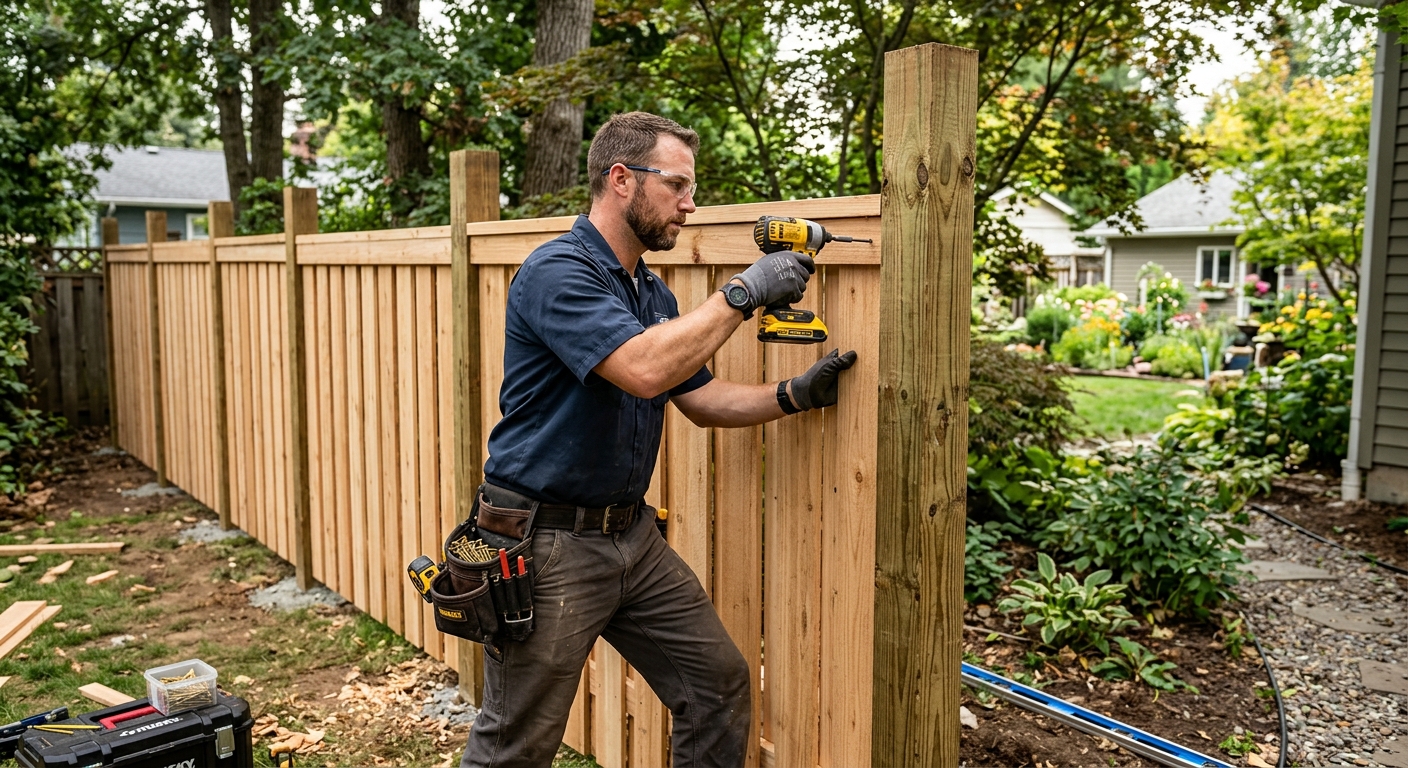
Fencing options and costs in Sioux Lookout
Sioux Lookout is a lake-and-forest community where fencing demand is steady year-round, especially for single-detached homes—about 67.9% of dwellings locally. With 66.7% of households owning their homes, many property upgrades are planned with a “fit it once, keep it for years” mindset. That planning shows up in material choices: homeowners tend to favour solid privacy and structures that can handle freeze–thaw cycles rather than lightweight, short-lived fences.
In Northwest Ontario, frost penetrates deeper than in southern Ontario, so posts typically need to be set about 4 ft (1.2 m+) below grade, often with concrete, to stay below the frost line and avoid frost heave. That deeper embedment increases excavation time, concrete volume, and labour, so even a “budget” fence costs more to install than in milder climates. Wind exposure also influences layout: on open lots or highway-adjacent areas, contractors often use closer post spacing and sturdier rails, which can raise installed cost.
In Sioux Lookout, trade is especially busy around the downtown and waterfront area (for lake-view lots where privacy and wind protection matter). If you’re comparing bids, start with material and expected lifespan—but also think about how the frost and wind will change post depth and framing.
Use the table below to compare common options and realistic installed ranges before you request a quote.
| Material |
Lifespan |
Maintenance |
Privacy Rating |
Price per Linear Foot |
| Pressure-treated pine (standard wood) |
10–15 years |
Stain/seal every 2–3 years; inspect rails and pickets seasonally |
High (solid board style) |
$55–$90 |
| Cedar (natural rot resistance) |
15–20 years |
Still benefits from periodic staining; faster fade possible in sun-exposed sections |
High (solid board or close picket) |
$75–$110 |
| Vinyl / PVC (no-maintenance) |
20–30 years |
Wash occasionally; check for post alignment after extreme cold snaps |
High (solid privacy panels) |
$70–$110 |
| Chain-link (galvanized steel) |
20–40 years |
Occasional hose-down; straighten ties and tension if needed |
Low–Medium (no privacy without slats/planting) |
$35–$65 |
| Aluminum ornamental |
25–40 years |
Wash annually or as needed; inspect fasteners after winters |
Low–Medium (ornamental spacing) |
$80–$140 |
| Composite / recycled material |
20–30 years |
Low; periodic cleaning; check for fastener integrity |
High (solid panels) |
$90–$140 |
Prices are estimates only and vary by project scope, site access and material selection.
What affects the price of fencing in Sioux Lookout
In Sioux Lookout, the same “average” fence can land 30–50% apart between quotes because the biggest drivers—post depth, wind-conscious framing, excavation conditions, and removals—aren’t always identical from one lot to the next. Northwest Ontario’s colder freeze–thaw means contractors typically set posts about 4–6 inches below the design frost depth to prevent heaving, which often translates into roughly 1.5–2.0 m into the ground in cold Ontario and similar regions. Deeper holes require longer posts, more concrete, and more labour time, so installation cost rises even if material cost stays similar.
Wind exposure can also reshape the design. On more open rural approaches or near highway corridors, crews often respond by using tighter post spacing and heavier rails. That can push a “standard privacy” layout upward toward the higher end of the $55–$90 wood band or into the higher end of vinyl—particularly if you go to solid-board privacy styles.
Concrete examples from local sites we see: (1) A lake-facing property usually needs stronger bracing, so you may see higher labour for additional rails and sturdier fasteners. (2) Clay or mixed soil pockets can slow excavation and increase the time spent shimming and aligning posts, which can add both labour and disposal. (3) Older homes—many built before 1981 (49.6% locally)—often have older fence remnants or utility runs, so removal and rerouting can add cost.
To keep bids comparable, ask each contractor to explain the post embedment, the setting method, and what they’re including in the base price (especially concrete and disposal).
| Price Factor |
Why It Matters |
Cost Impact |
| Fence length in linear feet |
Every extra foot adds rails, posts, and hardware; labour scales with total run |
Typically the largest driver—often 50–70% of the quote |
| Post depth required |
Frost line determines how long the posts must be and how deep each hole goes |
Deeper embedment can add substantial excavation and concrete cost |
| Post setting method |
Concrete vs. gravel pack vs. driven posts changes durability and time on site |
Concrete-set posts usually cost more but reduce frost heave risk |
| Material choice |
Vinyl, cedar, chain-link, and aluminum have very different material and framing needs |
May shift the project from a low band toward mid/high bands |
| Gate count and type |
Walk-through gates are simpler; drive-through (double) gates need heavier framing |
Can add a meaningful premium per gate |
| Grade and terrain |
Sloped yards require stepping or raking panels, plus extra layout time |
Often adds labour and increases waste from cut-offs |
| Old fence removal and disposal |
Demolition, haul-away, and any buried posts affect time and equipment needs |
Can add a one-time disposal premium |
| Permit fees and survey / property line locate |
Survey/loci prevent encroachment issues; permits may apply at higher heights |
Costs vary—usually a small but important line item |
Permits & regulations in Ontario
In Ontario, fences are generally governed by municipal setback bylaws and property-line rules, and permits may apply depending on height and location. A common threshold that triggers a building permit is around 2.0 m (6.5 ft) at the rear and roughly 1.0–1.2 m (3–4 ft) along the front or corner areas; if your design exceeds those typical ranges, confirm with the Town/City office before you dig. Even when a permit isn’t required, you still must respect the property line and any applicable setbacks.
Before installing any posts, call for utility locates (Ontario One Call). This is essential because excavation near power, telecom, and service lines can be dangerous and can delay the schedule if utilities aren’t cleared first. Also, obtain a survey or at least a property-pin locate so your fence line matches the legal boundary—this helps avoid disputes with neighbours, particularly in areas where older lots may have legacy fencing or unclear alignments.
Shared fence ownership is addressed through Ontario’s line-fences principles, but the safest approach is to confirm who owns what and how costs will be handled before starting.
What typically DOES require a permit: higher fences near/above the rear or front/corner thresholds noted above, plus projects that clearly exceed typical local fence standards. What typically does NOT: small backyard repairs or fence replacements in the same footprint and height range that remain within bylaw limits (still confirm height/location to be safe).
To verify a contractor: request their proof of licence (Ontario credentials via their public-facing registry listing, where applicable), a current Certificate of Insurance (liability coverage naming you as applicable), and documentation confirming coverage equivalent to WSIB/WCB for workers on site. Ask for the clearance letter or the most recent coverage evidence and ensure it’s valid for the period of your project.
Choosing the right fence material for Sioux Lookout
Choosing the right fence material in Sioux Lookout is less about “what looks best on day one” and more about what survives cold winters, deep frost, wind, and snow load without turning into a maintenance project. With 49.6% of homes built before 1981, many properties already have older fencing infrastructure, so replacement and upgrades are common—and you want materials that match your tolerance for staining, repairs, and seasonal checks.
Pressure-treated pine is usually the budget-friendly path, but it commonly needs staining or sealing every 2–3 years to reduce grey weathering and surface cracking. Cedar resists rot more naturally and typically ages more attractively, but it still benefits from periodic maintenance in sun and wind-exposed sections. Vinyl/PVC is popular for low maintenance and privacy panels, yet in extreme cold it can become brittle at the wrong fastening points—proper post depth, alignment, and compatible hardware matter. Chain-link offers long life and affordability but doesn’t provide privacy unless you add slats, screening mesh, or plantings. Aluminum ornamental doesn’t rust and handles winters well, but it’s generally a visual barrier, not a private one. If you want a solid privacy feel with low upkeep, composite/recycled can be a good compromise, though it’s often priced above wood.
Because Northwest Ontario frost can require posts to sit about 4 ft (1.2 m+) below grade (with concrete often used), the structural portion of your cost rises for every material. That’s why the best “value” comparison is often: an installed wood privacy fence at roughly $55–$90 per linear foot may be attractive, but switching to cedar or vinyl can be justified when you expect fewer touch-ups and longer service life. For example, if vinyl costs closer to the higher side of $70–$110 but eliminates repeated staining cycles, some homeowners find the premium pays back over time—especially on lake-facing lots where boards take heavy weather.
Wind and snow loads also matter. For open properties, heavier rails, tighter spacing, and sturdy brackets help resist sway—regardless of material—so ask your contractor how they’re bracing for Sioux Lookout conditions.
| Material |
Cold Tolerance |
Lifespan |
Annual Maintenance |
Best For |
Price Band |
| Pressure-treated pine |
Good (with proper staining and tight hardware) |
10–15 years |
Inspect; minor re-staining 0–1 times per year (full stain typically every 2–3 years) |
Budget privacy with manageable upkeep |
$55–$90 |
| Cedar |
Good (natural rot resistance) |
15–20 years |
Inspect joints; light cleaning and occasional stain touch-ups |
Attractive privacy that handles moisture better |
$75–$110 |
| Vinyl / PVC |
Very good (avoid improper fastener practices in extreme cold) |
20–30 years |
Wash and check post alignment; typically minimal |
Low maintenance privacy |
$70–$110 |
| Chain-link |
Very good (galvanized steel resists corrosion) |
20–40 years |
Minimal; tension/repairs as needed |
Security, pets, and budget fencing |
$35–$65 |
| Aluminum ornamental |
Very good (powder-coated, no rust) |
25–40 years |
Wash and inspect fasteners |
Front-yard curb appeal and perimeter definition |
$80–$140 |
| Composite / recycled |
Good (designed for freeze–thaw longevity) |
20–30 years |
Low; periodic cleaning and hardware checks |
Solid privacy with reduced upkeep |
$90–$140 |
How to choose a fencing contractor in Sioux Lookout
When you’re hiring a fencing contractor in Sioux Lookout, verifying Ontario credentials and insurance protects you from delays and liability. First, ask for proof of appropriate Ontario licensing/registration (if applicable for their business structure and work) and request a current Certificate of Insurance for general liability naming you as applicable. If workers are involved, confirm they carry coverage evidence equivalent to WSIB/WCB for the period of your job. A legitimate contractor will hand these over without pushing back and will usually include the coverage period on the documents.
Second, get 2–3 itemised written quotes—not one lump sum. The best quotes break down line items for: excavation, post depth and embedment method, concrete/setting materials, rails and bracing, fence pickets or panels, gates, hardware, and removal/disposal. Ask whether a permit pull (if required) and any property line locate costs are included or excluded. If you’re comparing a wood privacy job versus vinyl, the quote should clearly state the post spacing, concrete quantity approach, and any wind-bracing plan—these are often where hidden cost differences appear.
Third, read warranty terms carefully. Confirm the length of workmanship warranty, the manufacturer’s product warranty for components, and whether warranty coverage transfers if you sell your home. For payment, keep it conservative: never pay more than about 10–15% upfront, and agree on a holdback until the fence is complete and cleaned up.
Finally, lock in the timeline. The quote should include an expected start date and a completion estimate in writing, with notes on when weather could affect installation. In Northwest Ontario, schedule changes due to thaw/refreeze and ground conditions are normal—good contractors plan around them.
- Request their Certificate of Insurance and confirm it’s current for your project dates.
- Confirm they have coverage evidence equivalent to WSIB/WCB for workers.
- Ask for an Ontario business registration/licence reference and verify it matches their contract details.
- Get 2–3 itemised quotes (posts, rails, excavation, concrete, gates, removal, disposal listed separately).
- Require the quote to specify post depth and whether concrete is used.
- Confirm post spacing and whether the design accounts for wind exposure on your lot.
- Ask what’s included in grading/stepping on slopes (raked panels vs. stepped rails).
- Check if old fence removal and stump/post extraction are included, and where debris is hauled.
- Verify gate framing is rated for the latch hardware you want (especially double/drive-through gates).
- Confirm hardware choices: hinges, tension wire (chain-link), fastener type (vinyl/wood).
- Review warranty: workmanship length, product warranty, and whether it transfers to future owners.
- Set payment milestones: small deposit (10–15%), remainder by completion, and holdback for punch-list items.
Common red flags in Sioux Lookout include: refusing to provide proof of insurance/coverage, quoting only a lump sum without stating post depth or setting method, promising installation without acknowledging frost/post embedment realities, giving vague warranty terms, and asking for a large upfront payment with no clear schedule or holdback plan.
Frequently asked questions — fencing in Sioux Lookout
What's the best fence for privacy?
For privacy in Sioux Lookout, most homeowners choose solid privacy fencing like pressure-treated pine or cedar (close-board/solid board styles) or vinyl/PVC privacy panels. Solid board layouts block wind and snow-driven visibility better than ornamental aluminum or chain-link. The right choice depends on how much maintenance you’re willing to do: wood often needs periodic staining to limit grey weathering, while vinyl is typically far lower maintenance. Pricing usually starts around the mid-range wood band of $55–$90 per linear foot for many installed wood configurations, while vinyl privacy commonly sits in the $70–$110 range due to material and framing needs.
How do I compare fencing quotes?
Compare quotes like-for-like. Ask each contractor to list post depth (and whether they set posts with concrete), post spacing, rail/bracing style, and the gate hardware. Make sure the scope includes excavation, concrete setting materials (if used), and removal/disposal of the old fence if applicable. In Sioux Lookout, many price differences come from how deep they embed posts and how they handle frost heave risk—so don’t accept quotes that only say “standard posts.” The best quotes also show a breakdown of labour vs materials rather than a single lump sum, so you can see whether the bid is higher because of more concrete, heavier panels, or more robust wind bracing.
How long does fence installation take in Sioux Lookout?
For a typical residential run, installation often takes from one to a few days depending on length, ground conditions, and gate count. In Sioux Lookout, cold weather and freeze–thaw cycles can affect excavation timing; sometimes crews need to pause until the ground is workable. Projects with deeper post embedment (commonly about 4 ft/1.2 m+ with concrete in Northwest conditions) also add time because each hole takes longer to excavate and align. If you’re adding a double drive-through gate, expect extra framing and finishing time. Your contractor should provide a start date and completion estimate in writing, with realistic weather contingencies.
Can I install a fence on a slope in Sioux Lookout?
Yes—sloped yards are common around lakes and cottage-like properties. The key is choosing a method that matches the terrain: stepping (where each section is level but changes height in increments) or racking/raking panels (continuous angle adjustments). For privacy fences on slopes, stepping often looks clean and reduces stress on rails. A good contractor will measure carefully and confirm how they’ll handle drainage near the ground, because snow build-up and freeze–thaw can shift footing areas. Make sure the quote explicitly includes slope handling (stepped or raked panels) and any extra labour or waste from cut lengths.
What is the most weather-resistant fence for Sioux Lookout's climate?
“Most weather-resistant” typically means the system that resists rot, frost movement, and wind sway. In Sioux Lookout’s cold Northwest winters, the weather resistance of any fence depends heavily on proper post embedment and setting. Cedar and vinyl both perform well against moisture issues when installed correctly; vinyl/PVC is often chosen for low maintenance through harsh winters, while cedar offers natural rot resistance but still needs periodic attention. Chain-link can also be very durable for long-term stability and corrosion resistance, but it won’t provide privacy by itself. Regardless of material, the post depth and concrete/setting method are what keep the fence aligned through frost heave, not just the picket or panel material.
How do I prevent wood fence rot in Sioux Lookout?
Preventing wood rot starts with preventing water retention and movement. Ensure posts are properly set below frost with a stable base (often concrete-set posts in Northwest conditions) so wood doesn’t stay exposed to wet, heaving ground. Use good fasteners, keep bottom rails and pickets from trapping standing water, and improve airflow where possible. For the wood itself, staining/sealing on a schedule matters—pressure-treated pine commonly needs staining every 2–3 years to prevent grey weathering and surface breakdown, while cedar benefits from periodic maintenance even though it resists rot naturally. Also inspect after heavy thaw/freeze cycles for loose hardware or gaps where moisture can enter. In an ownership-heavy community with many single-detached homes (66.7% of households own), keeping up with these checks can save major replacement costs over time. (Statistics Canada, 2021 Census)