Fencing options and costs in Cornwall
Cornwall, Ontario has a mix of older neighbourhoods and family housing, and that shows up in the fencing market. With a population of 47,845 and about 53.6% of households owning their homes (Statistics Canada, 2021 Census), most demand is replacement and upgrades—new privacy sections, backyard gates, and perimeter work around detached properties (single-detached homes make up 49.0% of dwellings). That matters because post holes, concrete setting, and gate hardware are repetitive trades tasks, and availability of experienced crews is usually strongest in areas with active renovations.
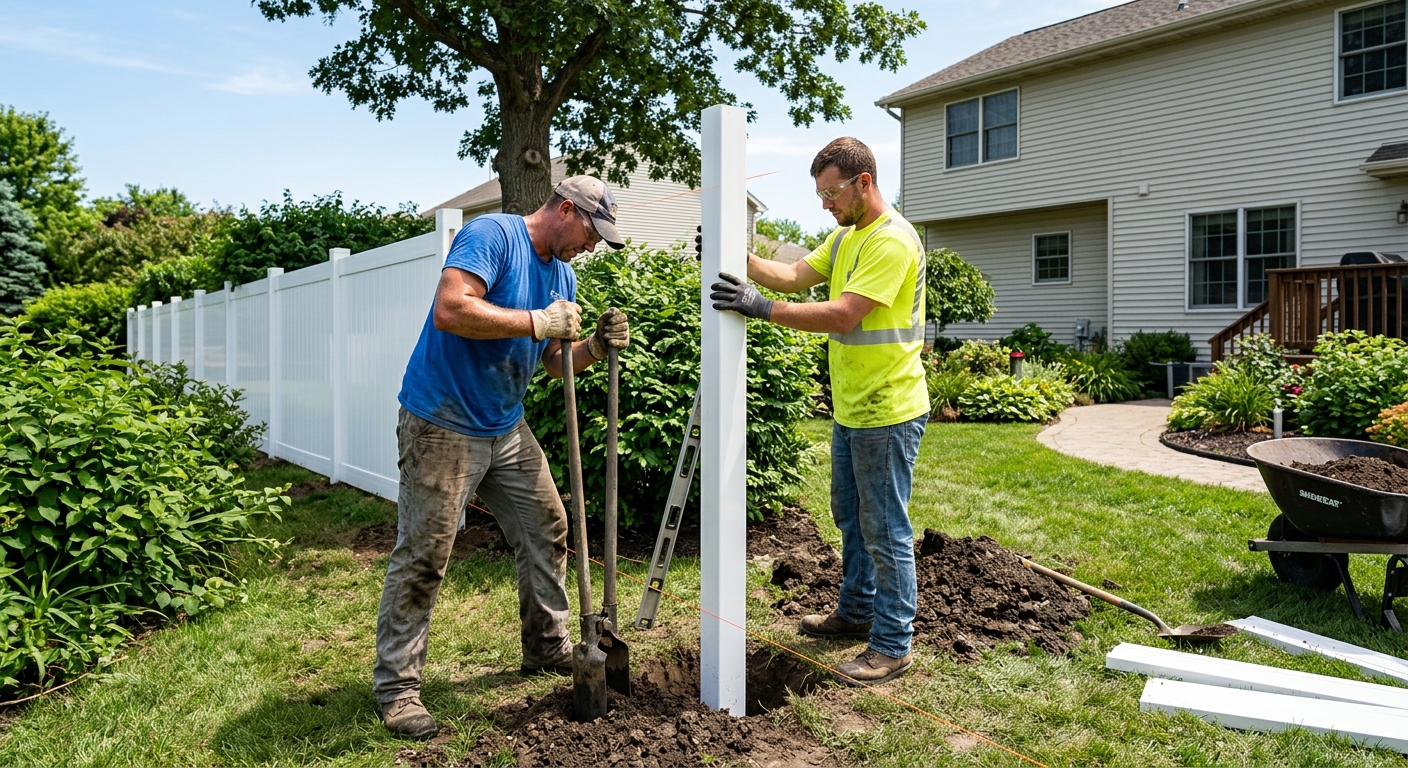
In the Ottawa economic region, Cornwall fencing costs are shaped by winter conditions more than by summer appearances. Frost depth is about 3.5–4 ft, so quality installs generally bury posts near 4 ft and use concrete footings—especially where clay can shift during freeze–thaw. That deeper digging increases labour hours, machine time, and site cleanup/disposal costs, which helps explain why “the same fence” can land at different total prices from one contractor to the next. Wind and snow loading also influence spacing and panel strength; privacy fences can behave like sails when there’s exposure along busy access roads and open lots.
Demand is especially steady around south-end residential pockets such as Brookdale and the surrounding established blocks near the city’s arterial routes, where older fencing is commonly due for replacement. From there, it’s easier to compare options side by side—starting with a clear view of lifespan, upkeep, and typical per-foot pricing in Cornwall.
| Material |
Lifespan |
Maintenance |
Privacy Rating |
Price per Linear Foot |
Price Range |
| Pressure-treated pine (standard wood) |
10–15 years |
Stain/seal every 2–3 years; hardware checks |
High (solid boards) |
$45–$70 |
$40 – $75 |
| Cedar (natural rot resistance) |
15–25 years |
Seal/stain every 2–4 years; periodic fastener check |
High (solid boards) |
$55–$80 |
$55 – $85 |
| Vinyl / PVC (no-maintenance) |
20–30 years |
Minimal wash; inspect posts and brackets |
High (solid styles) |
$50–$75 |
$45 – $80 |
| Chain-link (galvanized steel) |
20–30 years |
Occasional tension/repairs; keep gates aligned |
Low to Medium (privacy slats optional) |
$25–$50 |
$25 – $50 |
| Aluminum ornamental |
25–40 years |
Low; periodic cleaning |
Low (open pickets) |
$80–$115 |
$70 – $120 |
| Composite / recycled material |
25–35 years |
Very low; clean and inspect fasteners |
Medium to High (solid board styles) |
$70–$110 |
$65 – $110 |
Prices are estimates only and vary by project scope, site access and material selection.
What affects the price of fencing in Cornwall
Even when you’re comparing the “same” fence style, Cornwall and the broader Ottawa region can produce quote gaps of 30–50%. The biggest reason is that winter installation requirements change the job structure: deeper post holes, more concrete, and more careful alignment. Another reason is crew efficiency—some contractors move quickly with standard layouts, while others spend more time on locating property lines, staging materials, and dealing with clay that behaves differently across freeze–thaw cycles.
In cold Ontario conditions, frost depth is a direct driver. Ottawa’s regional frost depth is about 3.5–4 ft, so posts typically must be set roughly 4–6 inches below the design frost depth to prevent heaving and leaning. That generally means posts go 1.5–2.0 m into the ground, which requires longer posts, deeper augers, and concrete setting—pushing total labour and machine costs up. By contrast, milder regions sometimes only need 2–3 ft, so the same material package ends up cheaper elsewhere.
Wind and snow exposure add another layer. While we don’t face the open-sky extremes of the Prairies, privacy fences still experience gusty loads and drifting snow impact, so post spacing, hole diameter, and footing size are often “stronger than it looks.” On the cost side, this can mean additional hardware bracing and bigger footings.
Concrete examples from Cornwall: a fence on clay-heavy lots near established neighbourhood streets often costs more because excavation is messier and concrete setting is used more consistently; a short run with easy gate access may come in lower because there’s less labour time per linear foot. Older properties built mostly before 1981 (70.4% of homes in the area were built before then—Statistics Canada, 2021 Census) can also create hidden surprises like buried debris, mature root systems, and older fence tie-ins.
Those practical realities are why wood installation often clusters in the $40–$75 per linear foot band, while vinyl/PVC tends to land in the $45–$80 range, and chain-link usually sits lower (about $25–$50) when no privacy add-ons are requested.
| Price Factor |
Why It Matters |
Cost Impact |
| Fence length in linear feet |
Most costs scale directly with total run length. |
High (+15% to +40% depending on length and access) |
| Post depth required |
Frost line depth determines post length and hole depth. |
High (+20% to +35% vs shallow installs) |
| Post setting method |
Concrete vs gravel pack vs driven posts changes labour and materials. |
Medium to High (+10% to +30%) |
| Material choice |
Vinyl/cedar/chain-link have different hardware, framing, and unit costs. |
Medium (+5% to +35% vs wood) |
| Gate count and type |
Drive-through double gates require more framing and heavier latches. |
Medium (+15% to +60% depending on gate size) |
| Grade and terrain |
Slope needs stepped or raked panels; added layout time. |
Medium (+8% to +25%) |
| Old fence removal and disposal |
Debris, hauling, and disposal costs vary by material and condition. |
Medium (+10% to +25%) |
| Permit fees and survey / property line locate |
Locates prevent encroachment; permits may apply above thresholds. |
Low to Medium (+0% to +20%) |
Permits & regulations in Ontario
In Ontario, fence rules are tied to height limits, property lines, and municipal setback bylaws. As a practical baseline, fences above a height threshold—often around 2.0 m (6.5 ft) at the rear and about 1.0–1.2 m (3–4 ft) at the front or corner—commonly fall into “permit required” territory. Exact requirements can vary by location and lot configuration, so your contractor should confirm what applies to your Cornwall property before digging starts.
Before any post holes are dug, you should ensure utility locates are completed (Ontario One Call). Even if a fencing contractor typically coordinates this, you should still ask to confirm it’s been done and that the locate marks are visible on site. If there’s any chance the existing fence is off the property line—or if you’re replacing an older fence—obtain a survey or at least a property pin locate so you’re not building partly onto a neighbour’s yard.
Shared fence ownership is handled under provincial line-fences legislation, which can affect responsibilities for maintenance and replacement when the fence is on or near a shared boundary.
To verify a contractor: ask for their Ontario licence details (where applicable), a current certificate of insurance showing liability coverage (and WSIB coverage where required), and a WSIB/WCB clearance letter. You can also ask the contractor for a direct link to their insurance documents and check WSIB/WCB status using the account or clearance documentation they provide.
Choosing the right fence material for Cornwall
Choosing a fence in Cornwall is less about what looks best in July and more about what holds up through Ontario winters—frost depth, freeze–thaw movement, wind, and snow load. Because Ottawa’s frost depth is about 3.5–4 ft, posts usually need to be set close to 4 ft to reduce winter heaving and leaning. That makes the post system (depth, concrete setting, and spacing) a major part of overall performance, regardless of what material you select.
Pressure-treated pine is the budget-friendly choice, but it requires staining or sealing every 2–3 years to reduce grey weathering and protect the boards from moisture cycling. Cedar offers better natural rot resistance and a warmer look, but it still benefits from regular sealing to maintain colour and reduce cracking. Vinyl/PVC is popular for low maintenance and clean lines; however, in extreme cold, you still need correct installation practices and proper expansion allowance to avoid panel stress. Chain-link is the longest-life low-cost perimeter option, but privacy is naturally low unless you add slats or switch to a privacy-screen style. Aluminum ornamental gives curb appeal and never rusts like steel, though it’s not a privacy fence by design. Composite/recycled options can be durable and low-maintenance, often with more consistent looks than wood.
Concrete-set posts are typically recommended for Cornwall because deeper frost-related movement is a real issue. For example, if you’re deciding between standard pressure-treated wood and vinyl, the vinyl/PVC option may cost more upfront (commonly in the $45–$80 per linear foot band versus wood at roughly $40–$75). That difference is justified when you want to avoid repeated staining cycles, especially on fences facing long, wind-driven snow exposure and wet clay sites.
| Material |
Cold Tolerance |
Lifespan |
Annual Maintenance |
Best For |
Price Band |
| Pressure-treated pine |
Good (with proper post depth and staining) |
10–15 years |
2–3 year cycle staining + hardware checks |
Lower budget with solid privacy (wood style) |
$40 – $75 |
| Cedar |
Good (stays stable when installed and sealed well) |
15–25 years |
Light sealing/inspection every 2–4 years |
Attractive privacy fence that resists rot |
$45 – $85 |
| Vinyl / PVC |
Very good (correct installation matters in cold snaps) |
20–30 years |
Occasional wash; inspect brackets |
Low-maintenance privacy |
$45 – $80 |
| Chain-link |
Excellent (robust against temperature swings) |
20–30 years |
Minimal; tension and gate alignment |
Security/perimeter with optional privacy slats |
$25 – $50 |
| Aluminum ornamental |
Excellent (no rust) |
25–40 years |
Light cleaning |
Front-yard appearance and long service life |
$70 – $120 |
| Composite / recycled |
Good to very good (material-dependent) |
25–35 years |
Very low; periodic inspection |
Consistent look with reduced upkeep |
$65 – $110 |
How to choose a fencing contractor in Cornwall
When you’re hiring a fencing contractor in Cornwall, verification should be non-negotiable. Start with liability insurance: request a certificate showing current coverage for fencing work and make sure the business name matches the quote and invoice. Next, confirm WSIB/WCB coverage where applicable—ask for a clearance letter or proof document for the specific contractor doing the work. In practice, you can also cross-check that the certificate and clearance information are valid for the dates of the project (not expired PDFs), and that subcontractors aren’t missing coverage.
Then get 2–3 itemised written quotes. You want a breakdown that lists labour, concrete/post setting materials, hardware (hinges/latches), line items for gates, and any exclusions like property locating, disposal, or permit pull costs. Avoid lump-sum quotes that don’t explain how frost-depth post installation will be handled. A well-prepared contractor will also describe post depth, concrete volume/footing approach, and how they will address slope with stepped or raked panels.
Warranty matters too: ask for workmanship warranty length (how long they stand behind alignment, posts, and gate function) and the product/manufacturer warranty for materials like vinyl, aluminum finishes, or composite components. Clarify whether the warranty is transferable to you as the homeowner.
Payment scheduling should be reasonable—typically no more than 10–15% upfront, with a holdback until the job is complete and gate operation, grading, and cleanup are verified. Finally, ask for a start date and completion estimate in writing, including weather-related contingencies for winter access and curing time for concrete.
- Ask how deep posts will be set (frost depth-aware) and whether concrete footings are included.
- Confirm site access plan for digging and material staging (gates, driveway runs, side yard paths).
- Ensure the quote lists gate hardware and gate count explicitly (walk-through vs drive-through).
- Verify disposal/haul-away is included or stated as an exclusion.
- Confirm utility locate responsibility is assigned before digging starts.
- Ask whether property line locating or survey cost is included, excluded, or optional.
- Request a workmanship warranty in writing and what it covers (leaning, gaps, gate sag).
- Ask for a product/manufacturer warranty document for the materials being installed.
- Confirm who pulls any required permits (and whether permit fees are included).
- Check the insurance certificate is current and matches the legal business name on the quote.
- Require WSIB/WCB clearance documentation (where applicable) before work begins.
- Confirm payment schedule: small deposit, holdback at completion, and no “final payment without walkthrough.”
Red flags in Cornwall include: quotes that don’t state post depth or footing method; “permit included” claims without specifying heights/locations; asking for large upfront payments; refusing to provide itemised labour/materials breakdown; and starting excavation before utility locates are confirmed.
Frequently asked questions — fencing in Cornwall
How do I compare fencing quotes?
Start by comparing apples to apples: same fence style, same height, same post setting method, and same gate hardware. Ask each contractor to provide an itemised quote showing labour, materials, and key inclusions like concrete footings (important in Cornwall’s frost conditions). In the Ottawa region, quotes can differ because good installs typically bury posts close to the ~3.5–4 ft frost depth; contractors who use different post depth assumptions often end up cheaper at first but cost more long-term. Also compare whether disposal/haul-away is included, whether property line locating or permit pulls are included, and what’s excluded. A practical benchmark is that chain-link commonly lands around the $25–$50 per linear foot band, while wood and vinyl/PVC typically sit closer to $40–$75 and $45–$80 respectively (depending on style and materials).
How long does fence installation take in Cornwall?
Most residential fencing in Cornwall takes anywhere from a day or two for short line segments to several days for longer runs with multiple gates. The schedule is driven by post installation time (digging to frost-depth depth), concrete setting/curing, and alignment work—especially on clay or sloped yards. If you’re replacing an old fence, demo and disposal can add time because the crew must remove materials and clear the work zone before new posts are set. Weather also matters: crews often pause when ground is too frozen to excavate safely, and concrete setting needs appropriate curing conditions. To plan properly, ask for a start date and a written completion estimate that includes contingencies, rather than a “best case” date.
Can I install a fence on a slope in Cornwall?
Yes, but the installation method matters. On sloped lots in Cornwall, you typically use stepped panels (common for more gradual changes) or raked panels (for smoother grade transitions). A good contractor will lay out the grade line before digging so the fence stays level in appearance and posts are set to an appropriate depth at each point. This is especially important with Ottawa-area frost conditions because uneven post depth can lead to leaning or gaps over time. In quotes, ask whether the contractor includes extra labour for layout and material cutting and whether panel height will change with grade or remain consistent using a step arrangement. Itemised quotes should reflect the added work—often without changing the per-foot rate too dramatically.
What is the most weather-resistant fence for Cornwall's climate?
“Most weather-resistant” usually comes down to the combination of correct post depth, solid footing, and the right material. In Cornwall’s winter freeze–thaw environment, a fence with posts set close to frost depth (around 4 ft in the Ottawa region) and concrete footings generally performs better long-term. Material-wise, vinyl/PVC and aluminum are strong options because they resist rot and rust, respectively. Chain-link also performs well under harsh cold because it doesn’t rot, though it doesn’t provide privacy by itself. Pressure-treated pine can last well if you maintain it (stain/seal on a regular cycle), while cedar is rot-resistant but still benefits from maintenance. If you want a single practical target, vinyl/PVC often balances cold durability with low upkeep, commonly within the $45–$80 per linear foot band.
How do I prevent wood fence rot in Cornwall?
Wood rot prevention is mostly about limiting moisture contact and keeping the structure stable through winter movement. Start with proper post installation: posts must be set at frost-aware depth to reduce heaving/leaning, because movement opens gaps and accelerates moisture intrusion. For horizontal rails and board ends, ensure they’re installed with correct spacing so water can drain rather than pool. Use pressure-treated lumber for treated components and consider cedar where appearance matters—then commit to maintenance. In Cornwall, plan to stain or seal pressure-treated pine every 2–3 years to slow down grey weathering and moisture cycling. Even cedar usually needs periodic sealing to prevent cracking and surface breakdown. Finally, confirm hardware is corrosion-resistant, and ask whether the contractor uses the right fasteners for exterior conditions.
What is the cost per linear foot for fencing in Cornwall?
Typical installed residential ranges in the Ottawa economic region (which Cornwall follows closely due to similar frost and winter exposure) are: pressure-treated wood about $40–$75 per linear foot, vinyl/PVC about $45–$80, chain-link about $25–$50, and aluminum/metal about $70–$120. Your actual total will depend on run length, fence height, gate count, post depth/footing method for frost protection, material grade, site access, and whether old fence removal and disposal are included. Because Cornwall homes skew older (many built before 1981—70.4%—Statistics Canada, 2021 Census), older fence replacements sometimes require extra prep for debris or roots, which can move your price within a band. The best way to confirm your number is an itemised quote that matches your scope line by line.