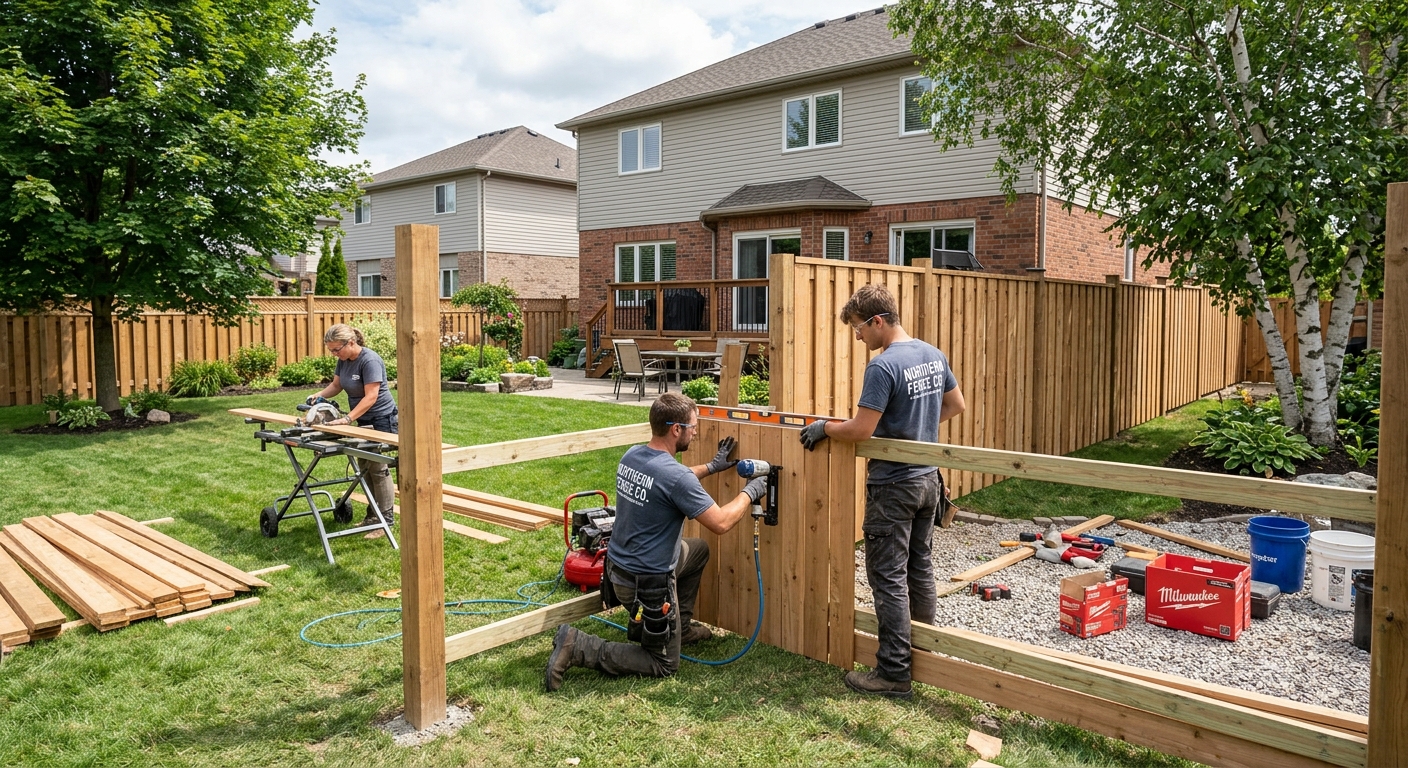
Fencing options and costs in Port Perry
Port Perry has a small-town feel, but the fencing business is very much shaped by the broader Toronto economic region. With a population of 9,553 (Statistics Canada, 2021 Census), demand is steady rather than explosive—most jobs come from routine property upkeep and backyard upgrades. In practical terms, Port Perry’s housing stock includes a lot of individual properties where homeowners treat the yard line as a long-term boundary, so choosing the right material and installing posts correctly matters. In the Toronto area, the common “rule of thumb” frost-line planning (about 42"–48" in Southern Ontario) means privacy fences are rarely installed with simple driven posts; they’re usually concrete-set to reduce frost heave and racking.
That installation reality—longer posts, deeper holes, and more labour—helps explain why pricing can land at the higher end of the provincial bands, even when the fence length is “average.” It also affects contractor availability: crews focus on post-footing accuracy because a fence that shifts a few inches after freeze/thaw cycles tends to cost more to fix than to build right the first time. Around town, I often see particular demand in the established residential pockets near historic downtown Port Perry, where many lots back onto green space and people want consistent privacy along the back property line.
Below are typical installed cost ranges and performance expectations to help you compare options before you request itemised quotes.
| Material |
Lifespan |
Maintenance |
Privacy Rating |
Price per Linear Foot |
| Pressure-treated pine (standard wood) |
10–15 years |
Stain/seal every 2–3 years |
Good (solid panels) |
$65–$120 |
| Cedar (natural rot resistance) |
15–25 years |
Light stain/seal every 3–4 years |
Excellent (solid panels) |
$85–$140 |
| Vinyl / PVC (no-maintenance) |
20–30 years |
Rinse as needed (rare repairs) |
Excellent (solid pickets) |
$75–$130 |
| Chain-link (galvanized steel) |
25–40 years |
Occasional tension/hardware checks |
Low (visual permeability) |
$45–$85 |
| Aluminum ornamental |
25–40 years |
Wash every 1–2 years |
Low to Fair (semi-open) |
$90–$160 |
| Composite / recycled material |
20–30 years |
Minimal; inspect hardware annually |
Good (solid styles available) |
$95–$170 |
Prices are estimates only and vary by project scope, site access and material selection.
What affects the price of fencing in Port Perry
In the Toronto region, two homeowners can receive quotes that differ by 30–50% for what looks like the same “6 ft privacy fence,” and the reason is almost always hidden in the ground work. Frost-line planning drives how deep posts must be set. In cold Ontario conditions, contractors typically set posts about 1.5–2.0 m into the ground (roughly 4–6 inches below the design frost depth), and that means longer posts, deeper auger time, more concrete, and extra bracing. Those labour and material inputs push costs toward the upper end of wood ($65–$120) and vinyl/PVC ($75–$130) bands—especially on solid panel designs where racking forces are higher.
Wind also matters even though we don’t see the extreme open-field exposure of the Prairies. If your property is more exposed—open corners, end lots, or areas with less shielding—post spacing (often 6–8 ft centres) and post size get upgraded to reduce sway. Coastal BC is more about moisture-driven rot, but here in Ontario the issue is freeze/thaw and uplift; you still want proper hardware and correct post setting, not shortcuts.
In Port Perry, I frequently see cost differences from three local examples. Example one: a back fence on clay-heavy soils usually needs more concrete-set posts and careful alignment, which raises labour. Example two: steep or uneven grades often require step methods or racked panels, increasing material cuts and installation time. Example three: when removal is required, disposal and hauling can add meaningfully to total cost versus a “new build” replacement with minimal demolition.
That’s why your quote should tell you what’s happening underground and at the posts—not just the board height. Next, we’ll break down the biggest price factors that show up in itemised estimates.
| Price Factor |
Why It Matters |
Cost Impact |
| Fence length in linear feet |
Most materials and labour scale directly with length. |
High |
| Post depth required |
Frost line determines post length and hole depth for freeze/thaw stability. |
High |
| Post setting method |
Concrete-set posts reduce heaving risk versus simple driven posts. |
Medium to High |
| Material choice |
Vinyl/PVC and cedar cost more than chain-link; aluminum varies by style. |
Medium to High |
| Gate count and type |
Double gates and walk-through gates require heavier framing and hardware. |
Medium |
| Grade and terrain |
Slopes require stepping/racking and extra labour for straight sight lines. |
Medium |
| Old fence removal and disposal |
Demolition, haul-away, and any salvage credits change the budget. |
Medium |
| Permit fees and survey / property line locate |
Needed for compliance and to avoid encroachment disputes. |
Low to Medium |
Permits & regulations in Ontario
In Ontario, fences can trigger permit requirements depending on height and location. As a general rule of thumb, fences above about 2.0 m (6.5 ft) along the rear and above roughly 1.0–1.2 m (3–4 ft) near the front or corners often require a building permit. Your municipal rules may also restrict fence placement by setback and how close it can be to a lot line, driveway, or corner sight triangle.
Before digging post holes, you should always call for utility locates (Ontario One Call). Hitting buried services is not just dangerous—it can halt work and create major costs. Also, confirm your boundary using a survey or property line locate (especially if previous fences were installed “off” the pins). Shared-fence expectations in Ontario follow provincial line-fences principles; if you’re building or replacing a fence that neighbours share or are affected by, it’s smart to communicate early and document agreements.
Licence and insurance checks should be part of your homeowner process in Port Perry. Ask your contractor for: (1) proof of Ontario licence eligibility for the work they’re doing (and their business details), (2) a current certificate of insurance showing liability coverage, and (3) proof they have coverage aligned with employment requirements (WSIB/WCB). How to verify: review the certificate of insurance for policy limits and effective dates, check the contractor’s business information online through the relevant Ontario business/registry listings where applicable, and confirm their clearance/coverage status if they provide it.
Choosing the right fence material for Port Perry
Picking fence material in Port Perry is really about matching your priorities—privacy, maintenance level, lifespan, and budget—to the climate realities of Southern Ontario. Pressure-treated pine is usually the lowest upfront option, but it needs staining or sealing every 2–3 years to prevent grey weathering and to slow surface cracking. Cedar costs more, yet it’s popular because it naturally resists rot and tends to look better for longer. Vinyl/PVC is the low-maintenance choice (wash and move on), but in extreme cold it can become brittle if products are underspecified or installed with poor thermal allowances. Chain-link offers the best value and longest service life at the lowest privacy level; aluminum ornamental looks sharp and won’t rust, but it’s also semi-open and works better for definition than privacy.
For any solid privacy fence, Toronto-area frost-line planning matters. That typically means concrete-set posts and a deeper hole than many homeowners assume—so the real decision isn’t only “wood vs vinyl,” it’s whether your contractor is building for freeze/thaw stability with appropriate post depth and spacing. Wind loads are moderate here, but taller solid panels still need sturdy posts and good bracing, especially on exposed corners and end lots. Snow also adds impact risk; properly installed rails and hardware reduce racking during freeze/thaw and after heavy weather.
As a simple dollar example, if you’re comparing a wood privacy option at roughly the $65–$120 per linear foot band versus vinyl at about $75–$130, vinyl’s higher material cost can make sense when you value fewer maintenance trips over a 15–25 year horizon—especially if you don’t want recurring staining on pine. Next, use the comparison table to align your priorities with the material that best fits.
| Material |
Cold Tolerance |
Lifespan |
Annual Maintenance |
Best For |
Price Band |
| Pressure-treated pine |
Good if properly sealed and post-set correctly |
10–15 years |
Inspect for fastener loosening; stain/seal every 2–3 years |
Budget-friendly privacy with periodic upkeep |
$65–$120 |
| Cedar |
Good; durable against rot with correct installation |
15–25 years |
Light seal/stain every 3–4 years |
Natural look and better rot resistance |
$85–$140 |
| Vinyl / PVC |
Very good with quality product and correct installation |
20–30 years |
Minimal; rinse and check posts/hardware annually |
Low maintenance privacy |
$75–$130 |
| Chain-link |
Excellent; galvanized hardware holds up in cold cycles |
25–40 years |
Occasional tension/hardware checks |
Security and pet containment |
$45–$85 |
| Aluminum ornamental |
Excellent; won’t rust |
25–40 years |
Wash and inspect annually |
Street appeal with visibility |
$90–$160 |
| Composite / recycled |
Good; depends on product quality and fastening |
20–30 years |
Minimal; inspect hardware and panel alignment |
Solid look with reduced upkeep |
$95–$170 |
How to choose a fencing contractor in Port Perry
Choosing a fencing contractor in Port Perry starts with verification, not just a price. In Ontario, reputable fence installers can show proof of their business information, liability insurance, and the coverage status relevant to workers (WSIB/WCB). How to check each: (1) request a current certificate of insurance and confirm it lists you as the certificate holder where offered, includes liability limits appropriate for construction work, and has an active policy date; (2) ask for their insurance “original” certificate wording and expiry date so you know it isn’t expired at the start of your project; and (3) confirm their WSIB/WCB status (or clearance details) before they begin so you’re not left holding the bag if a worker is injured.
Next, insist on 2–3 itemised written quotes with a materials-and-labour breakdown, not just a lump sum. Make sure the quote clarifies what’s included: post depth and setting method, rail count, gate hardware, fasteners, disposal, and whether permits are included or billed separately. A solid workmanship warranty (commonly expressed in years) should be clearly stated, and you should also know the product/manufacturer warranty terms—plus whether it’s transferable to you as the homeowner.
For payment schedule, never pay more than about 10–15% upfront. Use a holdback until the fence is complete and accepted. Also, get your start date and completion estimate in writing to avoid schedule drift during freeze/thaw and storm periods.
- Confirm insurance certificate validity (active dates + liability limits)
- Confirm WSIB/WCB coverage status or clearance details before work starts
- Ask for Ontario business details and years in the trade
- Require itemised quotes: labour, posts/rails, panels/pickets, concrete, gates, and hardware
- Check that post depth and setting method are written (concrete-set in most privacy builds)
- Verify how they handle slopes: stepped vs raked sections
- Confirm whether demolition and disposal are included or extra
- Ask how they will protect lawns during excavation and concrete work
- Review warranty length for workmanship and product; ask if it’s transferable
- Ensure the quote states the total gate count and type (walk-through vs double)
- Use a contract timeline with a written start/completion window
- Keep payment tied to milestones; limit upfront to 10–15%
Red flags in Port Perry include contractors who: refuse to provide proof of insurance or WSIB/WCB status; quote “driven posts only” for tall solid fences without discussing frost-depth planning; provide only lump-sum pricing with no post-depth or setting details; ask for large upfront payments (well beyond 10–15%); or won’t include disposal/haul-away language in writing.
Frequently asked questions — fencing in Port Perry
How do I prevent wood fence rot in Port Perry?
To prevent wood rot in Port Perry, focus on the details that fight moisture and freeze/thaw. First, make sure posts are set correctly—Southern Ontario’s frost-line planning means most tall privacy fences are concrete-set to reduce heaving that can trap water at the base. Second, use proper pressure-treated lumber (or cedar if you prefer a more rot-resistant option) and ensure the bottom edges and cut ends are treated where required. Third, keep vegetation trimmed back so airflow reaches the boards after rain and snow melt. Finally, plan for maintenance: pine typically needs staining/sealing every 2–3 years to slow grey weathering and moisture penetration. If your quote is targeting the wood band (often roughly $65–$120 per linear foot), confirm it includes post setting and hardware quality—those choices are what determine whether rot shows up early or not.
What is the cost per linear foot for fencing in Port Perry?
In Port Perry, fencing pricing typically follows the Toronto-region installed bands because of similar labour rates, material availability, and frost-depth post installation practices. As a baseline, chain-link often lands around $45–$85 per linear foot, aluminum ornamental around $90–$160, wood privacy around $65–$120, and vinyl/PVC around $75–$130. Your exact per-linear-foot cost depends heavily on whether the design is solid privacy (usually needing stronger posts and closer spacing), how many gates you have, and how difficult the access is (plus whether old fence removal and disposal are included). If the job requires concrete-set posts due to frost stability, that increases labour and concrete, but it reduces long-term movement. For an accurate number, ask for itemised quotes showing labour, posts/setting method, and concrete quantities.
Should I repair or replace my old fence in Port Perry?
It’s usually worth repairing when the fence line is structurally sound—meaning posts are stable (no visible lean), rails aren’t rotted through, and damage is limited to a few boards or sections. Replace instead when you see widespread post rot at the ground line, repeated sagging after freeze/thaw, or multiple sections that have shifted out of alignment—those signs often mean the underlying post setting or drainage isn’t holding up. In Port Perry and the wider GTA, frost heave can make a “half repair” fail: if posts have moved, new boards don’t fix the underlying problem. A cedar replacement may cost more upfront, but it can reduce rot risk versus untreated wood. If you’re comparing budgets, understand the likely band difference (wood roughly $65–$120 per linear foot vs vinyl/PVC roughly $75–$130). A contractor should assess the posts first—rails and pickets alone can be misleading.
How do I handle a fence dispute with a neighbour in Ontario?
Fence disputes in Ontario are most often about boundaries and responsibilities. Start with facts: locate your property pins (or obtain a survey if you don’t have one) so you can confirm the fence line. Ontario also has shared fence concepts under provincial line-fences rules, so if the fence affects a neighbour’s property use, you should communicate clearly about what you’re building or repairing and why. Keep everything in writing: screenshots of messages, photos of existing conditions, and a copy of the contractor estimate. If you’re planning work, also ensure utility locates are done before digging, and confirm permits if you’re building a fence above the typical threshold (commonly 2.0 m at the rear and lower at the front/corners). If the dispute can’t be resolved informally, consider mediation or legal advice rather than arguing on-site—fencing work can be expensive to redo.
What fence style offers the best wind resistance in Port Perry?
For best wind resistance in Port Perry, you want a style that reduces racking and uplift while still matching your privacy goal. Solid privacy fences can catch wind like a sail if they’re not engineered with adequate post size, proper spacing, and strong bracing. In most cases, that means robust posts set deep enough for Southern Ontario frost stability (often concrete-set), good rail connection, and panel alignment. If you’re in a more exposed area (end lots, open corners, or lines with fewer natural windbreaks), tighter post spacing (commonly 6–8 ft centres) and heavier framing make a noticeable difference. Chain-link is naturally more wind-permeable and can resist uplift better, but you sacrifice privacy. Vinyl and wood solid panels can perform well when installed with the right hardware and post depth; aluminum ornamental resists rust and has good framing strength but is more open. Your contractor should show how they’re designing against wind loads, not just measuring height.
How much does a fence cost in Port Perry?
The total cost in Port Perry usually comes down to fence length, height, material, gate count, and how deep posts must be set for frost stability. For example, a wood privacy fence often falls within the $65–$120 per linear foot band, while vinyl/PVC privacy is commonly around $75–$130 per linear foot. If you choose chain-link for security, it’s often about $45–$85 per linear foot, while aluminum ornamental frequently lands around $90–$160 per linear foot. Your project may end up higher or lower based on site conditions: sloped yards can require stepped/raked panel work, and old fence removal plus disposal adds time and hauling. Also, if your fence is above typical permit thresholds (commonly around 2.0 m at the rear, with lower heights at the front/corners), permit and survey/locate steps can affect the overall budget. The best approach is an itemised quote that clearly states post depth, setting method, and what’s included.