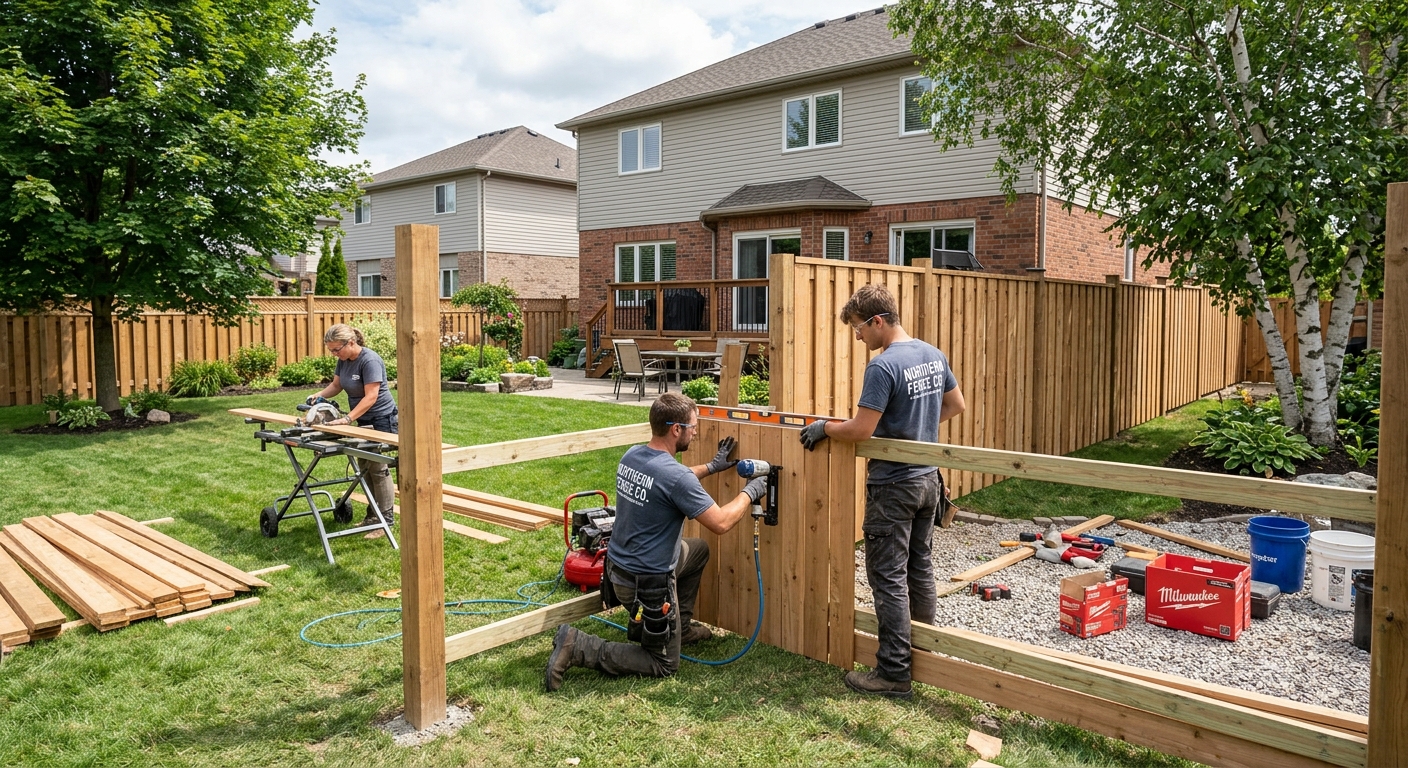
Fencing options and costs in Nepean
In Nepean, your fence choice is as much about Ontario winters as it is about style. With a population of about 180,000 residents (Statistics Canada, 2021 Census), Nepean has steady demand for residential fencing—especially around established neighbourhoods where many properties have mature lots and visible boundaries. In practice, every detached home represents a likely fencing decision point, and those decisions often cluster in the same seasons when digging is manageable and materials are readily available. For many homeowners, a fence is also a long-term privacy upgrade, which means the installation details matter just as much as the material.
Ottawa-area pricing is shaped by frost depth and soil movement. In the Ottawa economic region, contractors commonly set posts close to 4 ft to reduce winter heave and leaning. That deeper digging (often with concrete footings, particularly in clay soils) increases labour hours, equipment time, and disposal costs versus milder parts of Canada. Wind loading also plays a role: even when Nepean lots aren’t directly exposed like open farmland, privacy fences still need appropriate post spacing and panel strength for drifting snow and gusts.
If you’re comparing quotes, it helps to start with the material bands. In Nepean, trade activity is especially noticeable in areas like Barrhaven, where many family lots and backyard renovations drive regular installations. From there, you can use the table below to benchmark a realistic, installed per-linear-foot expectation before your site measurements refine the final number.
| Material |
Lifespan |
Maintenance |
Privacy Rating |
Price per Linear Foot |
| Pressure-treated pine (standard wood) |
15–20 years |
Stain/paint every 2–3 years to prevent grey weathering and checking |
8/10 (with solid boards) |
$40 – $65 |
| Cedar (natural rot resistance) |
20–30 years |
Plan on re-staining every 2–4 years; inspect for end-grain wear |
9/10 (solid cedar) |
$55 – $75 |
| Vinyl / PVC (no-maintenance) |
25–30 years |
Wash as needed; check fittings after extreme freeze–thaw |
8/10 (solid privacy styles) |
$50 – $80 |
| Chain-link (galvanized steel) |
20–35 years |
Minimal; periodic tightening and vegetation trimming |
3/10 (privacy needs slats or mesh) |
$25 – $45 |
| Aluminum ornamental |
25–40 years |
Occasional cleaning; touch-up only if damaged |
4/10 (typically semi-privacy) |
$70 – $120 |
| Composite / recycled material |
25–35 years |
Low; rinse and inspect for surface wear |
8/10 (solid boards) |
$60 – $95 |
Prices are estimates only and vary by project scope, site access and material selection.
What affects the price of fencing in Nepean
If you get three quotes for what sounds like the “same fence,” you can absolutely see a 30–50% swing across Ottawa and Ontario. The difference is rarely just the material—it’s how deep posts are set, what footing method is included, how many gates you need, how yard grade is handled, and what the contractor includes for disposal and line locating. In Nepean, many homeowners also renovate in phases, which can change access and staging time for crews and equipment.
Start with frost depth. Ottawa’s frost depth is roughly 3.5–4 ft, and contractors typically bury posts about 4–6 inches below the design frost line to reduce heaving. In practical terms, that often means posts going about 1.5–2.0 m into the ground, with longer posts and more labour-intensive holes. When you add concrete setting (commonly required for stability in clay soils that shift during freeze–thaw), you get higher labour, concrete, and waste/disposal costs. That’s one reason Nepean wood installs often land nearer the $40–$75 per linear foot Ontario band, while faster installs with lighter footing methods can land closer to the low end.
Next is exposure. While the Prairies are windier, Nepean still sees gusts and drifting snow loads. That can affect post spacing, bracing, and the rigidity of privacy panels—especially on longer runs without interruption. Coastal BC is milder but wetter, which changes wood rot risk; here, the freeze–thaw cycle is the bigger driver of footing cost and whether panels stay plumb.
Two typical Nepean examples that change your total: (1) A clay backyard near schools or parks often requires concrete footings to keep posts stable—adding labour and concrete compared with gravel pack-only bases. (2) A property with a sloped grade may need stepped panels or raked rails, increasing framing time; on a 40 ft run, that extra carpentry can push the job toward the higher end of the $55–$80 vinyl range. If you’re comparing wood versus chain-link, chain-link may start near $25–$50 per linear foot, but the price gap narrows once you add privacy slats and the same deep post setting.
| Price Factor |
Why It Matters |
Cost Impact |
| Fence length in linear feet |
Materials and labour scale directly with each measured foot |
Major (often the biggest driver) |
| Post depth required |
Frost line dictates hole depth, post length, and footing volume |
Major in Nepean (deeper digging, more concrete) |
| Post setting method |
Concrete vs. gravel pack vs. driven posts changes stability and labour |
Medium to major depending on soil and design |
| Material choice |
Different systems have different components, rail types, and install time |
Medium (vinyl/cedar/aluminum typically higher) |
| Gate count and type |
Double-drive gates and wide openings require stronger hardware and framing |
High (gates can add substantial labour and cost) |
| Grade and terrain |
Slopes require stepped sections or racked rails |
Medium (more cutting, measuring, and alignment time) |
| Old fence removal and disposal |
Hauling and demolition add time and dump/disposal fees |
Medium (varies with condition and access) |
| Permit fees and survey / property line locate |
Some heights/locations require permits; surveys prevent boundary disputes |
Low to medium, but can become high if issues arise |
Permits & regulations in Ontario
In Ontario, fence rules generally come down to location, height, and property-line compliance. For many residential properties in Nepean, fences above a height threshold—commonly around 2.0 m (6.5 ft) at the rear and about 1.0–1.2 m (3–4 ft) along the front or corner—often require a building permit. Municipal setback requirements and property-line placement bylaws still apply even if the height is under a threshold. The safest approach is to confirm your exact fence location (front corner visibility lines are often where homeowners run into trouble) before a contractor schedules post holes.
Before you dig any post hole, call for utility locates through Ontario One Call. That protects you and the contractor from underground services and allows the installer to adjust layouts if needed. Also, obtain a survey or at least a property pin locate before installing; it’s the difference between “our fence is close” and a dispute that turns into rework and possible removal.
Shared fence ownership is handled through Ontario’s line-fences framework, but the practical takeaway for homeowners is simple: confirm who owns which portion, and document any agreement about boundaries and ongoing maintenance.
Verification steps before signing: ask for the contractor’s Ontario business/contractor licensing details (when applicable), their certificate of liability insurance, and their WSIB/WCB coverage confirmation for workers. Look for (1) proof of clearance or account standing, (2) named insured details matching the company quote, and (3) coverage dates that remain valid through the scheduled build. A credible contractor can provide copies to you in writing and will usually include permit pull responsibility clearly in the contract scope.
Choosing the right fence material for Nepean
Choosing the right fence material in Nepean is mostly matching your priorities to how Ottawa’s freeze–thaw cycle behaves. Pressure-treated pine is the budget-friendly route, but it still needs maintenance—typically staining or sealing every 2–3 years—to reduce grey weathering and surface checking. Cedar looks great and naturally resists rot better than many treated softwoods, but it still benefits from periodic staining and end-grain attention. Vinyl/PVC is popular for low upkeep, yet in extreme cold it can become more brittle; quality systems handle it better, but installation quality (especially post alignment and correct hardware) is still key.
For privacy, you’ll often want solid board layouts, and those must be braced and set correctly for snow and gusty conditions. Because Ottawa’s frost depth is about 3.5–4 ft, posts usually need to be buried close to 4 ft to reduce heave. That means concrete-set posts are often the stability choice, particularly in clay areas where freeze–thaw shifts ground movement. If a contractor proposes short posts or skipping proper footings, you’ll likely pay later in leaning panels.
Where the price difference is justified: consider a typical privacy run. If pressure-treated pine installs around the $40–$65 per linear foot band, cedar often lands closer to $55–$75 due to material and labour. On a 50 ft run, that can be a difference of roughly $750–$1,000 installed—often worth it when you want better appearance and longer service life without upgrading to a premium system like aluminum.
Chain-link has the lowest baseline cost and very long life, but it won’t provide privacy unless you add slats or mesh (which becomes an added-material and often a post/rail loading consideration). Aluminum ornamental is attractive and maintenance-light; it’s mid-to-higher cost and best when you want security and visibility rather than full privacy.
| Material |
Cold Tolerance |
Lifespan |
Annual Maintenance |
Best For |
Price Band |
| Pressure-treated pine |
Good with proper post depth and sealing |
15–20 years |
Low to moderate (re-stain/inspect every 2–3 years) |
Budget privacy with a solid maintenance plan |
$40 – $65 |
| Cedar |
Good; handles cold well when properly finished |
20–30 years |
Low to moderate (stain/inspect every 2–4 years) |
Premium look and better rot resistance |
$55 – $75 |
| Vinyl / PVC |
Good when installed with correct hardware and alignment |
25–30 years |
Very low (wash and visual checks) |
Low-maintenance privacy |
$50 – $80 |
| Chain-link |
Excellent (metal tolerates cold well) |
20–35 years |
Very low (tighten/trim as needed) |
Security on a budget |
$25 – $45 |
| Aluminum ornamental |
Excellent (powder-coated metal) |
25–40 years |
Very low (cleaning if needed) |
Security with curb appeal, not full privacy |
$70 – $120 |
| Composite / recycled |
Good; performs best when supported and installed square |
25–35 years |
Low (rinse and inspect surface wear) |
Long-life privacy without frequent staining |
$60 – $95 |
How to choose a fencing contractor in Nepean
Choosing the right fencing contractor in Nepean starts with proof, not promises. In Ontario, verify three things: liability insurance, WSIB/WCB coverage for workers, and (where applicable) business licensing/registration details. To check insurance, ask for a current certificate of insurance naming your contractor as the insured, with coverage that remains valid through your planned start date. For WSIB/WCB, request clearance/account confirmation or coverage documentation—then confirm the company name on the document matches the quote and the invoice. If they can’t produce this, treat it as a serious risk.
Next, request 2–3 itemised written quotes. “Itemised” means you can see labour + materials breakdowns, and you understand what’s included for posts, rails, fasteners, gate hardware, and any special footing requirements. Make sure the scope clarifies exclusions such as permit pull, locate costs, and excavation in difficult access points. Also confirm whether old fence removal and disposal are included, and whether stump/grub work is part of the excavation or handled separately.
Warranty matters in a different way for fences: insist on a workmanship warranty length for installation (not only product components), and ask whether it transfers if you sell the home. For payment, never pay more than 10–15% upfront; hold a balance until the job is complete and any punch-list items are fixed. Finally, get the start date and an estimated completion window in writing, including a weather-related contingency note—especially important in Ottawa winters where digging schedules can shift.
- Confirm certificate of insurance (liability) is current and matches the contracting company.
- Verify WSIB/WCB clearance/coverage for all workers, not just subcontractors.
- Ask for proof of past installs in similar soil conditions (especially clay or heavy freeze–thaw areas).
- Require measured drawings showing linear footage, gate sizes, and post spacing.
- Ensure quotes state post depth approach (frost-line strategy) and footing method.
- Get an itemised labour/materials list—no “lump sum” only.
- Clarify permit responsibility: who pulls it, who pays, and what’s needed from you.
- Confirm utility locate responsibility (usually contractor scheduling after your call).
- Ask whether property line locate/survey is included or recommended if pins are unclear.
- Include disposal/hauling details for old fence materials and excavation spoil.
- Review warranty terms for both workmanship and products; request transferability wording.
- Use a payment schedule with 10–15% maximum deposit and holdback until final inspection.
Red flags I see in Nepean include: contractors refusing to show insurance/WSIB documents, quoting without discussing frost-depth post depth, inconsistent gate hardware specs (especially for double-drive gates), and “quick install” claims that omit concrete setting in clay or skip soil-appropriate footing. If the proposal doesn’t clearly list exclusions and disposal, you’re likely heading toward change orders.
Frequently asked questions — fencing in Nepean
What fence style offers the best wind resistance in Nepean?
In Nepean and the broader Ottawa area, wind resistance is mainly about how rigid the frame is and how well the fence resists racking. Solid privacy fences with correct bracing and proper post spacing typically handle gusts better than lightweight open styles—provided the posts are set below the local frost line (commonly close to 4 ft) and the footing matches your soil. If your backyard has open exposure to wind or drifting snow, ask about stronger rail connections, closer post spacing, and hardware that won’t loosen during freeze–thaw cycles. While aluminum ornamental can resist corrosion, very open picket patterns can act like sails unless they’re designed with adequate stiffness.
How much does a fence cost in Nepean?
Installed fence costs in Nepean usually land inside the Ontario residential price bands depending on material and how much site work is required. As a baseline, wood privacy installs often come in around $40 – $75 per linear foot, while vinyl/PVC is commonly closer to $45 – $80. Chain-link is often the lowest starting point at roughly $25 – $50, and aluminum ornamental typically ranges about $70 – $120. Your final number can shift based on post depth strategy (frost-line setting), soil type, gate count, and whether old fencing needs removal and disposal.
How deep should fence posts be for Nepean's frost?
Nepean homeowners should plan for post depths based on the Ottawa economic region frost depth of about 3.5–4 ft. In practice, contractors typically bury posts about 4–6 inches below the design frost depth to help prevent heaving and winter leaning—often meaning posts going close to 4 ft into the ground. That can translate to roughly 1.5–2.0 m depending on the material and grade. For clay soils that shift through freeze–thaw cycles, concrete footings are commonly used for stability. Always match post depth to your site conditions and the contractor’s frost-depth plan; shortcuts here are one of the most common causes of early fence failure.
Wood vs vinyl vs aluminum fence — which is best?
The “best” choice depends on what you value most in Ontario winters: maintenance, appearance, and privacy. Wood (pressure-treated pine) offers a strong budget option, often aligning with the $40 – $75 per linear foot range, but it needs staining or sealing every 2–3 years to prevent weathering. Cedar costs more, yet often brings better rot resistance and a longer service life. Vinyl/PVC is appealing for low maintenance and commonly sits near $45 – $80; it stays clean with simple wash-downs, but quality installation matters in cold snaps. Aluminum is durable and maintenance-light, but it typically provides less privacy (more visibility), and pricing often matches the $70 – $120 band.
Do I need a permit to build a fence in Ontario?
In Ontario, many fences require a building permit once they exceed common height thresholds, especially around the rear (often about 2.0 m or 6.5 ft) and near front/corner areas (often 1.0–1.2 m or 3–4 ft). Nepean homeowners should also follow property-line placement and municipal setback requirements. Before digging, you must call for utility locates through Ontario One Call. It’s also wise to use a survey or property pins to avoid encroachment—fence disputes are expensive and often lead to rework. A solid contractor will tell you whether your specific fence height/location is likely permit-relevant and whether permit pulling is included in the quote.
How long does a wood fence last in Nepean?
With correct installation—especially correct post depth for Ottawa frost and stable footings—a wood fence in Nepean commonly lasts about 15–20 years for pressure-treated pine, and 20–30 years for cedar. The biggest early-life risk isn’t just the wood type; it’s the freeze–thaw behaviour when posts are too shallow or footing methods don’t match local soil. Maintenance strongly affects real lifespan: staining/sealing every 2–3 years for pressure-treated pine helps reduce grey weathering and checking, while cedar should be inspected and stained on a similar cycle (often every 2–4 years). If you want maximum longevity, make sure your contractor addresses drainage, post depth, and hardware corrosion too.