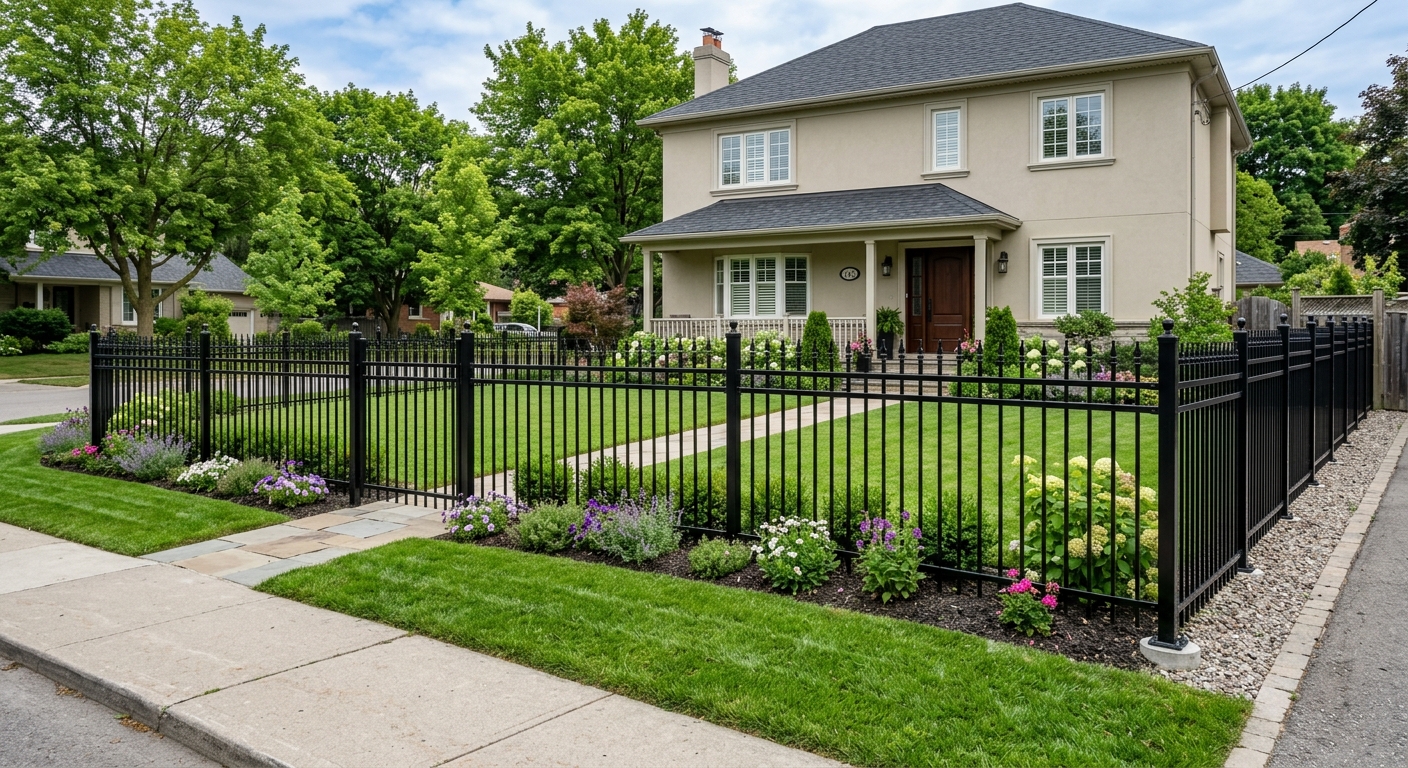
Fencing options and costs in Huntsville
Huntsville homeowners typically have a clear starting point for fencing decisions because the city’s housing mix creates strong, year-round demand for backyards and side lot boundaries. With 79.9% of dwellings being single-detached houses (Statistics Canada, 2021 Census), many properties are planned around private yard space, walkouts, and driveway gates—exactly where fences get installed or replaced. Homeownership is also high, with 80.4% of households owning their homes (Statistics Canada, 2021 Census), which usually means residents invest in longer-lived materials rather than temporary solutions.
In Muskoka–Kawarthas, the biggest reason fence quotes can feel “higher than expected” is ground and climate. Winters push the design frost depth to roughly 4 ft in this part of Ontario, so posts generally need to be set about 42–48 in. deep to reduce frost heave and leaning. That translates to more excavation time, more concrete, and often longer posts—plus better hardware to handle freeze–thaw movement. On top of that, some Huntsville areas have more challenging access: rock pockets, clay spots, and tighter backyards can add labour even when the fence looks “straightforward” on paper.
Trade demand is especially steady in family-oriented neighbourhoods such as Deerhurst Heights and along the wider residential pockets near the downtown core, where property lines are frequently fenced for privacy, pets, and lake-area wind exposure.
Below is a practical comparison of common fence types so you can align your priorities before we talk about what changes pricing between quotes.
| Material |
Lifespan |
Maintenance |
Privacy Rating |
Price per Linear Foot |
| Pressure-treated pine (standard wood) |
10–15 years |
Stain/seal every 2–3 years; hardware checks |
High (solid pickets/panels) |
$55–$80 |
| Cedar (natural rot resistance) |
15–20 years |
Seal/stain every 2–4 years (appearance-focused) |
High (solid styles) |
$65–$95 |
| Vinyl / PVC (no-maintenance) |
20–30 years |
Rinse/clean as needed; check posts for shifts |
High (solid privacy boards) |
$65–$95 |
| Chain-link (galvanized steel) |
20–30 years |
Occasional tension/repairs; no staining |
Low (security only) |
$40–$65 |
| Aluminum ornamental |
25–35 years |
Wash/inspect; repainting rarely required |
Low–Medium (aesthetics) |
$70–$110 |
| Composite / recycled material |
20–30 years |
Clean periodically; minimal coatings |
High (solid board systems) |
$75–$115 |
Prices are estimates only and vary by project scope, site access and material selection.
What affects the price of fencing in Huntsville
In Muskoka–Kawarthas, two “similar” fencing projects can land 30–50% apart because the quote is driven by what’s underground (frost and soil) and what’s on site (access, slope, and gate complexity). A 100 ft privacy fence with standard straight runs can be materially cheaper than the same footage with multiple corners, rock excavation, and two gates—especially when posts must be set for frost protection. Even within Ontario, contractor schedules and regional availability can shift total labour pricing, but the ground conditions are what most often explain the biggest gap.
Let’s use the frost line as the baseline: because typical Muskoka winters push the frost depth to about 4 ft, posts usually need to be set roughly 4–6 in. below that design depth reference to prevent heaving. In practical terms, that commonly means 1.5–2.0 m into the ground, which requires longer posts and more concrete. That labour and material increase is why a wood or vinyl privacy fence can trend toward the higher end of the $55–$80 or $65–$95 per-foot bands, rather than the low end.
Wind exposure also matters. While we don’t see the constant prairie winds or coastal storm patterns, Huntsville’s open lots and lake-adjacent yards can experience frequent gusts. In those cases, we may tighten post spacing and upgrade rails/hardware so the fence doesn’t “sail” under gusts or snow loads.
Concrete examples from Huntsville: (1) a clay pocket behind a mature tree line often makes post holes more labour-intensive and increases concrete consumption versus sandy soil; (2) rock encountered near the surface can slow augering and drive up excavation time; and (3) a sloped back yard may require stepped panels, which can increase material usage and take longer to lay out. For older homes built before 1981 (45.3% of dwellings), there are also more common cases of outdated property boundary markers, which can add locate and layout time.
| Price Factor |
Why It Matters |
Cost Impact |
| Fence length in linear feet |
Most costs scale directly with total run length |
Often the biggest variable on the invoice |
| Post depth required |
Frost line determines hole depth and post length |
Deeper posts increase labour + concrete + materials |
| Post setting method |
Concrete setting improves stability versus quick fills |
Concrete typically raises per-foot cost vs gravel pack |
| Material choice |
Vinyl/cedar/metal have different material and hardware costs |
Can shift projects by tens of dollars per foot |
| Gate count and type |
Gates need heavier posts, more hinges, and tighter alignment |
Double drive-through gates often add the most |
| Grade and terrain |
Slopes require stepped, raked, or custom-fit panels |
More layout time and sometimes extra boards |
| Old fence removal and disposal |
Demolition, hauling, and disposal add distinct labour |
Can add 10–25% depending on access and volume |
| Permit fees and survey / property line locate |
Accurate layout avoids rework and boundary disputes |
Adds admin and professional costs when needed |
Permits & regulations in Ontario
In Ontario, fences are often treated differently based on height and location. As a practical homeowner guide for Huntsville, fences above a typical threshold of about 2.0 m (6.5 ft) at the rear and about 1.0–1.2 m (3–4 ft) at the front or corner frequently require a building permit, and municipal setback rules can also apply. Even when a permit isn’t required, you still must respect property lines and any relevant municipal bylaw setbacks.
Before any digging, call for utility locates using Ontario One Call. This step is non-negotiable because post holes go deep (commonly around the frost-protection depth in this region). Also plan a property pin verification or obtain a survey/locate so you can position posts on the correct boundary—especially in Huntsville where older lots can have less obvious boundary markers.
If you’re dealing with a shared fence, line-fences principles govern the ownership and maintenance responsibilities under provincial legislation; disputes usually come down to who maintains what section and how costs are shared. For contractor hiring, ask whether permit pulling is included—some contractors bundle it, while others require you to obtain the permit.
To verify your contractor in Ontario: confirm they have the appropriate Ontario licence/registration for their business category (check their business details online), request a current certificate of insurance showing general liability, and make sure they have WSIB coverage (or the applicable proof of coverage/clearance letter). You should receive insurance documents before work begins, not after.
Choosing the right fence material for Huntsville
Choosing a fence material in Huntsville is really about matching your priorities—privacy, upkeep level, and budget—against local winter conditions and the way Muskoka–Kawarthas soil behaves. Because posts typically sit deep (frost protection), the foundation is as important as the surface material. A well-set system with the right hardware performs far better than the “best-looking” product installed with the wrong footing depth.
Pressure-treated pine is the budget-friendly choice, but expect an upkeep plan: stain or seal every 2–3 years to slow grey weathering and help protect against moisture cycling. Cedar looks better for longer and has natural rot resistance, but it still benefits from periodic sealing/staining to keep it looking even and to protect against moisture in freeze–thaw conditions. Vinyl/PVC is popular for low maintenance and privacy styles; however, in extreme cold it can become more brittle than flexible materials—so quality post systems and proper installation matter, and we still recommend frost-stable post setting. Chain-link is the longest-life, lowest-cost route for security and boundaries, but it doesn’t provide privacy; adding privacy slats can help, yet it doesn’t match solid-board privacy. Aluminum ornamental offers an attractive, rust-resistant option with low maintenance, but privacy is limited unless you’re using specialty panel systems. Composite/recycled board systems can provide solid privacy with less maintenance, though they are usually priced higher upfront.
Whether concrete-set posts are necessary: in this region we commonly recommend concrete or an engineered equivalent for stability because posts are set deep to resist frost heave. The cost justification is straightforward—if you’re paying toward the $65–$95 per-foot band for vinyl/cedar, you’re also buying a system designed to stay plumb and level through winter movement. If you go with chain-link in the $40–$65 band, the savings are most noticeable when you have long runs and don’t require solid privacy.
Example: upgrading a 50 ft privacy line from pressure-treated pine to cedar often costs roughly the difference between the lower wood band and the cedar range—about $10–$20 more per foot installed. That’s a realistic justification when you want better appearance longevity and fewer “touch-up” seasons, especially if your fence faces strong sun and wind exposure.
| Material |
Cold Tolerance |
Lifespan |
Annual Maintenance |
Best For |
Price Band |
| Pressure-treated pine |
Good with proper installation and coatings |
10–15 years |
Light prep/inspect; stain/seal every 2–3 years |
Budget-conscious privacy with planned upkeep |
$55–$80 |
| Cedar |
Excellent; manages moisture cycling well |
15–20 years |
Inspect yearly; seal/stain every 2–4 years |
Privacy + better aesthetics |
$65–$95 |
| Vinyl / PVC |
Very good when installed on stable, frost-set posts |
20–30 years |
Minimal; rinse/clean as needed |
Low-maintenance privacy |
$65–$95 |
| Chain-link |
Very good in cold cycles |
20–30 years |
Occasional tension/hardware checks |
Security and property boundaries |
$40–$65 |
| Aluminum ornamental |
Good; resists cold impacts |
25–35 years |
Wash/inspect; minimal repairs |
Curb appeal with limited privacy |
$70–$110 |
| Composite / recycled |
Good; performs well with correct footing |
20–30 years |
Minimal; clean periodically |
Solid privacy with reduced maintenance |
$75–$115 |
How to choose a fencing contractor in Huntsville
Choosing a fence contractor in Huntsville comes down to proof and clarity: credentials, written scope, and a plan that accounts for frost-depth post installation and local site realities. Start by verifying Ontario business licensing/registration for fence contracting as applicable, and ask for a current certificate of insurance. For liability, request a certificate that lists you as an interested party if possible, and confirm it covers the work being performed on your property. For worker protection, verify WSIB coverage (or obtain the appropriate WSIB clearance letter/proof of coverage) so you’re not exposed to risk if an on-site injury occurs.
Next, get 2–3 written, itemised quotes. You want line items for post excavation/augering depth, concrete quantities or setting method, fencing materials, rails/hardware, gate framing/hinges/latches, and any disposal or removal. Avoid “lump sum only” quotes without detail—fencing pricing is sensitive to gates, terrain, and post depth, so the numbers should reconcile to your exact layout.
Read the scope carefully: what’s excluded (old fence removal, disposal, permit pulling, utility locate fees, survey/locate)? Is the permit included if required? What is the workmanship warranty length, and is any manufacturer warranty transferable when ownership changes? Finally, manage payment terms: never pay more than about 10–15% upfront. Hold back a balance until the fence is complete and aligned, with all gates operating correctly and the site cleaned.
Ask for the start date and a completion estimate in writing, and confirm access plan (walkways, staging area, and any need to protect landscaping). A reliable contractor will schedule based on ground conditions too—because excavation and curing time affect the end result here.
- Request certificate of insurance and confirm general liability limits.
- Verify WSIB clearance/proof of coverage before work begins.
- Confirm their Ontario business licence/registration details are current.
- Get itemised quotes: posts, concrete setting, rails, pickets/panels, gates, hardware.
- Ask whether permit pulling is included for your fence height/location.
- Confirm whether old fence removal and disposal are included (and where disposal is billed).
- Check for detailed site plan notes: corners, line changes, gate swing direction.
- Verify post depth and setting method match frost-protection requirements for Muskoka winters.
- Require a workmanship warranty (length and what it covers).
- Ask whether warranties are transferable and what triggers voiding.
- Confirm payment schedule: 10–15% max deposit; holdback until complete.
- Get a written timeline with start and completion estimates.
Red flags I see sometimes in Huntsville: (1) contractors who won’t discuss post depth or setting method and just quote “per foot” with no detail; (2) no proof of liability insurance or WSIB clearance; (3) refusing to provide an itemised scope (especially for gates and disposal); (4) asking for a large deposit upfront (well above 15%); and (5) vague timelines like “sometime in spring” with no written start/completion estimate.
Frequently asked questions — fencing in Huntsville
How much does a fence cost in Huntsville?
In Huntsville, fence costs depend mainly on linear footage, gate count, and how difficult post excavation is due to frost-protection depth. For installed pricing, wood fences typically land around $55–$80 per linear foot, while vinyl/PVC privacy fences are often in the $65–$95 range. Chain-link is usually the lowest-cost option at $40–$65 per linear foot, and aluminum ornamental often runs higher at $70–$110. The biggest swing in total cost usually comes from added work: deeper concrete-set posts, rock/clay excavation, sloped yards requiring stepped panels, and drive-through gates. If you tell us your approximate run length and whether you need privacy and gates, we can narrow the estimate quickly.
How deep should fence posts be for Huntsville's frost?
For Huntsville and Muskoka–Kawarthas conditions, we typically design around a design frost depth of roughly 4 ft. In practical installation terms, that usually means setting posts about 42–48 in. deep (often translating to roughly 1.5–2.0 m into the ground, depending on your fence system and exact design). The goal is to reduce frost heave so the fence doesn’t gradually lean or separate at joints. Depth alone isn’t enough—using a stable setting method (commonly concrete-set posts) and correct bracing/hardware matters just as much. If you have clay pockets or encounter rock, installation time can rise, but the post depth and alignment must remain the priority for long-term straight runs.
Wood vs vinyl vs aluminum fence — which is best?
“Best” depends on whether you value privacy, maintenance, or curb appeal most. Wood (pressure-treated pine or cedar) can deliver strong privacy, but it generally needs a maintenance routine—stain/seal every 2–3 years for pine, and periodic sealing for cedar—to keep it looking good through freeze–thaw cycles. Vinyl/PVC is popular for low maintenance and privacy; it typically sits in the $65–$95 per-foot band and can last decades with the right frost-stable post installation. Aluminum ornamental is often the best choice for appearance and rust resistance, but it usually offers less privacy because it’s designed with open pickets; it commonly runs $70–$110 per foot installed. For many Huntsville homeowners with single-detached homes and backyards designed for privacy, vinyl or cedar is the practical sweet spot.
Do I need a permit to build a fence in Ontario?
In Ontario, permits commonly apply when fences exceed typical height thresholds—often around 2.0 m (6.5 ft) at the rear and about 1.0–1.2 m (3–4 ft) at the front or corner, depending on location and rules. Even when a permit isn’t required, you still must follow municipal setback bylaws and stay on your property line. Before digging any post holes, you must arrange utility locates through Ontario One Call. For Huntsville homeowners, it’s also smart to verify boundary pins or obtain a locate/survey to avoid encroachment disputes, especially on older properties where boundary markers can be less obvious. Your contractor should be able to tell you whether permit pulling is part of the scope for your specific design and height.
How long does a wood fence last in Huntsville?
A wood fence in Huntsville commonly lasts about 10–15 years for pressure-treated pine and around 15–20 years for cedar, assuming proper frost-depth post setting and regular maintenance. If posts are too shallow, freeze–thaw cycles can cause heaving and gradual leaning, which shortens the usable life even if the boards are still in decent shape. Maintenance also changes outcomes: pine needs staining/sealing every 2–3 years to manage grey weathering and moisture cycling, while cedar still benefits from periodic sealing to keep colour and reduce surface deterioration. Many homeowners notice the biggest decline at the bases (posts/hardware) rather than in the middle of the panels—so protecting the installation details is what extends life.
Who owns and maintains a shared fence?
In Ontario, shared fence ownership and maintenance are handled under provincial line-fences principles. Practically, the fence is treated as the boundary structure, and responsibility often comes down to who benefits from the fence and which party installed or agreed to it. If you and a neighbour share a fence, it’s best to clarify in writing: which sections are considered shared, who performs repairs, and how costs are split. In real Huntsville situations, disputes usually start when an old fence is failing and the parties disagree on whether replacement is “maintenance” or a new improvement. If you’re planning replacement or major repairs, communicate early, document the condition, and confirm any shared boundary arrangements before work starts. When in doubt, a survey locate can help confirm the shared line.