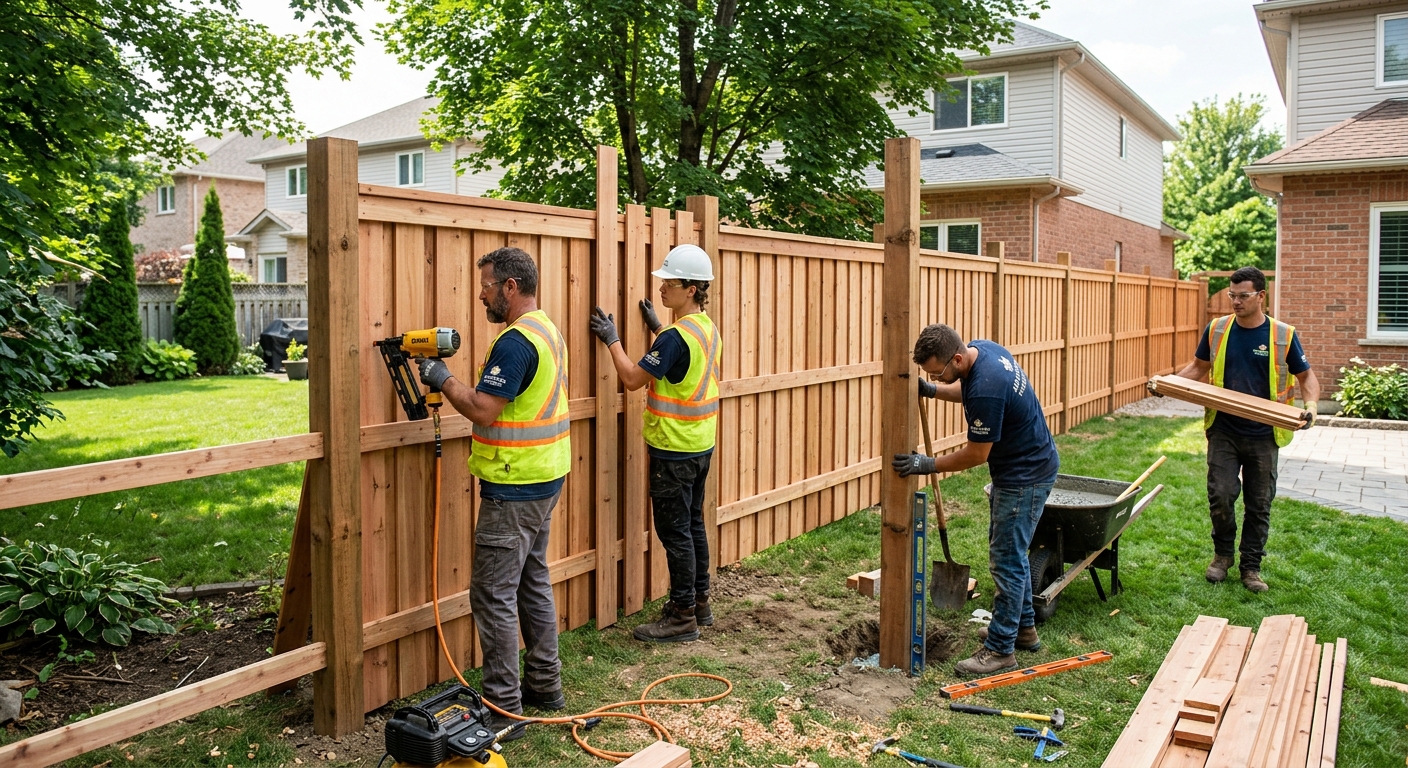
Fencing options and costs in Greenstone
Greenstone homeowners often start by asking what fencing will hold up to the long, cold Northern winters—and which options still look good on older properties. In Greenstone, most households are owner-occupied (1,485 homeowner households, or 77.3% of all households), and with single-detached homes making up 87.2% of dwellings, driveways, side yards, and backyard enclosures are common. That mix creates steady demand for both practical boundary fencing and privacy upgrades. It also means contractors are busiest in the usual spring-to-fall window, so booking early helps you get the crew you want.
Northwest Ontario’s climate directly shapes pricing. Frost penetrates deeper than in southern Ontario, so fence posts typically need to be set roughly 4 ft (1.2 m) or deeper below grade (often with concrete) to reduce the risk of frost heave and post movement. In addition, wind exposure—especially near highway corridors and more open rural or lakeside lots—pushes up labour and material requirements, such as closer post spacing, heavier rails, and sturdier brackets. Local soil conditions (including clay and mixed soils common around the broader Northwest) can also require slightly larger or belled footings for stability.
As a result, quotes can vary even when the fence height is the same. The table below compares common materials and their typical installed ranges so you can budget with confidence before we talk site access, line length, and footing conditions around your property in town (for example, areas closer to the main services where vehicle access is tighter).
| Material |
Lifespan |
Maintenance |
Privacy Rating |
Price per Linear Foot |
| Pressure-treated pine (standard wood) |
10–15 years |
Stain/seal every 2–3 years; inspect posts after freeze-thaw |
Medium (solid rails recommended) |
$55 – $90 |
| Cedar (natural rot resistance) |
15–20+ years |
Periodic staining; clean mildew; inspect fasteners |
Medium–High (solid board styles) |
$70 – $110 |
| Vinyl / PVC (no-maintenance) |
20+ years |
Occasional wash; no painting or staining |
High (solid privacy panels) |
$70 – $110 |
| Chain-link (galvanized steel) |
25+ years |
Rare; rinse and check tension |
Low–Medium |
$35 – $65 |
| Aluminum ornamental |
30+ years |
Occasional cleaning; check hardware |
Low (open pickets) |
$80 – $140 |
| Composite / recycled material |
20+ years |
Rinse; occasional cleaning; replace damaged boards |
High (solid/composite privacy systems) |
$90 – $150 |
Prices are estimates only and vary by project scope, site access and material selection.
What affects the price of fencing in Greenstone
Even in the same Ontario town, fencing quotes can differ by 30–50% because the cost drivers aren’t just the fence material. The biggest swing is what happens below grade and how the fence performs in Northwest weather. In Greenstone, crews price deeper post holes, extra concrete, and wind-conscious framing because frost heave and wind loading are real failure points—especially for uncovered areas.
Post depth is the clearest example. Contractors typically set posts about 4–6 inches below the design frost depth to prevent movement. In cold Ontario and Alberta climates, that often translates to roughly 1.5–2.0 m into the ground (or deeper depending on local frost depth assumptions and soil). Deeper holes mean more excavation time, more concrete, more labour, and longer posts—pushing the total project toward the higher end of the wood or vinyl bands (for example, wood-style builds can land closer to $55 – $90 and cedar/vinyl closer to $70 – $110 per linear foot when footing conditions are tough).
Wind exposure also changes the “hidden” structure: tighter post spacing, heavier top rails, and more robust braces can be needed on open rural or lakeside lines, which raises both material and labour. If you’re in a hurry to start mid-season, limited contractor availability can also affect pricing, because crews book the best-access jobs first.
Local examples that raise or lower cost in Greenstone: (1) clay-heavy mixed soils may require wider, more stable footings (more excavation and sometimes belled holes); (2) easy ground access and clear right-of-way reduce labour time for trenching and concrete placement; (3) older fence removal can add disposal fees and extra labour if posts are set deeply and need grinding or removal piece-by-piece. The age of many homes is also a factor—79.9% of homes were built before 1981, and older properties often have settled fences, buried edging, or irregular boundaries that complicate line finding and layout.
| Price Factor |
Why It Matters |
Cost Impact |
| Fence length in linear feet |
Every foot adds rails, posts, hardware, and fabrication time |
Largest driver; scales directly |
| Post depth required |
Frost heave risk increases with shallow posts |
Higher depth usually raises cost materially |
| Post setting method |
Concrete setting stabilizes posts in freeze-thaw cycles |
Concrete typically costs more than gravel backfill |
| Material choice |
Vinyl, cedar, and chain-link have different material and install requirements |
Shifts you within the local price bands |
| Gate count and type |
Hinges, latches, and reinforced frames cost more |
More gates and a drive gate increase labour and hardware |
| Grade and terrain |
Sloped yards require stepping or raked panel layouts |
More labour and sometimes additional materials |
| Old fence removal and disposal |
Removal takes time and affects waste handling |
Can add a noticeable standalone line item |
| Permit fees and survey / property line locate |
Line confirmation avoids encroachment and rework |
Upfront administrative costs plus possible re-labour |
Permits & regulations in Ontario
In Ontario, fence rules can vary by municipal bylaw and lot characteristics, but permits are commonly required when fences reach certain heights—typically around 2.0 m (6.5 ft) at the rear and about 1.0–1.2 m (3–4 ft) at the front or corner. For a backyard privacy fence in Greenstone that pushes into the taller range, it’s smart to assume a permit may be needed and confirm with your local municipality before work starts. Regardless of height, fences must be built within your property limits and respect any municipal setback requirements.
Before digging any post holes, utility locates are mandatory. Use Ontario One Call (formerly One-Call) so they can mark buried services. Even if you’ve “done it before,” the locate protects you from hitting power, gas, or telecom lines—especially on older lots.
Step-by-step homeowner checks:
- Request or confirm a survey/locate to verify where your pins are, especially if you’re replacing an older fence that may have drifted.
- Ask your contractor whether they pull permits and what they handle (some do, some require homeowners to approve).
- Verify Ontario licensing through the appropriate public registry for their business credentials (and match the legal name on the quote to their certificate documentation).
- Ask for a Certificate of Insurance showing liability coverage and confirm it’s current.
- Confirm WSIB/WCB coverage for the trade work—ask for a clearance letter and document it in your job file.
What typically does NOT require a permit: standard replacement of a fence at the same height and within existing lines (still requires locates and adherence to bylaws), or lower boundary fences that stay under the typical threshold. What DOES require a permit: changes that increase height beyond the common thresholds, new fences in front/corner areas, or anything that triggers a municipal review due to setbacks or lot conditions.
Choosing the right fence material for Greenstone
Choosing the right fencing material in Greenstone means matching your priorities—privacy, low maintenance, budget, and lifespan—to Northwest Ontario’s freeze-thaw cycle, wind exposure, and snow conditions. With much of the housing stock built before 1981 (79.9% of homes), replacement work is common, and the “right” material depends as much on post performance as on surface appearance. The structural reality here is that frost can shift weakly anchored posts, so quality installation matters no matter what you pick.
Pressure-treated pine is usually the budget starter, but it needs staining or sealing about every 2–3 years to slow grey weathering and keep the wood looking clean. Cedar costs more upfront but handles rot resistance better and often stays attractive longer, though it still benefits from maintenance. Vinyl/PVC offers no-stain convenience and high privacy options, but extreme cold can make components more brittle—so the right bracket system and proper post setting are important. Chain-link is typically the longest-life and lowest-cost barrier ($35 – $65 per linear foot), but it doesn’t provide privacy unless you add slats or a screen. Aluminum is rust-resistant and mid-range to higher cost, with good curb appeal but open pickets. Composite/recycled systems are solid for privacy and durability, though they’re usually priced toward the higher end of the local bands.
Post-depth guidance in Greenstone is consistent: because frost penetrates deeper in Northwest Ontario, plan on posts being set roughly 4 ft (1.2 m+) below grade (often with concrete for stability). That means the footing part of the job is often non-negotiable—so the biggest savings usually come from material selection (for example, choosing chain-link instead of cedar) rather than trying to reduce embedment.
To put pricing into perspective, a privacy-focused cedar fence often lands near the higher portion of the wood/cedar band, commonly around $70 – $110 per linear foot, while a chain-link solution might be closer to $35 – $65. That difference is justified when you need a true privacy barrier, because solid board designs tolerate wind better than lightweight screens and typically require less creative add-ons.
| Material |
Cold Tolerance |
Lifespan |
Annual Maintenance |
Best For |
Price Band |
| Pressure-treated pine |
Good with proper concrete-set posts |
10–15 years |
Inspect after winter; stain or seal every 2–3 years |
Budget privacy where you’re willing to maintain |
$55 – $90 |
| Cedar |
Very good |
15–20+ years |
Inspect annually; stain as needed (often every 2–3 years) |
Appearance-focused privacy with better rot resistance |
$70 – $110 |
| Vinyl / PVC |
Good; correct hardware and installation required |
20+ years |
Wash as needed; check for tight brackets in extreme cold |
Low-maintenance privacy |
$70 – $110 |
| Chain-link |
Excellent |
25+ years |
Minimal; rinse and check tension |
Security on a budget (add slats for partial privacy) |
$35 – $65 |
| Aluminum ornamental |
Excellent (won’t rust with proper coatings) |
30+ years |
Clean and inspect hardware periodically |
Curb appeal security without solid privacy |
$80 – $140 |
| Composite / recycled |
Good |
20+ years |
Rinse and spot-check boards/hardware |
Durable solid privacy with less routine upkeep |
$90 – $150 |
How to choose a fencing contractor in Greenstone
Choosing the right fencing contractor in Greenstone starts with proof that they can build safely and correctly for Northwest Ontario conditions. First, verify they carry liability insurance and WSIB/WCB coverage for their workers. You can check a contractor’s Ontario licensing and business credentials through the relevant online public registry, then match the legal business name on that record to the quote and invoices. Next, request a Certificate of Insurance and confirm it lists fencing work (and that the coverage is current during your project dates). For labour coverage, ask for a WSIB/WCB clearance letter or proof of coverage—if they can’t provide it, it’s a major red flag.
Then get 2–3 itemised written quotes rather than lump sums. A good quote breaks down labour versus materials, includes the number of posts and bracing details, and clearly states whether concrete is included for below-frost embedment. Ask if disposal and haul-away are included, and whether the contractor will pull permits if your project triggers them. Make sure the scope spells out gate construction (frames, hardware, and swing direction) and any grading adjustments (stepped vs raked layouts).
Quality signs include a real workmanship warranty (not just “we’ll do it properly”)—and clarity on product warranties from the manufacturer. Confirm whether any warranty is transferable if you sell the home. For payment, never pay more than 10–15% upfront; hold back the balance until the job is complete, inspected, and cleaned up. Finally, require a written start date and an estimated completion window that reflects the weather window and curing time for concrete footings.
- Provide written proof of liability insurance (certificate with policy dates).
- Provide WSIB/WCB clearance letter or coverage proof.
- Show Ontario business credentials that match the quote/invoice.
- Quote includes post spacing, post embedment depth, and whether concrete is used.
- Itemise labour, materials, gates, hardware, and any concrete line items.
- State what’s included for permit pulling and utility locates (and who pays).
- Confirm property line verification approach (survey locate vs relying on old fence).
- Include old fence removal, scrap handling, and disposal details.
- List warranty length for workmanship and separately for materials.
- Use a signed contract with start/completion dates and agreed change-order rules.
- Payment schedule capped at 10–15% deposit; holdback until final walkthrough.
- Walk the site to confirm access routes, excavation locations, and any obstacles.
In Greenstone, common red flags include: contractors who won’t discuss frost-depth embedment and concrete setting; quotes that omit post counts or hardware specifications; refusing to provide insurance/WSIB proof; offering only a lump-sum price with no disposal or permit scope; and asking for a large upfront payment (beyond 10–15%) without a clear contract and schedule.
Frequently asked questions — fencing in Greenstone
What fence style offers the best wind resistance in Greenstone?
In Greenstone, wind resistance is mostly about structure, not just appearance. Solid-board privacy styles with properly braced rails tend to perform better than light screens, especially when wind pushes hard through open lines. The key is installing posts below the frost-risk zone—often around 4 ft (1.2 m+) or deeper below grade—and using concrete-set posts where soil and freeze-thaw conditions demand it. If you’re on a more exposed edge of town or near a clearing where gusts funnel, ask for closer post spacing and reinforced hardware. That typically keeps panels from racking and reduces the chance of gaps opening after winter. If you’re comparing budgets, chain-link can last a long time, but it won’t block wind the same way, and you may need privacy additions that change the overall performance.
How much does a fence cost in Greenstone?
Fence pricing in Greenstone depends mainly on total linear feet, post embedment, and whether concrete setting is required for below-frost stability. As a planning benchmark, chain-link is often the lowest-cost option at roughly $35 – $65 per linear foot installed, while wood and vinyl commonly fall into the $55 – $90 and $70 – $110 per linear foot ranges depending on material and privacy style. Cedar and solid privacy builds generally trend toward the higher end due to materials, solid rail construction, and more rigid framing. Because Northwest Ontario frost can require deeper post holes, don’t expect a “low-footprint” bargain if your soil and footing needs call for concrete. A proper site visit and itemised quote will show how much of your price is going into excavation and structure versus the visible fence material.
How deep should fence posts be for Greenstone's frost?
For Greenstone and other Northwest Ontario settings, you should plan for posts set deeper than what people use in southern Ontario. The general approach is to set posts about 4–6 inches below the design frost depth to reduce the risk of frost heave. In practice, many fences in this region are set roughly 1.2 m+ into the ground, and frequently around 1.5–2.0 m depending on frost assumptions, soil, and local conditions. That deeper embedment is why quotes can rise compared to milder areas: it increases excavation time, concrete volume, and sometimes the size of the holes. In many projects, concrete-set posts are the safest bet to keep the line straight through freeze-thaw cycles. Your contractor should state the planned embedment depth in writing, along with whether they use concrete backfill or an engineered method based on soil conditions.
Wood vs vinyl vs aluminum fence — which is best?
“Best” depends on your priorities. Wood (pressure-treated pine or cedar) can be a great choice for privacy and aesthetics, but it requires periodic maintenance—commonly staining or sealing every 2–3 years for pressure-treated boards to prevent heavy weathering. Cedar resists rot better and often holds up visually longer, but it still benefits from upkeep. Vinyl/PVC is popular for low maintenance and strong privacy options; it typically stays looking consistent with occasional washing, but installation details and cold-weather handling matter. Aluminum is excellent for corrosion resistance and curb appeal, but ornamental pickets don’t provide privacy like a solid-board fence. If your main goal is privacy and wind blocking, wood or vinyl solid panels are usually the better match. If your goal is long-term durability with minimal maintenance and you can live with open visibility, aluminum is often a strong option.
Do I need a permit to build a fence in Ontario?
It can be required in Ontario, and the trigger is usually fence height and location on your lot (rear vs front/corner), plus how your municipal bylaw defines setbacks. A common rule of thumb used in many Ontario communities is that fences around 2.0 m (6.5 ft) at the rear or about 1.0–1.2 m (3–4 ft) at the front/corner can require a building permit. Even when a permit isn’t needed, your fence still must respect property lines and setbacks. Before any digging, you must call for utility locates via Ontario One Call so buried services are marked. For Greenstone homeowners replacing old fences, a like-for-like replacement at the same height often avoids permit work, but any height increase or front/corner changes may trigger municipal review. If you’re unsure, ask your contractor to confirm the requirement for your exact height and placement, and request that the scope clarifies whether permits are handled.
How long does a wood fence last in Greenstone?
A wood fence in Greenstone commonly lasts about 10–15 years for pressure-treated pine when it’s installed with correct below-frost posts and maintained properly. Cedar often extends the lifespan to roughly 15–20+ years because of its natural rot resistance, provided the fence is built to resist freeze-thaw movement. The biggest threats aren’t just weather—they’re post movement and failing fasteners after winters. That’s why proper embedment (often around 4 ft (1.2 m+) or deeper) and structured bracing matter as much as the species. If you’re seeing leaning posts after a couple of seasons, it’s usually an installation/footing issue more than a “bad wood” issue. Budget-wise, if you’re comparing materials, higher upfront cedar costs versus pressure-treated can be justified when you want to reduce future maintenance cycles.