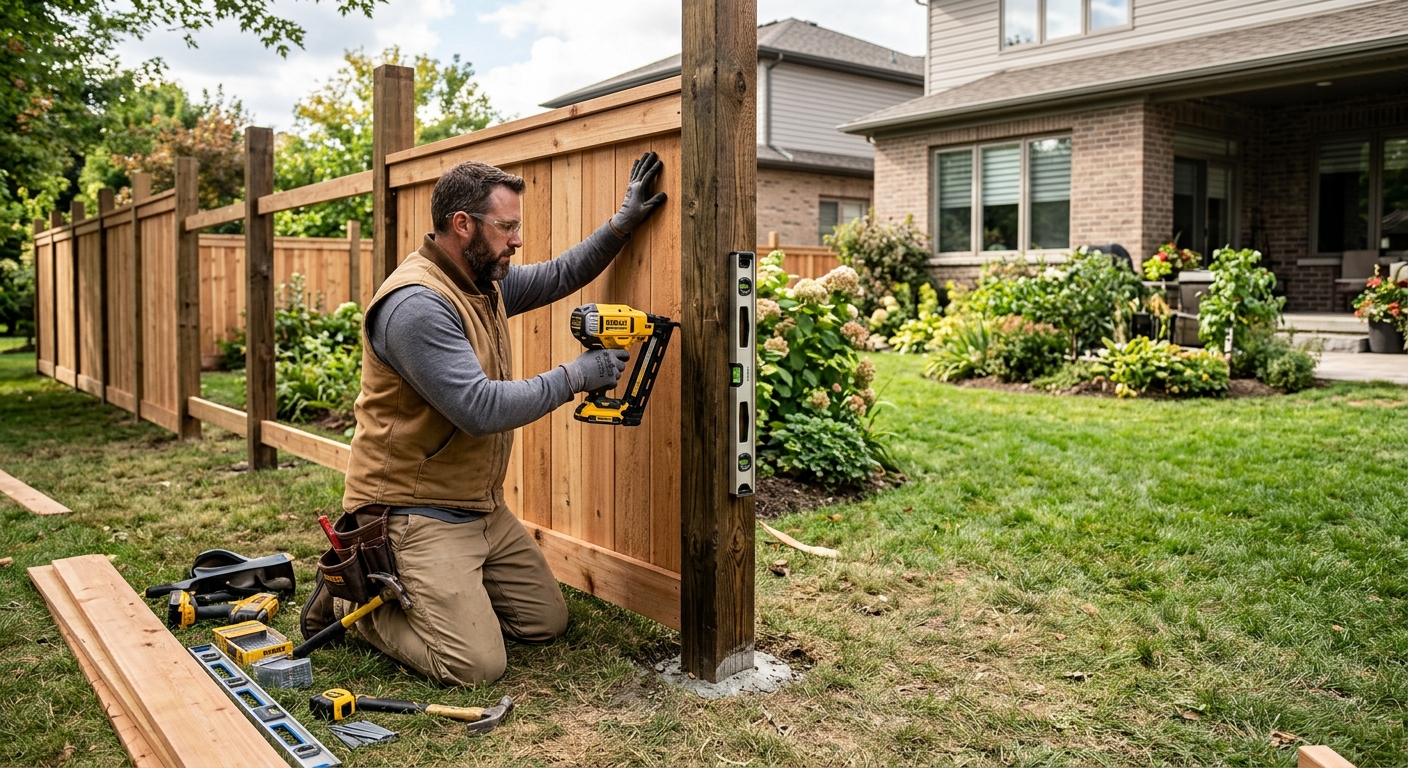
Fencing options and costs in Greenwood-Coxwell
In Greenwood-Coxwell, choosing a fence is usually about balancing privacy, winter durability, and long-term appearance for a neighbourhood that stays busy year-round. With a population of 14,417 (Statistics Canada, 2021 Census), there’s enough steady demand that you’ll often see faster scheduling for straightforward back-yard installs, especially around the Coxwell Avenue corridor where many lots sit on established, fully serviced residential streets. Also, because Toronto-area housing stock is dominated by family properties with back-yard space, fence projects are a frequent home-improvement priority when homeowners are updating landscaping or adding secure side access.
Pricing here is heavily influenced by Southern Ontario’s frost depth approach. Even though crews in the GTA don’t face Prairies-level wind, the freeze-thaw cycle still drives how deep posts must be set. For privacy-height fences, most contractors plan for post holes roughly 3.5–4.0 ft deep (or deeper, depending on soil and final design), and concrete-set posts are common for stability in clay and mixed soils. That means the “same” fence height can price differently based on footing requirements, post size, and panel style.
You’ll also notice contractor availability and crew costs can move with seasonal demand. Late spring and early summer typically cost more due to scheduling pressure, while fall projects often come in sharper. With that in mind, the section below compares common materials using realistic lifespan, maintenance expectations, and typical installed price bands for Greenwood-Coxwell, then breaks out where those differences come from.
| Material |
Lifespan |
Maintenance |
Privacy Rating |
Price per Linear Foot |
| Pressure-treated pine (standard wood) |
10–15 years |
Stain/seal every 2–3 years; inspect posts annually |
8–9/10 (solid boards) |
$15–$30 |
| Cedar (natural rot resistance) |
15–20 years |
Light staining every 2–4 years; fasten checks after storms |
8–10/10 (solid boards) |
$18–$38 |
| Vinyl / PVC (no-maintenance) |
20–30 years |
Wash as needed; check for any warped rails after extreme cold |
8–10/10 (solid privacy panels) |
$20–$42 |
| Chain-link (galvanized steel) |
20–35 years |
Occasional tightening and rinse; add slats if desired |
2–4/10 (unless privacy slats added) |
$10–$22 |
| Aluminum ornamental |
25–40 years |
Wash and inspect fasteners; repaint rarely |
3–6/10 (good visibility, limited privacy) |
$22–$44 |
| Composite / recycled material |
20–30 years |
Wash; occasional hardware checks |
8–10/10 (solid boards) |
$22–$45 |
Prices are estimates only and vary by project scope, site access and material selection.
What affects the price of fencing in Greenwood-Coxwell
In Greenwood-Coxwell, even “the same” fence height can come in 30–50% apart between quotes because the real drivers are often hidden in the details: post size, footing depth, concrete quantity, rail thickness, hardware grade, and how much labour is required for removals and disposal. Two contractors can both quote for a 6 ft privacy fence, yet one designs with larger posts set in concrete and the other uses lighter spacing or a less robust footing plan. The labour difference shows up fast in the GTA because crew time is tied to excavation, post plumb/level setup, and curing time.
Frost depth is the big Ontario factor. Best practice commonly treats the design frost depth as setting the minimum below-grade requirement, so contractors typically set posts about 4–6 inches below the frost depth “design zone” to reduce heaving. In practical terms for Southern Ontario, that often means posts go roughly 1.5–2.0 m into the ground for taller fences, especially where clay and mixed soils hold moisture. Concrete-set posts (plus longer post lengths) add both material and installation time—often pushing wood privacy projects toward the higher end of the $65–$120 backbone for wood installs. Conversely, chain-link tends to stay nearer the $45–$85 band because it uses lighter posts and simpler footing profiles.
Local conditions that change cost in this area include: (1) clay-heavy lots where excavation is slower and concrete volumes can increase for stable anchoring; (2) yards with narrow side access from older Greenwood-Coxwell homes, which increases labour per post; and (3) variable ground slope near property boundaries, where stepped or raked panels require additional layout time. Homeowners often notice that an extra gate or a removal of an old fence with embedded rails can shift the quote by hundreds—sometimes over $1,000—because disposal and rework time stack quickly.
| Price Factor |
Why It Matters |
Cost Impact |
| Fence length in linear feet |
Most materials and labour scale directly with length |
High (primary driver) |
| Post depth required |
Frost line dictates below-grade depth to prevent heaving |
Medium–High |
| Post setting method |
Concrete vs. gravel pack vs. driven posts changes excavation and stability |
Medium–High |
| Material choice |
Vinyl/cedar/hardware grade affects unit cost and install speed |
Medium |
| Gate count and type |
Double-drive gates need more structure, hinges, and often a wider opening plan |
High |
| Grade and terrain |
Sloped yards require stepped/raked framing and extra measuring/layout |
Medium |
| Old fence removal and disposal |
Hauling time, nail/rail stripping, and hidden anchors add labour |
Medium |
| Permit fees and survey / property line locate |
Paperwork and locating reduce risk of encroachment disputes |
Low–Medium (project-dependent) |
Permits & regulations in Ontario
In Ontario, fence rules are tied to property lines and (in many municipalities, including Toronto-area practice) permit triggers by height and location. A common threshold is that fences above roughly 2.0 m (about 6.5 ft) at the rear and around 1.0–1.2 m (about 3–4 ft) at the front or corner often require a building permit. The key point for Greenwood-Coxwell homeowners is: if you’re planning a tall privacy fence close to a front/corner boundary, assume you may need a permit and check with the city’s permit process before digging.
Before any post holes, call for utility locates. In Ontario, you use Ontario One Call so crews can flag buried services—this is essential because even a “simple” backyard fence can cross gas, hydro, or low-voltage lines. Also, get a survey or locate your property pins to confirm your exact boundary. That protects you from encroachment disputes, especially on older lots where fences were sometimes placed conservatively or moved over time.
For shared fence ownership, Ontario’s line-fence approach governs responsibilities between neighbours (for example, when repairs or replacement are required and how costs are considered). To verify a contractor’s compliance, ask for their proof of Ontario licensing status (as applicable), a current certificate of liability insurance naming you as additional insured where possible, and WSIB coverage details. Look for clear expiry dates on insurance certificates and confirm coverage is active for the install period; don’t rely on verbal confirmation.
Choosing the right fence material for Greenwood-Coxwell
Choosing the right fence material in Greenwood-Coxwell comes down to pairing your priorities—privacy, low maintenance, and lifespan—with the reality of Toronto’s freeze-thaw winters and frequent freeze during shoulder seasons. Pressure-treated pine is the budget-friendly starting point, but it typically needs staining or sealing every 2–3 years to slow grey weathering and protect against moisture cycling. Cedar looks excellent and naturally resists rot better than many softwoods, which helps in yards that stay damp after spring thaw, but it still benefits from periodic maintenance. Vinyl/PVC is popular for low upkeep: you can wash it and largely forget it, but in extreme cold snaps it can become brittle if installed with poor rail support or insufficient expansion considerations. Chain-link is the lowest-cost long-life option, but it won’t provide privacy unless you add slats or another privacy system. Aluminum ornamental offers a clean, rust-resistant look with minimal maintenance; however, it’s usually a “front property boundary” style rather than a true privacy solution.
Post depth matters in Toronto. With the frost line in Southern Ontario commonly handled as roughly 42"–48" design depth, installers typically set posts at about 3.5–4 ft deep for privacy heights, using concrete-set posts for stability in clay and mixed soils. That means your material choice isn’t the only cost driver—better framing, heavier posts, and concrete settings help the fence resist racking from winter wind gusts and spring storms.
A practical example: if a wood privacy fence starts at the $65–$120 installed band and a vinyl option lands closer to the $75–$130 band, the vinyl premium can be justified when you want a true “set it and forget it” approach for 15–25 years. If you’re comfortable maintaining wood every few seasons, pine can still be a smart choice; you’re paying more in time rather than upfront.
| Material |
Cold Tolerance |
Lifespan |
Annual Maintenance |
Best For |
Price Band |
| Pressure-treated pine |
Good (with proper sealing and hardware) |
10–15 years |
Low–Moderate (inspect; stain/seal every 2–3 years) |
Budget privacy with periodic upkeep |
$65–$120 |
| Cedar |
Good (stable grain; better moisture performance) |
15–20 years |
Low–Moderate (light staining every 2–4 years) |
Appearance + better rot resistance |
$75–$130 |
| Vinyl / PVC |
Very good (if installed with correct support) |
20–30 years |
Very low (wash seasonally; check hardware) |
Low maintenance privacy |
$75–$130 |
| Chain-link |
Very good (galvanized steel) |
20–35 years |
Low (tighten/inspect; occasional rinse) |
Security on a budget; add slats for privacy |
$45–$85 |
| Aluminum ornamental |
Very good (powder-coated) |
25–40 years |
Very low (wash; inspect posts after winter) |
Front boundaries and decorative fencing |
$90–$160 |
| Composite / recycled |
Good (design depends on board structure) |
20–30 years |
Low (wash; check fasteners) |
Privacy with wood-like feel and less upkeep |
$90–$160 |
How to choose a fencing contractor in Greenwood-Coxwell
Choosing the right fencing contractor in Greenwood-Coxwell starts with proof, not promises. First, verify Ontario licensing status where required for fence-related contracting in your situation, and ask for liability insurance documentation before work begins. You should also confirm WSIB coverage for workers (WCB equivalents are used in other provinces, but in Ontario you’ll be looking for WSIB coverage details). How to check: request a current certificate of insurance (showing policy limits and expiry date) and make sure you receive a clearance letter or confirmation that coverage is active for the period your project is scheduled. If a contractor won’t provide documents upfront, treat that as a serious risk.
Next, get 2–3 itemised written quotes. You want a breakdown that shows labour and materials separately, including post size, spacing, and the footing method (concrete-set vs. alternative). Clarify whether disposal of the old fence is included, whether permits are pulled by the contractor or by you, and what’s excluded (for example: landscaping restoration, buried utilities repair, or survey costs). Read warranty language carefully: ask for the workmanship warranty length, the product/manufacturer warranty terms, and whether warranties are transferable to future owners.
Finally, control payment. In Ontario, a reasonable approach is to never pay more than 10–15% upfront. Use a holdback tied to completion and punch-list items. Get a start date and a realistic completion estimate in writing, including curing time assumptions for concrete-set posts.
- Ask for proof of liability insurance with your project address listed where possible, plus expiry date.
- Confirm WSIB coverage for all workers assigned to your job.
- Request itemised quotes (posts, rails, panels, concrete, hardware, labour, disposal) not lump sums.
- Verify post size and spacing match your fence height and expected wind/racking loads.
- Confirm post depth plan in writing (Toronto frost-depth best practice) and footing method.
- Check whether concrete-set posts are included for privacy-height fences.
- Ask who pulls the permit and how permit-related timelines affect the schedule.
- Ensure utility locate coordination is included before digging.
- Require a scope line for old fence removal, disposal, and any patch/restore work.
- Get the warranty terms in writing (workmanship vs. manufacturer coverage).
- Use a payment schedule with a holdback; avoid large upfront deposits.
- Require a written timeline with milestones (excavation, posts, rails/panels, gate install, cleanup).
Concrete red flags in Greenwood-Coxwell: quoting a 6 ft privacy fence with “driven posts only” when soil is clay-heavy or frost-depth compliant footings weren’t discussed; refusing to provide insurance/WSIB proof; giving only a single lump-sum without listing post depth, spacing, or material grades; starting without confirming property lines or utility locates; and offering a workmanship warranty that’s vague (“warranty included”) without specific coverage duration and exclusions.
Frequently asked questions — fencing in Greenwood-Coxwell
How do I compare fencing quotes?
Start by comparing apples to apples: fence height, style (solid privacy vs. semi-private), and the exact materials. Ask each contractor to quote with itemisation that includes post size, post spacing, and the footing method—especially whether posts are concrete-set for frost stability. In Greenwood-Coxwell, frost depth and freeze-thaw can push quotes apart, so a quote that shows concrete-set posts and proper hole depth usually lasts longer than one that doesn’t. Also compare removals: disposal of old rails and posts can change the number quickly. Finally, look at price bands: wood privacy often lands around $65–$120 installed, while vinyl/PVC commonly runs higher within $75–$130 depending on design and hardware. If the details are missing, treat it as a guessing contest.
How long does fence installation take in Greenwood-Coxwell?
Most backyard fence installs in Greenwood-Coxwell are completed in a few working days, but the timeline depends on length, access, and how many posts need concrete. For shorter runs, chain-link can sometimes go up quickly, while privacy fences with concrete-set posts require excavation, setting posts, installing rails/panels, then completing final alignment. Weather matters too: heavy rain can slow excavation and grading, and cold snaps can affect concrete performance, which is why many crews schedule concrete-heavy work during milder stretches. If your project includes old fence removal, disposal, or a double drive-through gate, add time for demolition and staging. Ask the contractor for a written start date and completion estimate, including concrete curing assumptions and cleanup/punch-list days.
Can I install a fence on a slope in Greenwood-Coxwell?
Yes, you can install a fence on a slope in Greenwood-Coxwell, but it should be designed correctly. Most contractors handle sloped yards with stepped sections (keeping boards level per run) or raked framing (following the slope smoothly). Which method is “best” depends on how your neighbour-facing boundaries line up and how strict you need to be about height. Stepped designs can look more uniform and are common when frost-depth footings vary along the slope, while raked designs can blend better visually but require more careful layout. Ensure your quote specifies whether panels are stepped or raked and how the top rail height is measured. Also confirm post depth is still planned for Ontario frost conditions, not just set to “look level” above ground.
What is the most weather-resistant fence for Greenwood-Coxwell's climate?
For Greenwood-Coxwell’s Toronto-area winter and freeze-thaw conditions, the most weather-resistant choices are typically vinyl/PVC for low maintenance and consistent performance, or cedar/pressure-treated wood when properly sealed and installed with correct post depth and hardware. Vinyl generally holds up well to moisture cycling because it doesn’t rot or warp like untreated wood, though poor installation can lead to issues if rails aren’t supported properly. Cedar offers strong natural rot resistance, which helps in damp thaw periods, but it still benefits from periodic maintenance. For the most stable results, the real “weather-resistance” factor is often the footing system: concrete-set posts planned to address the local frost approach help prevent heaving and panel sag over time. If you’re budget-flexible, vinyl in the $75–$130 band is a common value-for-longevity pick.
How do I prevent wood fence rot in Greenwood-Coxwell?
Wood rot prevention starts at the base. Make sure your contractor uses treated lumber rated for ground contact and sets posts deep enough for frost stability in Southern Ontario, commonly with concrete-set footings for privacy-height fences. Above-grade protection matters too: use proper fasteners (exterior-rated, corrosion-resistant) and plan staining or sealing on a realistic cycle—often every 2–3 years for pressure-treated pine to reduce moisture absorption and grey weathering. Avoid trapping water around post bases by confirming drainage is reasonable and the fence isn’t installed too low to the ground. Also keep landscaping back from the fence so airflow can dry boards after rain and thaw. If you’re comparing budgets, pine often sits around $65–$120 installed, but cedar can reduce rot risk due to natural oils while typically costing more within the $75–$130 range depending on height and design.
What is the cost per linear foot for fencing in Greenwood-Coxwell?
Cost per linear foot in Greenwood-Coxwell varies by material and how the project is built (post depth, concrete setting, gates, and removals). As a practical guide, wood privacy fences often price within the $65–$120 installed band for typical backyard projects, while vinyl/PVC tends to fall in the $75–$130 range. Chain-link is commonly lower, landing around $45–$85, and aluminum/metal can run higher at roughly $90–$160. These bands reflect local labour rates and the Toronto-region approach to frost-depth footings. For an accurate per-foot number, ask for an itemised quote that breaks out materials and labour, and ensure “linear feet” is based on actual run length between posts—not just the fence line appearance.