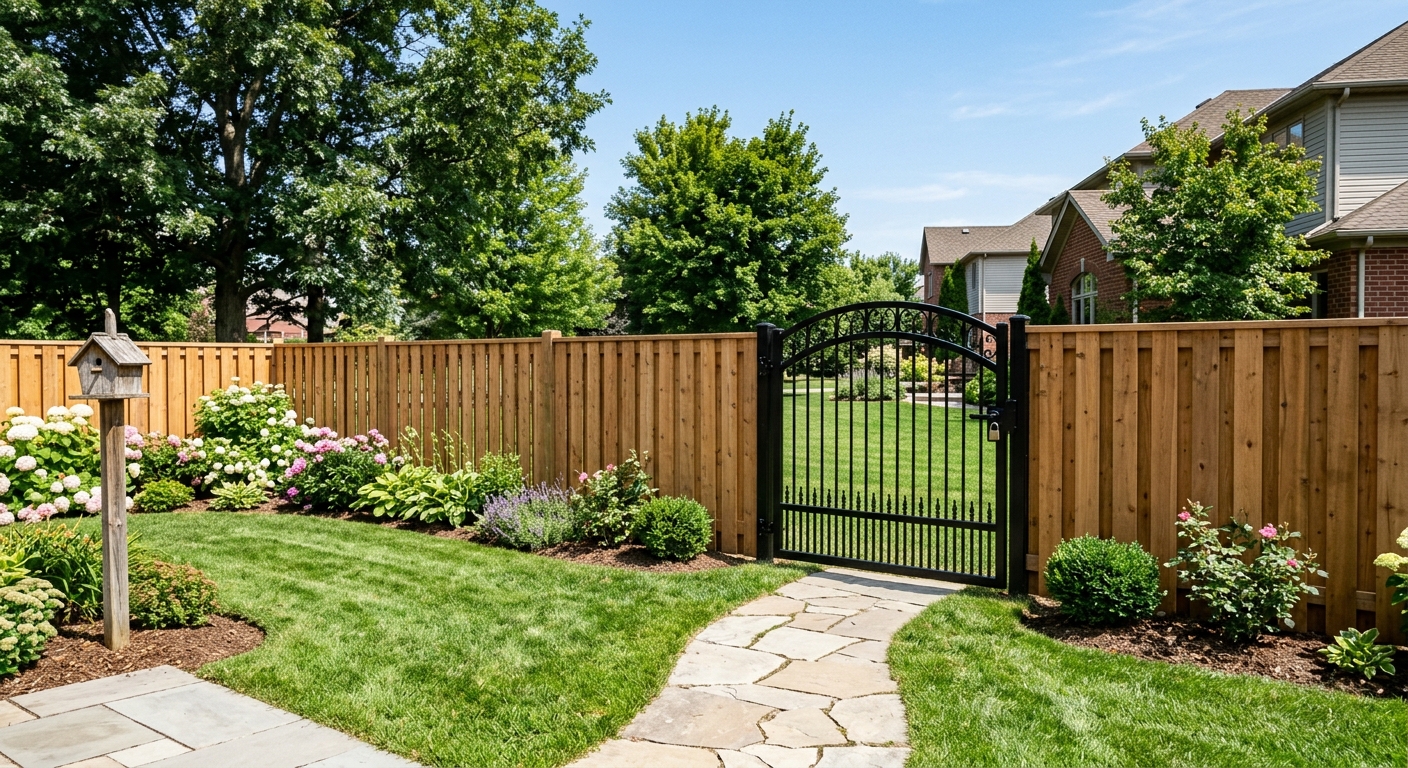
Fencing options and costs in Hanover
Hanover homeowners typically start their fence search by comparing materials and installed pricing, especially when they’re protecting yards around a growing number of single-detached homes (64.2% of dwellings, Statistics Canada, 2021 Census). With 2,210 homeowner households in the area (64.2% of households own, Statistics Canada, 2021 Census), demand stays steady for privacy panels, pet enclosures, and decorative front-yard borders. That matters when you’re budgeting: in Hanover, you’re rarely paying only for rails and pickets—you’re also paying for frost-safe installation and the labour to get posts deep enough for winter conditions.
In the Stratford–Bruce Peninsula region, frost depth is the main cost driver. Practical residential installations commonly set posts about 0.9–1.2 m (3–4 ft) deep, often with concrete footings to resist heaving in clay and mixed soils. In exposed farm-field locations and near larger open areas around Hanover, wind loads can also force contractors to tighten post spacing and use sturdier hardware, which modestly increases the total. In short: two yards with the same fence length can price quite differently depending on soil, access, and how “open” the site is to wind and snow.
For many residents, the trade is especially busy in family-heavy pockets near downtown Hanover and along the approaches toward the rural perimeter, where backyards are used year-round and pets are common. If you’re comparing options now, the table below will help you line up lifespan, maintenance expectations, privacy, and a realistic per-foot price before you request quotes.
| Material |
Lifespan |
Maintenance |
Privacy Rating |
Price per Linear Foot |
| Pressure-treated pine (standard wood) |
10–15 years |
Stain/seal every 2–3 years; fastener checks |
High (solid pickets) |
$55–$85 price range per linear foot |
| Cedar (natural rot resistance) |
15–25 years |
Light staining or re-sealing every 3–4 years |
High (solid boards) |
$70–$105 price range per linear foot |
| Vinyl / PVC (no-maintenance) |
20–30 years |
Occasional wash; inspect posts after storms |
High (solid privacy panels) |
$75–$115 price range per linear foot |
| Chain-link (galvanized steel) |
20–35 years |
Minimal; rinse and check tension |
Low (open mesh) |
$35–$55 price range per linear foot |
| Aluminum ornamental |
25–40 years |
Wash as needed; tighten hardware |
Medium (semi-open) |
$90–$150 price range per linear foot |
| Composite / recycled material |
20–30 years |
Low; occasional cleaning |
High (solid styles) |
$85–$130 price range per linear foot |
Prices are estimates only and vary by project scope, site access and material selection.
What affects the price of fencing in Hanover
In Hanover and across the Stratford–Bruce Peninsula region, fence quotes can vary by 30–50% for the same “style” because installers don’t just price the fence—they price the ground and the wind. Two common reasons: posts must be set deep enough for winter freeze conditions, and heavier or more “closed” fencing systems require stronger framing and hardware. That’s why a simple-looking backyard privacy fence can land in very different ranges once contractors factor in soil conditions, frost-safe post depth, and the distance between posts.
Frost is the biggest driver. In cold Ontario conditions, posts typically need to sit about 4–6 inches below the design frost depth to prevent heaving. Practically, that often means posts are set roughly 1.5–2.0 m into the ground (depending on design and soil), using longer posts and concrete setting. In older neighbourhoods where many homes were built before 1981 (64.2% of dwellings, Statistics Canada, 2021 Census), yards often have established grades, mature trees, and buried services that slow excavation and add labour—pushing your total higher. If you choose heavy systems like vinyl or solid wood privacy (often priced in the $75–$115 range for vinyl and $55–$85 for wood), the framing also needs to resist lateral loads and snow-on-panel stress.
Local examples that change costs in Hanover: (1) clay-heavy spots near downspouts or low areas can require additional excavation and more concrete for stable footing; (2) sloped lots on the edge of town often need stepped rails, extra labour, and custom panel cuts; and (3) sites close to trees may need careful post placement and slower digging to avoid roots, which affects both timelines and material waste. These are the moments where the difference between a $35–$55 chain-link budget approach and a $90–$150 ornamental or upgrade-heavy installation becomes easy to justify.
| Price Factor |
Why It Matters |
Cost Impact |
| Fence length in linear feet |
Most materials and labour scale directly with total linear feet. |
High—often the single largest variable. |
| Post depth required |
Frost line determines how long posts must be and how deep holes go. |
High—increases excavation time and concrete. |
| Post setting method |
Concrete footings add labour and material; gravel packs or driven posts vary by system. |
Medium to high—can swing totals noticeably. |
| Material choice |
Vinyl, cedar, and chain-link differ in framework needs, panel weights, and longevity. |
Medium to high—vinyl typically costs more than pressure-treated wood; chain-link is usually lowest. |
| Gate count and type |
Drive-through gates require heavier hardware and often double framing. |
Medium—each gate adds material, alignment labour, and stronger posts. |
| Grade and terrain |
Slopes require stepped panels or raked rails and more measuring. |
Medium—more labour and fewer “standard” cuts. |
| Old fence removal and disposal |
Demolition takes time and disposal fees can apply. |
Low to medium—becomes higher with concrete debris or long runs. |
| Permit fees and survey / property line locate |
Some fencing heights and locations need permits; line locate helps avoid encroachment disputes. |
Low to medium—varies by scope and complexity. |
Permits & regulations in Ontario
In Ontario, fence rules are tied to height, location, and your municipality’s setback bylaws. As a practical homeowner guideline in Hanover, fences above common thresholds—often around 2.0 m (6.5 ft) at the rear, and roughly 1.0–1.2 m (3–4 ft) at the front or corner—may require a building permit, especially if you’re enclosing a yard at higher-than-typical heights. Even when a permit isn’t required for the height you choose, the fence still must stay on your property line and respect municipal setbacks.
Before anyone digs post holes, you must get utility locates. In Ontario, homeowners and contractors typically coordinate via Ontario One Call, so locate work is done before excavation. Also, if you don’t have clear survey information, arrange a property pin/line locate (or use a recent survey) to avoid encroaching onto a neighbour’s property.
Shared fence ownership and responsibilities are generally addressed under Ontario’s line-fence approach: if a fence is on the line or intended to serve as a boundary, the “who maintains what” expectations can differ from a purely private fence.
To verify a contractor properly in Hanover, check three things in writing: (1) an Ontario licence/registration status where applicable (and the company’s business details on their website or public directories), (2) liability insurance (request a current certificate of insurance naming you as certificate holder if the contractor offers it), and (3) WSIB/WCB coverage documentation for workers on site. Then ask for a clearance letter or proof of account status and confirm dates match your scheduled start date.
Choosing the right fence material for Hanover
Choosing a fence material in Hanover is mostly about matching your priorities—privacy, maintenance level, and budget—to what our winters do to the ground and what our freeze–thaw cycles do to posts. Because the Stratford–Bruce Peninsula region has a meaningful frost depth, post depth matters regardless of material. For most residential fence builds, posts are set below the frost line to limit heaving; that usually means concrete-set posts around 1.5–2.0 m deep (project-dependent), with longer posts and deeper holes than homeowners expect.
Pressure-treated pine is the budget-friendly path (often in the $55–$85 per linear foot range). However, wood typically greys and stains unevenly in Ontario’s wet spring and freeze conditions, so plan on staining or sealing every 2–3 years to protect appearance and reduce fastener looseness. Cedar costs more up front but naturally resists rot and tends to look better for longer; maintenance is still recommended, even if it’s less frequent. Vinyl/PVC is popular for “set-and-forget” maintenance and privacy, but it can be more expensive at install time (commonly $75–$115 per linear foot) and can become brittle if installed incorrectly—especially if rails are forced when posts shift. Chain-link is usually the lowest cost (often $35–$55 per linear foot) and lasts well, but it won’t give true privacy. Aluminum ornamental gives a clean look with strong corrosion resistance and no rust concerns, but it’s more decorative than private.
If you’re on the fence between options, a practical example: upgrading from standard pine to vinyl might add roughly $20–$40 per linear foot. That can be justified if you want minimal maintenance over 20+ years, and if your yard is prone to dampness where staining becomes a recurring chore. In exposed spots near open fields or windier runs, denser privacy styles may also need closer post spacing and heavier hardware to handle wind and snow load.
| Material |
Cold Tolerance |
Lifespan |
Annual Maintenance |
Best For |
Price Band |
| Pressure-treated pine |
Good when properly installed and sealed |
10–15 years |
Seasonal checks; stain/seal every 2–3 years |
Budget privacy with willingness to maintain |
$55,XXX – $85,XXX |
| Cedar |
Good; natural rot resistance helps in wet cycles |
15–25 years |
Inspect and re-seal about every 3–4 years |
Better appearance with moderate maintenance |
$70,XXX – $105,XXX |
| Vinyl / PVC |
Very good with correct expansion allowances |
20–30 years |
Wash and inspect fasteners after heavy storms |
Low maintenance and long-term privacy |
$75,XXX – $115,XXX |
| Chain-link |
Very good; galvanized components resist weather |
20–35 years |
Minimal; rinse and check tension |
Security on a budget (pets/containment) |
$35,XXX – $55,XXX |
| Aluminum ornamental |
Excellent in cold with powder-coated finish |
25–40 years |
Occasional wash; hardware check |
Decorative boundary with curb appeal |
$90,XXX – $150,XXX |
| Composite / recycled |
Good; designed for freeze–thaw stability |
20–30 years |
Low; clean as needed |
High privacy without wood rot concerns |
$85,XXX – $130,XXX |
How to choose a fencing contractor in Hanover
Choosing the right fencing contractor in Hanover starts with verifying the basics before you compare prices. First, ask for proof of Ontario liability insurance (a current certificate of insurance is the cleanest way) and confirm workers are covered under the appropriate WSIB/WCB arrangement. In practice, you can ask the contractor to provide a clearance letter or proof of account coverage, and you should verify the dates line up with your proposed start date. Second, check their business registration status as applicable and request their workplace contact details so you have a real entity to hold accountable if something goes wrong.
Next, get 2–3 itemised written quotes that separate labour and materials (including post depth assumptions, rail style, hardware grade, and gate components). Avoid quotes that only provide a lump-sum number without explaining what’s included. Read the scope carefully: does the quote include permit pulls if needed, old fence removal, concrete/disposal, and utility locate coordination? Also confirm whether the contractor will complete line locating or provide guidance if your property pins are unclear.
Warranty matters for fencing in Ontario’s freeze–thaw climate. Ask for (1) workmanship warranty length and what it covers (for example, post alignment and installation defects), (2) the product/manufacturer warranty terms, and (3) whether warranties are transferable if you sell the home. Keep payment sensible: never pay more than about 10–15% upfront, and use a holdback until the job is complete and cleaned up. Finally, request a written start date and a completion estimate so you’re not stuck waiting during spring site surges.
- Request an itemised quote: posts, rails, pickets/panels, gates, hardware, and concrete all broken out.
- Confirm post depth and setting method in writing (frost-safe depth and concrete setting where required).
- Ask for proof of liability insurance (certificate) before signing anything.
- Ask for WSIB/WCB coverage proof or clearance letter for workers.
- Verify whether utility locates are included or the homeowner must coordinate.
- Check if permit pulls (when required by height/location) are included or billed separately.
- Clarify whether old fence removal and disposal are included.
- Ensure gates are specified: type (walk-through vs double), frame reinforcement, and latch hardware.
- Confirm who supplies and installs the property line locate/survey info (or how they handle unclear pins).
- Ask about warranty: workmanship term, product term, and whether it’s transferable.
- Confirm payment schedule: 10–15% max upfront; holdback until completion and final walkthrough.
- Get a written timeline with start date and completion estimate, plus weather-related contingencies.
In Hanover, four common red flags I see: (1) quotes that don’t specify post depth or setting method, (2) refusal to provide insurance/WSIB/WCB proof, (3) “cash only” or unusually high upfront deposits, and (4) no written scope for removal/disposal or gate hardware. If you’re hearing vague answers about frost depth, warranty coverage, or who handles permits/locates, pause and get a clearer itemised proposal.
Frequently asked questions — fencing in Hanover
What is the cost per linear foot for fencing in Hanover?
In Hanover, fencing is commonly budgeted using local per-foot price bands that reflect labour, post excavation, and frost-safe installation. For example, pressure-treated pine typically lands around $55,XXX – $85,XXX per linear foot, while vinyl/PVC is often $75,XXX – $115,XXX. Chain-link usually comes in lowest at about $35,XXX – $55,XXX, and aluminum ornamental is frequently the higher end at $90,XXX – $150,XXX. Your actual number depends on how deep posts must be set for frost resistance, how many gates you need, and whether you’re in a windier, more open run where contractors tighten post spacing and upgrade hardware.
Should I repair or replace my old fence in Hanover?
Most fences in Hanover can be repaired when the damage is limited to a few panels, missing rails, or loosened hardware. A replacement is usually the better long-term move if posts are shifting due to frost heave, the base rails are failing, or the fence has widespread rot (common with untreated or poorly sealed boards). Since many homes were built before 1981, some boundary fences were installed long ago and may have incompatible post depths or corroded metal hardware. If you see leaning sections that don’t straighten with new posts, factor in the cost of excavation and concrete. A repair that looks cheaper can still cost more if it requires rework across multiple sections.
How do I handle a fence dispute with a neighbour in Ontario?
In Ontario, fence disputes are usually about property lines, maintenance responsibility, and whether the fence is on the correct boundary. First, gather evidence: any existing survey, property pin locations, and photos showing when the issue started. Avoid “moving it back” based on guesswork—get a professional property line locate or survey update. If the fence is intended as a boundary or shared fence, Ontario line-fence expectations can affect who maintains what. The practical next step is to discuss a written agreement with your neighbour, ideally showing planned changes (materials, height, and who pays). If it escalates, consult a local professional for boundary confirmation rather than relying on opinions or old stakes.
What fence style offers the best wind resistance in Hanover?
For wind resistance in Hanover, the main goal is to reduce sail-effect. Privacy fences can perform well when they’re built with the right framing and frost-safe post support, but solid panels catch wind more than open styles. Contractors often improve performance by using closer post spacing, stronger posts, and higher-quality hardware, especially in exposed runs near fields or open areas. Semi-privacy designs with more airflow can reduce wind loading compared with fully solid panels, while still giving separation. If you want maximum wind stability, ask your contractor how they plan to handle the local conditions: post depth, concrete setting, and rail bracing are often more important than the “look” of the fence.
How much does a fence cost in Hanover?
Total cost depends on length, material, gates, and how the site affects excavation. As a rough planning approach, homeowners often use the per-foot bands: chain-link is often $35,XXX – $55,XXX, wood is commonly $55,XXX – $85,XXX, vinyl/PVC is frequently $75,XXX – $115,XXX, and aluminum ornamental is typically $90,XXX – $150,XXX. Your final total also reflects frost-safe installation—posts must go deep enough to avoid winter heaving in clay and mixed soils common across the region. If you’re replacing an old fence, removal and disposal can add cost, but well-scoped projects avoid surprises by clarifying what’s included in the written quote.
How deep should fence posts be for Hanover's frost?
For Hanover and the broader Stratford–Bruce Peninsula region, frost protection is critical. Posts are typically set about 4–6 inches below the design frost depth, which in practical residential builds often means roughly 1.5–2.0 m into the ground, depending on soil and design assumptions. This depth helps prevent frost heaving that can loosen posts over time, especially in heavier soils. Many installations also use concrete setting for stability where the ground is clay-heavy or where panels experience lateral load from wind and snow. The best answer comes from your contractor’s site assessment and fence design—so ask your quote to explicitly state the post depth and setting method, not just the fence style.