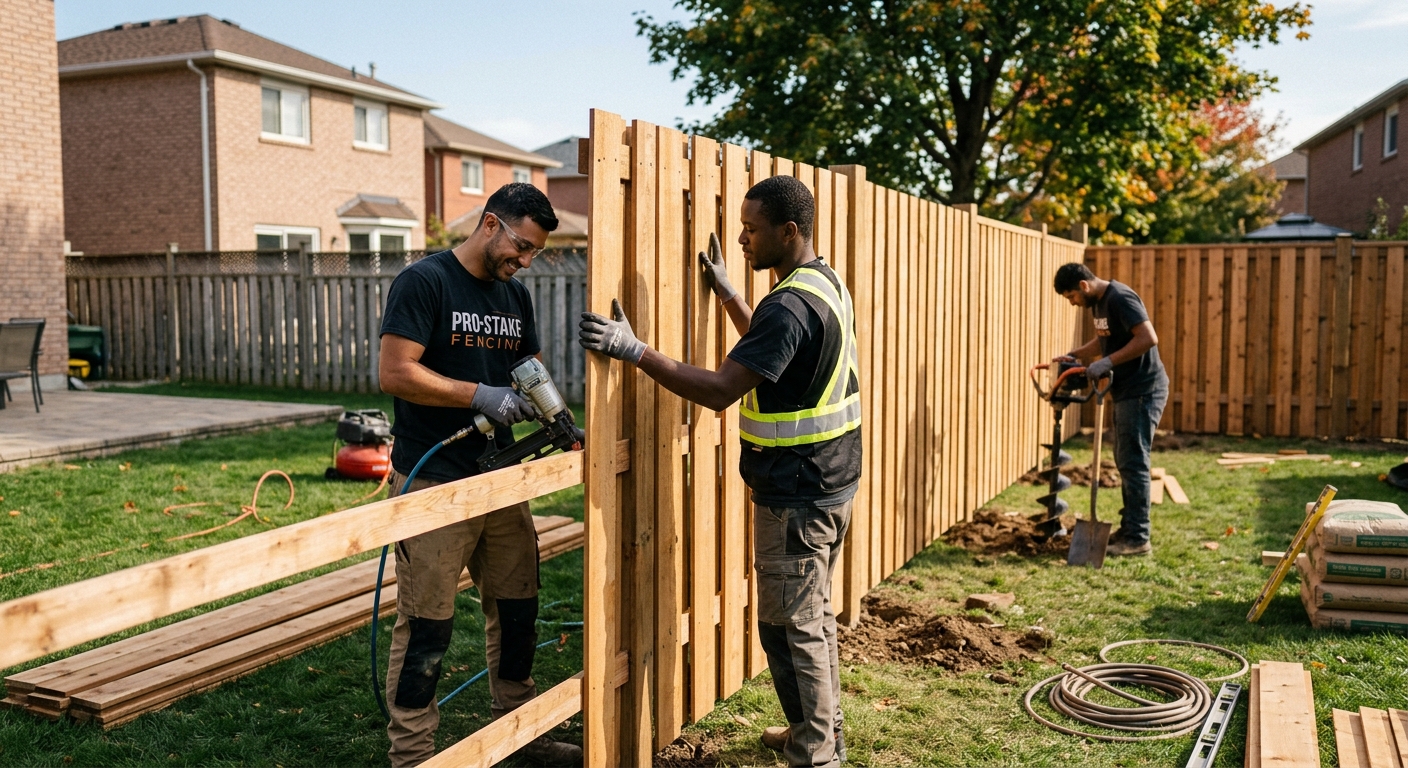
Fencing options and costs in Willowdale West
Willowdale West is a fast-moving part of Toronto where homeowners tend to upgrade outdoor spaces alongside landscaping, pool builds, and driveway work. With a population of 16,936 (Statistics Canada, 2021 Census), there’s steady local demand—particularly from detached-house neighbourhood streets where fencing is used to mark yards and improve privacy. In practice, fence buying is also strongly shaped by housing patterns across the Toronto economic region, where lots are often tighter and neighbours’ proximity makes privacy and line accuracy more important.
In Southern Ontario, pricing is influenced by climate and local building practice. The frost line is commonly planned around 42"–48", so posts for 6–8 ft privacy fences usually need to be set deep—typically 3.5–4 ft—to reduce frost heave risk. That means more excavation, more concrete, and longer posts, especially for wood and heavier panel systems. Availability and scheduling also matter: in a dense area like Willowdale West, access limits (driveways, gates, and sidewalk edges) can change labour hours, and contractors often price accordingly.
Trade demand is especially visible around parts of Willowdale West where backyards are narrower and homeowners prioritize privacy—areas close to Yonge Street corridors tend to see more requests for solid privacy panels and gates. Below is a straightforward comparison to help you budget before we talk about site-specific factors.
| Material |
Lifespan |
Maintenance |
Privacy Rating |
Price per Linear Foot |
| Pressure-treated pine (standard wood) |
15–25 years |
Stain/seal every 2–3 years; periodic fastener checks |
High (solid boards) |
$11 – $19 |
| Cedar (natural rot resistance) |
20–30 years |
Light stain or oil every 2–4 years; clean and inspect annually |
High (solid boards) |
$13 – $22 |
| Vinyl / PVC (no-maintenance) |
25–35 years |
Wash as needed; inspect posts and fasteners |
High (solid or semi-solid styles) |
$16 – $25 |
| Chain-link (galvanized steel) |
25–40 years |
Occasional tension check; rinse debris buildup |
Low–Medium (depends on slats) |
$8 – $14 |
| Aluminum ornamental |
30–45 years |
Minimal; rinse and inspect annually |
Low–Medium (ornamental infill) |
$16 – $28 |
| Composite / recycled material |
25–35 years |
Low; occasional cleaning; inspect for warping at posts |
High (solid composite boards) |
$18 – $30 |
Prices are estimates only and vary by project scope, site access and material selection.
What affects the price of fencing in Willowdale West
It’s common in Willowdale West to see fencing quotes for what looks like the “same fence” land 30–50% apart once you compare details. In Toronto and across Ontario, the variance usually comes down to how deeply posts must be set for freeze protection, whether concrete is included, how many gates you’re adding, and how tight the access is for hauling materials and disposing of old fencing. Labour availability also changes seasonally; when crews are booked for landscaping season, pricing can flex.
Here’s the big driver: frost depth planning. In Southern Ontario, posts are typically set 4–6 inches below the design frost depth—so many installs end up requiring 1.5–2.0 m into the ground. That depth translates into longer posts, deeper holes, and concrete-set work rather than simple gravel or driven posts, especially for 6–8 ft privacy fences. If you’re comparing materials, that extra footing work pushes wood and vinyl into the higher end of the local bands (for example, wood installations often land inside the $65 – $120 range depending on rail strength and panel style).
Two practical examples from Toronto-area conditions: (1) clay/mixed soils in many lots can hold shape differently during thaw, so we often recommend concrete-set posts to prevent gradual movement—this increases labour and ready-mix costs but improves stability. (2) when a fence runs along a narrow side yard, we may need smaller equipment access or more manual handling; that can raise labour hours even if the linear footage is similar.
Wind isn’t typically Prairies-level in the GTA, but panel racking still matters. Solid privacy styles often need heavier posts and closer spacing (commonly 6–8 ft centres), which can move costs toward the mid-to-upper end—especially for PVC/vinyl where post sizes and bracing are critical. Next, we’ll break down each price factor you’ll see on an itemised quote.
| Price Factor |
Why It Matters |
Cost Impact |
| Fence length in linear feet |
Most costs scale directly with total footage |
Major driver; smallest differences multiply across the run |
| Post depth required |
Frost line determines hole depth and post length |
Moderate–high increase in labour and material |
| Post setting method |
Concrete vs. gravel pack vs. driven posts affects stability |
Concrete-set typically costs more but reduces movement risk |
| Material choice |
Vinyl vs. cedar vs. chain-link changes hardware, labour and longevity |
Can swing total cost significantly; vinyl often higher than chain-link |
| Gate count and type |
Gates require heavier frames, hinges, and often tighter tolerances |
High impact; a double drive gate can add notable labour and steel |
| Grade and terrain |
Sloped yards require stepped rails or raked panels |
Moderate increase due to extra layout time and cut labour |
| Old fence removal and disposal |
Demolition, hauling, and dump fees affect schedule and cost |
Moderate; can be high if posts are deeply set |
| Permit fees and survey / property line locate |
Ensures correct location and compliance with local rules |
Usually small to moderate; survey can be a separate line item |
Permits & regulations in Ontario
In Ontario, fence rules are tied to both property lines and municipal bylaws, and a permit may be required once a fence exceeds typical height thresholds. As a homeowner guideline, fences above roughly 2.0 m (6.5 ft) at the rear and about 1.0–1.2 m (3–4 ft) at the front or corners often fall into “permit or approval” territory—especially when they can affect sightlines or encroach near roadway edges. Even when a permit isn’t required, you’re still responsible for building within your property line and complying with setback requirements.
Before any digging, call for utility locates using Ontario One Call. Then, confirm your property pins or arrange a professional locate/survey if your lot boundaries aren’t clear—this prevents expensive encroachment disputes with neighbours.
Shared fence maintenance generally follows shared-line practices: if a fence serves as the boundary and both parties benefit, responsibilities are commonly shared, but the exact split can vary depending on agreements and local line-fencing legislation. For compliance, your contractor should be able to show how they’re referencing the boundary.
How to verify your contractor for Willowdale West: ask for (1) their Ontario business licence/registration (where applicable), (2) proof of liability insurance and (3) proof of WSIB coverage (or a clearance letter showing your status). Review certificates of insurance for active coverage and ensure the policy lists your project address (or is valid for the work location). Only then confirm a start date in writing.
Choosing the right fence material for Willowdale West
Choosing the right fence material in Willowdale West means matching your priorities—privacy, low maintenance, budget, and lifespan—to Toronto’s freeze-thaw climate. The big practical point is post stability: with the frost line commonly planned around 42"–48", most privacy fences need concrete-set posts and deeper holes so panels don’t shift as the ground expands and contracts. That influences how materials perform at the posts and how long you’ll tolerate ongoing tightening or repairs.
Pressure-treated pine is the budget-friendly entry point, but in our Ontario weather it typically needs staining or sealing every 2–3 years to avoid grey weathering and premature cracking at high-dryness edges. Cedar resists rot better and looks more natural, which many homeowners appreciate, but it still benefits from periodic oil or stain to keep it looking sharp. Vinyl/PVC is designed for low maintenance; it washes clean and won’t rot, but extreme cold can make some panels feel stiffer and can reveal poor installation if posts aren’t braced properly. Chain-link is the least expensive and long-lived, but it offers limited privacy unless you add slats or privacy mesh. Aluminum is attractive and rust-resistant, providing a durable ornamental barrier, usually without the heavy privacy you get from solid wood or PVC.
For a realistic dollar example: if you’re pricing a solid privacy fence where wood comes in around the lower end of the local wood range, moving to vinyl often adds upfront cost (Toronto-area material pricing commonly lands vinyl higher than wood), but the trade-off is fewer maintenance visits. In many Willowdale West yards, that extra cost is justified when homeowners want “set it and forget it” and are budgeting for long-term stability. Wind and snow load are less punishing than Prairies conditions, yet solid panels still need proper post sizing and closer spacing to prevent racking.
| Material |
Cold Tolerance |
Lifespan |
Annual Maintenance |
Best For |
Price Band |
| Pressure-treated pine |
Good (with proper staining and stable posts) |
15–25 years |
Inspect 1–2x; stain/seal every 2–3 years |
Lowest upfront cost for privacy |
$65 – $120 |
| Cedar |
Good (excellent rot resistance in wet/dry cycles) |
20–30 years |
Inspect; oil/stain every 2–4 years |
Natural look with better weather resistance |
$80 – $130 |
| Vinyl / PVC |
Very good (best with correct spacing and bracing) |
25–35 years |
Wash and inspect fasteners/posts |
Low maintenance privacy |
$75 – $130 |
| Chain-link |
Very good (galvanized steel resists corrosion) |
25–40 years |
Minimal inspection; rinse buildup |
Security on a budget |
$45 – $85 |
| Aluminum ornamental |
Very good (won’t rust like steel) |
30–45 years |
Occasional rinse; inspect annually |
Decorative curb appeal and durability |
$90 – $160 |
| Composite / recycled material |
Good (depends on post anchoring and panel grading) |
25–35 years |
Low cleaning; inspect at hardware |
Privacy with low maintenance |
$95 – $160 |
How to choose a fencing contractor in Willowdale West
For fencing work in Willowdale West, don’t rely on a quick phone quote alone—verify the contractor’s credentials, then get itemised pricing. Start by confirming Ontario-specific requirements: ask for proof of liability insurance (active certificate) and proof of WSIB coverage (or a clearance letter if appropriate). You’ll also want to see an Ontario business registration/licence where applicable for the work they’re performing. Where to look: insurance certificates can be emailed directly for your job, WSIB/coverage documentation can be provided before scheduling, and licensing/business registration can typically be verified through public business search resources.
Next, request 2–3 written, itemised quotes that separate labour and materials. Look for line items that show: new posts (and depth), concrete quantities, rails, panels, gate hardware, and any permit or locate work. Avoid quotes that only provide a lump sum without showing what’s included—fencing costs commonly rise when demolition, disposal, and property-line locating weren’t assumed in the first place.
Warranty matters: confirm the workmanship warranty length (how long they guarantee post setting and panel alignment) and the product/manufacturer warranty for the materials themselves. Ask whether the warranty is transferable if you sell your home. Payment schedule should be conservative—never more than 10–15% upfront. A practical approach is to hold back until the fence is fully complete and inspected.
Finally, get a start date and completion estimate in writing. If a contractor can’t commit to a realistic timeline, it’s often a sign subcontracting or material lead times aren’t controlled.
- Request WSIB coverage proof (or clearance letter) before work begins.
- Ask for current liability insurance certificates and confirm coverage for your address or region.
- Use itemised quotes with labour + materials breakdown (posts, rails, panels, hardware, gates).
- Confirm post depth and setting method (concrete-set recommended for frost stability).
- Make sure permits/property line locate responsibilities are clearly stated.
- Verify old fence removal and disposal is included (or priced separately).
- Confirm who handles utility locate scheduling and whether the contractor respects locates before digging.
- Check gate hardware quality (hinges, latches, reinforcement) and who installs alignment shims.
- Confirm warranty terms in writing for workmanship and product materials.
- Set payment schedule: maximum 10–15% upfront; define holdback amount and conditions.
- Ensure measurements reference a plan (string line, level, stepped/raked layout for slopes).
- Get start date, duration estimate, and cleanup responsibilities documented.
Red flags to watch in Willowdale West: (1) no proof of WSIB/clearance or no valid insurance certificate, (2) vague quotes without post depth, concrete, or gate hardware specifications, (3) pressure to pay the majority upfront, (4) refusal to provide a written scope that lists exclusions (disposal, permits, property locate), and (5) dismissing frost-post depth concerns or suggesting driven posts for 6–8 ft privacy fences without freeze-stability reasoning.
Frequently asked questions — fencing in Willowdale West
Wood vs vinyl vs aluminum fence — which is best?
In Willowdale West, “best” usually depends on how much maintenance you’re willing to do and how private you need the yard to feel. Wood (pressure-treated pine) is often the budget route, with typical installation pricing landing in the $65 – $120 band depending on post depth, rail strength, and gate count. Vinyl/PVC usually costs more upfront (often the $75 – $130 range) but is popular for low maintenance in Toronto’s freeze-thaw cycles. Aluminum is typically durable and low-rust, but it’s best when you want curb appeal and boundary definition rather than full privacy; its pricing often sits in the $90 – $160 band. For most privacy-focused yards, solid wood or vinyl wins—provided posts are concrete-set deep enough to prevent frost movement.
Do I need a permit to build a fence in Ontario?
Possibly—Ontario rules depend on your fence location (rear vs front/corners) and height. As a practical guideline used by many municipalities, rear fences above about 2.0 m (6.5 ft) and front/corner fences above roughly 1.0–1.2 m (3–4 ft) often require a permit or approval. Even when a permit isn’t required, you still need to stay within your property line and follow municipal setback requirements. In Willowdale West, the safest path is to have your contractor confirm whether your proposed height triggers a permit, then document that in the quote. Also, before any holes are dug, ensure you do utility locates through Ontario One Call and confirm your boundary pins or arrange a proper locate so the fence doesn’t encroach.
How long does a wood fence last in Willowdale West?
A properly built wood fence in Ontario—especially with concrete-set posts set for freeze protection—commonly lasts 15–25 years for pressure-treated pine and about 20–30 years for cedar. In Willowdale West, the biggest reason wood fences fail early is not the wood alone, but installation details: shallow post depth and poor drainage can lead to movement after freeze-thaw, loosening rails and fasteners. Maintenance matters too: pressure-treated wood typically needs staining/sealing every 2–3 years to reduce grey weathering and cracking at joints. If you keep up with seasonal inspections (look for loose boards, tilted posts, and fastener corrosion), you’ll usually extend service life and reduce mid-cycle repair costs. If you want minimal upkeep, vinyl or composite can be a better long-term fit.
Who owns and maintains a shared fence?
Shared fence ownership and maintenance are usually governed by line-fencing principles under Ontario’s framework, but the “who pays for what” can depend on who built the fence, whether it serves as the boundary, and any agreements between neighbours. In practice, many disputes are avoided by documenting the boundary and discussing maintenance responsibilities before work starts. For homeowners in Willowdale West, the best approach is to confirm whether the fence is actually on the property line, then agree in writing on repair/replacement scope (posts, panels, and gate hardware). Your fencing contractor can help with practical documentation like measurements and layout referencing pins/locates, but the legal responsibility ultimately depends on the boundary situation and any shared agreements. When uncertain, a neighbour conversation plus a clear scope in writing prevents misunderstandings.
How do I find my property line before fencing?
Finding your property line is one of the most important steps in Ontario before installing posts. Start with your property pins: many Willowdale West lots have markers that reflect the legal boundary; if pins are unclear, use a professional property locate or survey. Many contractors will include (or coordinate) a locate as part of the project scope, but it should be explicitly stated in your quote. Avoid guessing from old fencing or landscaping lines, because fences sometimes sit slightly over or under the legal boundary. Also, remember to complete utility locates before digging. Once you know the boundary, your contractor can lay out the fence line, plan gate placement, and ensure the fence complies with setbacks and height requirements where applicable.
What's the most low-maintenance fence?
In Ontario, the lowest-maintenance options are typically vinyl/PVC or aluminum, with composite close behind depending on the product and installation quality. Vinyl/PVC is popular in Willowdale West because it won’t rot and usually only needs occasional rinsing and inspection of posts and hardware. Aluminum is also very resistant to rust and generally needs minimal upkeep beyond seasonal checks. If you want privacy and low maintenance, vinyl/PVC solid styles are often the best match, though they usually cost more than pressure-treated wood (commonly within the $75 – $130 installation band). Chain-link is also low-maintenance but offers limited privacy unless you add slats or mesh. Whatever you choose, the long-term upkeep depends heavily on correct post depth and bracing for Toronto’s freeze-thaw movement.