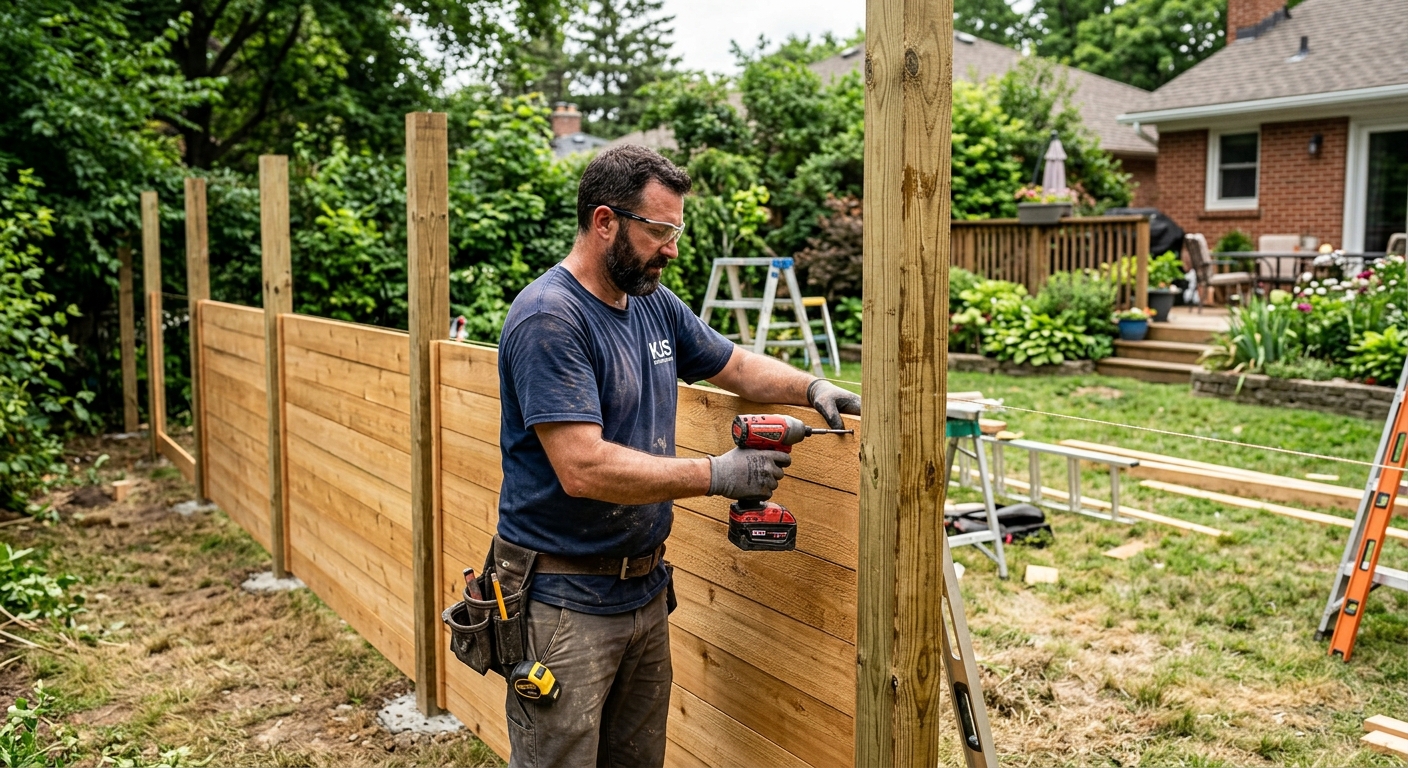
Fencing options and costs in Timmins
Timmins homeowners have a wide range of fencing options, and the local housing mix strongly influences what sells most. With 67.0% of households owning their homes and single-detached houses making up 65.1% of dwellings, many properties have private backyards that need boundary fencing for security, pets, and seasonal storage. Another big factor is the age of the housing stock—71.7% of homes were built before 1981—so it’s common to see older rails, leaning panels, and posts that have shifted over time and need replacement rather than “patching.”
In Northeast Ontario, fencing costs are shaped by long freeze–thaw cycles, wet snow events, and heavy winter winds that can rack tall panels and stress weaker posts. Even though Timmins isn’t as exposed as the Peace River prairie environments described in parts of western Canada, the province’s cold winters still mean contractors plan for deeper post setting to limit frost heave and movement. Availability can also affect pricing: during peak install months, crews may book out faster for neighbourhood-scale replacement jobs, especially for standard runs like 5–6 ft perimeter fences.
Trade demand is particularly high in areas with lots of detached homes and mature lots, such as the North End near downtown Timmins, where boundary lengths are often longer and property access (driveways, side gates, and mature landscaping) increases labour time. Below is a practical comparison of common materials and what homeowners typically budget per linear foot.
| Material |
Lifespan |
Maintenance |
Privacy Rating |
Price per Linear Foot |
| Pressure-treated pine (standard wood) |
10–15 years |
Stain/seal every 2–3 years |
Good–Very Good (solid panels) |
$80–$130 |
| Cedar (natural rot resistance) |
15–25 years |
Light staining/maintenance every 2–4 years |
Very Good (solid boards) |
$95–$140 |
| Vinyl / PVC (no-maintenance) |
20–30 years |
Wash as needed |
Very Good (privacy styles) |
$85–$140 |
| Chain-link (galvanized steel) |
20–40 years |
Occasional rinse; replace damaged links |
Low (can add privacy slats) |
$55–$90 |
| Aluminum ornamental |
25–40 years |
Wash as needed |
Low–Moderate |
$95–$150 |
| Composite / recycled material |
20–30 years |
Wash; minor repairs if damaged |
Good–Very Good (solid styles) |
$110–$160 |
Prices are estimates only and vary by project scope, site access and material selection.
What affects the price of fencing in Timmins
For the same yard layout in Timmins, fencing quotes can differ by 30–50% depending on how installers deal with cold-weather construction details and site constraints. Across Ontario, contractors price differently for factors like how they set posts (depth and concrete vs. gravel), crew access, and the labour intensity of building braces and gates. On top of that, the region’s demand cycles can shift availability: when older fences fail in winter storms or spring thaws, crews often get booked for fast replacements, which can raise labour rates.
The biggest cost driver is frost planning. Frost line depth typically determines how deep posts must be set—often roughly 4–6 inches below the design frost depth—to prevent heaving and seasonal movement. In cold Ontario and Alberta-style conditions, that commonly pushes posts to around 1.5–2.0 m into the ground, meaning longer posts, more excavation, and often concrete setting in deeper holes. That extra machine time can move a “typical” job up from the lower side of the wood band (around $80–$130) toward the higher end once concreting, braces, and longer rails are included.
Wind and panel design matter too. Even if Timmins wind exposure is not identical to prairie fetch, tall, solid privacy fences still act like wind sails during gusts, so contractors tighten post spacing and may upsize rails—especially for 6 ft and higher privacy systems. As a result, a vinyl privacy job can run closer to $85–$140 when the base structure is beefed up for winter loads.
Concrete examples that commonly change the price in Timmins: (1) removing an old fence with buried rotten posts often requires extra excavation and disposal, (2) replacing sagging runs may uncover misaligned property line markers that require a careful locate before continuing, and (3) steep or uneven yards can require stepped grading, increasing material and labour. With many homes dating back pre-1981 (Statistics Canada, 2021 Census), older fence posts are more likely to have moisture-related rot and frost movement, driving replacement scope and cost.
| Price Factor |
Why It Matters |
Cost Impact |
| Fence length in linear feet |
Material and labour scale directly with run length |
High (primary driver of total cost) |
| Post depth required |
Frost line determines post length and hole depth |
High (extra excavation and longer posts) |
| Post setting method |
Concrete vs. gravel pack vs. driven posts affects stability |
Medium–High (concrete adds materials/time) |
| Material choice |
Vinyl/cedar cost and structure requirements differ |
Medium (can shift you into higher bands) |
| Gate count and type |
Drive-through gates need heavier frames and hardware |
Medium–High (hardware + stronger posts) |
| Grade and terrain |
Sloped yards require stepped or raked panels |
Medium (extra labour and cut material) |
| Old fence removal and disposal |
Rotten posts often require deeper digging |
Medium (dump fees + labour) |
| Permit fees and survey / property line locate |
Ensures correct alignment and avoids rework |
Low–Medium (project-dependent) |
Permits & regulations in Ontario
In Ontario, fences above a height threshold—commonly 2.0 m (6.5 ft) at the rear and about 1.0–1.2 m (3–4 ft) at the front or corner—may require a building permit, depending on where the fence sits relative to the street and local setback rules. Even when a permit is not triggered, the fence still must respect property lines and municipal setback bylaws. If you’re unsure of your exact boundary, confirm it before installing posts.
Before digging any post hole, call for utility locates through Ontario One Call to mark buried services. Then, obtain a survey (or at minimum a property pin locate) so you can build to the correct line—this is a common cause of disputes and rework when older boundary markers are unclear.
Step-by-step for verifying contractor readiness in Timmins: (1) ask for their Ontario business information and check their licensing/registration details through the relevant provincial sources, (2) request a current certificate of liability insurance showing they carry coverage for property damage and bodily injury, and (3) confirm WSIB coverage where applicable (or WCB clearance documentation for the appropriate coverage situation). Also request these documents as copies with your quote—reputable contractors will provide them without pressure.
Shared fence ownership and line-fence responsibilities are governed by Ontario line-fences legislation. The safest approach is to review the fence location, height, and responsibilities in writing with any adjacent property owner before work begins.
Choosing the right fence material for Timmins
Choosing a fence for Timmins comes down to matching material performance to how you use your yard: privacy, low maintenance, budget, and how long you want to avoid replacement. Timmins winters bring moisture and freeze–thaw stress, so even “good” materials fail sooner if posts are under-set or if the fence isn’t braced for seasonal movement.
Pressure-treated pine is the budget-friendly entry point, but it still needs staining or sealing every 2–3 years to reduce grey weathering and water uptake. Cedar looks better longer and resists rot naturally, which often makes it a strong mid-cost choice for privacy. Vinyl/PVC is popular for its low maintenance—no periodic staining—but extreme cold can make thinner products brittle, and cheap installations can struggle when posts move; it’s typically priced closer to the mid-to-upper band of the $85–$140 range for privacy runs. Chain-link is the most economical and longest-lived option, though it offers low privacy unless you add slats or consider an alternate design. Aluminum ornamental provides a clean, rust-resistant look with modest privacy, often used for front yard boundaries or where visibility matters. Composite/recycled fencing can offer solid privacy with less upkeep than wood, but it’s usually a premium upfront.
Post depth is where cold weather drives decisions. In Timmins, contractors generally plan for deep setting to limit heaving—concrete-set posts are commonly used for stability on heavier fences and in higher-risk soil. Wind and snow load also influence the structural build: solid privacy panels need stronger bracing, and lightweight rail systems may need tighter post spacing.
For a practical dollar example: if a solid cedar privacy fence comes in closer to $95–$140 per linear foot, it can be justified over pressure-treated pine at $80–$130 when you want fewer repainting cycles and a cleaner look through the first 10+ years. If your priority is strict cost control and long-term durability, chain-link around $55–$90 can also be the most rational baseline.
| Material |
Cold Tolerance |
Lifespan |
Annual Maintenance |
Best For |
Price Band |
| Pressure-treated pine |
Good with proper posts and sealing |
10–15 years |
Stain/seal every 2–3 years |
Budget privacy with regular upkeep |
$80–$130 |
| Cedar |
Very good; handles wet/dry cycles well |
15–25 years |
Light maintenance every 2–4 years |
Premium look and rot resistance |
$95–$140 |
| Vinyl / PVC |
Good; choose quality and proper structure |
20–30 years |
Wash as needed |
Low-maintenance privacy |
$85–$140 |
| Chain-link |
Excellent; won’t rot |
20–40 years |
Rinse/spot repairs as needed |
Security on a budget |
$55–$90 |
| Aluminum ornamental |
Very good; rust-resistant |
25–40 years |
Wash as needed |
Front-yard curb appeal |
$95–$150 |
| Composite / recycled material |
Very good; stable in freeze–thaw |
20–30 years |
Wash; minor repairs |
Solid privacy with reduced upkeep |
$110–$160 |
How to choose a fencing contractor in Timmins
Choosing a contractor in Timmins is mostly about verification and clarity. First, confirm licensing/registration where applicable in Ontario and request a current certificate of liability insurance (it should list the worksite/province and include adequate coverage). Next, confirm WSIB coverage where applicable and ask for WSIB clearance documentation (or appropriate coverage documentation if their work structure differs). If they can’t provide these promptly, treat it as a major warning.
Then get 2–3 itemised written quotes—ask for a breakdown that separates labour (excavation, post setting, framing, rails, gate install) and materials (posts, concrete, rails, pickets/panels, hardware, fasteners). A solid quote also notes whether permit fees, utility locate coordination, and property line locating are included or billed separately. Read the scope: what’s excluded (e.g., tree removal, trenching across hardpack, landscaping reinstatement, electrical/lighting for gates)? Confirm whether old fence removal and disposal are part of the price.
Warranty matters. Ask for the workmanship warranty length, whether it covers re-setting moved posts, and whether it’s transferable to future owners. Also check if there’s a separate manufacturer warranty for panels/posts. For payment, use a conservative schedule: never pay more than 10–15% upfront; hold back a portion until the fence is complete, gates function properly, and the site is cleaned up. Finally, require a written start date and a completion estimate—winter timing can affect delivery and crew scheduling.
- Request proof of liability insurance before signing.
- Request WSIB coverage documentation and confirm it’s current.
- Ask for an Ontario business contact and reference the project location in the quote.
- Get at least 2–3 itemised quotes (labour + materials, not a lump sum).
- Confirm post setting method (concrete vs. alternative) and post depth plan for frost movement.
- Verify gate hardware type and whether hinges/latches are rated for winter use.
- Ensure the quote includes disposal/removal of old fencing if needed.
- Ask how they handle slopes—stepped vs. raked layout—and whether it changes pricing.
- Confirm utility locate responsibility and whether they will schedule Ontario One Call.
- Clarify permit/pull responsibilities if a permit is required for your height/location.
- Check workmanship warranty duration and what repairs are covered after freeze–thaw seasons.
- Use a payment schedule with a holdback until final inspection and cleanup.
Red flags I often see in Timmins: contractors who won’t show insurance/coverage documents, quotes that don’t specify post depth or setting method, vague scopes that omit gate hardware details, “cash only” payment requests with no written agreement, and start dates that keep slipping without any change-order process.
Frequently asked questions — fencing in Timmins
Should fence posts be set in concrete here?
In Timmins, concrete-set posts are often the best choice for stability because freeze–thaw cycles and moisture can encourage frost heave and gradual movement. Many installers plan to set posts deeper than “surface” installs—commonly around 4–6 inches below the local design frost depth—so the fence stays true after winter. For heavier systems like privacy boards, taller gates, or where soil is soft or uneven, concrete helps resist lateral shifting. That said, the right method depends on your soil and fence type, so a good contractor will explain the plan in your quote (post depth, hole size, and whether they use concrete or an engineered alternative).
If you’re comparing quotes, look for a clear line item for post setting rather than assuming all contractors treat posts the same—this is a common reason pricing differs within the wood and vinyl bands (for example, $80–$130 for standard wood installations).
What's the best fence for privacy?
For privacy in Timmins, the best match is usually a solid-panel privacy fence: cedar or pressure-treated wood for a traditional look, or vinyl/PVC privacy panels for low upkeep. Solid fences block views, but they also catch wind, so the structural build has to be designed for winter gusts and snow load—stronger bracing, appropriate post spacing, and properly set posts. Cedar often performs well in our wet-to-freeze cycles and can look better for longer than standard pine, while vinyl is attractive if you want “wash and forget” maintenance, but you still need quality installation so it doesn’t become loose as posts settle or shift.
Budget-wise, privacy options typically fall in the mid-to-upper installed ranges. For example, standard wood privacy projects are often budgeted around $80–$130, while vinyl privacy tends to land around $85–$140 depending on height, gate count, and how much reinforcement the contractor includes.
How do I compare fencing quotes?
Compare quotes like-for-like, not by total price alone. Start by confirming the fence type, height, and style (solid privacy vs. open rails, board spacing, and gate style). Then check post setting: post depth, whether holes are concreted, and the planned post spacing. Quotes should also list what’s included—fence removal and disposal, utility locate coordination, and whether permit/pull work is included if your fence height/location triggers it. Make sure materials are specified (wood species, vinyl line thickness/grade, chain-link gauge/coating) and that hardware is described for gates (hinges, latch type, and reinforcement).
Finally, look for warranty language and the payment schedule. A reasonable approach in Ontario is to never pay more than 10–15% upfront and hold back until the fence is complete and gates operate smoothly. If one quote is far below the others but doesn’t explain these details, it usually means a scope gap.
How long does fence installation take in Timmins?
Timmins timelines depend on fence length, number of posts, gates, and whether you’re removing an existing fence. Many crews can install a straightforward run in a matter of days, but deeper frost planning, difficult access, or old-post removal adds time. Weather also plays a role: in winter, the ground can be hard and excavation slower, which increases labour time for drilling and post setting. That’s why it’s smart to ask for a written start date and a completion estimate, rather than a vague “this week” promise.
As a homeowner, you can use scope to estimate: longer linear runs usually expand crew time more than people expect because each corner post, gate, and brace requires extra installation steps. Also ask whether the contractor is planning concrete setting or other methods, since curing and additional work steps can stretch the schedule.
Can I install a fence on a slope in Timmins?
Yes, you can install a fence on a slope in Timmins, but it needs the right layout method. Contractors typically choose between stepped panels (keeping posts vertical and adjusting panel height in increments) or raked panels (following the slope with angled rails). Stepped layouts are often best for privacy fences where aesthetics and consistent top lines matter; raked designs can work, but the look changes as the grade shifts and may require extra trimming and reinforced rails.
When you’re getting quotes, ask how the fence will be measured and how the slope affects material usage and labour. Slopes can increase installation time due to extra cuts, more precise post heights, and sometimes additional bracing. If you’re removing a worn older fence, the slope may reveal drainage issues or soft soil, which can influence post setting depth and whether concrete is recommended.
What is the most weather-resistant fence for Timmins's climate?
For Timmins’s freeze–thaw conditions, chain-link and aluminum are often the most weather-resistant in the long run because they don’t rot and handle moisture cycling well. Chain-link provides the strongest durability-to-cost ratio and can last decades, especially with good post setting and proper tensioning. Aluminum ornamental is also resistant to rust and doesn’t need staining, though it offers limited privacy unless combined with additional screening. For full privacy, cedar and vinyl can be very durable when installed correctly—mainly by setting posts deep enough to prevent movement and bracing the fence for wind stress.
If you want a quick budget reference, chain-link installations are commonly positioned around $55–$90 per linear foot, while aluminum ornamental is more often in the $95–$150 range. The “most weather-resistant” choice depends on whether you want visibility control or maximum longevity with minimal upkeep.