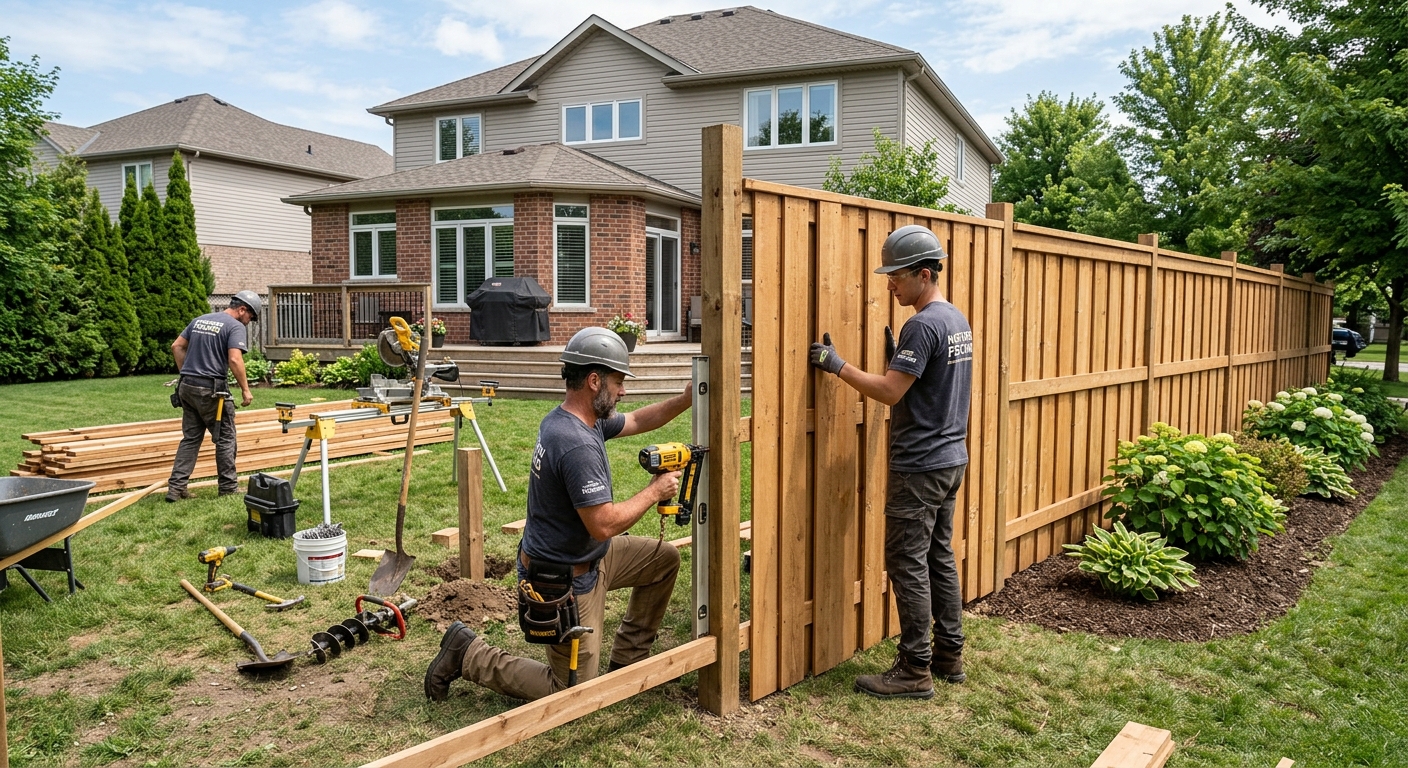
Fencing options and costs in Ottawa
Ottawa is where fencing choices quickly become a mix of weatherproofing and practicality. With 260,220 homeowner households in the Ottawa area (Statistics Canada, 2021 Census) and single-detached houses making up 41.7% of dwellings, there’s steady demand for backyard privacy, pet containment, and front-yard boundary definition—often on established lots where an older fence is being replaced rather than installed on blank ground. That matters for cost because removal, post replacement, and clean disposal are frequently bundled into “replacement” quotes.
Ottawa’s winters drive the numbers. Quality installations set posts close to the regional frost depth (about 3.5–4 ft), which typically means digging holes deep enough for stable, winter-heave-resistant concrete footings—especially when soils are clay and shift through freeze–thaw cycles. Labour time and machine time rise accordingly, and that can push prices toward the upper end of Ontario’s typical bands. Wind and drifting snow also influence spacing and bracing for privacy fences, so a “standard” design may be upsized for gusty lots.
In neighbourhoods with lots of older housing stock—like Alta Vista and comparable mature residential areas—contractors often see frequent fence refreshes because the original post-and-rail systems have aged. Next, here’s a side-by-side cost guide by material so you can compare options before you request an itemised quote.
| Material |
Lifespan |
Maintenance |
Privacy Rating |
Price per Linear Foot |
| Pressure-treated pine (standard wood) |
10–15 years |
Stain/seal every 2–3 years; inspect posts annually |
High (with solid boards) |
$40 – $75 |
| Cedar (natural rot resistance) |
15–25 years |
Stain or clear coat every 2–4 years |
High (with solid boards) |
$55 – $95 |
| Vinyl / PVC (no-maintenance) |
20–30 years |
Wash with soap/water; inspect for flex in extreme cold |
Medium to High (style-dependent) |
$45 – $90 |
| Chain-link (galvanized steel) |
25–40 years |
Occasional rinse; replace damaged sections as needed |
Low (no privacy unless added screening) |
$25 – $50 |
| Aluminum ornamental |
30–45 years |
Rinse; repaint only if you choose a custom finish |
Low to Medium (decorative pickets) |
$70 – $120 |
| Composite / recycled material |
20–35 years |
Wash as needed; limited staining |
Medium to High (solid designs) |
$85 – $135 |
Prices are estimates only and vary by project scope, site access and material selection.
What affects the price of fencing in Ottawa
In Ottawa, two homeowners can receive very different quotes for what looks like the same fence. It’s common to see swings of 30–50% across the city because the real cost drivers aren’t just the material—they’re how deep posts must go, how much excavation is required, how many gates you need, and whether your yard is accessible for augers and dump runs. Ottawa’s housing mix also matters: many properties include mature landscaping, mature trees, and older fences—plus a large share of homes built before 1981 (44.2% of dwellings in the local profile), which often means more removal and more post holes than a first-time installation.
Frost depth sets the foundation work. With Ottawa’s frost depth around 3.5–4 ft, quality installers typically dig deeper—often about 4–6 inches below the design frost line—so posts don’t heave and lean. In practical terms, that usually means 1.5–2.0 m into the ground and concrete setting for many lots. That’s longer post lengths, more labour, and more concrete and disposal costs, which helps explain why wood can end up near the upper end of the $40–$75 band and why vinyl and cedar often don’t land at the low end either.
Ottawa’s wind exposure is rarely “Prairie extreme,” but privacy panels still catch gusts and drifting snow, so contractors may tighten post spacing and add bracing. For an Ottawa backyard backing onto an open or treeless area, a stronger post schedule can raise labour and materials. Conversely, a sheltered lot with straight runs and good access can bring costs down toward the lower end of Ontario bands, and chain-link typically stays closer to $25–$50 because its footing approach is often simpler.
Here are examples of how local conditions change your bill: clay soils can require extra care and concrete for stability; rocky areas can slow auger drilling; and sloped yards often need stepped or raked panels that add layout time. These are the reasons your quote should be itemised—not lumped—before you choose a material.
| Price Factor |
Why It Matters |
Cost Impact |
| Fence length in linear feet |
Every extra foot adds posts, rails, hardware and install time. |
Major; often the largest portion of total cost. |
| Post depth required |
Ottawa frost depth drives hole depth; deeper holes require longer posts and more excavation. |
Moderate to high; can add significant labour and concrete. |
| Post setting method |
Concrete setting improves stability in freeze–thaw soils versus gravel packs or driven methods alone. |
High for many residential privacy fences in Ottawa. |
| Material choice |
Vinyl/PVC and composite cost more upfront; chain-link saves on material but not on framing. |
Ranges widely; commonly shifts totals by $15–$40/ft equivalent. |
| Gate count and type |
Double drive gates need stronger posts and more hardware. |
High; gates can be priced as premium subcomponents. |
| Grade and terrain |
Slopes require stepped/raked sections, extra layout, and sometimes custom fabrication. |
Moderate; increases time and waste. |
| Old fence removal and disposal |
Debris hauling, dump fees, and time can be substantial on replacement jobs. |
Moderate to high depending on condition and access. |
| Permit fees and survey / property line locate |
Some fences need permits and accurate line confirmation avoids costly rework. |
Usually low to moderate, but can be critical. |
Permits & regulations in Ontario
In Ontario, fence rules can vary by municipality, but the province-wide reality is that many fences above certain heights trigger a permit process. A common threshold is around 2.0 m (6.5 ft) for rear yards, while front yards or corner lots often have lower thresholds (often 1.0–1.2 m or 3–4 ft). That means a “privacy fence” designed for backyard screening is more likely to need approval than a low boundary fence. Regardless of height, all fences must respect property lines and any municipal setback bylaws.
Before you dig any post holes, you must call for utility locates. In Ontario that means using Ontario One Call so utilities are marked prior to excavation. Also, get a survey or at least a property pin/locate before installing to reduce the risk of encroachment disputes—especially on older lots where original boundaries may be unclear.
Shared fence ownership and responsibilities are typically governed by Ontario line-fences legislation, which affects who can maintain, replace, or relocate a fence when it sits on or near the boundary.
What typically requires a permit: new fence builds that exceed the local height threshold (commonly around 2.0 m for rear yards), plus situations involving corner visibility areas or other special local conditions.
What typically does NOT require a permit: like-for-like repairs or short, low-height replacements that stay under the local height limit and do not alter the boundary layout.
To verify an Ontario contractor, ask for their business details and then check: (1) their Ontario licence/registration information on the relevant online registry, (2) a certificate of liability insurance naming you as an additional insured where applicable, and (3) proof of coverage such as WSIB/WCB clearance or coverage letter for their workers. Request these before work begins and keep copies with your quote.
Choosing the right fence material for Ottawa
Choosing the right fence material in Ottawa is mostly about matching your priorities—privacy, low maintenance, budget, and lifespan—to a climate that repeatedly freezes and thaws. Ottawa’s frost conditions mean posts must be set properly (often using concrete footings and digging to near the regional frost line) for the fence to stay straight over time, no matter which material you pick.
Pressure-treated pine is usually the lowest upfront option, but it’s not truly “set and forget.” Expect staining or sealing every 2–3 years to reduce greying and help resist water penetration at board ends and rail joints. Cedar typically looks better and resists rot more naturally, so homeowners often see longer useful life, but it still benefits from periodic staining or coating to keep colour and reduce surface checking.
Vinyl/PVC offers real low maintenance: wash it, inspect it, and move on. The trade-off is upfront cost and performance in extreme cold—vinyl can become brittle if the installation doesn’t allow for proper expansion and uses the right rail design. Chain-link is the most budget-friendly and longest-lasting for longevity, but it won’t provide privacy unless you add screening or a top privacy slat system. Aluminum ornamental fences won’t rust and are great for curb appeal, but they’re not designed for high privacy.
For many Ottawa homeowners, the “best value” is when the material’s strengths align with the foundation requirements. For example, if you already have to invest in deep concrete-set posts due to frost depth, spending a bit more on cedar or a properly built vinyl system can be justified because the fence won’t fail at the base—while cheap materials can age faster in the upper rails and board tops where moisture and wind-driven snow hit hardest.
| Material |
Cold Tolerance |
Lifespan |
Annual Maintenance |
Best For |
Price Band |
| Pressure-treated pine |
Good when posts are deep-set and boards are sealed |
10–15 years |
Inspect annually; stain/seal every 2–3 years |
Lower budget with traditional look |
$40 – $75 |
| Cedar |
Very good; performs well in freeze–thaw when kept coated |
15–25 years |
Inspect annually; stain/coat every 2–4 years |
Natural appearance and better rot resistance |
$55 – $95 |
| Vinyl / PVC |
Good if installed with proper expansion and rigid post spacing |
20–30 years |
Wash as needed; check fit and flex after hard winters |
Low maintenance and privacy styles |
$45 – $90 |
| Chain-link |
Excellent; galvanized steel handles winter well |
25–40 years |
Minimal; rinse and spot-fix damage |
Security and pet containment |
$25 – $50 |
| Aluminum ornamental |
Excellent; powder coat resists winter weathering |
30–45 years |
Minimal; rinse and touch up if desired |
Curb appeal without rust |
$70 – $120 |
| Composite / recycled |
Good; stable boards if installed correctly with proper support |
20–35 years |
Wash as needed; limited coatings |
Long life with a modern, low-maintenance look |
$85 – $135 |
How to choose a fencing contractor in Ottawa
Choosing the right contractor in Ottawa comes down to verified coverage, clear scope, and realistic installation methods for our freeze–thaw conditions. Start by verifying Ontario licensing/registration (if required for the contractor’s trade category) and then request proof of liability insurance. Your contractor should provide an up-to-date certificate showing the policy holder, coverage limits and expiry date. Next, confirm worker coverage through WSIB/WCB compliance—ask for a clearance letter or proof of coverage for their workers (not just a subcontractor’s name). For your peace of mind, keep these documents with your contract so you can confirm eligibility if there’s damage or an on-site incident.
Get 2–3 itemised written quotes, not just one lump-sum number. Itemisation should separate labour, posts/footings (including concrete setting), rails, pickets/panels, gates, hardware, and removal/disposal. Ask whether a permit pull is included when needed, and what’s excluded (for example, marking tree roots, landscaping reinstatement, or extending beyond the assumed measurement).
Warranty matters in Ottawa where board joints and post stability are tested repeatedly each winter. Confirm the workmanship warranty length, whether the product/manufacturer warranty covers colour/finish or only material defects, and whether warranties are transferable if you sell your home. For payment scheduling, never pay more than 10–15% upfront; a practical holdback is held until the job is complete and reviewed.
Finally, insist on a timeline in writing: a start date target and an estimated completion window, because post-hole excavation, concrete cure time, and deliveries can change the schedule.
- Provide Ontario licensing/registration information before starting.
- Share a current certificate of liability insurance (with coverage expiry date).
- Provide WSIB/WCB clearance or proof of coverage for workers.
- Submit an itemised quote (labour vs materials vs hardware vs gates).
- Clarify footing scope: concrete set vs gravel pack vs driven posts.
- Confirm post depth approach aligned with Ottawa frost conditions.
- Include disposal/hauling costs for removed fence materials.
- State whether utility locate costs or permit fees are included.
- Specify gate type (walk-through vs double drive) and hardware quality.
- Define how they’ll handle sloped yards (stepped vs raked panels).
- Provide a workmanship warranty and separate manufacturer warranty terms.
- Use a payment schedule with a holdback until final acceptance.
Red flags I see in Ottawa include: contractors who won’t provide insurance/WSIB proof, quotes that omit footing depth and concrete setting details, “allowance” language that makes totals unclear, refusing to itemise gates and removal/disposal, and pushing for a large upfront payment (beyond 10–15%).
Frequently asked questions — fencing in Ottawa
Wood vs vinyl vs aluminum fence — which is best?
In Ottawa, the “best” fence depends on whether you’re prioritizing privacy, maintenance, or curb appeal. Wood (pressure-treated pine or cedar) can deliver strong privacy and looks great, but it usually needs planned upkeep; most homeowners should expect staining every 2–3 years on pine and periodic coating on cedar to slow weather greying and moisture wear. Vinyl/PVC is typically the lowest maintenance choice and often provides good privacy in solid panel styles, but it costs more upfront than standard wood and needs correct installation to perform well in extreme cold. Aluminum ornamental is best for appearance and rust resistance; it’s excellent for front yards but usually won’t satisfy privacy goals. If you want a practical benchmark, wood installs in the region commonly land in the $40–$75 per linear foot range, while aluminum ornamental often sits higher in the $70–$120 band.
Do I need a permit to build a fence in Ontario?
Often, yes—depending on height and location. In Ontario, many municipalities require a building permit when a fence exceeds common height thresholds, frequently around 2.0 m (about 6.5 ft) for rear yards and lower heights (often 1.0–1.2 m) in front or corner areas. Ottawa homeowners should also follow setback and visibility rules where applicable. Regardless of whether a permit is required, you must respect property lines and municipal bylaws. Before digging, call Ontario One Call for utility locates so your contractor doesn’t hit buried services. Finally, if you’re replacing an existing fence “exactly like for like” and staying under the threshold, a permit may not be required—but confirm with your contractor and the municipality so your paperwork is correct.
How long does a wood fence last in Ottawa?
With proper post depth, concrete setting where appropriate, and routine maintenance, a wood fence in Ottawa commonly lasts about 10–15 years for pressure-treated pine and around 15–25 years for cedar. Ottawa’s freeze–thaw cycles are the key reason maintenance and construction quality matter: if posts aren’t set deep enough near the frost depth, they can shift and cause leaning and gaps. Moisture on the top rails and board ends can accelerate weathering, which is why staining every 2–3 years on pine is typical. Cedar resists rot better naturally, but it still benefits from coating to reduce surface cracking and water absorption. If you’re comparing prices, remember that choosing a fence plan near the middle of the $40–$75 band can still produce long results when footing and sealing are done right.
Who owns and maintains a shared fence?
Shared fences are governed by Ontario line-fences rules, and ownership can depend on how the fence is located relative to the boundary and how it was originally established. Many disputes happen when neighbours assume “half-and-half” without confirming boundary placement. As a homeowner, start by verifying where the property line actually runs (survey pins/locates can help) and document the fence’s condition. Maintenance responsibilities commonly fall on the parties in a way that reflects their shared use, but the practical approach is to communicate early: agree on repair scope, costs, and whether one side will lead the project. If the fence is deteriorated, it’s also wise to keep photos and written messages so expectations are clear. A licensed contractor can also help document what needs to be repaired versus replaced.
How do I find my property line before fencing?
The safest method in Ottawa is to rely on a survey or a proper property pin/locate rather than guessing from landmarks or old measurements. Before any post holes are dug, confirm the boundary so you don’t build on a neighbour’s land or run through municipal setbacks. Many homeowners start with existing survey documents, but these can be outdated or unclear—especially on older properties built before 1981 (44.2% of local dwellings). A surveyor can mark the pins, and some municipalities also provide locate information. Once you know the line, mark the proposed fence route on the ground and take photos for your records. If you want peace of mind, ask your contractor whether they’ll coordinate layout from your pins/survey and include any property line location steps in the quote.
What's the most low-maintenance fence?
For low maintenance in Ottawa, vinyl/PVC is usually the first choice, because it typically doesn’t require staining or repainting. In practice, you’ll still want to rinse it occasionally and inspect for fastening issues after heavy snow or hard freezes, but the “annual work” is minimal compared with wood. Chain-link is also very low maintenance and can last decades, but it won’t provide privacy unless you add screening or slats. Aluminum ornamental is likewise low maintenance and won’t rust, though it may not meet privacy goals. If you compare budgets, vinyl often falls into the $45–$90 per linear foot range in Ontario residential pricing, while chain-link commonly sits around $25–$50. The best “low maintenance” pick is the one that matches your privacy needs while using proper deep-set posts for stability in winter.