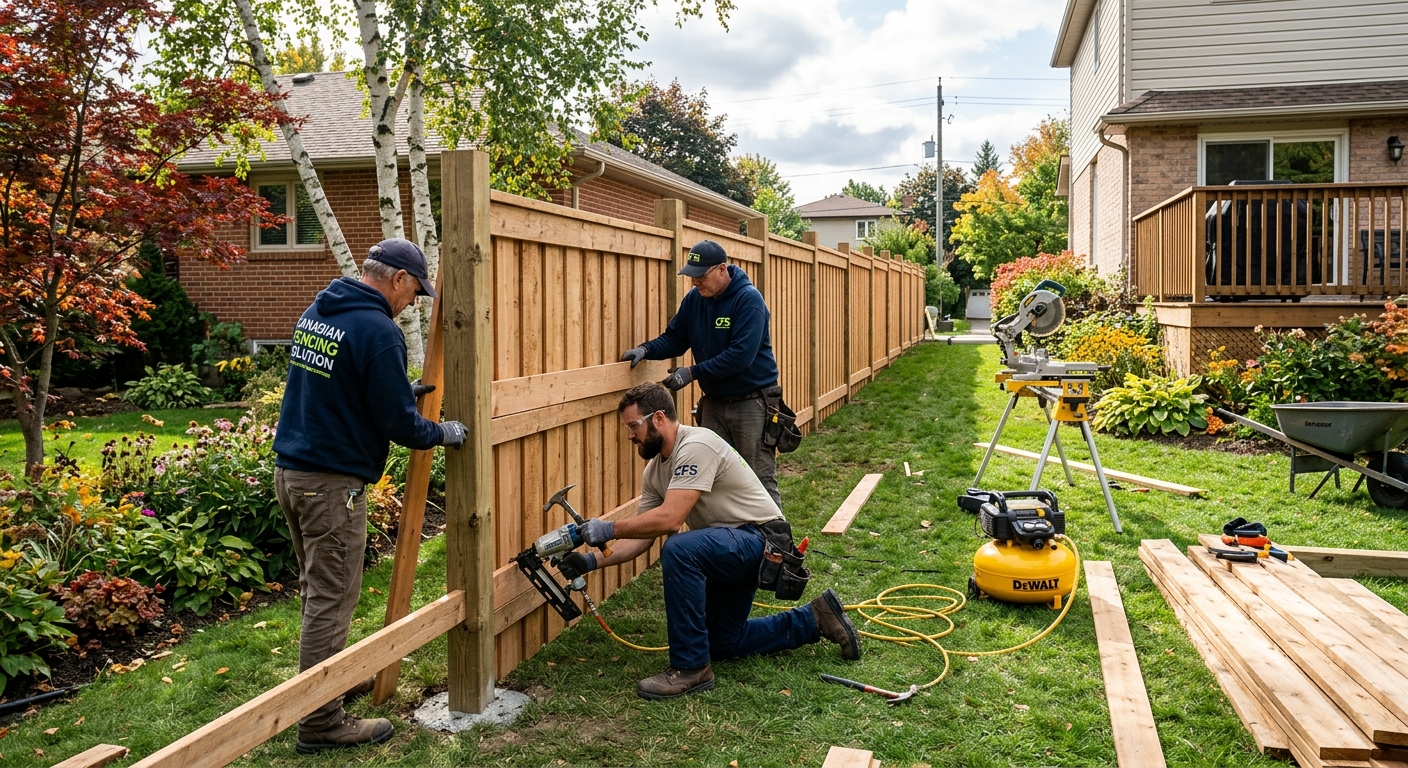
Fencing options and costs in Tam O'Shanter-Sullivan
Tam O'Shanter-Sullivan is a busy, family-focused part of Toronto, and fencing demand follows the pattern of local housing—where the area’s mix of homes creates a steady pipeline of rear-yard projects and side-yard repairs. With a 2021 population of 27,446 (Statistics Canada, 2021 Census), you’ll see plenty of ongoing upgrades, especially around neighbourhood blocks where backyards back onto wider lanes and green spaces. That growth matters for pricing because it impacts contractor availability during peak season, and it also influences how quickly crews can schedule post-and-panel work.
In Southern Ontario, frost depth is a major reason fences cost more here than people expect. In practice, many contractors plan for concrete-set posts because posts must be installed below the frost line—commonly starting around 42"–48"—to prevent heaving. For the typical 6–8 ft privacy fence in this area, that usually means deeper holes, longer posts, and more concrete than a homeowner might budget for when they first compare “cheap” quotes. Wind still plays a role in the GTA, particularly at corner lots and where yards are more exposed, which pushes installers to use heavier posts and tighter spacing for solid panels.
If you’re in or near areas such as Finchdene / McNicoll pockets (within Tam O’Shanter-Sullivan), fencing work is especially in demand as families refresh privacy, containment, and pet barriers. Use the table below to compare common material choices and realistic price bands for installed fencing in your neighbourhood, then we’ll break down what drives variation in Section 2.
| Material |
Lifespan |
Maintenance |
Privacy Rating |
Price per Linear Foot |
| Pressure-treated pine (standard wood) |
10–15 years |
Stain/seal every 2–3 years; annual inspection |
High (solid picket/board) |
$65–$120 |
| Cedar (natural rot resistance) |
15–25 years |
Typically stain every 2–3 years; clean debris build-up |
High (solid cedar board/picket) |
$90–$145 |
| Vinyl / PVC (no-maintenance) |
25–35 years |
Rinse as needed; inspect for impact cracks |
High (solid privacy panels) |
$75–$130 |
| Chain-link (galvanized steel) |
20–30 years |
Occasional tightening and rinse; replace bent sections |
Low–Medium (privacy slats needed) |
$45–$85 |
| Aluminum ornamental |
25–40 years |
Occasional wash; check caps/hardware |
Low–Medium (decorative spacing) |
$90–$160 |
| Composite / recycled material |
20–30 years |
Low; wash and spot-check fasteners |
High (solid board styles) |
$85–$150 |
Prices are estimates only and vary by project scope, site access and material selection.
What affects the price of fencing in Tam O'Shanter-Sullivan
Even when homeowners describe the “same fence” across Toronto, quotes can swing by 30–50%—and it’s rarely because contractors are simply overcharging. In practice, the difference is usually found in three areas: how deep they set posts for Ontario frost conditions, what they include in labour and site prep, and the hardware/material allowances for local wind and panel height. Because Tam O’Shanter-Sullivan is part of the Toronto economic region, crews also experience seasonal demand, which can influence labour rates during peak installation windows.
Here’s the key: frost line depth sets how deep posts must be set. Southern Ontario frost conditions commonly mean setting posts about 4–6 inches below the design frost depth. That typically works out to around 1.5–2.0 m into the ground, depending on soil and the fence height (especially for 6–8 ft privacy fences). Deeper holes mean more digging time, longer posts, and more ready-mix concrete—pushing many projects into the upper end of the $65–$120 wood band and closer to the $75–$130 vinyl range when solid privacy panels are involved.
Local examples that change cost in Tam O'Shanter-Sullivan: (1) heavier clay or mixed soils often require more excavation effort and careful backfill, (2) corner lots or sections exposed to more wind may require upgraded post size and closer spacing to reduce racking, and (3) yards with older fencing frequently include extra time for removal and hauling. If you’re replacing an old run, demolition can add cost but also prevents “hidden” rot from undermining new base rails.
As a ballpark, a similar 60 ft run with solid privacy boards can cost far more if the quote includes concrete-set posts and proper bracing versus a budget approach that cuts corners on footing depth. That’s why comparing line-by-line scope matters before you sign.
| Price Factor |
Why It Matters |
Cost Impact |
| Fence length in linear feet |
The biggest driver of materials (posts, rails, panels) and labour hours. |
High (directly scales the total) |
| Post depth required |
Frost line determines hole depth and effective post length to prevent heaving. |
High (+concrete, longer posts) |
| Post setting method |
Concrete-set posts typically outperform gravel pack or driven posts in clay/mixed soils. |
Medium–High (more labour + ready-mix) |
| Material choice |
Vinyl/PVC and cedar cost more upfront than standard wood; chain-link is usually lowest. |
Medium–High (material price difference) |
| Gate count and type |
Walk gates are labour-light; drive-through/double gates require heavier framing and hardware. |
Medium–High (hinges, latches, bracing) |
| Grade and terrain |
Sloped yards need stepping or racking to maintain panel alignment and privacy. |
Medium (extra layout time + rails) |
| Old fence removal and disposal |
Demolition, hauling, and disposal add time; buried footings may require extra labour. |
Low–Medium (but can be High on older installs) |
| Permit fees and survey / property line locate |
Locates reduce dispute risk; permit costs and admin time vary by scope. |
Low–Medium (scope-dependent) |
Permits & regulations in Ontario
In Ontario, fence rules are tied to height thresholds, setbacks, and property-line location. In many municipal contexts around Toronto, a permit is often required when fencing exceeds common limits—typically about 2.0 m (6.5 ft) at the rear and about 1.0–1.2 m (3–4 ft) at the front or corner. Even if a permit isn’t required for your specific height, you still need to respect property lines and any municipal setback bylaws that apply in your area.
Before you dig any post holes, call for utility locates using Ontario One Call (and don’t rely on “we think it’s clear”). After that, get a survey or at least confirm your property pins / property line locate before installing. This is the simplest way to avoid expensive rework if a fence ends up encroaching on a neighbour’s property.
Shared fence ownership is handled under Ontario’s line-fences legislation—so if you’re upgrading a shared run, clarify who is responsible for what (and document it) rather than assuming all costs are split automatically.
Licence and coverage checks are also part of responsible hiring. Ask to see the contractor’s proof of Ontario business registration (when applicable), their liability insurance certificate (and that it matches your job address), and WSIB coverage where relevant. Look for a clear COI from their insurer showing coverage limits and effective dates, and confirm their WSIB/WCB clearance letter if they’re required to carry it for the work. When in doubt, verify directly using the document details they provide before the first shovel hits the ground.
Choosing the right fence material for Tam O'Shanter-Sullivan
Choosing the right fencing material in Tam O’Shanter-Sullivan comes down to matching your priorities—privacy, low maintenance, budget, and lifespan—to Southern Ontario conditions. With freeze–thaw cycles and periodic heavy snow loads on solid sections, your material has to handle temperature swings, moisture, and winter impacts. It also has to be installed with the right post depth: because of frost depth in this region, many projects benefit from concrete-set posts rather than relying on driven posts alone for long-term stability.
Pressure-treated pine is usually the budget-friendly starting point, but it needs staining or sealing every 2–3 years to slow grey weathering and protect against moisture. Cedar costs more up front yet resists rot better and typically looks better over time, though it still benefits from periodic maintenance. Vinyl/PVC is a favourite for homeowners who want low upkeep—there’s no staining—but in extreme cold it can crack if struck hard, so proper panel alignment and hardware installation matters. Chain-link is the lowest-cost option and lasts a long time, but it provides low privacy unless you add privacy slats or a secondary barrier. Aluminum ornamental looks clean and rust-resistant, but it’s mainly for aesthetics and containment rather than privacy.
Concrete-set posts are especially relevant for 6–8 ft privacy fences. In those heights, taller solid panels can rack in wind if posts and spacing aren’t right, so heavier posts and proper bracing are common. If you’re deciding between wood and vinyl, a practical example is: a wood privacy fence might land near the $65–$120 per linear foot band, while vinyl privacy often sits closer to $75–$130—worth it when you want fewer maintenance visits over the next decade, not just a lower initial bill.
| Material |
Cold Tolerance |
Lifespan |
Annual Maintenance |
Best For |
Price Band |
| Pressure-treated pine |
Good (with proper sealing) |
10–15 years |
Inspect fasteners; re-stain/seal every 2–3 years |
Budget privacy with acceptable upkeep |
$65–$120 |
| Cedar |
Good (naturally rot-resistant) |
15–25 years |
Clean and re-stain/seal every 2–3 years |
Premium look with less rot risk |
$90–$145 |
| Vinyl / PVC |
Good (impact can still crack in cold) |
25–35 years |
Rinse/clean; check for impact damage |
Low maintenance privacy |
$75–$130 |
| Chain-link |
Excellent (galvanized resists freeze effects) |
20–30 years |
Tighten where needed; rinse |
Security/containment on a budget |
$45–$85 |
| Aluminum ornamental |
Excellent (no rust) |
25–40 years |
Wash occasionally; inspect hardware |
Aesthetics with light barrier function |
$90–$160 |
| Composite / recycled material |
Good (handles moisture well) |
20–30 years |
Low; spot-check fasteners |
Privacy with reduced maintenance |
$85–$150 |
How to choose a fencing contractor in Tam O'Shanter-Sullivan
In Ontario, fencing is labour- and compliance-heavy—so choosing the right contractor means verifying coverage and reading the quote like a contract. First, confirm Ontario licensing/registration where applicable and request proof of liability insurance with your address listed or project details included. Next, verify WSIB/WCB coverage: ask for the contractor’s clearance documentation (or confirmation they’re in good standing if they’re required to carry coverage for the work). You’re aiming to avoid being stuck with liability if something goes wrong on-site.
Then get 2–3 written, itemised quotes. A good quote breaks out labour and materials separately: posts, rails, panels, concrete, gate hardware, and line items for removal/disposal. Avoid lump-sum-only pricing if it doesn’t explain what’s included. Ask whether permit pulling is included (when needed), whether a property line locate/survey is assumed, and whether old fence disposal is part of the scope or billed separately.
Warranty matters: request the workmanship warranty length and whether it covers post movement, panel warping, and gate alignment. Also confirm the manufacturer warranty on the product and whether it transfers to you if the fence is installed under contract.
For payment, never pay more than 10–15% upfront. Hold back the remainder until the job is complete, cleaned up, and any adjustments are done. Finally, insist on a written start date and an estimated completion window—fencing crews often stack multiple projects in the GTA, so a clear timeline helps you plan around weather and access constraints.
- Verify proof of liability insurance (certificate of insurance with project/company details).
- Confirm WSIB/WCB clearance where applicable and keep a copy for your records.
- Request an itemised breakdown (posts, concrete, rails, panels, gates, hardware, removal/disposal).
- Ask how deep posts will be set for frost protection and whether concrete is included.
- Confirm panel style and post size for the height you want (especially for 6–8 ft privacy).
- Check if the quote includes grading steps/racking for sloped yards.
- Ensure demolition and disposal are clearly stated (not “as available”).
- Clarify fence alignment with the property line and whether a locate/survey is assumed.
- Ask about permit responsibility for your fence height (and document it in the scope).
- Get a written workmanship warranty length and what qualifies for service.
- Confirm product/manufacturer warranty and whether it’s transferable.
- Agree on payment schedule in writing with a small deposit and final payment after completion.
Red flags I watch for in Tam O’Shanter-Sullivan: quotes that don’t specify post depth or footing method, “no concrete needed” claims for tall privacy fences, missing insurance/WSIB paperwork, vague exclusions like “repairs not included” without listing what’s covered, and contractors who won’t provide a written scope or timeline.
Frequently asked questions — fencing in Tam O'Shanter-Sullivan
What's the most low-maintenance fence?
In Tam O'Shanter-Sullivan and across Ontario, the lowest-maintenance option is usually vinyl/PVC, followed by aluminum. Vinyl typically avoids staining and re-sealing, which is a big benefit in a climate with frequent freeze–thaw cycles. That said, vinyl can still crack if something impacts it (lawn equipment, ice throw from shovels), so it’s still important to install panels straight and use correct hardware. In many GTA projects, homeowners choosing vinyl privacy land around the $75–$130 per linear foot band (depending on height, post size, and gate count). If you want “set-and-forget” but still want maximum longevity for containment, aluminum ornamental is also durable—though it won’t give the same privacy as solid vinyl unless you add privacy screening.
How tall can my fence be in Tam O'Shanter-Sullivan?
Fence height limits in Ontario usually depend on where the fence sits (front/corner versus rear) and the local rules applied around Toronto. In many cases, permits are commonly required when you exceed roughly 2.0 m (6.5 ft) at the rear and about 1.0–1.2 m (3–4 ft) at the front or corner. Even if your height is under a threshold, you still must respect property lines and any setback bylaws that apply to your specific street and lot. The safest approach is to tell your contractor your exact proposed height and fence location (front yard, corner side, rear yard) and ask them to confirm whether a permit is typically required for your scenario. A proper property-line locate also helps because disputes happen most often when fences are built even slightly over the line.
Should fence posts be set in concrete here?
For most solid privacy fences in Tam O'Shanter-Sullivan, yes—concrete-set posts are typically the best practice. The reason is Ontario frost conditions: posts often need to go below the design frost line to prevent heaving during freeze–thaw cycles. Many contractors plan for deeper holes and concrete setting (rather than gravel pack or driven posts alone), especially for 6–8 ft privacy fences on mixed soils. That method costs more upfront because it increases labour and ready-mix concrete, but it reduces long-term movement, leaning, and gaps as the ground shifts. If you’re comparing quotes, look for a clear statement about post depth and how they set posts. If one quote is in the $65–$120 wood band and another uses concrete set properly, the “cheaper” option often isn’t cheaper over time.
What's the best fence for privacy?
The best privacy fence in Ontario is usually a solid-panel design—wood boards, cedar boards, vinyl privacy panels, or composite boards—because open-spaced styles don’t block sightlines. In Tam O'Shanter-Sullivan, the practical issue is not just the material, but also installation quality for tall sections: correct post spacing, properly sized posts, and solid bracing so the panels don’t rack in wind. For many homeowners, vinyl privacy is attractive because it’s low maintenance; wood privacy is attractive because it’s often lower cost to install initially. In the Toronto market, vinyl privacy commonly falls around the $75–$130 per linear foot band, while pressure-treated wood privacy often starts in the $65–$120 range (depending on height, gate count, and whether concrete-set posts are included). If your goal is maximum privacy with minimal upkeep, vinyl or composite are usually the top picks.
How do I compare fencing quotes?
When comparing quotes in Tam O'Shanter-Sullivan, don’t compare only the bottom-line number. Compare what’s included line by line: post depth and footing method (concrete vs gravel pack), exact material type (pressure-treated vs cedar vs vinyl grade), panel style, post spacing, gate count and hardware, and whether old fence removal/disposal is included. Ask whether the quote includes permit support where needed, and whether a property line locate/survey is assumed. The best quotes are itemised and show labour and materials separately so you can see what drives the difference. Also confirm warranty: workmanship coverage length, product warranty, and whether warranties are transferable. Finally, check payment terms—reputable contractors usually keep deposits modest (often 10–15%) and avoid large upfront payments. If one estimate is much lower, it often means missing concrete, shortcuts on post depth, or reduced hardware quality.
How long does fence installation take in Tam O'Shanter-Sullivan?
Installation timelines in Tam O'Shanter-Sullivan depend on fence length, gate count, soil conditions, and whether there’s demolition and disposal. A simple run with no old fence removal can go faster, but taller privacy fences typically take longer because of deeper post holes (often concrete-set posts), layout accuracy, and bracing. In typical GTA conditions, a crew might install a moderate-size project in several days, with concrete-set posts requiring time for proper curing before gates and panels are fully finished. Weather can also affect schedule—frosty ground or heavy rain can slow excavation and backfilling. To plan, ask for a written start date and completion estimate that includes assumptions about access (narrow gates, driveway constraints, landscaping obstacles). A contractor who won’t commit to a timeline in writing usually isn’t planning the job stages clearly.