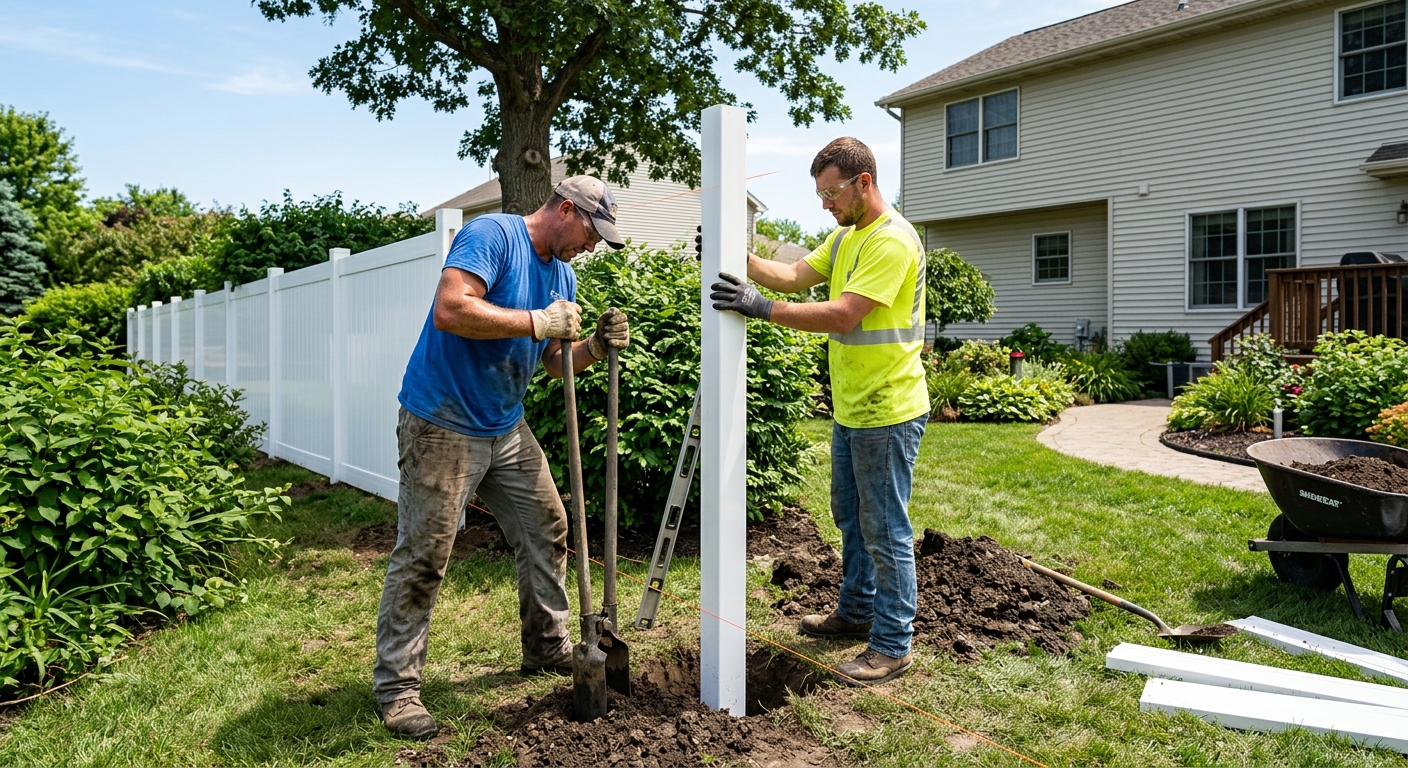
Fencing options and costs in Petrolia
Petrolia is a small, well-established community, and that’s reflected in the local housing stock: single-detached homes make up about 82.3% of dwellings (Statistics Canada, 2021 Census), which means there’s steady demand for private backyard fencing and perimeter boundary work. With 55.1% of homes built before 1981 (Statistics Canada, 2021 Census), we also see a lot of “refresh” projects—replacing older panels, upgrading gates, and fixing post rot where stakes were set less deeply or with older hardware.
In the Windsor–Sarnia corridor around Petrolia, fencing costs are strongly influenced by southern Ontario’s frost line. We typically design around frost depth of roughly 1.2 m (about 4 ft), so posts are commonly set at least 3 ft deep (and often closer to 4 ft in exposed or clay-heavy soils). That means more digging, more concrete, and longer posts—plus more labour time on tight lots or where equipment access is limited.
Wind load matters too. While we’re not as gusty as the Prairies, open farm-field edges and nearby Lake Erie/Lake Huron conditions can still create noticeable racking on tall privacy fences. Where gusts are a concern, we tighten post spacing and may recommend more wind-relieving layouts (board-on-board or open styles) so panels don’t act like a solid sail.
In Petrolia, installations tend to be especially active in older residential pockets such as the downtown and near Victoria Street, where many homeowners are upgrading aging boundaries. Below is a clear comparison of common materials and typical pricing to help you shortlist options before we talk site measurements and post depth.
| Material |
Lifespan |
Maintenance |
Privacy Rating |
Price per Linear Foot |
Price Range |
| Pressure-treated pine (standard wood) |
10–15 years |
Stain or seal every 2–3 years; inspect hardware annually |
High (solid panels) |
$20–$28 |
$45–$80 |
| Cedar (natural rot resistance) |
15–25 years |
Light cleaning/staining every 3–4 years |
High (solid boards) |
$25–$38 |
$55–$95 |
| Vinyl / PVC (no-maintenance) |
25–35 years |
Occasional rinse; no staining |
Medium to High (depends on slat spacing) |
$28–$45 |
$65–$110 |
| Chain-link (galvanized steel) |
20–30 years |
Rinse yearly; replace tension hardware as needed |
Low (open mesh) |
$18–$28 |
$30–$55 |
| Aluminum ornamental |
25–40 years |
Occasional wash; check gate alignment |
Low to Medium (ornamental pickets) |
$30–$50 |
$70–$130 |
| Composite / recycled material |
20–30 years |
Minimal cleaning; fastener checks |
High (privacy styles available) |
$35–$55 |
$75–$120 |
Prices are estimates only and vary by project scope, site access and material selection.
What affects the price of fencing in Petrolia
In Petrolia and the wider Windsor–Sarnia region, two bids for the “same” fence can land 30–50% apart because the expensive parts are often hidden: post depth, concrete volume, gate hardware, and labour time for tricky access or removal. Contractors price for how the site actually behaves under winter conditions—especially the freeze-thaw cycle that can loosen shallow posts and rack panels if they’re not installed to resist frost heave.
First, frost-line depth sets how deep posts must go. Best practice in our corridor typically means posts are set around 1.5–2.0 m into the ground (often at least 4 ft embedment in exposed or clay-heavy soils). That increases the length of posts, the amount of digging, and whether we need concrete setting. Concrete-set posts cost more than gravel pack or driven-only methods, but they’re often the difference between a fence that stays plumb for years versus one that sags after a severe winter.
Second, wind exposure influences framing and spacing. Near open farm fields or lakeshore areas, gusts can be strong enough that solid privacy fences behave like sails. We reduce post spacing and may upsize posts and braces—costing more material but reducing future callbacks.
Concrete examples from Petrolia jobs: (1) a 6 ft privacy replacement on heavier clay usually requires more excavation and concrete—often pushing the total into the wood or vinyl bands such as $45–$80 for standard wood labour/material scope or $65–$110 for vinyl in higher-access or hardware-heavy runs. (2) If the line includes two drive-through gates, hardware and reinforcement substantially increase cost compared to a simple walk-through.
Finally, removals, terrain, and older lot layouts matter. With 55.1% of homes built before 1981 (Statistics Canada, 2021 Census), it’s common to find old footings or embedded posts that require extra labour to extract and dispose of properly.
| Price Factor |
Why It Matters |
Cost Impact |
| Fence length in linear feet |
The longer the run, the more posts, rails, and fittings are required |
Very high (primary driver) |
| Post depth required |
Frost line determines embedment to prevent heaving and leaning |
High (more digging + deeper holes) |
| Post setting method |
Concrete vs. gravel pack vs. driven posts changes material and labour time |
Moderate to high |
| Material choice |
Vinyl, cedar, chain-link, and metals have different install and hardware needs |
High (often drives the base rate) |
| Gate count and type |
Drive-through/double gates need heavier posts, bracing, and hardware |
Moderate to high |
| Grade and terrain |
Slopes require step/rake adjustments and extra framing |
Moderate |
| Old fence removal and disposal |
Demolition, hauling, and off-site disposal add time and equipment costs |
Moderate to high (site-dependent) |
| Permit fees and survey / property line locate |
Locates and survey verification prevent encroachment and change layout work |
Low to moderate (but can become high) |
Permits & regulations in Ontario
In Ontario, fence permitting depends largely on height, location on the property, and local municipal rules. As a practical rule of thumb, fences above a height threshold—often around 2.0 m (6.5 ft) at the rear and about 1.0–1.2 m (3–4 ft) at the front or corner—may require a building permit. Even when a permit isn’t triggered, fences must respect property lines and any municipal setback bylaws.
Before you dig any post holes, call for utility locates (Ontario One Call). This step is non-negotiable: it protects you and your contractor from damaged services. Next, verify property lines. For many Petrolia properties—especially where older fences may have shifted over time—getting a survey or at least a proper locate of your property pins helps avoid neighbour disputes and costly rework.
For shared fences, Ontario’s line-fences principles govern how neighbours may share costs and responsibilities. Your best approach is to confirm the boundary line and document the agreement in writing before ordering materials.
What usually DOES require a permit: tall fences that exceed common local thresholds (especially at the rear), fences that include substantial structural elements, or projects where municipal bylaws require it. What typically does NOT: standard-height replacement fences that stay within common yard thresholds, using the existing fence line—provided you still respect setbacks and obtain locates.
To verify a contractor for a Petrolia project: check they hold an Ontario licence where applicable for their scope, request a certificate of insurance (liability) that lists your property/municipality where permitted, and confirm they carry WSIB/WCB coverage. Ask for their clearance documentation and review the dates before work starts.
Choosing the right fence material for Petrolia
Choosing the right fence material in Petrolia comes down to four things: privacy, low maintenance, budget, and how long you want to avoid replacements—then we align that with our winter reality (frost depth, freeze-thaw, and occasional harsh winds). Pressure-treated pine is the budget-friendly starting point, but it needs staining or sealing every 2–3 years to prevent grey weathering and to protect the boards from moisture cycling. Cedar looks better for many homeowners and naturally resists rot, but it still benefits from periodic staining and hardware checks.
Vinyl/PVC delivers low day-to-day work and holds up well when properly installed with correct post embedment for frost. However, in extreme cold snap conditions, vinyl panels can become brittle if they’re not framed correctly, so we pay attention to fastening and panel support. Chain-link is usually the lowest upfront cost and has excellent durability, but it provides limited privacy unless you add screening or privacy slats. Aluminum ornamental offers long life and no rust, while staying visually open—great for curb appeal, not ideal if your priority is full backyard privacy. Composite/recycled options can provide privacy-style aesthetics with less maintenance, though pricing typically lands above standard wood.
Post depth is central to performance here. In Windsor–Sarnia, we commonly set posts below southern Ontario’s frost line—often around 4 ft embedment in exposed or clay-heavy soils—so materials last longer regardless of whether you choose wood, vinyl, or metal. That reduces future leaning and racking from freeze heave.
Example: if a pressure-treated privacy fence (budget wood band) comes in around $45–$80 and vinyl lands nearer $65–$110, the difference is justified when you want fewer maintenance days over 15–25 years. If you enjoy annual outdoor upkeep and have easy access for staining, wood can be the smarter value.
| Material |
Cold Tolerance |
Lifespan |
Annual Maintenance |
Best For |
Price Band |
| Pressure-treated pine |
Good (with proper framing and sealing) |
10–15 years |
$50–$250 worth of stain/seal + hardware checks |
Lower initial cost privacy |
$45–$80 |
| Cedar |
Good (rot-resistant under typical residential exposure) |
15–25 years |
$75–$350 for staining and inspections |
Natural look with better rot resistance |
$55–$95 |
| Vinyl / PVC |
Good (best with correct support spacing and fastening) |
25–35 years |
Low: rinse and quick hardware check |
Low-maintenance privacy or semi-privacy |
$65–$110 |
| Chain-link |
Excellent (galvanized steel) |
20–30 years |
Low: rinse and tension check |
Security with minimal upkeep |
$30–$55 |
| Aluminum ornamental |
Excellent (powder-coated finish) |
25–40 years |
Low: wash and gate alignment checks |
Visual curb appeal and safe boundaries |
$70–$130 |
| Composite / recycled |
Good (depends on system and fasteners) |
20–30 years |
Low to moderate: clean and inspect fasteners |
Privacy look with reduced maintenance |
$75–$120 |
How to choose a fencing contractor in Petrolia
When you hire a contractor in Petrolia, verify the three basics before signing: (1) Ontario licensing for their scope, (2) liability insurance, and (3) WSIB/WCB coverage. Ask for their certificate of insurance (current, with a valid policy number) and confirm they list appropriate coverage for on-site work. For WSIB/WCB, request proof/clearance documentation and check the effective dates—don’t accept “it’s coming” or expired papers. If you’re working with crews that do concrete footings, rail brackets, and gate swings, you want coverage that matches the job’s risk level.
Next, get 2–3 written, itemised quotes. The best quotes split labour and materials (posts, rails, hardware, gates, and concrete if included). Avoid one-line lump sums that don’t show post depth assumptions, installation method, or whether removal/disposal is included. Read the scope: confirm what’s excluded (for example, tree clearing, rock excavation, permit costs, or utility locate fees) and whether the contractor will pull permits where required.
Warranty matters for both workmanship and product. Ask how long the workmanship warranty lasts, whether it’s transferable, and what manufacturer coverage applies to materials like vinyl or metal frames. For payment schedules, never pay more than 10–15% upfront; keep a holdback until the fence is complete, straight, and gates operate properly. Finally, request a written start date and a completion estimate that accounts for weather delays and curing time for concrete footings.
- Request proof of Ontario licensing and confirm it matches the fencing scope.
- Check certificate of liability insurance is current and includes fencing work on residential sites.
- Verify WSIB/WCB clearance or proof of coverage before work starts.
- Insist on itemised quotes: posts, rails, panels, hardware, concrete, gates, and removal.
- Confirm post depth assumptions (typical local install uses frost-safe embedment) and setting method.
- Ask who does utility locates and whether the contractor covers the cost.
- Clarify permit responsibility: who applies, who pays, and when it’s scheduled.
- Confirm disposal is included for old fencing (hauling and landfill fees).
- Ask for a written material spec (grade of lumber, thickness for vinyl, coating for metals).
- Check the warranty terms for both workmanship and material defects, and whether it’s transferable.
- Use a payment schedule with a holdback until gates align and everything is finished.
- Get a construction timeline in writing, including concrete curing time if footings are used.
Specific red flags I see in Petrolia: “cheap” quotes that don’t mention post depth or concrete setting; refusing to provide insurance/WSIB proof; vague scopes that don’t include gate reinforcement or removal/disposal; quoting a high-end look without naming the actual material grade; and pressuring homeowners into paying a large deposit before measuring and locating the boundary.
Frequently asked questions — fencing in Petrolia
How do I prevent wood fence rot in Petrolia?
In Petrolia, wood rot prevention starts below grade: posts should be set to frost-safe depth in our southern Ontario freeze-thaw conditions, typically around 4 ft embedment in many residential installs depending on soil and exposure. Above ground, the goal is keeping joints dry and protecting cut ends. Use appropriate pressure-treated lumber (and cedar if you prefer it) with proper ventilation between boards and avoid trapping water at the base. We also recommend sealing/staining on a schedule—pressure-treated pine usually needs re-stain every 2–3 years to prevent heavy grey weathering that can hide early damage. If your existing fence is failing, rot often concentrates at the post area and the lowest rails, so plan for replacement of compromised sections rather than patching only the visible boards.
What is the cost per linear foot for fencing in Petrolia?
For Petrolia fencing, cost varies most by material, post embedment, and gate hardware. As a practical guide, local installation pricing typically falls within the regional bands: wood often lands around $45–$80, vinyl/PVC around $65–$110, chain-link around $30–$55, and aluminum/metal around $70–$130. If you’re comparing quotes, make sure they include the same post depth and setting method (concrete vs. gravel pack), plus removal/disposal and the number of gates. The biggest reason “per foot” comparisons can mislead is that taller privacy fences with deeper concrete footings and heavy gate reinforcement can raise the true installed cost even if the linear footage looks similar. For an accurate per-linear-foot price, we price to the actual measurements and site conditions in Petrolia.
Should I repair or replace my old fence in Petrolia?
Repair can make sense when only a few sections are damaged and the posts are still solid and plumb. In Petrolia, many older fences were built to different standards than today—especially with older embedment and hardware choices—so rot and post movement are common after hard winters. If you see leaning posts, inconsistent gaps, or soft wood at the post bases, replacement usually costs less over the long run because new frost-safe installation stops the underlying issue. For example, if your fence line is partially functional but the corner posts are compromised, we may recommend targeted post replacement first; otherwise, a full run replacement is often the most consistent solution. With 55.1% of homes built before 1981 (Statistics Canada, 2021 Census), it’s common that “repairs” become a repeating cycle unless the root cause—post condition and embedment method—is addressed.
How do I handle a fence dispute with a neighbour in Ontario?
Fence disputes in Ontario are usually about property lines, shared responsibility, or maintenance expectations. Start by confirming the boundary: locate your property pins or get a survey update before any major changes. If your fence is on a shared line, discuss line-fence responsibilities and agree on scope and cost sharing in writing; verbal agreements often lead to misunderstandings. If you’re unsure whether a fence is encroaching, document everything (photos of existing fence positions, correspondence, and any prior survey info). Because Ontario’s process relies on accurate boundary information, the most effective early step is verifying the line with a surveyor or property locate rather than arguing over appearances. Also check whether a permit is needed if you plan to install a taller fence—height thresholds can trigger permitting, which adds another layer to disputes.
What fence style offers the best wind resistance in Petrolia?
For wind resistance in Petrolia, the best-performing style is the one that reduces sail effect. Solid tall privacy fences can catch gusts and rack if the post spacing or bracing isn’t designed for local exposure. That’s why we often recommend board-on-board designs, tighter spacing, and stronger post systems for open field edges. Chain-link and aluminum pickets also perform well because they’re more “breathable,” letting gusts pass through. In windy lakeshore or open farmland situations near the Windsor–Sarnia corridor, we reinforce the framework and ensure gates are braced so the hinge side doesn’t shift in winter. Regardless of style, frost-safe embedment and correct concrete setting are critical; even a wind-friendly design can fail if posts heave during freeze-thaw.
How much does a fence cost in Petrolia?
In Petrolia, most homeowner fence projects land within the regional price bands depending on material and complexity. For example, a basic wood fence installation is commonly estimated in the $45–$80 range, while vinyl/PVC privacy fences often fall in $65–$110. Chain-link can be lower at $30–$55, and aluminum ornamental often runs higher at $70–$130. The final number is driven by linear footage, number of gates, the need for deeper frost-safe post embedment, and whether concrete setting is required in your soil type. If you’re replacing an old fence, demolition and disposal can add cost, but it’s usually worthwhile to do a clean rebuild rather than repeatedly patch failing sections.