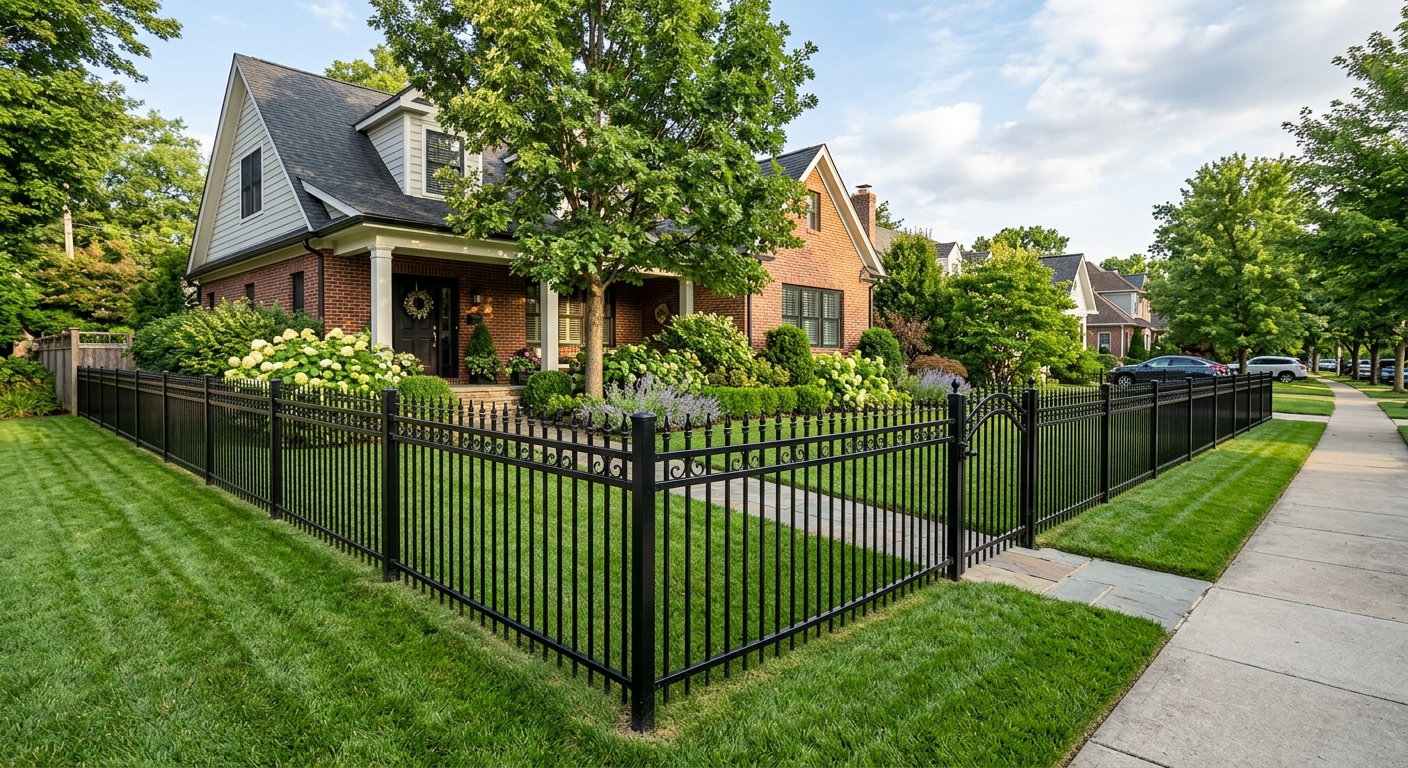
Fencing options and costs in Walkerton
Walkerton homeowners typically start their fence search by thinking about privacy and curb appeal, especially when properties sit in established neighbourhoods like Riverbend Drive where backyard fencing is a common upgrade. With Walkerton’s population at 4,724 (Statistics Canada, 2021 Census), demand is smaller than the GTA core, but the work is steady because every detached home is effectively a potential customer for boundary fencing and gates. In addition, most local projects are influenced by Toronto-area building practice and climate expectations—contractors in the region price for freeze-thaw, wind stresses, and long-term post stability rather than “drive-and-forget” installs.
In Southern Ontario, frost is commonly planned at roughly 42"–48". That means posts are usually set at least 3.5–4 feet deep to reduce frost heave, particularly for 6–8 ft privacy fences. This concrete-set approach increases labour time and ready-mix costs, but it improves performance in mixed soils and clay patches that can heave during spring thaw. Because Walkerton draws from the same supply and workmanship standards as the broader Toronto economic region, pricing generally aligns with the established Ontario ranges—wood typically lands below vinyl, while chain-link is the budget option.
Below is a practical cost and performance comparison to help you shortlist materials before you request itemised quotes.
| Material |
Lifespan |
Maintenance |
Privacy Rating |
Price per Linear Foot |
| Pressure-treated pine (standard wood) |
10–15 years |
Stain/seal every 2–3 years; inspect posts annually |
High (solid panels) |
$15 – $28 |
| Cedar (natural rot resistance) |
15–20 years |
Light sealing as needed; periodic cleaning and staining |
High (solid privacy pickets/panels) |
$18 – $34 |
| Vinyl / PVC (no-maintenance) |
20–30 years |
Rinse as needed; no staining |
High (solid infill options) |
$20 – $36 |
| Chain-link (galvanized steel) |
20–35 years |
Occasional wash; check tension and hardware |
Low–Medium (privacy slats optional) |
$13 – $22 |
| Aluminum ornamental |
30–40 years |
Wash annually; inspect latches |
Low–Medium (decorative railings) |
$24 – $42 |
| Composite / recycled material |
25–35 years |
Minimal; occasional cleaning |
High (solid composite boards) |
$22 – $40 |
Prices are estimates only and vary by project scope, site access and material selection.
What affects the price of fencing in Walkerton
In Walkerton and across Ontario, two quotes for what looks like the same fence can diverge by 30–50% because contractors price the fundamentals differently: footing depth, post spacing, hardware quality, and how they handle tight access or property-line complexity. Even within the Toronto economic region, fencing pricing reflects local building practice and frost planning—especially for 6–8 ft privacy fences where stability matters. The “design freeze” approach pushes costs upward compared with driven posts that look cheaper at the start.
Here’s the key driver: frost line depth sets how deep posts must be set to prevent heaving. In cold Ontario winters, that typically means posts going about 1.5–2.0 m into the ground (so concrete-set posts are common). Longer posts and concrete setting time raise both material cost and labour hours. Wind exposure doesn’t reach Prairie extremes in Walkerton, but the region still factors racking into panel style, post size, and spacing (often 6–8 ft centres for solid privacy runs). If you’re comparing materials, the market’s practical price bands apply—wood installs commonly land roughly in the $65 – $120 per linear foot band, while vinyl/PVC tends to be higher, often around $75 – $130.
Concrete examples from this area: (1) a 100 ft privacy fence on clay that freezes and thaws repeatedly will usually require deeper holes and more bracing than a shorter run on loose topsoil; (2) a backyard with narrow gate access slows skid-steer and wheelbarrow handling, adding labour; (3) if you’re removing an old fence at the same time, disposal and haul-off can materially change the quote. For housing-stock context, Walkerton’s small, established base (4,724 residents; Statistics Canada, 2021 Census) means many upgrades occur around older lots where line locations and old post remnants take extra time—often costing a few hundred dollars more just for demo and re-setting.
| Price Factor |
Why It Matters |
Cost Impact |
| Fence length in linear feet |
Most materials and labour scale directly with total run |
Highest cost driver (plan your budget by length first) |
| Post depth required — frost line determines post length and hole depth |
Deeper holes mean more excavation time and longer posts |
Can add notable labour and concrete cost for privacy fences |
| Post setting method — concrete vs. gravel pack vs. driven posts |
Concrete-set posts resist freeze-thaw movement better |
Concrete setting typically increases cost versus simple driven methods |
| Material choice — vinyl vs. cedar vs. chain-link |
Differences in material pricing and installation complexity |
Vinyl and cedar generally higher than wood; chain-link is usually lowest |
| Gate count and type — walk-through vs. drive-through (double) |
Gates require heavier frames, hinges, and latching hardware |
Each additional gate can shift the total materially |
| Grade and terrain — sloped yards require stepped or raked panels |
Slopes affect labour, layout time, and panel cutting |
Often adds labour for layout, step spacing, and extra hardware |
| Old fence removal and disposal |
Demolition time plus disposal/haul-off charges |
Can add a significant one-time cost depending on condition |
| Permit fees and survey / property line locate |
Ensures fence is on-side and meets local height/setback expectations |
May add small-to-moderate costs but prevents costly rework |
Permits & regulations in Ontario
In Ontario, fences above a height threshold—typically 2.0 m (about 6.5 ft) at the rear and roughly 1.0–1.2 m (3–4 ft) at the front or corner—often require a building permit. Even when a permit is not required, all fencing must respect property lines and municipal setback bylaws. Before you dig any post holes, call for utility locates through Ontario One Call so crews mark buried services; this is a safety requirement, not just a “best practice.”
For Walkerton homeowners, the cleanest way to avoid boundary disputes is to confirm where your pins sit. If you don’t already have a recent survey, plan to obtain a property locate or survey and mark the fence line before installation. Shared fence ownership rules are governed by provincial line-fences legislation, which can affect responsibilities for maintenance, repairs, and cost-sharing depending on the arrangement and boundary facts.
What usually requires a permit: building permits are commonly triggered when you’re installing or significantly altering a fence at heights above the typical thresholds (especially taller backyard/privacy installations) or when municipal rules call it out for your specific location. What typically does not: routine replacement of like-for-like fencing that remains within typical height limits and setbacks generally avoids permit requirements, but confirmation with the local building department is still smart.
To verify a contractor, ask for: (1) proof of Ontario licensing/registration where applicable for the work category; (2) a current certificate of insurance showing liability coverage; and (3) clearance or coverage proof for WSIB/WCB under their employer profile. Then, check their paperwork against what they provide—certificates should match the company name you’re contracting with, and coverage should be active for your project dates.
Choosing the right fence material for Walkerton
Choosing a fence in Walkerton is really about matching material to how you live: privacy needs, how much maintenance you’ll tolerate, and how long you want the fence to “set and forget.” With Southern Ontario freeze-thaw and clay/mixed soils, posts that are properly set for frost are as important as the board material itself. For pressure-treated pine, you get the best starting price, but plan on staining or sealing about every 2–3 years to reduce grey weathering and to slow surface checks. Cedar looks great and resists rot better, but it still benefits from periodic maintenance to preserve colour and reduce cracking. Vinyl/PVC delivers low maintenance and strong privacy when installed as solid panels, but in extreme cold it can become brittle—meaning good installation, correct post spacing, and proper hardware matter. Chain-link is the most economical and longest-lived, but it provides little privacy unless you add slats or screening. Aluminum ornamental stays rust-free and clean-looking, yet it’s decorative rather than privacy-first.
For Toronto-area best practice, you generally cannot “buy your way out” of frost concerns: fence posts should be set deep enough to avoid heaving. That commonly means concrete-set posts for taller privacy fences, with deeper hole excavation for 6–8 ft heights and longer posts for stability. In addition, wind and snow-load effects influence how rigid the fence system is—solid panels typically require sturdier posts and closer spacing to resist racking.
A practical way to justify the price difference: if your wood privacy fence estimate is near the $65 – $120 band and vinyl comes closer to $75 – $130, that extra cost is often worth it when you want fewer weekend chores and a consistent look through freeze-thaw seasons—especially if you’ve had maintenance fatigue with wood in past years.
| Material |
Cold Tolerance |
Lifespan |
Annual Maintenance |
Best For |
Price Band |
| Pressure-treated pine |
Good when posts are concrete-set; boards can grey in winter weather |
10–15 years |
Light inspection; plan stain/seal every 2–3 years |
Budget privacy with manageable upkeep |
$65 – $120 |
| Cedar |
Good; performs well in freeze-thaw when kept sealed |
15–20 years |
Inspect; reseal as needed (often every 2–4 years) |
Appearance-driven privacy with better rot resistance |
$75 – $130 |
| Vinyl / PVC |
Good in Ontario cold when installed with correct spacing and hardware |
20–30 years |
Rinse/wash as needed; no staining |
Low-maintenance privacy |
$75 – $130 |
| Chain-link |
Excellent for cold; galvanized steel resists corrosion |
20–35 years |
Occasional wash and hardware checks |
Security on a budget |
$45 – $85 |
| Aluminum ornamental |
Excellent; non-rusting design |
30–40 years |
Wash annually; check gates and latches |
Decorative curb appeal and boundary definition |
$90 – $160 |
| Composite / recycled |
Good for cold; best with proper installation and drainage awareness |
25–35 years |
Minimal; periodic cleaning |
Long-life solid privacy |
$90 – $160 |
How to choose a fencing contractor in Walkerton
When you hire a fencing contractor in Walkerton, don’t treat paperwork as “extra.” Start by verifying Ontario coverage and credentials. Ask for their certificate of insurance (liability) and make sure it matches the legal company name. For WSIB/WCB, request evidence of coverage/clearance that shows they’re compliant for the workers who will be on site. If the quote is vague, that’s often where problems start—so require clear scope, not just a price.
Next, get 2–3 itemised written quotes. “Itemised” should mean a line-by-line breakdown for materials (posts, rails, boards/panels, fasteners, gate hardware), labour (layout, excavation, set posts, assemble, install gates), and site work (demo and haul-off if applicable). A good quote also states what’s excluded: buried stump removal, restoring landscaping, trimming trees, re-staining, permit pulling, and whether an existing fence base will be removed or reused.
Warranty matters too: insist on a workmanship warranty length (often the real one you’ll rely on) and a product/manufacturer warranty for the fencing system. Confirm whether the warranty is transferable to future owners—if you sell, you don’t want to lose coverage.
For payment schedule, never accept more than 10–15% upfront. Hold back the remainder until the job is complete, including gate alignment and final cleanup. Finally, require a written start date and a completion estimate so you can plan around weather delays.
- Confirm liability insurance is active and ask for the certificate before work begins.
- Request WSIB/WCB clearance or coverage proof for their workers.
- Use itemised quotes: posts, concrete, labour, hardware, gates, and disposal should be separate lines.
- Make sure frost-depth installation is included for privacy fences (concrete-set posts where required).
- Verify whether property line locate/survey costs are included or excluded.
- Ask who calls utility locates and whether they’ll wait for markings before digging.
- Check warranty terms: workmanship start date, duration, and what voids coverage.
- Confirm whether the fence is “racked/stepped” for slopes or if panel cuts are included.
- Ask about gate hardware: hinges, latches, and whether it includes heavy-duty components.
- Clarify old fence removal: demolition method, haul-off, and where debris is disposed.
- Require a payment schedule with only small deposits and a substantial completion holdback.
- Get the plan for cleanup and final grading/restoration listed in writing.
Common red flags in Walkerton: a contractor who won’t provide insurance/coverage paperwork, quotes that list “driven posts” without discussing frost stability, unclear scope about disposal or permits, refusal to itemise labour vs materials, and warranty language that covers the product only but not workmanship.
Frequently asked questions — fencing in Walkerton
How long does a wood fence last in Walkerton?
In Walkerton and across Southern Ontario, a properly installed pressure-treated pine or cedar wood fence typically lasts about 10–20 years depending on material and maintenance. The biggest variable is post stability through freeze-thaw: if posts are only set shallow or in a way that allows frost heave, boards can loosen within a few winters. With concrete-set posts and annual inspections, you’re more likely to see the longer end of the range. Maintenance is also key—pressure-treated pine often needs staining/sealing every 2–3 years to slow grey weathering and surface checks. If you’re budgeting, it’s also worth comparing the installed wood pricing band (often around $65 – $120 per linear foot) against cedar or vinyl when you want fewer repainting cycles.
Who owns and maintains a shared fence?
For shared fences in Ontario, ownership and maintenance responsibilities generally follow provincial line-fences principles and the specific facts of how the boundary fence was built and agreed upon. Practically, homeowners should treat the “shared” fence as a boundary feature: repairs that affect safety or structural stability are often discussed jointly, but the exact cost-sharing can depend on the shared agreement and whether the fence sits on or near the property line. In Walkerton, many older neighbourhoods have fences that predate modern surveys, so it’s wise to confirm the fence line before planning major repairs. If you’re replacing sections, ask the contractor for a clear plan that matches the agreed boundary and avoids encroachment. When in doubt, speak with your municipality for guidance and base any rebuild on confirmed locate information.
How do I find my property line before fencing?
The safest approach in Ontario is to verify your property pins and fence line before any post holes are dug. If you have a recent survey, use it to locate corner pins and boundary markers. If not, order a property locate from the surveyor/locating service (or have your pins marked where applicable) so your contractor can string the layout accurately. This matters because even small boundary mistakes can trigger disputes—and fencing is hard to “fix” without redoing expensive concrete-set posts. In Walkerton, where many lots are mature, old fence lines may not match current property lines. Also remember to call Ontario One Call for utility locates before digging so the marked boundary doesn’t accidentally lead you into buried services.
What's the most low-maintenance fence?
For low maintenance in Walkerton, vinyl/PVC and aluminum are usually the easiest year after year. Vinyl is popular because it typically doesn’t require staining, and it holds a consistent look through Ontario winters when installed correctly with proper post spacing and hardware. Aluminum ornamental is also non-rusting and generally needs only periodic washing and latch checks. If privacy is your priority, vinyl privacy panels usually outperform chain-link for privacy while still reducing maintenance compared with wood. Wood can be fine if you enjoy occasional staining, but pressure-treated pine often needs attention every 2–3 years. Pricing-wise, you’ll typically see vinyl/PVC installations in the mid range (often around $75 – $130), versus chain-link being cheaper (often around $45 – $85) but with less privacy unless you add slats.
How tall can my fence be in Walkerton?
Height limits in Ontario commonly depend on location within your property (rear versus front/corner) and municipal bylaws. As a general guideline used across Ontario, fences may be treated as permitting-triggering when they’re around 2.0 m (about 6.5 ft) at the rear, while front or corner fences are often limited closer to 1.0–1.2 m (3–4 ft). Walkerton homeowners should verify your specific case with the municipality because rules can vary by zoning, setbacks, and corner lot conditions. Before you commit to a tall privacy fence, confirm whether a building permit is required and plan your line so it respects setbacks and property boundaries. Taller solid fences also increase wind and racking considerations, which can change the post depth and material choices.
Should fence posts be set in concrete here?
In most Walkerton privacy fence scenarios, yes—concrete-set posts are the safer long-term choice because of Southern Ontario frost. The region commonly uses an approximate frost line planning depth of 42"–48", and best practice is to set posts about 3.5–4 feet deep (or deeper based on soil conditions) to reduce frost heave. For 6–8 ft privacy fences, that stability matters because solid panels catch wind and can rack if the posts move slightly. Concrete-set posts increase labour and ready-mix costs, but they usually prevent fence sagging and early failure. If a contractor proposes only driven posts for a tall, solid privacy run without explaining how frost movement will be prevented, ask for a frost-depth plan in writing. This is one reason fencing quotes can differ by 30–50% for similar-looking fences—footings and post setting method are often the deciding factor.