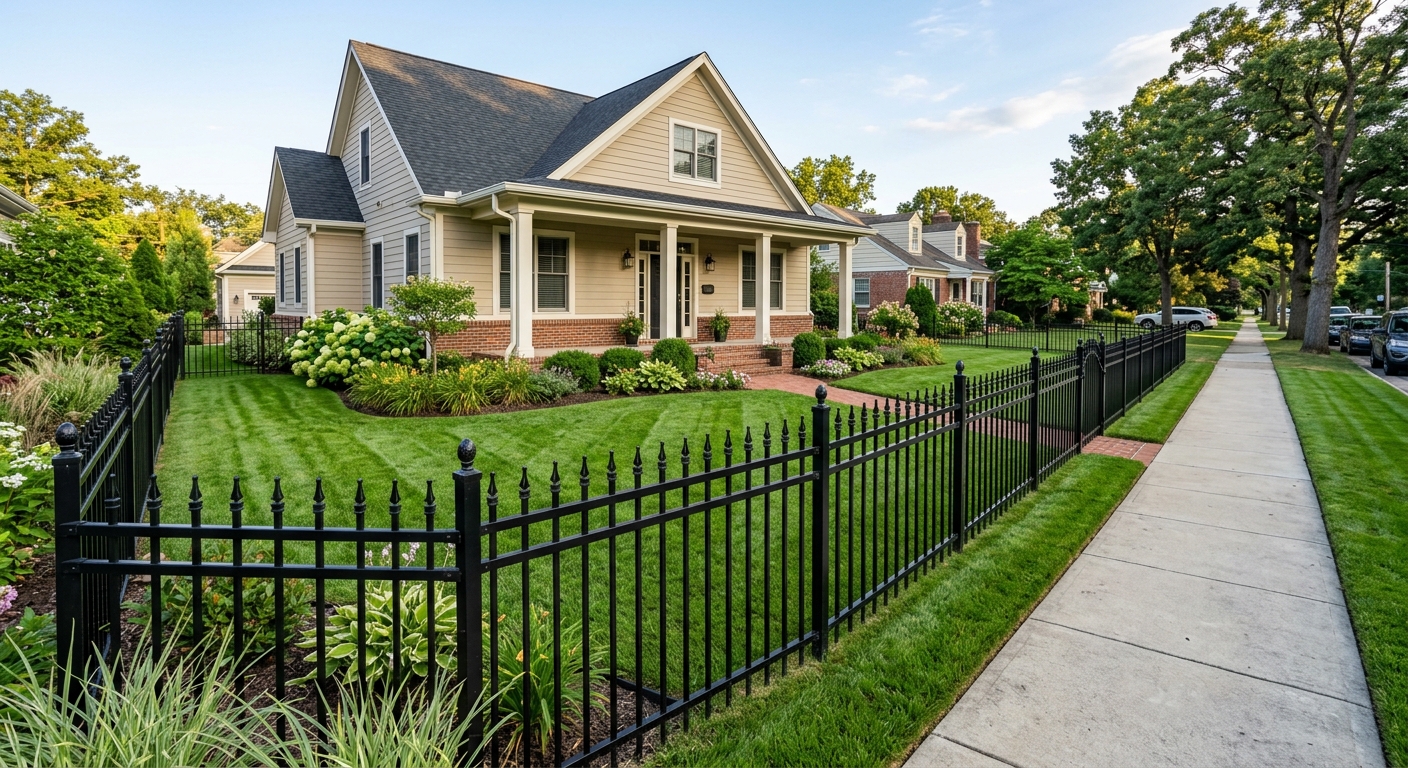
Fencing options and costs in Colonial Acres
Colonial Acres homeowners often start their search with a simple question—what will it cost to get the look and privacy they want. With a population of 8,163 (Statistics Canada, 2021 Census), this neighbourhood has enough owner-occupiers to support steady demand for fencing and gate work. In Toronto’s economic area, the strongest predictor of local activity is ongoing residential re-lotting, renovations, and replacement cycles—meaning detached homes and established yards frequently trigger new privacy fencing upgrades.
In Southern Ontario, fencing pricing is strongly shaped by freeze/thaw conditions. The frost line is commonly planned around 42"–48", so posts usually must be set a minimum of 3.5–4 feet deep to reduce frost heave risk—especially for 6–8 ft privacy fences. That means more trenching, more concrete, and longer posts, which pushes labour and material costs upward compared to regions where driven posts are more common.
You’ll also notice contractors in Colonial Acres prioritize stability over “fast installs.” For taller solid fences, local best practice uses concrete-set posts and appropriately sized panels to manage wind uplift and racking in spring storms. Trade activity is especially visible around the more established housing pockets near Major Mackenzie Drive and the surrounding residential streets, where privacy upgrades are common as families settle into yard improvements.
Below is a realistic cost comparison to help you budget before you request itemised quotes.
| Material |
Lifespan |
Maintenance |
Privacy Rating |
Price per Linear Foot |
| Pressure-treated pine (standard wood) |
10–15 years |
Stain/seal every 2–3 years |
Good (solid) |
$65 – $120 |
| Cedar (natural rot resistance) |
15–20 years |
Light stain/oil every 2–4 years |
Excellent (solid) |
$75 – $130 |
| Vinyl / PVC (no-maintenance) |
20–30 years |
Rinse as needed |
Excellent (solid) |
$75 – $130 |
| Chain-link (galvanized steel) |
25–40 years |
Occasional rinse; tighten/stretch as needed |
Low (visibility through) |
$45 – $85 |
| Aluminum ornamental |
25–35 years |
Minimal (wash annually) |
Low to Medium (open pickets) |
$90 – $160 |
| Composite / recycled material |
20–30 years |
Minimal; keep clear of debris |
Excellent (solid/board-to-board) |
$85 – $150 |
Prices are estimates only and vary by project scope, site access and material selection.
What affects the price of fencing in Colonial Acres
In Colonial Acres and the broader Toronto region, two quotes for the “same” fence can differ by 30–50% because the real drivers are site conditions and installation requirements—not just the fence style. The Toronto market also has variable labour availability across seasons, and privacy fence projects often bundle deeper post holes, heavier rails, and more hardware to meet stability expectations in freeze/thaw cycles.
First, frost line depth sets how deep posts must be set. In Southern Ontario, design frost is typically planned around 42"–48", so contractors often dig 4–6 inches below that planning depth to reduce heaving risk. That commonly translates to posts going roughly 1.5–2.0 m into the ground, which usually requires concrete-set posts (and longer posts), increasing both material cost and labour time. Second, wind considerations still matter. While the GTA isn’t as wind-battered as open prairie areas, tall solid fences can rack in gusts, so contractors tighten post spacing (often 6–8 ft centres) and choose larger post sizes and better bracing.
Concrete examples of what changes cost in Colonial Acres: (1) a sloped backyard may require stepped panels or racked sections, which increases labour and sometimes adds extra rails and brackets; (2) replacing a 6 ft fence with a full 8 ft privacy layout usually increases post count and hardware quantity, pushing you toward the upper portion of the wood or vinyl price bands (for example, wood often aligns with $65 – $120, while higher-end vinyl/private upgrades tend to land closer to $75 – $130); (3) yards with clay-heavy soils frequently take longer to excavate clean, level post holes, which affects production time and concrete volume.
Finally, the age of local housing and typical lot grading influence how often we encounter buried debris, older fence footings, or uneven property lines—small surprises that can add several hundred dollars to a project before the first panel is installed.
| Price Factor |
Why It Matters |
Cost Impact |
| Fence length in linear feet |
Most materials (posts/rails/panels) scale directly with footage |
Largest driver; small per-foot changes add up fast |
| Post depth required |
Frost line determines hole depth and post length |
More excavation and concrete for deeper set posts |
| Post setting method |
Concrete vs gravel pack vs driven posts affects stability |
Concrete-set posts increase labour and ready-mix costs |
| Material choice |
Vinyl/cedar generally cost more than chain-link |
Shifts budget between typical band ranges (wood/vinyl/metal) |
| Gate count and type |
Hinges, latches, and heavier framing increase complexity |
Additional hardware and labour; double gates cost the most |
| Grade and terrain |
Slopes require racked/stepped panels or custom cutting |
Extra labour and sometimes extra rails/panels |
| Old fence removal and disposal |
Haul-away and demolition time add to install time |
Can add substantial non-material costs, especially for concrete posts |
| Permit fees and survey / property line locate |
Some fence heights and locations trigger municipal requirements |
May add direct permit and locate fees to the quote |
Permits & regulations in Ontario
In Ontario, fences above a height threshold—typically 2.0 m (6.5 ft) at the rear and 1.0–1.2 m (3–4 ft) at the front or corner—often require a building permit, and local setback bylaws can also apply. Regardless of height, you still need to build within your property limits and respect any municipal requirements for corner visibility. In Colonial Acres, where many properties have mature lots and established yard lines, it’s common to see fence replacement projects stumble at the “where exactly is the line?” step.
Before you dig post holes, call for utility locates through Ontario One Call. Even if you’ve never hit an issue before, locating is required before excavation to protect buried services. Next, verify your property pins or obtain a survey/locate before installing—this is one of the most effective ways to prevent encroachment disputes with neighbours.
Shared fence ownership rules are governed by provincial line-fences legislation, but the practical question homeowners ask is who maintains what. Your agreement (and any local shared maintenance arrangements) can affect ongoing upkeep, upgrades, and cost-sharing.
To verify an Ontario contractor, confirm they’re licensed where applicable, then check liability insurance and WSIB/WCB coverage. Look for an up-to-date insurance certificate (COI) showing fence-related work is covered, and confirm WSIB clearance (or the appropriate exemption documentation if they’re not required). Ask for the clearance or certificate directly and keep copies with your paperwork—reputable installers won’t hesitate.
Choosing the right fence material for Colonial Acres
Choosing the right fence material in Colonial Acres is mostly about matching your priorities—privacy, low maintenance, budget, and lifespan—to what Southern Ontario weather does to fences. With freeze/thaw cycling and winter freeze in the GTA planning range, it’s the post installation (depth and setting) that protects the fence long-term. However, material still matters: it changes how well your fence holds up visually, how much maintenance you’ll do, and how it performs in snow and wind.
Pressure-treated pine is the budget entry point, but it needs staining or sealing every 2–3 years to help prevent grey weathering and surface checking. Cedar looks better as it ages and has natural rot resistance, often giving you a longer service life, though it still benefits from periodic staining/oiling in our humidity swings. Vinyl/PVC is popular for low maintenance and privacy; it doesn’t need staining, but in extreme cold it can become brittle if poorly manufactured or incorrectly installed—so quality and correct fittings matter. Chain-link is the lowest-cost and typically longest-lived option, but it won’t give you privacy unless you add privacy slats or plant screening. Aluminum is attractive and won’t rust, but it’s usually best for curb appeal and boundary definition rather than privacy.
For Toronto’s frost line planning, most privacy fence builds use concrete-set posts at deeper depths (commonly around the 1.5–2.0 m zone) to reduce heaving risk, regardless of whether you choose wood or vinyl. Heavier solid designs also handle wind better when posts and rails are sized appropriately, which is why tall panel styles often land in the mid-to-upper price bands. For example, if you’re deciding between cedar and pressure-treated pine, spending roughly a few dollars more per linear foot can be justified when it reduces the frequency of maintenance—especially if you want to keep the fence looking solid for the next decade.
| Material |
Cold Tolerance |
Lifespan |
Annual Maintenance |
Best For |
Price Band |
| Pressure-treated pine |
Good (if properly sealed and installed) |
10–15 years |
Inspect and re-seal/stain every 2–3 years |
Lower upfront cost privacy fence |
$65 – $120 |
| Cedar |
Very good (natural resistance) |
15–20 years |
Light stain/oil every 2–4 years |
Premium look with natural materials |
$75 – $130 |
| Vinyl / PVC |
Good with quality fittings |
20–30 years |
Rinse as needed |
Low-maintenance privacy |
$75 – $130 |
| Chain-link |
Excellent (steel with coating) |
25–40 years |
Occasional rinse and tension checks |
Security and pet containment |
$45 – $85 |
| Aluminum ornamental |
Excellent |
25–35 years |
Minimal wash annually |
Curb appeal with light boundary definition |
$90 – $160 |
| Composite / recycled |
Good (varies by product quality) |
20–30 years |
Minimal; keep clear of debris |
Solid privacy with reduced upkeep |
$85 – $150 |
How to choose a fencing contractor in Colonial Acres
Choosing the right contractor is where homeowners in Colonial Acres can either protect their investment—or accidentally trade long-term stability for a low initial number. Start with licensing and proof of coverage. In Ontario, verify that the contractor meets the applicable licensing requirements for your project type, then request a current certificate of liability insurance showing fencing installation work. For worker protection, confirm WSIB coverage (or obtain clearance documentation if they’re properly exempt). Don’t accept “it’s included” without paperwork—ask for the certificate number and effective dates.
Next, get 2–3 itemised written quotes. Ask for a breakdown separating labour from materials, including the number of posts, post depth/setting method, rail configuration, gate frames/hardware, and any demolition/disposal. Avoid quotes that only provide a lump sum with no installation details—especially in Ontario where concrete-set posts and deeper holes are often the difference between a fence that stands and one that heaves.
Read the scope carefully: does the quote include permit pull (if required), utility locate costs, survey/property line locating, and disposal/haul-away of the old fence? Confirm the warranty details. You should see a workmanship warranty length (how long they stand behind their build), a manufacturer/product warranty (what covers material defects), and whether warranties transfer to future owners.
Finally, manage payment. Never pay more than 10–15% upfront; use milestones and keep a holdback until the job is complete and final cleanup is done. In writing, request a start date and a completion estimate tied to weather dependencies.
- Ask for proof of liability insurance and confirm the policy is active for your project dates.
- Request WSIB clearance documentation and keep a copy with your contract.
- Confirm concrete-set post method and typical hole depth in writing for Ontario frost conditions.
- Ensure the quote lists the number of posts, linear footage, and panel/gate counts.
- Check whether hardware (latches, hinges, brackets) is included and specified by model/grade.
- Look for disposal/haul-away included or clearly priced as a separate line item.
- Verify whether utility locates and any required permit pull are included.
- Confirm property line verification method (pins survey/locate) is addressed.
- Ask about how they handle slopes—stepped vs raked panels—and whether it changes the price.
- Get a written timeline with start and completion dates, plus weather contingency language.
- Review warranty terms separately for workmanship vs materials, including transferability.
- Use milestone payments; do not exceed 10–15% upfront and keep a completion holdback.
Red flags I see in Colonial Acres include: (1) quotes that ignore post depth/concrete setting and only talk about “straight driven posts”; (2) no itemisation for gates, hardware, or demolition/disposal; (3) missing WSIB or inability to produce a valid liability insurance certificate; (4) vague warranty language like “manufacturer warranty applies” without stating workmanship coverage; and (5) requests for large upfront payments without a schedule or contract milestones.
Frequently asked questions — fencing in Colonial Acres
Wood vs vinyl vs aluminum fence — which is best?
In Colonial Acres and the wider Ontario market, “best” depends on whether you value privacy, maintenance, or curb appeal most. If you want privacy with the least upkeep, vinyl/pvc privacy panels are a common choice and typically sit around $75 – $130 per linear foot. If you prefer a natural look and can handle staining, cedar often lasts longer than standard pine and can be cost-competitive depending on the exact design. Aluminum is excellent for appearance and rust resistance, but it’s usually open, so privacy is limited. For all three, installation quality matters: deeper, concrete-set posts are usually recommended around Toronto’s frost planning depth to reduce heaving risk. If your yard is sloped or you’re adding tall panels (6–8 ft), that also influences which option makes the most sense.
Do I need a permit to build a fence in Ontario?
Often, yes—depending on height and location. In Ontario, fences above about 2.0 m (rear) and about 1.0–1.2 m (front/corner) commonly require a building permit, and setback rules can still apply. Before you dig in Colonial Acres, also consider utility locates: you should use Ontario One Call before post-hole excavation. If you’re working near a corner, road allowance visibility requirements can change what’s allowed. Many homeowners don’t need a permit for lower fences, but taller privacy fences frequently do. The safest approach is to ask your contractor to confirm whether your proposed height and placement triggers a permit, then ensure it’s documented in the quote scope.
How long does a wood fence last in Colonial Acres?
Wood lifespan in Ontario usually comes down to post installation and maintenance habits. Pressure-treated pine commonly lasts around 10–15 years in real-world conditions when it’s properly sealed, supported by concrete-set posts, and maintained every 2–3 years to reduce greying and surface checking. Cedar generally performs better, often reaching 15–20 years with periodic staining/oiling. In Colonial Acres, freeze/thaw cycling means fences with shallow or improperly set posts are more likely to move, which shortens life regardless of wood type. Taller solid fences also experience more wind load at height, so bracing and post sizing matter. If you’re budgeting, comparing a wood build at roughly $65 – $120 against vinyl at $75 – $130 helps many homeowners see where maintenance savings can justify the difference.
Who owns and maintains a shared fence?
Shared fence ownership and responsibilities in Ontario are guided by line-fences legislation, but the practical details depend on your specific boundary and any agreements between neighbours. Many shared fences are maintained by both properties according to usage and cost-sharing arrangements, while others may be maintained by only one side if that’s how the boundary has been historically handled. In Colonial Acres, where lots can be older and yard lines established, it’s especially important to confirm: (1) whether the fence is actually on the property line, (2) whether it’s considered a shared boundary structure, and (3) what each party agreed to regarding repairs or replacement. Before work starts, have the contractor include a clear description of the fence location and scope so you can address responsibility with your neighbour calmly and in writing.
How do I find my property line before fencing?
Start by locating your property pins and boundary markers—many homeowners in Colonial Acres have them near the front yard or alongside driveways, but vegetation and old landscaping can hide them. If you’re uncertain, obtain a survey or have a property locate completed before installing posts. This matters because even when the fence “looks” right, Ontario boundary rules and setbacks can create encroachment issues. Also, plan for utility locates (Ontario One Call) before digging so you don’t hit buried services while you’re confirming boundary positioning. When you request contractor bids, ask how they confirm the fence line (pins vs survey) and whether that process is included. A reputable contractor will treat property line confirmation as part of a stable, dispute-resistant build—not an afterthought.
What's the most low-maintenance fence?
For low maintenance in Ontario, vinyl/pvc privacy fences are often the top choice. They don’t require staining like wood, and you can typically manage upkeep with occasional rinsing and visual inspections for loose hardware. In the Toronto pricing tier, vinyl/privacy builds commonly land in the $75 – $130 range per linear foot depending on height, post spacing, and gate count. Aluminum can also be low maintenance for open ornamental styles (usually minimal washing), but it won’t give the same privacy level as solid vinyl. Chain-link is also low maintenance for longevity, though privacy is limited unless you add slats. In Colonial Acres, the big “maintenance multiplier” is still post stability: concrete-set posts where frost heave risk exists helps keep repairs low over time.