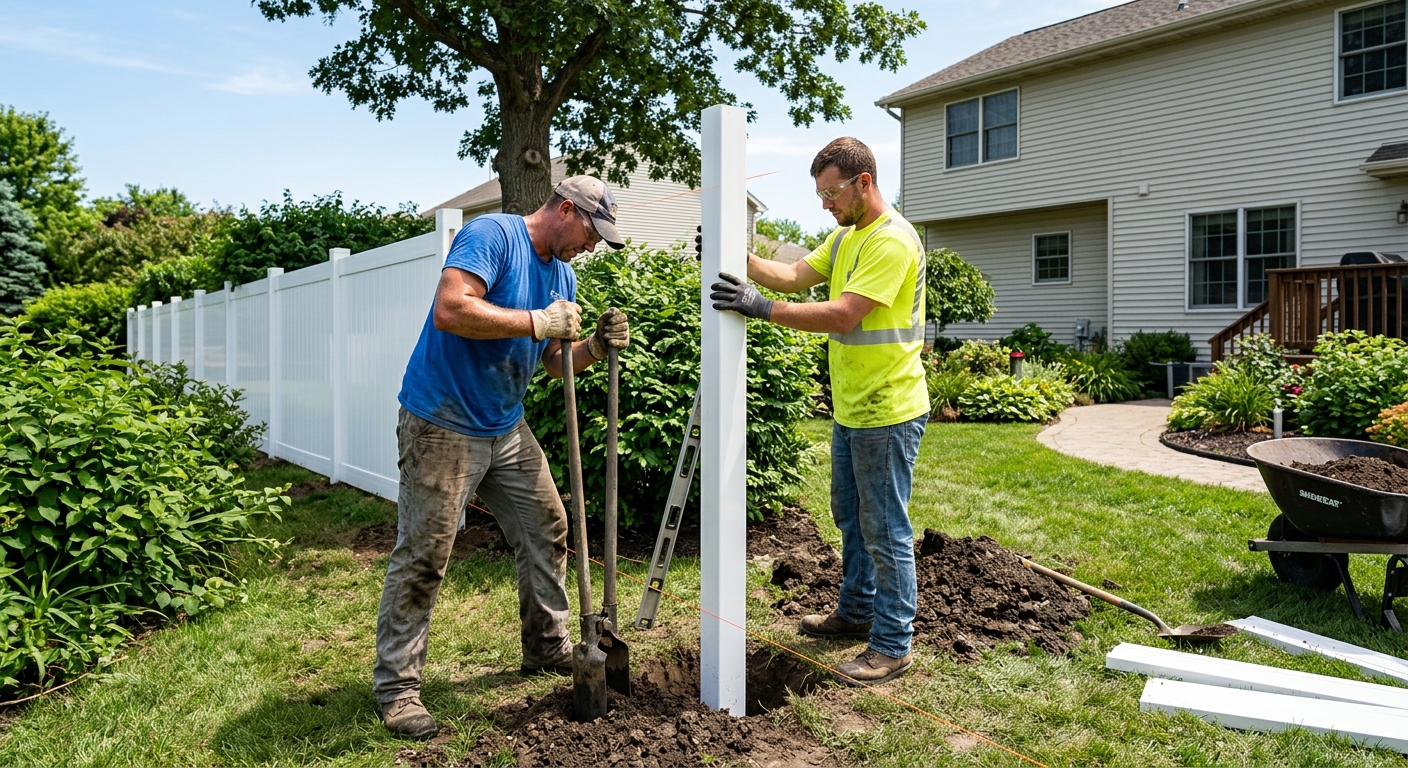
Fencing options and costs in Breslau
Breslau, Ontario is a small community with a lot of family properties, and that matters for fencing demand—local buyers commonly invest in yards where privacy and pet safety are priorities. With a population of 5,053 (Statistics Canada, 2021 Census), the market is tight enough that reputable crews stay busy, especially around spring install season. In practice, most fencing jobs in Breslau are driven by detached-home lots and backyard renovations, where new privacy fences, gates, and dog runs are frequent upgrades.
Because Breslau sits in the Toronto economic region, fencing costs are shaped by Southern Ontario’s freeze–thaw cycles. Contractors plan for frost heave by setting posts deep enough to sit below the frost line, typically requiring concrete-set posts for 6–8 ft privacy fences. That means more excavation time, more ready-mix and longer posts, which pushes pricing toward the higher end of the Toronto bands. On top of that, crew availability and material lead times can swing quotes month-to-month as neighbouring cities like Kitchener and Waterloo overlap labour demand.
In Breslau, areas with busier home improvement activity—like the neighborhoods near the downtown/core streets where lots back onto larger residential properties—tend to see the most calls for new fence lines and replacement gates. If you’re planning a privacy upgrade or simply want to understand realistic budgeting, the table below compares common options and typical cost ranges for this area.
| Material |
Lifespan |
Maintenance |
Privacy Rating |
Price per Linear Foot |
| Pressure-treated pine (standard wood) |
10–15 years |
Stain/seal every 2–3 years |
High (solid boards) |
$65–$90 |
| Cedar (natural rot resistance) |
15–25 years |
Light staining/sealing every 2–4 years |
High (solid boards) |
$80–$120 |
| Vinyl / PVC (no-maintenance) |
20–30 years |
Rinse as needed (no painting) |
High (solid styles) |
$75–$130 |
| Chain-link (galvanized steel) |
25–40 years |
Occasional wash and repairs |
Low–Medium (privacy slats optional) |
$45–$70 |
| Aluminum ornamental |
25–40 years |
Wash periodically; tighten hardware |
Low–Medium (decorative pickets) |
$90–$160 |
| Composite / recycled material |
20–30 years |
Minimal cleaning; no staining |
High (board-style systems) |
$110–$160 |
Prices are estimates only and vary by project scope, site access and material selection.
What affects the price of fencing in Breslau
In Breslau and the wider Toronto region, quotes for the “same” fence can vary by 30–50% because pricing isn’t just material—it’s how the fence is engineered for our ground conditions, wind loads, and jobsite constraints. Two contractors may both quote a 6 ft privacy fence, but if one uses proper concrete-set posts at adequate depth and the other uses faster installation methods, their labour and material costs will move substantially. Availability also matters: when crews are booked tight across the Toronto economic region, the best teams price in scheduling and excavation time.
The biggest driver is frost depth and post installation. Southern Ontario frost depth is commonly taken around 42"–48", so crews typically set posts 3.5–4 feet deep for stability—meaning holes are deeper, more concrete is used, and longer posts are required. For Toronto-style privacy fences, that increases labour time and ready-mix costs, often keeping wood installations closer to the upper part of the $65–$120 wood range and vinyl closer to the $75–$130 band. In colder years with heavier freeze–thaw, proper footing becomes non-negotiable.
Wind also influences panel design and post spacing. While we don’t get the extreme open-field exposure of the Prairies or the coastal storm load profile of British Columbia, tall solid fences still rack in gusts. Heavier posts and tighter spacing can add cost—especially for 8 ft solid privacy and wide gate openings.
Concrete examples from Breslau-area sites: (1) clay-heavy soils can slow excavation and increase disposal loads, pushing overall costs up; (2) sloped backyards often require stepped/raked panel layouts, which increases material waste and layout time; (3) replacing a fence along a narrow side yard typically raises labour costs due to staging and hauling, especially when old boards must be removed. When your quote compares a wood privacy fence in the $65–$90 range versus a cedar or vinyl option closer to $110–$130, it’s usually the combination of post depth, concrete quantity, and gate complexity doing the explaining.
| Price Factor |
Why It Matters |
Cost Impact |
| Fence length in linear feet |
Most material and labour scale directly with length |
Typically the primary driver |
| Post depth required |
Frost line determines hole depth and post length |
Higher depth increases concrete and labour |
| Post setting method |
Concrete vs. gravel pack vs. driven posts affects stability |
Concrete-set posts usually cost more, but last longer |
| Material choice |
Vinyl and cedar cost more than pressure-treated wood and chain-link |
Can shift the project by tens of percent |
| Gate count and type |
Double drive gates and wide openings need heavier framing |
Often adds the equivalent of several fence sections |
| Grade and terrain |
Sloped yards require stepped or raked panels and extra layout work |
Increases labour and material waste |
| Old fence removal and disposal |
Demolition, hauling and dump fees add time and cost |
Can meaningfully raise the quote for replacement jobs |
| Permit fees and survey / property line locate |
Clear lines reduce rework and neighbour disputes |
Varies by municipality and site requirements |
Permits & regulations in Ontario
In Ontario, fence permitting depends mainly on height and location relative to your property. A common threshold is that fences above about 2.0 m (6.5 ft) at the rear often trigger a building permit, while fences above roughly 1.0–1.2 m (3–4 ft) at the front or corner can also require approval—though exact requirements can vary by municipality and by how the fence relates to the road allowance. For Breslau homeowners, the safest approach is to confirm the height and placement before you order materials, because permit delays can affect installation scheduling.
Before digging any post holes, you must call for utility locates (Ontario One Call). That’s to prevent damage to buried services when you’re excavating near the fence line. Also, obtain a survey or at minimum a property-pin locate before you install. This reduces the risk of encroaching on a neighbour’s yard or building on the wrong setback.
Shared fence ownership and line-fence responsibilities are governed by provincial line-fences rules. Practically, you’ll want clear written agreement on who maintains the fence, especially if the fence is on or near the property boundary.
For contractor verification, a legitimate Ontario fence contractor should be able to show proof of licensing (where applicable), liability insurance, and coverage consistent with worker protection obligations. Step-by-step: (1) ask for their certificate of insurance and confirm it’s current; (2) request proof of WSIB/WCB clearance or applicable coverage documentation; (3) verify any Ontario business and licence standing through the relevant online registry/check; and (4) keep copies of those documents for your records.
Choosing the right fence material for Breslau
Picking a fence in Breslau is mostly about matching material to your priorities—privacy, low maintenance, budget, and how long you want the fence to look solid through Ontario winters. Pressure-treated pine is the budget-friendly option, but it typically needs staining or sealing every 2–3 years to slow weathering and keep the wood from turning grey and rough. Cedar offers better natural rot resistance and often looks better longer, but it still benefits from periodic maintenance. Vinyl/PVC is popular for “set it and forget it” convenience and doesn’t require painting, but in extreme cold you still need quality installation and proper post spacing to prevent movement and stress. Chain-link is the longest life at the lowest initial cost, but it provides minimal privacy unless you add slats or a privacy screen. Aluminum ornamental provides a clean, rust-resistant look and good curb appeal, though it’s not a privacy solution.
For Southern Ontario’s typical frost line of about 42"–48", Toronto-area best practice is to set posts deep—often 3.5–4 feet for 6–8 ft privacy fences—using concrete-set posts on clay/mixed soils. That’s what protects the fence against heaving and wobble. With snow load and wind, solid fence panels can rack in gusts, so heavier posts (and appropriate spacing) matter more for privacy styles than for ornamental fencing.
Example of where the price difference is worth it: if you’re comparing pressure-treated wood near the $65–$90 per linear foot range versus vinyl near $75–$130, the vinyl premium often makes sense when you want to avoid repeated staining during the wet–freeze seasons. If your site is difficult to access for repairs or you expect to stay long-term, investing in materials with lower maintenance can be more economical over the fence’s lifespan.
| Material |
Cold Tolerance |
Lifespan |
Annual Maintenance |
Best For |
Price Band |
| Pressure-treated pine |
Good (with proper concrete-set posts) |
10–15 years |
2–3 year stain/seal cycle |
Budget privacy where you’re okay with upkeep |
$65–$120 |
| Cedar |
Good (natural oils slow rot) |
15–25 years |
Every 2–4 years (light staining as needed) |
Better looks + rot resistance for privacy |
$80–$120 |
| Vinyl / PVC |
Very good (proper installation matters) |
20–30 years |
Minimal (rinse/clean as needed) |
Low-maintenance privacy in Ontario winters |
$75–$130 |
| Chain-link |
Excellent (corrosion-resistant) |
25–40 years |
Occasional wash and hardware check |
Security and boundary definition |
$45–$85 |
| Aluminum ornamental |
Excellent (no rust) |
25–40 years |
Minimal (tighten hardware; wash) |
Curb appeal with a more open look |
$90–$160 |
| Composite / recycled |
Good (depends on brand/system) |
20–30 years |
Minimal cleaning; inspect fasteners |
Privacy with low upkeep and modern look |
$110–$160 |
How to choose a fencing contractor in Breslau
Start by verifying the contractor’s coverage and standing, not just their price. In Ontario, fencing is labour-heavy and excavation-based, so liability insurance and worker protection matter. How to check: (1) request their certificate of liability insurance and confirm the policy is active and that the coverage limits are appropriate for construction work; (2) ask for WSIB/WCB clearance (or applicable proof of coverage) and ensure it’s current—contractors should be able to provide documentation without hesitation; (3) verify the company’s business details and credentials through Ontario’s online registry and any publicly listed professional licensing information relevant to their trade; and (4) check that they can name who will be on-site and who holds the coverage.
Next, get 2–3 itemised written quotes rather than lump sums. A good quote breaks down labour and materials line-by-line, including post type, post depth, concrete quantity, panel style, and gate hardware. Read exclusions carefully: ask whether permit pulls (if needed), utility locate coordination, demolition of the old fence, and disposal are included. For warranty, confirm workmanship warranty duration (often specific to installation), manufacturer product warranty, and whether warranty is transferable to a future homeowner.
For payment, never pay more than about 10–15% upfront. Use progress payments tied to milestones and keep a holdback until the fence is complete, straight, gates latch properly, and cleanup is finished. Finally, insist on a written start date and completion estimate so you can plan around frost conditions and spring logistics in Breslau.
- Provides insurance certificate and WSIB/WCB clearance (current dates on documents)
- Shows a clear fence layout drawing with gate locations and measured linear footage
- Specifies post depth and whether posts are concrete-set vs. driven
- Lists material grades (board thickness/spec, rail type, fastener corrosion rating)
- Includes gate hardware quality (hinge type, latch type, reinforcement for double gates)
- States whether utility locates are coordinated and who calls
- Confirms permit responsibility when heights cross local thresholds
- Includes old fence removal and dump fees, or states it clearly as an exclusion
- Provides a workmanship warranty in writing and the exact coverage
- Shows expected start date and completion timeline
- Gives a payment schedule with a final holdback until punch list is complete
- Uses written change-order language for scope increases
Common red flags I see in Breslau include: (1) quotes that don’t specify post depth or concrete-set installation for privacy heights; (2) vague scope language like “remove and replace fence” without disposal details; (3) reluctance to provide insurance/WSIB documentation or giving outdated certificates; (4) asking for large upfront deposits well beyond 10–15%; and (5) skipping a property-line/survey conversation and offering to “figure it out later.”
Frequently asked questions — fencing in Breslau
What is the most weather-resistant fence for Breslau's climate?
For Breslau and the broader Southern Ontario freeze–thaw cycle, the most weather-resistant choices are typically vinyl/PVC and properly installed cedar, provided posts are set correctly below the frost line. In practice, the durability comes less from the panel alone and more from foundation work: concrete-set posts at the right depth are what prevent wobble and frost heave. Cedar has natural rot resistance and holds up well to moisture swings, while vinyl won’t rot and is low maintenance through wet winters. If you’re looking at budgeting, note that vinyl projects often land in the $75–$130 per linear foot band, while cedar commonly sits closer to the $80–$120 range—so you can compare longevity vs upfront cost.
How do I prevent wood fence rot in Breslau?
Wood rot prevention in Breslau is mostly about keeping water and soil contact under control. First, ensure posts are set using concrete (not just gravel pack or shallow holes), and that the post depth accounts for Ontario’s frost depth so the fence doesn’t heave and trap moisture. Second, use pressure-treated or cedar rated for ground contact and choose corrosion-resistant fasteners so screw holes don’t become failure points. Third, keep bottom boards slightly off the ground where design allows, and seal/stain on schedule—pressure-treated wood usually needs staining every 2–3 years, while cedar typically needs lighter maintenance every 2–4 years. Finally, address sprinklers and downspouts that dump water at fence bases.
What is the cost per linear foot for fencing in Breslau?
In Breslau, typical installed pricing follows the Toronto economic region bands, and your final per-linear-foot cost changes with post depth, gate count, and whether you need concrete-set footings. For quick budgeting: wood privacy fences often price around the $65–$120 per linear foot range, vinyl/PVC around $75–$130, chain-link around $45–$85, and aluminum/metal around $90–$160. If you’re comparing two options, make sure the quotes include the same installation standard—especially post setting—because skipping proper depth is how cheap quotes end up being expensive later. For a privacy job, gates and sloped yard layouts can push costs above the midpoint of the band.
Should I repair or replace my old fence in Breslau?
Replace when structural components have failed: rotted rails, loose posts, significant leaning, or sections where the bottom is sunk due to frost movement. Repair can make sense when the fence line is mostly sound—e.g., you have a few damaged boards, minor hardware issues, or you can replace posts without disturbing the entire system. A key Breslau factor is how the fence was originally installed: if posts were driven shallow or weren’t concrete-set, repairs may be short-lived because frost heave tends to reintroduce movement. When in doubt, ask for an on-site assessment that includes post condition and base moisture issues, not just a board-by-board check.
How do I handle a fence dispute with neighbour in Ontario?
In Ontario, fence disputes usually come down to property line location and responsibilities for maintenance. Start by confirming where your property line actually is—use a survey or property-pin locate rather than relying on guesswork. Then, document everything: photos of the fence condition, communication attempts, and any agreements about fence ownership or upgrades. Shared or boundary-adjacent fences are influenced by Ontario line-fence legislation, but practical outcomes often come from clear, written agreements about repairs and cost-sharing. Keep conversations calm and factual, and request a contractor to provide written recommendations tied to installation standards. If the dispute involves permit requirements or height thresholds, don’t proceed with major changes until you clarify what’s required for your specific location.
What fence style offers the best wind resistance in Breslau?
For wind resistance in Breslau, privacy fences built with solid panels can be very effective, but they need the right structure: heavier posts, appropriate spacing, and solid bracing/hardware so the fence doesn’t rack. In practice, a well-built solid privacy fence (wood or vinyl) with concrete-set posts is strong, but it must be engineered for height—especially at 6–8 ft. If you want a style that “lets the wind pass” and reduces lateral pressure, semi-open designs or ornamental aluminum can perform well, though they trade off privacy. Whatever you choose, insist the quote includes the post plan (depth and spacing) and gate reinforcement, since the widest openings typically see the most wind-related movement.