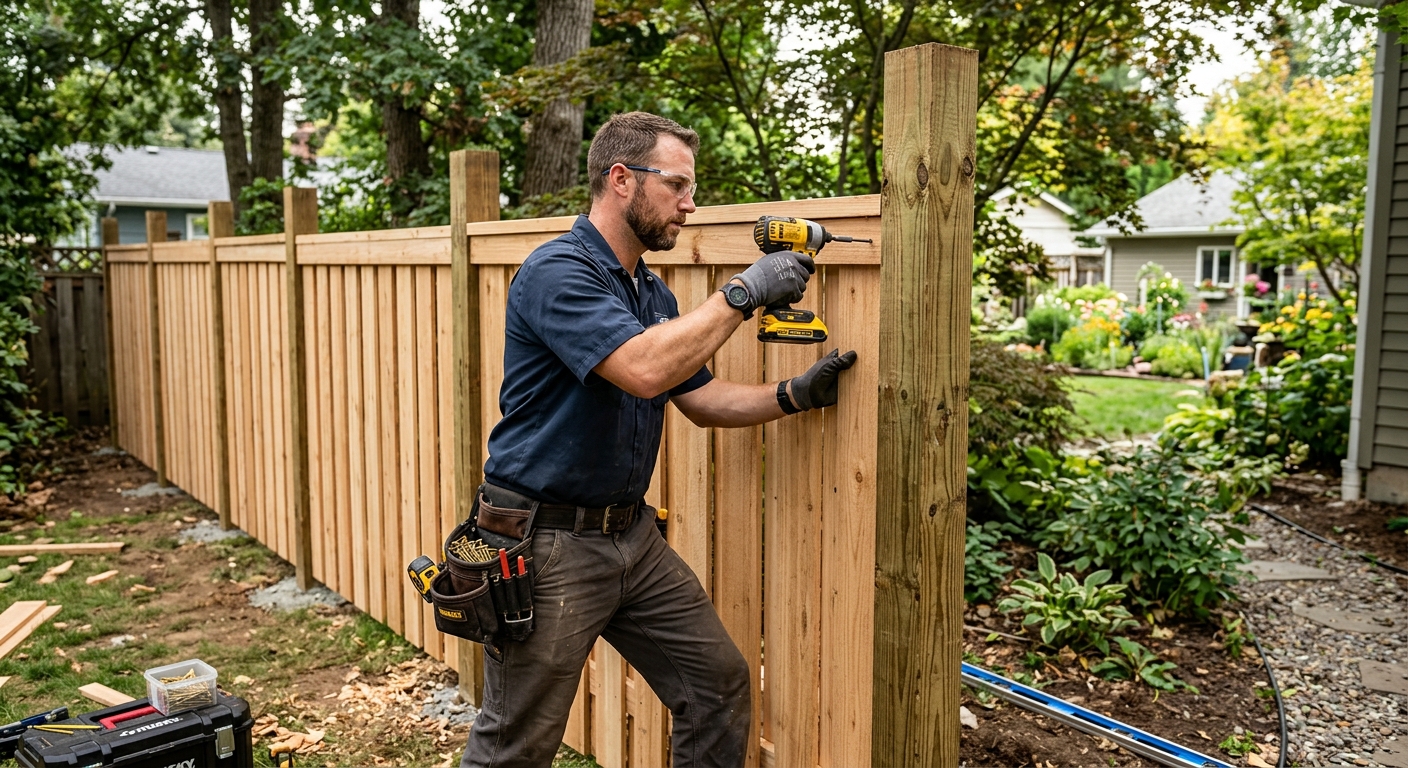
Fencing options and costs in Englehart
Englehart homeowners typically shop for fencing with one goal: a fence that looks good and holds up through our long winters. With Englehart’s housing stock leaning heavily toward single-detached homes—73.5% of dwellings are detached—and a homeowner rate of 67.6% (Statistics Canada, 2021 Census), demand is especially strong around private backyards and side-yard containment. That matters because more fences are built as part of routine property maintenance rather than shared walls.
Pricing in the Northeast corridor is driven less by “brand” and more by cold-climate installation realities: frost heave risk and wind loads change how contractors design post spacing, footing size, and whether they set posts in concrete. In Englehart, many older properties were built before 1981 (84.6% of homes), so it’s common to replace aging fences that were originally installed with shorter posts or minimal base preparation. That often adds labour for removal, property line checks, and reinstalling posts to the correct depth.
In Englehart, the trade is especially active in and around the residential blocks near downtown where properties are closer together and gates are often required. Expect more detailed quotes there because access, debris hauling, and line-locates can be more complicated.
Below is a realistic comparison of options you’ll see in Englehart quotes, including typical Ontario-style installed pricing bands. Use this as a baseline before you compare contractor line-items in your proposal.
| Material |
Lifespan |
Maintenance |
Privacy Rating |
Price per Linear Foot |
| Pressure-treated pine (standard wood) |
10–15 years |
Stain/seal every 2–3 years; check posts annually |
High (solid boards) |
$80 – $110 |
| Cedar (natural rot resistance) |
15–20 years |
Light staining/oiling as needed (often every 2–4 years) |
High (solid boards) |
$95 – $130 |
| Vinyl / PVC (no-maintenance) |
20–30 years |
Wash only; inspect hardware; replace occasional panels in extreme cold |
High (privacy pickets/panels) |
$90 – $140 |
| Chain-link (galvanized steel) |
25–35 years |
Occasional cleaning; tighten hardware |
Low to medium (unless privacy slats added) |
$55 – $85 |
| Aluminum ornamental |
25–40 years |
Wash and inspect annually; touch up hardware if needed |
Low (open style) |
$95 – $150 |
| Composite / recycled material |
25–30 years |
Minimal cleaning; inspect fasteners |
High (solid boards) |
$100 – $150 |
Prices are estimates only and vary by project scope, site access and material selection.
What affects the price of fencing in Englehart
In Englehart, two neighbours can receive quotes for “the same length” of fence that differ by 30–50% once you account for site conditions and install details. That’s common across the Northeast and across Ontario because labour rates, equipment access (including augers/mini-excavators), and required post depth change with frost and soil conditions. Even when materials are similar, the foundation work and the number of fittings can drive the final number.
Cold Ontario design realities are the biggest cost variable: frost line depth determines how deep posts must be set—typically about 4–6 inches below the design frost depth—to prevent heaving and seasonal movement. In cold regions, posts often need to be set roughly 1.5–2.0 m into the ground with concrete, which raises both material cost (longer posts, more concrete) and labour time (deeper holes, more setting and bracing).
Wind exposure also changes what a “good” fence looks like. On open lots, contractors may reduce post spacing and upgrade framework so the fence doesn’t rack or loosen during gusty weather. That’s why solid privacy systems (wood or vinyl) sometimes land nearer the upper end of the $80–$130 wood band, while chain-link can stay closer to the $55–$90 band because it’s lighter and more wind-permeable.
Here are a few real examples that commonly affect Englehart pricing: (1) replacing an old, rotted fence often means additional excavation and removal costs—especially if posts are concrete-set; (2) installing along uneven ground usually requires stepped or raked sections, increasing layout time and board waste; (3) if gate openings need double-drive-through hardware, the hardware package and labour go up versus a simple walk gate.
Finally, Englehart’s older housing stock (84.6% built before 1981, Statistics Canada, 2021 Census) often means you’re working around older boundary markers, older landscaping, and sometimes non-standard prior post depths—so correct rebuilds cost more upfront, even if the fence length is the same.
| Price Factor |
Why It Matters |
Cost Impact |
| Fence length in linear feet |
Most costs scale directly with length plus end posts and corners |
Highest impact; can move totals by 50%+ |
| Post depth required |
Frost protection drives deeper holes and longer posts |
Often the difference between “basic” and “code-sound” installs |
| Post setting method |
Concrete vs. gravel pack vs. driven posts changes labour and material |
Concrete-set posts typically raise costs but reduce future movement |
| Material choice |
Vinyl and cedar cost more and require different hardware and handling |
Upgrades commonly add 15–40% versus chain-link |
| Gate count and type |
Gates need stronger framing, hinges, latch hardware, and alignment |
Double gates can add major labour and steel components |
| Grade and terrain |
Slopes require stepped/raked layouts and extra materials |
Commonly adds waste and layout time |
| Old fence removal and disposal |
Hauling and disposal time varies by access and material |
Can add several hundred to well over a thousand dollars |
| Permit fees and survey / property line locate |
Some builds require a permit; property line disputes get expensive fast |
Usually a smaller line-item, but high consequences if missed |
Permits & regulations in Ontario
In Ontario, fence rules are primarily tied to height thresholds and how the fence relates to your property line and municipal setbacks. As a general homeowner reference point, fences above a typical 2.0 m (6.5 ft) height at the rear and above about 1.0–1.2 m (3–4 ft) at the front or corner often require a building permit. Your municipality can have specific bylaw wording, so the safest path in Englehart is to confirm the relevant fence bylaw and permit requirements before installing.
Before any post hole is dug, call for utility locates (Ontario One Call). Even “simple” yard fences can cross buried services such as electrical, low-voltage lines, or later additions from past landscaping. If you don’t already know where the property line is, obtain a survey or at minimum a property pin locate to reduce the risk of encroachment disputes.
Shared fence ownership and line-fence responsibilities are governed by provincial line-fences legislation, so disagreements are often resolved by looking at who maintains the fence and where it sits on the boundary.
How to verify your contractor for an Englehart project: ask for (1) Ontario business licensing/registration where applicable, (2) liability insurance—request a current Certificate of Insurance and ensure the policy covers fencing work, and (3) WSIB coverage (or equivalent coverage documentation as required for workers). Look for these items in writing—either on the quote package or as emailed certificates—and confirm the details match the contractor legal name and address.
Choosing the right fence material for Englehart
Choosing the right fence material in Englehart comes down to how you balance privacy, low maintenance, budget, and lifespan in an Ontario winter climate. Pressure-treated pine is usually the most budget-friendly look, but it needs staining or sealing every 2–3 years to reduce grey weathering and keep boards from drying and splitting. Cedar tends to weather more gracefully—its natural rot resistance often buys better appearance retention—yet it still benefits from periodic maintenance to avoid surface checking.
Vinyl/PVC offers the “set it and forget it” advantage: low maintenance, no routine sealing, and good colour stability. The trade-off is that extreme cold can make certain plastics more brittle, so quality rails, correct installation hardware, and proper temperature-aware fastening matter. Chain-link is the lowest-cost option with the longest service life, but it doesn’t provide privacy unless you add slats or choose a closed-top or privacy-screen accessory. Aluminum ornamental is an attractive mid-range option—won’t rust like steel—yet it’s typically an open style with limited privacy. Composite/recycled fencing splits the difference: typically higher upfront cost, long lifespan, and minimal upkeep.
For Northeast frost conditions, post depth is the main cold-weather equalizer. Regardless of material, posts should be set below frost risk (commonly about 4–6 inches below design frost depth) and many installs use concrete-set posts in colder Ontario to resist heaving. That doesn’t always mean “massive concrete every time,” but it does mean correct base prep and straight, well-braced posts. Wind and snow load also matter: open styles like chain-link and ranch rails resist wind better, while heavy privacy fences need sturdier framework and good corner/line post reinforcement.
Dollar example: if a 60 ft wood privacy fence comes in near the $80–$110 per linear foot range and vinyl lands around the $90–$140 range, you may pay roughly $600–$1,800 more for vinyl on the same length. If you’re tired of annual staining schedules and you want a colour-stable finish, that premium can be justified—especially on older properties where rework costs add up when boards start warping again.
| Material |
Cold Tolerance |
Lifespan |
Annual Maintenance |
Best For |
Price Band |
| Pressure-treated pine |
Good with proper post depth and sealing |
10–15 years |
Inspect yearly; stain/seal every 2–3 years |
Budget privacy and traditional look |
$80 – $110 |
| Cedar |
Very good; weathers well in cold cycles |
15–20 years |
Inspect yearly; stain/oil as needed |
Appearance + rot resistance on a privacy fence |
$95 – $130 |
| Vinyl / PVC |
Good when installed with quality hardware |
20–30 years |
Wash only; check fasteners after hard winters |
Low maintenance and clean lines |
$90 – $140 |
| Chain-link |
Excellent (corrosion-resistant) |
25–35 years |
Tighten hardware as needed; occasional rinse |
Security with minimal upkeep |
$55 – $85 |
| Aluminum ornamental |
Excellent in freeze/thaw |
25–40 years |
Wash and inspect annually |
Durability and curb appeal |
$95 – $150 |
| Composite / recycled |
Good; relies on correct fastening |
25–30 years |
Minimal cleaning; inspect hardware |
Long life with a modern privacy look |
$100 – $150 |
How to choose a fencing contractor in Englehart
For an Englehart fencing job, don’t rely on “we’ve been doing fences forever” alone. Start by verifying Ontario coverage and compliance. Ask for proof of liability insurance (Certificate of Insurance) that lists the contractor legal name and confirms coverage for fencing and related work. Next, confirm WSIB coverage for workers where applicable: request documentation showing the contractor’s coverage status and ask what it covers on your site. If a contractor can’t provide these documents up front, that’s a significant risk for you.
Then request 2–3 itemised written quotes. You want a labour-and-materials breakdown (posts, rails, panels, hardware, concrete/footings, gates, and any excavation) rather than a single lump sum. Make sure the quote states what is included and excluded: permit pull (if needed), utility locate coordination, property line locate/survey involvement, and disposal of old fence materials. Also confirm whether they handle stepped sections on slopes and how they’ll manage corners and gates.
Warranty is another key differentiator. Ask for the workmanship warranty length and whether it’s tied to you as the owner. Also ask about manufacturer warranties on fence panels and hardware, and whether they’re transferable to subsequent owners.
Payment schedules matter: never pay more than 10–15% upfront. Hold back the remaining balance until the job is complete and you’ve confirmed the fence is plumb, gates align, and the site is cleaned.
Finally, ask for an exact start date and a completion estimate in writing, not just “sometime in summer.” Fence installs often hinge on weather windows, site access, and footing work.
- Ask for Ontario liability insurance certificate and verify the legal name matches the quote.
- Confirm WSIB coverage documentation is current and relates to fencing/installation work.
- Get 2–3 itemised quotes (labour and materials) instead of lump sums.
- Confirm whether utility locates are included or if you must arrange Ontario One Call.
- Ask who pays for property line locating/survey if pins aren’t already located.
- Check the scope for old fence removal and disposal (dump fees included or not).
- Verify post depth and setting method (concrete vs. gravel pack) is specified.
- Require details on gate hardware quality and whether gates are single or double.
- Confirm warranty terms: workmanship length and manufacturer warranty specifics.
- Insist on a written payment schedule with a maximum 10–15% upfront.
- Ask for start date and completion timeline in writing.
- Ensure the quote includes cleanup and restoration (grading, topsoil, and debris removal).
Red flags in Englehart include: quoting a “per foot” price without specifying post depth and concrete setting; refusing to provide insurance/WSIB documentation; giving only a lump sum with no breakdown; starting work without confirming property line location; and demanding a large deposit (well beyond 10–15%) before any materials are ordered or footings are formed.
Frequently asked questions — fencing in Englehart
What is the most weather-resistant fence for Englehart's climate?
If your priority is long-term performance through freeze/thaw cycles, a properly installed vinyl/PVC privacy system or a cedar privacy fence usually stands out in Ontario for weather resistance—provided posts are set below frost risk and hardware is installed correctly. Chain-link is also extremely resilient in winter because it’s lighter and corrosion-resistant, but it won’t provide privacy without slats or add-ons. In Englehart, the biggest “resistance” factor isn’t just material—it’s the footing and post design: correct post depth, straight layout, and firm base setting reduce heaving and racking. Budget-wise, you’ll commonly see wood privacy in the $80 – $110 range, while vinyl privacy often lands closer to the $90 – $140 band due to material and fastening hardware. (Statistics Canada, 2021 Census)
How do I prevent wood fence rot in Englehart?
Wood rot is preventable, but it requires details at both the board level and the post level. First, make sure your posts are set correctly: in cold Ontario, posts should be placed below frost risk (often about 4–6 inches below design frost depth) and many installs use concrete setting to reduce seasonal movement that breaks seals. Second, stain or seal on a schedule—pressure-treated pine typically needs staining/sealing every 2–3 years to prevent persistent moisture exposure. Third, reduce trapped moisture: avoid planting vines or piling wet debris against the fence, and keep bottom rails off soggy ground where possible. Finally, insist on good airflow and proper spacing for rails so boards dry out between wet periods. If you’re replacing an older fence on a pre-1981 property, expect that some previous rot started where posts sat too shallow. (Statistics Canada, 2021 Census)
What is the cost per linear foot for fencing in Englehart?
In Englehart, installed costs commonly fall within the material bands homeowners see across Northern Ontario. For wood fence installation, typical installed pricing runs about $80 – $110 per linear foot for pressure-treated privacy styles, while cedar privacy often lands higher, around $95 – $130. Vinyl/PVC privacy systems usually price around $90 – $140 per linear foot because of material cost and the way rails and panels must be fastened in cold weather. Chain-link is often the most budget-friendly at about $55 – $85, especially for security-focused runs. Your quote may sit at the low or high end based on post depth requirements, concrete setting, gate count, slope/grade changes, and whether old fence removal/disposal is included.
Should I repair or replace my old fence in Englehart?
Repair can make sense when the fence posts are solid, boards are only partially damaged, and the fence isn’t leaning due to movement at the base. In Englehart and across Ontario, many older fences fail from the ground up—shallow posts, inadequate footings, and trapped moisture. If you see loose posts, gaps widening at corners, or repeated board rot around the bottom rails, replacement is usually the smarter long-term option. A practical approach is to ask for an assessment quote that estimates labour to test a few posts and identify whether the main run is stable. If you’re dealing with a fence on a property built before 1981 (84.6% of homes, Statistics Canada, 2021 Census), odds of aged footing methods are higher, and the “fix it now” cost can quickly approach replacement cost once multiple sections need new posts.
How do I handle a fence dispute with a neighbour in Ontario?
For fence disputes in Ontario, start by confirming where the fence is actually located relative to the property line. If you don’t have clear pins or a current survey, ask for a property pin locate or conduct a survey so you’re not arguing over distance estimates. Next, document the condition and the agreement history: photos, dates, and any prior communication. Shared fence ownership responsibilities are addressed under provincial line-fences legislation, so the resolution often depends on maintenance obligations and how the fence sits on or near the boundary. If there’s disagreement over changes (like adding privacy panels or replacing posts), pause work until the location and responsibility are clarified. A good contractor should be willing to support your documentation with measurements and written placement notes. If there’s no resolution, homeowners typically move toward mediation or formal dispute processes rather than forcing repairs during a disagreement.
What fence style offers the best wind resistance in Englehart?
Wind resistance is mostly about how the fence “catches” air. In Englehart, a wind-resilient choice is usually an open style like chain-link or aluminum ornamental, because wind passes through rather than pushing against a solid face. Solid privacy fences (wood or vinyl) can still be very strong, but they require more robust framing, tighter post spacing, properly set posts, and correct corner bracing to prevent racking during gusts. If your yard is exposed or you get strong gusts across an open lot, I often recommend chain-link if security is the goal and you can tolerate lower privacy—or using privacy screens only on the calmer sides. For pricing context, chain-link often sits around $55 – $85 per linear foot, while solid privacy upgrades tend to land closer to the $80 – $140 bands depending on material.