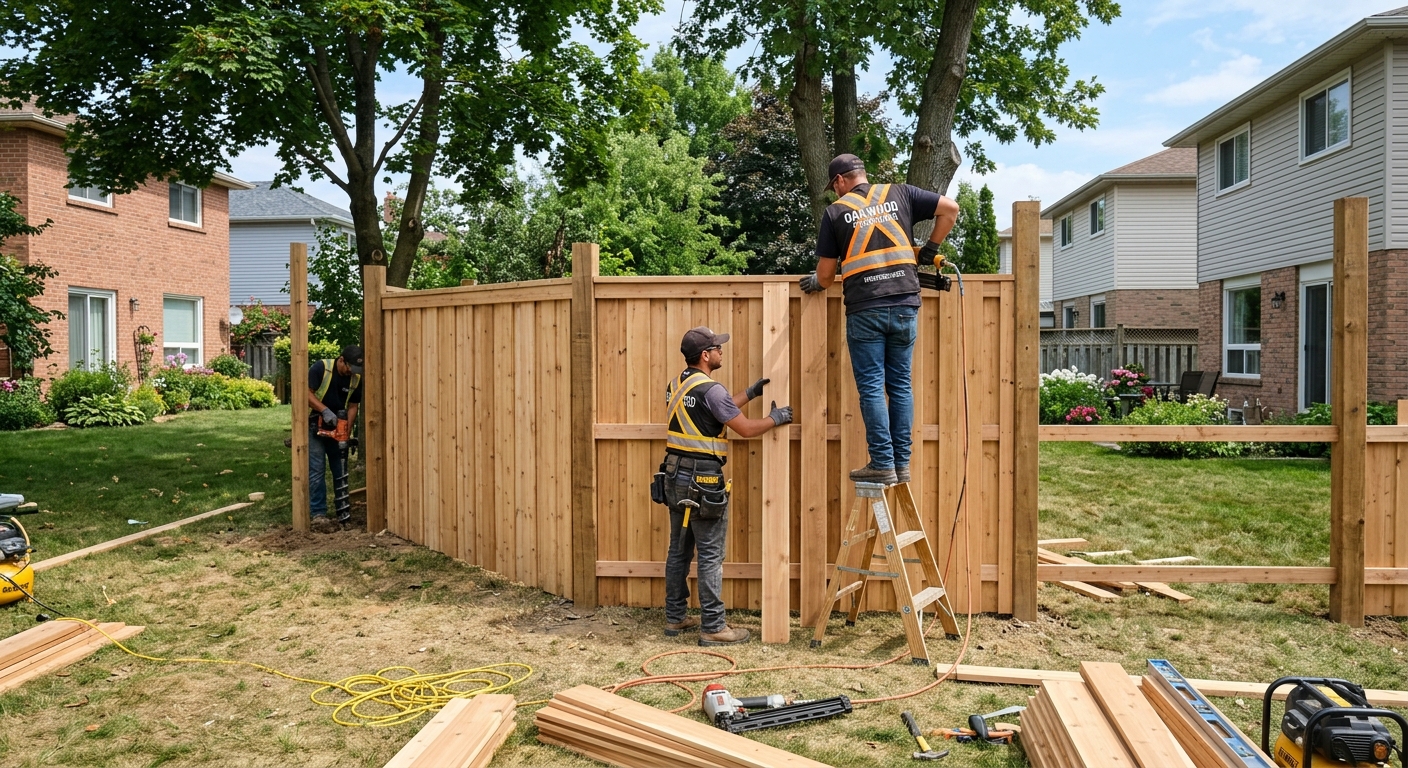
Fencing options and costs in Weston
In Weston, fencing demand tends to follow housing type: with a population of 17,992 (Statistics Canada, 2021 Census), many backyards are tied to single-family ownership patterns, and each detached property often needs a clear, weather-ready boundary. The Toronto economic region also pulls in active contractor availability, but costs still swing based on how much ground work is required and how the fence handles Southern Ontario winters.
In practice, Toronto-area pricing is shaped by frost depth and local soil conditions. Posts generally must be set deep enough to resist frost heave—typically by setting concrete-set posts around 3.5–4 feet deep on many 6–8 ft privacy fences. That means more excavation time, more concrete, and heavier posts, which pushes budgets toward the mid-to-upper end of the market. Access matters too: lots near busy collector roads, tight side yards, or properties with mature landscaping can add labour for materials staging and careful post-hole work.
In Weston, trades are especially busy around family-oriented streets and established neighbourhood pockets where older fencing is being replaced with privacy-style layouts—commonly along the edges of residential blocks where wind-off and snow loading can cause racking on lighter frames. If you’re comparing options, the table below gives a practical starting point for budgeting per linear foot, then you can match materials to your tolerance for maintenance and your need for privacy.
| Material |
Lifespan |
Maintenance |
Privacy Rating |
Price per Linear Foot |
| Pressure-treated pine (standard wood) |
10–15 years |
Stain/seal every 2–3 years |
Good (solid pickets/rails) |
$65 – $120 |
| Cedar (natural rot resistance) |
15–25 years |
Seal/stain every 2–4 years (recommended) |
Good to very good (solid styles) |
$85 – $140 |
| Vinyl / PVC (no-maintenance) |
20–30 years |
Rinse annually; inspect for impacts |
Very good (solid panels) |
$75 – $130 |
| Chain-link (galvanized steel) |
15–25 years |
Occasional wash; tighten/replace parts as needed |
Low (visibility through mesh) |
$45 – $85 |
| Aluminum ornamental |
25–40 years |
Wash as needed; check gates/hardware |
Low to moderate (decorative pickets) |
$90 – $160 |
| Composite / recycled material |
20–30 years |
Minimal; occasional cleaning |
Good (solid or capped styles) |
$95 – $160 |
Prices are estimates only and vary by project scope, site access and material selection.
What affects the price of fencing in Weston
For the same basic fence line, fencing quotes in Weston can differ by 30–50% from one contractor to another in the Toronto area because the “real” work isn’t just the material. In Ontario, pricing depends on how posts are engineered for frost, how the yard is accessed, and what’s included for gates, disposal, and property line verification. Even when two estimates use similar materials, one may include deeper concrete-set footings, heavier hardware, or panel upgrades for wind resistance—those choices affect both labour time and long-term stability.
Cold-weather ground conditions are the big driver. The design frost depth is commonly taken around 42–48 inches in Southern Ontario, and posts are typically set about 4–6 inches below the effective frost depth. Practically, that often means digging holes roughly 1.5–2.0 m into the ground for many privacy fence configurations. Once you factor longer posts and concrete setting, wood and vinyl pricing can quickly move into the mid-band—especially for 6–8 ft fences where heavier posts and tighter spacing help prevent racking and uplift.
Local examples in Weston that change cost fast: (1) clay/mixed soils can require more excavation and concrete to achieve firm footing, (2) tight side-yard access (common on older, established lots) can add staging time and labour, and (3) gate-heavy designs increase hardware and install time. On the other hand, shorter runs of chain-link can land closer to the lower band (often $45–$85 per linear foot), while full privacy wood or vinyl with concrete-set posts tends to land higher (often $75–$130+), based on height and gate count. When you’re budgeting, the fence line length plus post depth is usually the deciding combination.
| Price Factor |
Why It Matters |
Cost Impact |
| Fence length in linear feet |
Material, posts, rails, and labour scale directly with the run |
Highest impact (often the majority of total cost) |
| Post depth required |
Frost line determines hole depth and post length to prevent heaving |
Moderate to high increase (more digging + more post material) |
| Post setting method |
Concrete vs. gravel pack vs. driven posts affects stability and workmanship |
Concrete-set usually raises cost but improves longevity |
| Material choice |
Vinyl vs. cedar vs. chain-link changes both cost and storm performance |
Low-to-moderate to high, depending on privacy requirements |
| Gate count and type |
Gates require heavier framing, latches, hinges, and precise alignment |
Often a major add-on, especially double drive-through gates |
| Grade and terrain |
Slopes require stepped or raked panels and additional labour/hardware |
Moderate increase for surveying and layout work |
| Old fence removal and disposal |
Demo, haul-away, and recycling/disposal add time |
Moderate to high depending on quantity and access |
| Permit fees and survey / property line locate |
Accurate locate reduces encroachment risk and layout rework |
Variable; can be small but prevents costly corrections |
Permits & regulations in Ontario
In Ontario, fences can trigger permitting based on height and location. A practical rule of thumb we use when advising Weston homeowners is that fences above a height threshold—often around 2.0 m (6.5 ft) at the rear and roughly 1.0–1.2 m (3–4 ft) at the front or corner—may require a building permit. The exact cut-offs can depend on where the fence sits relative to roadways and lot lines, but if you’re planning a tall privacy fence facing a street or at a corner, treat it as “permit likely” until confirmed.
All fences must respect property lines and local setback bylaws. Before digging any post holes, call for utility locates using Ontario One Call so you don’t damage buried services. If you don’t already have a current survey, get a property pin locate or survey to confirm boundaries—this is one of the most common reasons for disputes after fencing goes up.
Shared fence ownership and responsibilities are handled under Ontario’s line-fence legislation, which generally governs how neighbouring owners manage and share costs for shared boundaries. For Weston contractors, the safest approach is to document boundary agreement in writing when a fence sits on or near a shared line.
Licence and insurance checks: verify the contractor is licensed/registered as required by their trade category, request a certificate of liability insurance, and confirm they carry WSIB coverage (and any applicable clearance letter) where required for workers. Ask for the COI renewal date and ensure the certificate matches the exact legal name on the quote.
Choosing the right fence material for Weston
Choosing the right fencing material in Weston is mainly about matching your priorities—privacy, low maintenance, budget, and lifespan—to how Southern Ontario behaves in winter. Pressure-treated pine is the budget-friendly option, but it needs staining or sealing every 2–3 years to reduce grey weathering and protect against moisture cycling. Cedar looks great and resists rot better in damp stretches, but it still benefits from maintenance to keep the surface stable and uniform. Vinyl/PVC is popular in Toronto-area backyards because it’s low maintenance, yet in extreme cold it can be more prone to impact cracking, so we recommend it with proper post spacing and sturdy hardware. Chain-link typically costs the least upfront and lasts well, but it’s not a privacy solution unless you add slats or screen features. Aluminum ornamental offers curb appeal and long life, though it won’t give the privacy you get from solid wood or vinyl panels.
For frost resilience, the bigger question is not just material—it’s post depth and setting. With Weston’s Southern Ontario frost line considerations (commonly planned around 42–48 inches), many privacy fence installs need concrete-set posts set deep enough to reduce heave risk. That requirement pushes the total cost more than the material swap alone. Wind and snow loading can also stress lighter panel designs, so thicker posts and closer spacing (often 6–8 ft centres in privacy applications) help prevent racking.
A simple dollar example: if a cedar privacy fence comes in near the upper wood range and a vinyl option is only a bit higher, the extra spend can be justified when you want 15–25 years of appearance with fewer maintenance sessions. If you’re comfortable maintaining wood and have a long fence line, pressure-treated pine can make sense—especially where budgets are tight and the run is mostly straight with easy access.
| Material |
Cold Tolerance |
Lifespan |
Annual Maintenance |
Best For |
Price Band |
| Pressure-treated pine |
Good (with proper sealing) |
10–15 years |
Inspect; stain/seal about every 2–3 years |
Budget privacy with acceptable maintenance |
$65 – $120 |
| Cedar |
Good (better rot resistance) |
15–25 years |
Inspect; seal/stain every 2–4 years |
Looks-first privacy and natural aesthetics |
$85 – $140 |
| Vinyl / PVC |
Very good (impact matters) |
20–30 years |
Rinse annually; check hardware |
Low-maintenance privacy in freeze-thaw cycles |
$75 – $130 |
| Chain-link |
Very good |
15–25 years |
Wash and tighten/repair as needed |
Security boundaries on a tight budget |
$45 – $85 |
| Aluminum ornamental |
Very good |
25–40 years |
Wash as needed; check gates |
Attractive, rust-resistant fencing |
$90 – $160 |
| Composite / recycled |
Good (choose quality boards) |
20–30 years |
Minimal cleaning; inspect caps/fasteners |
Low-maintenance solid looks |
$95 – $160 |
How to choose a fencing contractor in Weston
When hiring a fencing contractor in Weston, start by confirming they’re set up to do the work safely and legally. In Ontario, ask for their liability insurance certificate (COI) showing coverage limits, and confirm WSIB coverage for workers with a clearance letter where applicable. For your peace of mind, don’t rely on verbal assurances—request documents before work begins. Also check their trade/contractor registration information through official online resources when available, and ensure the company name on the quote matches the insured entity on the COI.
Next, get 2–3 itemised written quotes. You want a breakdown that separates labour (layout, digging, setting posts, installing rails/panels, gate build) and materials (posts, rails, fasteners, concrete, panels). Avoid lump-sum only quotes where the scope isn’t clear. Read what’s excluded: Is permit pulling included if needed? Is old fence removal and disposal part of the price? Are concrete footings included or “gravel pack” assumed?
Warranty matters. Ask for the workmanship warranty length and whether it covers labour for post movement, misalignment, or early hardware failure. Also confirm the manufacturer warranty (material defects) and whether it is transferable if you sell your home.
Payment schedules should be cautious. Never pay more than about 10–15% upfront, and use a holdback until the job is fully completed, gates operate correctly, and cleanup is done. Request a written start date and completion estimate so your schedule isn’t left to chance.
- Ask for COI: liability insurance certificate with policy limits and expiry date
- Confirm WSIB clearance/coverage for workers (request documentation)
- Get an itemised quote: labour vs materials (not one lump number)
- Written scope: fence height, panel type, post size, post spacing
- Post setting method clearly stated (concrete-set vs gravel pack vs other)
- Confirm gate hardware brand/type and who builds/install
- Ask if permit pulling is included if required by height/location
- Inquire about property line locate/survey responsibilities
- Removal/disposal listed as included or excluded (old fence hauling is often extra)
- Warranty terms written down for workmanship and materials
- Payment schedule: 10–15% max deposit; holdback until final walkthrough
- Layout confirmation method: string line/measurements before digging posts
Red flags I see in Weston: (1) quotes that don’t specify post depth or setting method, (2) “we’ll figure it out later” language about property lines, (3) no COI or WSIB documentation provided upfront, (4) deposits larger than 25% without a detailed schedule and scope, and (5) no written warranty or vague “lifetime” claims that don’t define coverage.
Frequently asked questions — fencing in Weston
Wood vs vinyl vs aluminum fence — which is best?
For most Weston homeowners wanting privacy, wood or vinyl usually wins. Wood (pressure-treated pine) fits best if you’re comfortable with maintenance every 2–3 years and you want to stay closer to the typical wood band of $65 – $120 per linear foot. Vinyl/PVC is the “set it and forget it” choice in freeze-thaw climates because it’s low maintenance, often landing in the $75 – $130 range while resisting rot better in wet periods. Aluminum ornamental is best when curb appeal matters more than privacy; it’s often $90 – $160, but it won’t block sightlines like a solid panel. If your backyard has higher wind or you’re building a 6–8 ft style, post depth and concrete-set installation matter as much as the material.
Do I need a permit to build a fence in Ontario?
Often, yes—depending on height and where the fence sits. In Ontario, fences above about 2.0 m (6.5 ft) at the rear and roughly 1.0–1.2 m (3–4 ft) at the front or corner may require a building permit. For Weston lots, the “front/corner” locations are the ones homeowners most often underestimate. Beyond permits, you still need to respect property lines and municipal setback rules, and you must call for utility locates before any digging. Your contractor should tell you whether a permit is likely and whether they include it in the quote. If they won’t discuss permits in writing, ask directly before you sign a contract.
How long does a wood fence last in Weston?
In Weston’s Southern Ontario conditions, a properly installed pressure-treated pine fence commonly lasts around 10–15 years, while cedar often stretches closer to 15–25 years. Longevity depends heavily on post setting (concrete-set posts placed deep enough to reduce frost heave risk), good ventilation, and surface protection. If you stain wood, budgeting a maintenance cycle every 2–3 years is realistic; skipping it can accelerate greying and fasten/rail deterioration from moisture cycling. For a long fence run, small differences in material and hardware can be less important than the quality of the post holes, concrete, and alignment—those determine how the fence stands through winter and spring thaw.
Who owns and maintains a shared fence?
In Ontario, shared fence responsibilities are generally governed by line-fence rules under provincial legislation. Practically in Weston, that means the neighbour situation depends on whether the fence is on the shared boundary and what was previously agreed—especially if one party installed or paid for the original fence. If it’s truly a shared boundary fence, both owners may have rights to use it and responsibilities that can include maintenance and cost sharing. The safest route is to confirm boundary location (survey/locate), then document agreements in writing for maintenance scope, replacement timing, and cost division. A good fence company should be willing to discuss boundary approach before digging, not after demolition starts.
How do I find my property line before fencing?
Don’t rely on eyeballing lot edges. Start by locating your property pins (or having them located) and comparing them to a current survey if you have one. If you don’t have a recent survey, hire a surveyor or request a property line locate through the proper channels so your fence line matches the boundary. Also, check municipal documentation or any existing lot plan you’ve received with home purchase papers. Before any post holes are dug, call Ontario One Call for utility locates so you can map services and avoid line strikes. This step matters in Weston because older neighbourhood lots can have irregularities, and a small boundary miscalculation can lead to removal/rebuild costs.
What's the most low-maintenance fence?
In Weston and across Ontario, vinyl/PVC is usually the lowest-maintenance option for homeowners who want privacy without recurring staining. With vinyl, the routine is typically an annual rinse and occasional hardware checks after storms or if a gate is used heavily. It often lands in the $75 – $130 per linear foot range depending on style and gate count. Wood can be low-maintenance only if you’re okay with weathering and slower repainting cycles, but most homeowners end up staining/sealing every 2–3 years for best appearance and protection. Chain-link is also low-maintenance, but it won’t provide privacy unless you add slats or screening features.