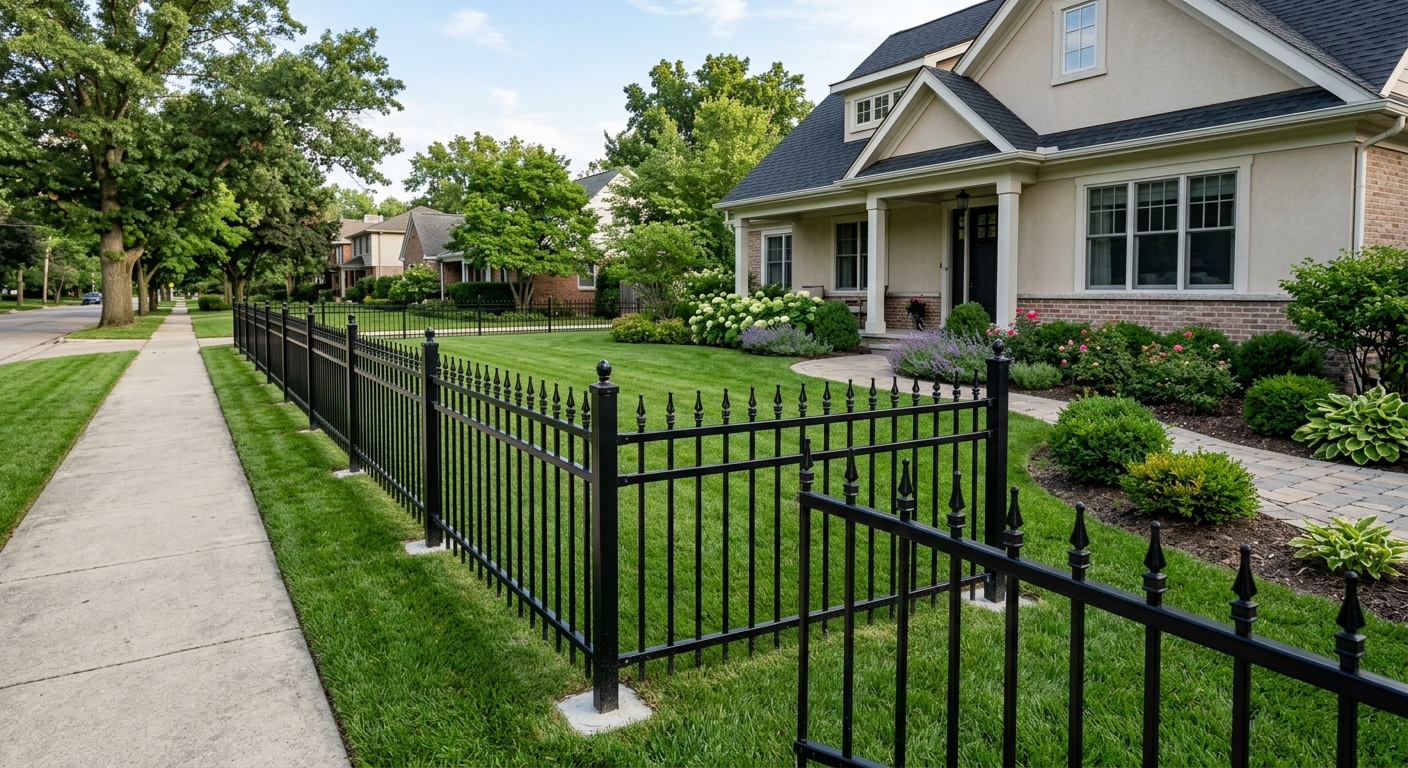
Fencing options and costs in Richmond
Fencing in Richmond, Ontario is mostly shaped by how winter interacts with your yard—especially the depth of frost and how exposed your lot is to wind-driven snow. Richmond is a small community (4,055 residents per the Statistics Canada, 2021 Census), so the local customer base is more concentrated: when homeowners replace or add fencing in busy areas, you often see contractors scheduling jobs tightly. In practice, fencing demand also tracks closely with older housing stock and established neighbourhoods where lots are already “fence-defined,” making upgrades a common homeowner project.
Costs in the Ottawa economic region tend to be higher than milder parts of Ontario because posts must be set below the regional frost line to limit heaving and leaning. Ottawa’s frost depth is roughly 3.5–4 ft, so quality installs often bury posts close to 4 ft, frequently with concrete footings in clay soils that shift during freeze–thaw cycles. That deeper digging increases labour hours, machine time, and disposal, which is a big reason wood and chain-link projects can differ substantially even when the material cost looks similar. Fence design also has to account for wind loading: even though Richmond isn’t as severe as open Prairie sites, privacy fences still behave like sails, and snow can drift against panels.
In Richmond, trade activity is especially strong around the downtown core and the older residential streets where lots are typically narrow and access is tighter, meaning gates, demolition, and haul-away often add to the estimate. With that in mind, the table below gives typical ranges and what you can realistically expect from each material.
| Material |
Lifespan |
Maintenance |
Privacy Rating |
Price per Linear Foot |
| Pressure-treated pine (standard wood) |
10–15 years |
Stain/seal every 2–3 years |
8/10 (solid boards) |
$40–$75 |
| Cedar (natural rot resistance) |
15–25 years |
Light staining as needed (often 3–4 years) |
9/10 (solid boards) |
$55–$95 |
| Vinyl / PVC (no-maintenance) |
20–30 years |
Rinse only (wash 1–2 times/season) |
8/10 (solid or privacy style) |
$45–$80 |
| Chain-link (galvanized steel) |
20–40 years |
Occasional tensioning/repair |
3/10 (low privacy) |
$25–$50 |
| Aluminum ornamental |
25–40 years |
Wash annually; no rust typical |
4/10 (open pickets) |
$70–$120 |
| Composite / recycled material |
20–30 years |
Minimal washing; no staining |
8/10 (solid composites) |
$60–$110 |
Prices are estimates only and vary by project scope, site access and material selection.
What affects the price of fencing in Richmond
Homeowners in Richmond can see quote differences of 30–50% for what looks like the “same” fence, mainly because the real drivers aren’t the fence boards—it’s the work required to install them in Ottawa-area soil and wind conditions. A standard linear-foot price can swing when your contractor must dig deeper post holes, set more concrete, adjust spacing for stronger gust loads, or manage removal and disposal. Labour rates and crew availability also tighten around peak season, so two quotes can differ simply because one includes more protective measures for frost heave and a storm-ready layout.
The frost line is the biggest structural driver in cold Ontario. As a practical rule, posts are typically set about 4–6 inches below the design frost depth to reduce uplift. With Ottawa’s frost depth around 3.5–4 ft, that often translates to posts going roughly 1.5–2.0 m into the ground. Deeper holes mean longer augers, more backfill, more material handling, and more time. In clay soils—common in parts of Eastern Ontario—concrete setting is commonly recommended to stabilize posts through freeze–thaw cycles, which raises labour and concrete costs compared with gravel-pack or driven-post approaches.
Wind exposure adds another layer. Privacy fences can act like sails; this typically means more robust post spacing and heavier bracing, especially if snow drifts push against panels. To illustrate cost movement: if your yard needs concrete-set footings to reach consistent frost-depth bearing, a “budget” wood install that might start near $40–$75 per linear foot can move toward cedar pricing depending on post requirements and hardware. Conversely, chain-link can remain close to $25–$50 per linear foot because it’s lighter and less affected by wind-profile panel loads. Coastal BC timber rot rules aren’t your main issue in Richmond, but Ontario’s freeze heave is—so the install method matters more than the board species alone.
In Richmond specifically, projects often cost more when (1) you have narrow side-yard access requiring hand digging and smaller equipment, (2) you’re replacing an old fence with multiple buried post remnants and disposal, or (3) the grade is uneven, forcing stepped layouts that increase labour and materials. Costs can be lower when the fence line is straight, accessible for a small auger, and removal is minimal.
| Price Factor |
Why It Matters |
Cost Impact |
| Fence length in linear feet |
Most labour and materials scale directly by distance. |
High (typically the largest line item) |
| Post depth required |
Frost line determines how long posts must be and how deep holes go. |
High in Richmond/Ottawa-area winters |
| Post setting method |
Concrete footings reduce heave and movement in freeze–thaw conditions. |
Medium to high (more labour and materials) |
| Material choice |
Vinyl and cedar change board price, hardware needs, and replacement intervals. |
Medium to high (varies by material band) |
| Gate count and type |
Double gates and heavier materials need extra framing and stronger hinges. |
Medium (can add significant labour) |
| Grade and terrain |
Slopes require stepped or raked panels and careful alignment. |
Medium (more cuts, layout time) |
| Old fence removal and disposal |
Disposal fees and time to break out buried posts increase costs. |
Medium (often overlooked) |
| Permit fees and survey / property line locate |
Some heights and locations require permits; locating prevents encroachment errors. |
Low to medium depending on scope |
Permits & regulations in Ontario
In Ontario, fence height rules and permit requirements depend on where the fence is located (front/corner versus rear) and how tall it is. As a common threshold, fences above about 2.0 m (6.5 ft) in the rear and roughly 1.0–1.2 m (3–4 ft) at the front or corner often require a building permit in Ontario municipalities. Even when a permit isn’t required, your fence still must respect property lines and municipal setback bylaws. In Richmond-area lots, disputes usually come from guessing the line—so verify it before you dig.
Before any post-hole excavation, call for utility locates (Ontario One Call). Then plan to obtain a survey or have your property pins located so your posts don’t encroach. Shared fence ownership rules are governed by provincial line-fences legislation, which can affect who pays for repairs or replacement when a fence benefits both properties.
What typically DOES require a permit: larger-height fences (especially rear privacy fences), fences that may affect setbacks, and situations where the municipality asks for permit documentation based on location. What typically does NOT require a permit: standard-height fences that stay under the local threshold and do not interfere with required setbacks (confirm with your municipal bylaw).
To verify a contractor in Richmond, check three things: (1) Ontario licence/registration status via the appropriate online registry for their category, (2) liability insurance certificate that matches your job address and includes adequate coverage, and (3) WSIB coverage (or the correct equivalent coverage status) by requesting proof of clearance/coverage documents. Insist on seeing the certificates before work starts—don’t accept “we’re covered” without paperwork.
Choosing the right fence material for Richmond
Choosing a fencing material in Richmond is mostly about matching what you want (privacy, upkeep, appearance) to what Ontario winters demand (stable posts, tight installation, and weather-appropriate materials). Pressure-treated pine is the usual budget option, but it needs staining or sealing every 2–3 years to avoid grey weathering and premature surface wear. Cedar costs more up front, yet it has better natural rot resistance and typically holds its look longer; you still should expect periodic maintenance, especially on sun-exposed or splash-prone sections.
For low maintenance, vinyl/PVC stands out: it doesn’t need staining and is easy to rinse clean. That said, extreme cold can make some vinyl styles more prone to cracking if the system isn’t installed correctly with proper post spacing and bracing. Chain-link is the most cost-predictable option (and can be the longest lasting if installed tight and tensioned), but it offers minimal privacy unless you add privacy slats or mesh. Aluminum ornamental fences look sharp and don’t rust, but they’re not a privacy solution in the traditional sense because the pickets are open.
On post depth: because Ottawa’s frost depth is about 3.5–4 ft, plan for posts set around that depth (often roughly 4 ft) and, in many Richmond yards, concrete-set footings are a reliable choice in clay to resist winter heave. Wind and snow load also matter: tighter post spacing and stronger rails help prevent panel bowing and sagging after repeated freeze–thaw cycles.
A concrete example: if you’re comparing pressure-treated pine at roughly $40–$75 per linear foot versus cedar or upgraded composite closer to the mid-to-upper range, paying the higher upfront cost is usually justified when you want longer service life and less frequent refinishing. If your budget is tight and you’re willing to maintain annually, pine can make sense—provided the contractor is building the foundation correctly with proper depth and concrete setting where needed.
| Material |
Cold Tolerance |
Lifespan |
Annual Maintenance |
Best For |
Price Band |
| Pressure-treated pine |
Good if posts are set below frost and wood is stained |
10–15 years |
Low-to-moderate (stain check; 0–1 small touch-ups) |
Value-driven privacy with routine upkeep |
$40–$75 |
| Cedar |
Good; handles freeze–thaw better with correct foundation |
15–25 years |
Low (often every season or every few years, as needed) |
Appearance and rot resistance for privacy |
$55–$95 |
| Vinyl / PVC |
Very good when installed with proper spacing and bracing |
20–30 years |
Very low (rinse/clean 1–2 times) |
Low maintenance and crisp look |
$45–$80 |
| Chain-link |
Excellent in winter; corrosion resistance depends on coating |
20–40 years |
Very low (occasional tensioning/repairs) |
Security/containment with minimal privacy |
$25–$50 |
| Aluminum ornamental |
Excellent (no rust typical) |
25–40 years |
Low (wash 1 time/year) |
Front-yard curb appeal and durability |
$70–$120 |
| Composite / recycled material |
Good; performance depends on fastening and foundation quality |
20–30 years |
Very low (wash as needed) |
Privacy with minimal maintenance |
$60–$110 |
How to choose a fencing contractor in Richmond
Choosing the right fencing contractor in Richmond comes down to proof—not promises. In Ontario, verify the contractor’s licensing/registration for their trade category (use the relevant online registry), then confirm liability insurance with a certificate of insurance showing coverage for your address. For worker coverage, ask for WSIB clearance or equivalent proof of coverage status before any work begins; you should be able to review documents during the estimate process.
Next, get 2–3 itemised written quotes. You want a breakdown that separates posts/footings, rails, pickets/boards or mesh, gate frames and hardware, concrete/aggregate (if used), labour hours, and disposal/removal. A good quote won’t lump everything into one number. Also ask what’s excluded: permit pull (if required), utility locate fees, site grading/levelling, and whether concrete footings are included based on frost requirements. In Richmond, old fence removal is often where costs hide—make sure demolition, hauling, and dump fees are clearly stated.
Warranty matters in fencing. Ask for a workmanship warranty (how long they stand behind installation), the manufacturer’s product warranty (board/panel material), and whether the warranty is transferable if you sell your home. Payment should be conservative: never pay more than 10–15% upfront, and hold back a portion until the job is complete and inspected. Get a start date and completion estimate in writing so you’re not left waiting through weather delays.
- Confirm Ontario trade registration/licence and that the name matches the quote and invoice.
- Request certificate of liability insurance before scheduling excavation.
- Ask for WSIB clearance/equivalent proof of coverage and check the effective dates.
- Get itemised pricing (posts, rails, panels, gates, concrete/aggregate, labour, disposal).
- Ensure post depth and footing method are written into the scope (frost-depth rationale).
- Clarify whether they include utility locates or if you must arrange Ontario One Call.
- Confirm permit responsibility in writing if your fence height triggers a permit threshold.
- Ask how they handle survey/property line locate and who pays if pins are missing.
- Verify gate hardware specs (hinges, latch type, and support framing for double gates).
- Review warranty terms for workmanship and manufacturer coverage; get it in writing.
- Check payment schedule: max 10–15% deposit and remaining balance after completion.
- Confirm cleanup/disposal responsibilities and what “site ready” means.
In Richmond, red flags I see: quotes without post-depth or footing details; no insurance/WSIB paperwork provided; vague “lump sum” estimates that omit removal/disposal; requesting large upfront payments; and refusing to put timelines and exclusions in writing.
Frequently asked questions — fencing in Richmond
What's the most low-maintenance fence?
In Richmond, the lowest-maintenance options are usually vinyl/PVC or composite, because they don’t need regular staining and only require occasional rinsing to keep off dirt and salt residue from slush. Vinyl typically sits in the installed range of about $45–$80 per linear foot for many residential projects, while composite often lands higher depending on the panel system. The key is installation quality for winter: posts still need to be set to frost-depth requirements (Ottawa-area frost is about 3.5–4 ft), and the rails/panels must be braced so they don’t rack during freeze–thaw cycles. Chain-link is also low maintenance, but it won’t provide privacy without adding slats or screening.
How tall can my fence be in Richmond?
Fence height limits in Ontario depend on whether the fence is in the front, corner, or rear yard and how it aligns with municipal setback bylaws. A commonly used permit threshold is around 2.0 m (6.5 ft) in the rear and roughly 1.0–1.2 m (3–4 ft) in the front/corner, where a building permit is often required. Even if your neighbour’s fence is similar, you still need to confirm the applicable rule for your exact location and property line. If you’re planning a taller privacy fence, ask the contractor to verify whether a permit will be required before digging posts—especially important in Richmond, where access and excavation scheduling can’t be easily redone once the line is staked.
Should fence posts be set in concrete here?
Often, yes—especially for privacy fences and wood installations in Richmond/Ottawa-area winters where freeze–thaw heave is a real risk. Ottawa’s frost depth is about 3.5–4 ft, so posts are commonly buried close to 4 ft to resist uplift. Using concrete footings is frequently recommended in clay soils because it stabilizes the post and reduces movement after repeated ground thaw and refreeze. That said, the “right” method depends on soil conditions, panel type, and how the contractor designs the post spacing. The best approach is to have your contractor specify the post depth and footing plan in the quote, rather than assuming gravel-only or driving will work for every yard.
What's the best fence for privacy?
For privacy in Richmond, solid panel fences—like wood (pressure-treated pine or cedar), vinyl privacy styles, and composite—tend to perform best because they block line of sight. Cedar or upgraded wood can offer a higher privacy “feel,” but the foundation is what prevents winter wobble: posts set to frost-depth and properly braced rails. In terms of cost, pressure-treated pine privacy installs commonly fall around $40–$75 per linear foot, while cedar typically costs more (often in the $55–$95 range). Vinyl privacy is often competitive for low upkeep, commonly seen around $45–$80. Chain-link can be made “more private” with screening, but it’s not comparable to solid-board panels during wind-driven snow and storm conditions.
How do I compare fencing quotes?
Compare quotes like a contractor would: focus on what’s included, not just the total. Ask each company to itemise posts/footings, concrete or aggregate (if used), rails, panels/mesh, hardware, gates, labour hours, and removal/disposal. Make sure they specify post depth and footing method appropriate for Ottawa-area frost (about 3.5–4 ft) instead of using generic notes. Confirm whether the quote includes permit pulling if your planned height triggers it, plus whether utility locates and property line locate/survey work are included or excluded. If one quote is far below the others, it’s often because it omits concrete setting, disposal, or uses thinner materials/hardware than the rest—leading to higher repair costs later.
How long does fence installation take in Richmond?
Timelines vary with fence length, access, and whether you’re removing an old fence, but many residential installs in Richmond take roughly 1–3 days on-site for a typical backyard run. Longer lines, double gates, sloped yards requiring stepped/raked panels, or projects that include demolition and disposal can extend the schedule. Weather matters in winter: frost and frozen ground can affect excavation and concrete setting, so crews may prioritize accurate post-hole plans to minimize delays. If your quote includes concrete footings to reach frost-safe depth, ensure the contractor schedules appropriate time for setting and finishing so the fence is stable through the first freeze–thaw cycle.