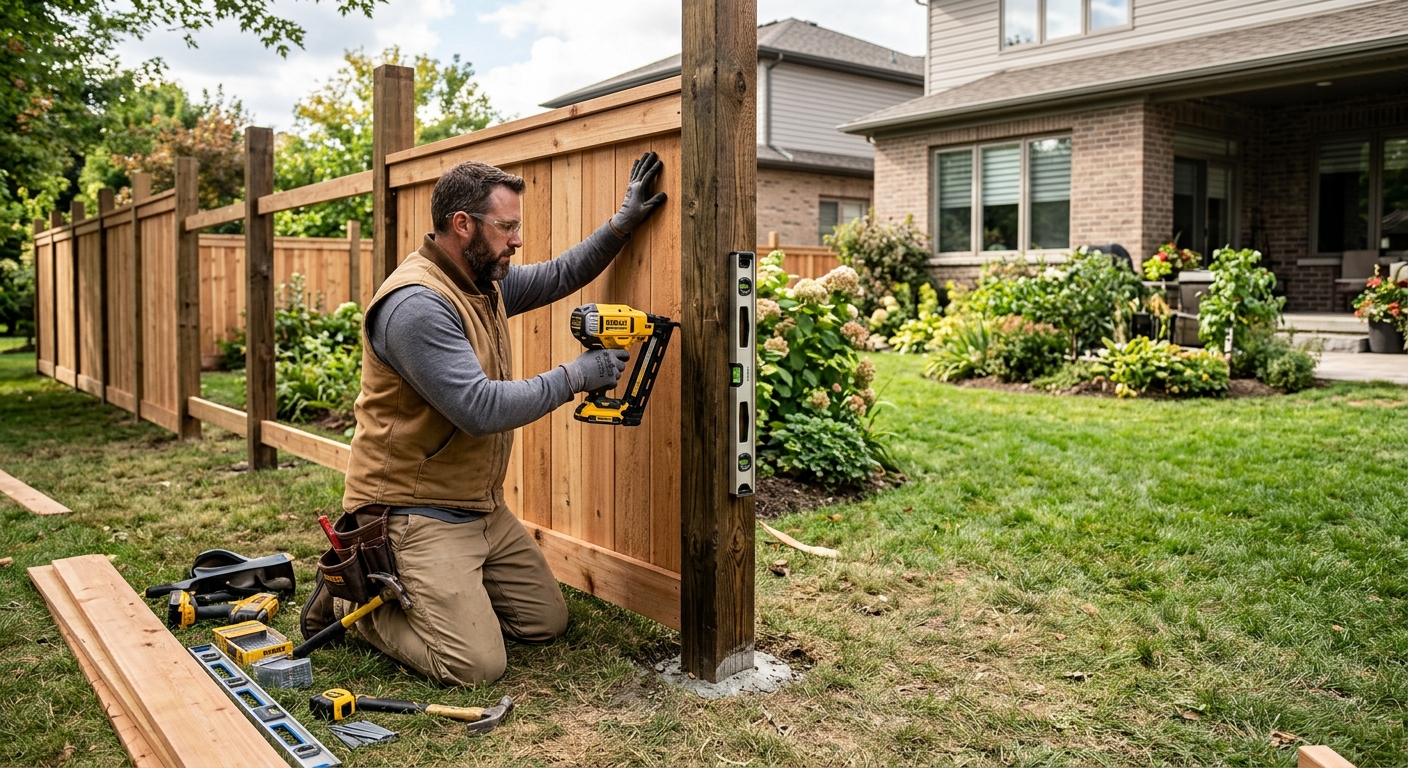
Fencing options and costs in Central
In Central, choosing the right fencing option is easier when you know what drives cost: post depth, panel style, and material durability in Southern Ontario. With a 2021 population of 12,650 in the local area (Statistics Canada, 2021 Census), demand is steady for residential properties—and in a market dominated by detached and family homes, every new boundary project is a potential “must-have” upgrade. That matters because Toronto-area buyers tend to treat fences as both privacy and safety improvements, not just boundary markers.
Central Ontario pricing is also shaped by winter conditions. The frost line is commonly estimated around 42"–48", which means fence posts usually need to be set deeper—typically 3.5–4 feet—to reduce frost heave risk on 6–8 ft privacy fences. Concrete-set posts are the norm when stability matters, especially for heavier wood and solid privacy systems. Availability of crews in built-up neighbourhoods like North York and parts of Etobicoke can affect timelines, but material options still follow the same seasonal pattern: spring and early summer install schedules book quickly.
Below is a practical comparison of common fencing types you’ll see around Central, including privacy performance and typical installed price per linear foot. Use the table as a baseline, then we’ll narrow the estimate based on your lot layout, gate count, and how much old fencing needs removal.
| Material |
Lifespan |
Maintenance |
Privacy Rating |
Price per Linear Foot |
Price Range |
| Pressure-treated pine (standard wood) |
10–20 years |
Stain/seal every 2–3 years to limit greying and surface checking |
High (solid boards) |
$65–$120 |
$2,700–$6,500 |
| Cedar (natural rot resistance) |
15–25 years |
Light staining/clearing every 2–4 years; oil/maintain to preserve colour |
High (solid boards) |
$75–$130 |
$3,200–$7,200 |
| Vinyl / PVC (no-maintenance) |
20–30 years |
Rinse with water; occasional cleaning; no painting |
Medium to High (solid panels/boards) |
$75–$130 |
$3,500–$8,400 |
| Chain-link (galvanized steel) |
25+ years |
Occasional rinse; tension checks |
Low (privacy only with slats/screens) |
$45–$85 |
$1,900–$4,400 |
| Aluminum ornamental |
25+ years |
Wash as needed; no rusting |
Low to Medium (open pickets) |
$90–$160 |
$2,800–$7,000 |
| Composite / recycled material |
20–30 years |
Rinse; avoid heavy abrasion; follow manufacturer cleaning |
High (solid systems) |
$90–$160 |
$3,800–$9,200 |
Prices are estimates only and vary by project scope, site access and material selection.
What affects the price of fencing in Central
In Central, two quotes for what looks like the same fence can still differ by 30–50% because the real drivers aren’t just “type of fence”—they’re how deep the posts must be set, how often materials are hauled, how many gates are included, and whether the contractor factors in long-term stability for Toronto’s freeze-thaw cycles. Labour rates and crew availability in the Toronto economic region also influence turnaround time and how much time it takes to manage excavation in clay and mixed soils.
First, frost depth sets your post depth. In cold Southern Ontario, posts typically must go about 1.5–2.0 m into the ground, which often translates to concrete-set footings for taller privacy fences. That means longer posts, more ready-mix, and more digging—so even if material unit prices are close, installed cost rises. If you choose driven-only posts in a typical Central lot, you may lower the up-front quote, but stability risks increase over a few winters.
Wind matters too. While Toronto isn’t the same extreme wind environment as the Prairies, taller solid panels still need proper post sizes and closer spacing (often 6–8 ft centres) to reduce racking. And while coastal BC sees faster rot, Toronto’s freeze can cause joints to loosen, so good installation details are what you’re paying for.
Concrete examples from Central: (1) a 40 ft run of solid privacy fence with 2 gates will usually cost notably more than a 40 ft run with no gates because hinges and frames add labour; (2) switching from chain-link to vinyl often raises the price because of both higher material costs and the need for heavier post configuration in high-visibility areas; (3) replacing a sagging fence with deeper concrete-set posts can push a wood project into the higher end of the $65–$120 range, while a smaller chain-link job can land in the $45–$85 band.
| Price Factor |
Why It Matters |
Cost Impact |
| Fence length in linear feet |
The more panels and posts you need, the more labour and material time increases |
High (primary driver) |
| Post depth required — frost line determines post length and hole depth |
Longer holes + concrete reduce frost heave risk |
Medium to High |
| Post setting method — concrete vs. gravel pack vs. driven posts |
Concrete-set footings improve long-term stability in mixed/clay soils |
Medium (often the difference between low and mid-range quotes) |
| Material choice — vinyl vs. cedar vs. chain-link |
Unit costs, hardware, and post requirements vary |
High (switching materials can change price band) |
| Gate count and type — walk-through vs. drive-through (double) |
Gate frames, hinges, latches and alignment take extra labour and hardware |
High for drive-through gates |
| Grade and terrain — sloped yards require stepped or raked panels |
More layout time and modified board/panel cuts |
Medium |
| Old fence removal and disposal |
Hauling, sorting, and disposal fees add time; buried posts add work |
Medium to High depending on condition |
| Permit fees and survey / property line locate |
Paperwork and professional locate reduce the risk of encroachment disputes |
Low to Medium |
Permits & regulations in Ontario
In Ontario, many fence projects require a building permit once the fence height exceeds local thresholds, which are commonly around 2.0 m (6.5 ft) at the rear and roughly 1.0–1.2 m (3–4 ft) at the front or corner. Because municipal bylaws vary, it’s smart to treat height and location as the key variables: a solid privacy fence behind the house may be treated differently than the same height at a corner lot.
Before digging, call for utility locates through Ontario One Call. This step is essential for protecting buried gas, hydro, and telecom lines, and it’s also where many delays come from when people skip it. If you’re unsure of the boundary, get a survey or a property line locate based on pins—this avoids costly disputes and rework from set-backs or encroachments.
Shared fence ownership and maintenance are handled under Ontario’s line-fences legislation. Practically, that means if your fence is truly on the boundary, agreements about repairs and cost-sharing should be documented early.
Typically, what does NOT need a permit: short boundary fences below the local threshold height, and smaller cosmetic upgrades like replacing boards in an existing permitted fence (when staying within the same height/location). What DOES require a permit: building or significantly altering a fence above the threshold height and/or in locations that trigger bylaw review.
To verify your contractor in Central: check their business presence in online Ontario licensing resources, request a current certificate of insurance showing liability coverage, and confirm workers are covered with WSIB (WCB coverage for employers). Ask for the clearance letter or confirmation document and verify the expiry dates before work starts.
Choosing the right fence material for Central
In Central and the Toronto economic region, the best fence material is the one that matches your priorities—privacy, low maintenance, lifespan, and upfront budget—while surviving Southern Ontario’s freeze-thaw season. Pressure-treated pine is the budget-friendly starting point, but it usually needs staining or sealing every 2–3 years to reduce grey weathering and surface cracking. Cedar offers a nicer look and natural rot resistance, which helps it age more gracefully, though it still benefits from periodic maintenance if you want colour consistency.
For low-maintenance owners, vinyl/PVC is the standout: it won’t need painting, and routine cleaning is usually all it takes. The trade-off is higher upfront cost, and it performs best when installed with correct post alignment and expansion considerations in cold snaps. Chain-link is the least expensive to install and the longest lived in a strict “structure-only” sense, but it delivers minimal privacy unless you add slats or screens (which change airflow and wind behaviour).
Aluminum ornamental fencing is a mid-range option that won’t rust and looks clean year-round, but it’s typically lower privacy because it’s open pickets. Composite/recycled panels can provide strong privacy with long-term durability, though it’s important to confirm the manufacturer’s installation guidance for cold weather.
Because frost depth is commonly around 42"–48" in Southern Ontario, concrete-set posts are often recommended for 6–8 ft systems to reduce heaving—especially in clay and mixed soils. That cost is often justified: for example, moving from pressure-treated pine in the $65–$120 wood band to cedar can add roughly a few hundred to a couple thousand dollars on a typical run, but it can reduce the need to re-stain as aggressively and improves visual longevity. For many homeowners, the biggest long-term value is investing in correct post depth and setting, regardless of whether you choose wood, vinyl, or composite.
| Material |
Cold Tolerance |
Lifespan |
Annual Maintenance |
Best For |
Price Band |
| Pressure-treated pine |
Good with proper staining and correct post depth |
10–20 years |
Low to moderate (clean check-ups; re-stain every 2–3 years) |
Lower upfront cost privacy |
$65–$120 |
| Cedar |
Good; better surface longevity in Ontario freeze-thaw |
15–25 years |
Low to moderate (periodic sealing/staining every 2–4 years) |
Appearance + rot resistance |
$75–$130 |
| Vinyl / PVC |
Very good if installed with correct spacing/alignment in cold |
20–30 years |
Very low (rinse/clean) |
Low-maintenance privacy |
$75–$130 |
| Chain-link |
Excellent; galvanized steel tolerates winter well |
25+ years |
Very low (tension and occasional wash) |
Security with minimal privacy |
$45–$85 |
| Aluminum ornamental |
Excellent (no rust) |
25+ years |
Very low (wash as needed) |
Attractive boundary definition |
$90–$160 |
| Composite / recycled |
Good; performs well with manufacturer-correct installation |
20–30 years |
Very low (rinse; avoid abrasive cleaning) |
Privacy with long-term durability |
$90–$160 |
How to choose a fencing contractor in Central
When you’re hiring a fencing contractor in Central, verify credentials before you sign. For Ontario licensing, look for the contractor’s registered business details and confirm the licence status through the appropriate online resources (the contractor should provide their business information clearly, not just a trading name). For liability insurance, request a current certificate of insurance that lists the insured parties correctly and includes sufficient general liability limits for residential work. For workers, confirm WSIB coverage (WCB coverage for employers) and ask for clearance confirmation—this is especially important if your project involves excavation in frozen or clay soil where injuries can happen during digging, lifting, and material handling.
Next, get 2–3 itemised written quotes. Avoid “lump sum only” pricing—ask for a breakdown of labour, materials, post depth/setting method, and the cost for gates, hardware, and brackets. Make sure the scope is explicit: is permit pulling included where needed? Is old fence removal and disposal included, or is it an add-on? Are utilities locates covered or is that your responsibility? A good quote will specify panel spacing, post size, and whether concrete is included for frost protection.
Warranty matters: request the workmanship warranty length (often different from the product warranty) and ask whether the product/manufacturer warranty is transferable to you as the homeowner. Payment schedules should be conservative—never more than 10–15% upfront. Hold back the remainder until the job is complete, cleaned up, and walkthrough items are addressed. Also request a start date and completion estimate in writing so you’re not guessing during a busy Toronto season.
- Provide proof of liability insurance and confirm the expiry date.
- Confirm WSIB clearance or WCB coverage for the employer doing the work.
- Use itemised quotes listing labour, materials, posts, concrete, and hardware separately.
- Specify post depth and setting method (concrete-set for stability in Ontario frost).
- Confirm gate hardware quality (hinge type, latch, and alignment details).
- Ask who calls for utility locates and who pays if locates delay the start.
- Clarify whether demolition and disposal of old fencing are included.
- Verify whether permits and property line locate/survey are included or billed separately.
- Confirm what happens with trees, rocks, and buried remnants during excavation.
- Request warranty terms for workmanship and product separately in writing.
- Avoid paying more than 10–15% upfront; set a holdback for completion.
- Ensure the contract includes a timeline and a written completion walkthrough.
Concrete red flags in Central: a quote that won’t state post depth or concrete setting method; refusing to itemise materials and labour (especially for gates); asking for a large deposit before you’ve seen insurance/WSIB documents; promising “driven posts only” on a 6–8 ft privacy fence without addressing frost heave; and leaving scope gaps like “permit extra” without explaining when permits are actually needed.
Frequently asked questions — fencing in Central
Do I need a permit to build a fence in Ontario?
Often, yes—if your fence is above the common height thresholds used in Ontario by municipal bylaw. Rear fences are frequently regulated around 2.0 m (6.5 ft), while front or corner areas are commonly lower, around 1.0–1.2 m (3–4 ft). If you’re planning a tall privacy fence, assume a permit review may be required, particularly on corners or street-facing sections. In Central, the practical step is to confirm the fence height and exact location before you order materials.
Also remember utilities locates are required before digging. For quotes, ask whether permit pulling is included. A contractor who offers only a mid-range installed price (for example, wood systems often land around the $65–$120 per linear foot band) should still be able to explain the permit pathway clearly if your design triggers it.
How long does a wood fence last in Central?
In Central Ontario, wood longevity is usually measured in decades, but it depends heavily on material choice and maintenance. Pressure-treated pine typically lasts about 10–20 years with reasonable staining/sealing every 2–3 years. Cedar often provides better rot resistance and can last around 15–25 years, especially when posts are set correctly and water is managed at the base.
Cold weather impacts installation details: Southern Ontario frost lines (commonly estimated around 42"–48") require posts to be set deep enough to reduce frost heave—often 3.5–4 feet deep for taller privacy fences—plus correct post spacing for wind load. If you want the fence to reach the high end of its lifespan, insist on concrete-set posts and proper hardware, not just the lowest material cost. A typical cedar or pressure-treated project usually falls into the $65–$120 wood band depending on run length, gate count, and disposal needs.
Who owns and maintains a shared fence?
For shared fences in Ontario, ownership and maintenance are governed by line-fences legislation and the reality of what portion sits on the boundary. If the fence is truly on the property line (as shown by a survey or locate), both owners may share responsibility for maintenance and repairs, but the details can depend on the facts and any past agreements between neighbours.
Practically, before work starts, identify whether your fence is boundary/shared or entirely on one lot. Get a property line locate if there’s any doubt. Then agree on scope: who pays for demolition, whether replacement is like-for-like, and how costs are split. Good contractors can help document what’s being removed and replaced, which matters if your neighbour later asks questions. If you’re budgeting, keep in mind privacy replacement often lands higher than chain-link; wood and cedar typically track the $65–$120 range, while chain-link is often around $45–$85 per linear foot.
How do I find my property line before fencing?
Start with whatever you have on hand: your survey, your deed, and any property pin information. If the pins aren’t visible or the survey is outdated, hire a surveyor or request a property line locate that ties fence placement to the pins and measured boundary. In Central, this step helps you avoid encroachment—especially where fences have historically been “moved” by previous owners.
Don’t guess based on neighbours’ opinions or existing fence alignment. When you request a quote, ask the contractor whether they will set the fence from marked boundary points you provide, or if a locate/survey is recommended. Also ensure utility locates are done before any post hole digging, through Ontario One Call, so you don’t interrupt service lines.
What's the most low-maintenance fence?
In Ontario’s Central region, vinyl/PVC and aluminum are usually the lowest-maintenance choices for homeowners because they don’t require staining like wood. Vinyl/PVC is typically a “rinse and forget” option, while aluminum ornamental generally needs only periodic washing and hardware checks. Composite/recycled systems can also be low maintenance if installed according to manufacturer requirements.
That said, the maintenance burden also depends on installation quality. If posts aren’t set deep enough for frost protection and panels aren’t properly aligned, you can get premature looseness or hardware stress regardless of material. For budget context, chain-link is also low maintenance structurally, but it doesn’t offer privacy unless you add slats or screens. If you’re choosing between options around the $75–$130 band (vinyl/most privacy wood) and a lower $45–$85 chain-link band, weigh whether you truly need privacy or mainly want boundary security.
How tall can my fence be in Central?
There isn’t one single height limit for every lot in Central because Ontario fence limits are enforced through municipal bylaw rules that vary by location on the property (front, corner, rear) and sometimes by zoning. Common thresholds used in Ontario discussions are about 2.0 m (6.5 ft) for rear fences and roughly 1.0–1.2 m (3–4 ft) for front or corner areas. Taller fences often trigger permit review.
Before you order materials, confirm two things: your proposed fence height and where it sits relative to the front yard, corner, or street line. If your design is in the taller range, ask your contractor whether a permit is likely and whether they’ve done similar projects in your type of neighbourhood. In practical terms, tall 6–8 ft privacy fences in Toronto-area conditions also demand heavier post configuration and typically concrete-set posts to reduce frost heave over freeze-thaw cycles.