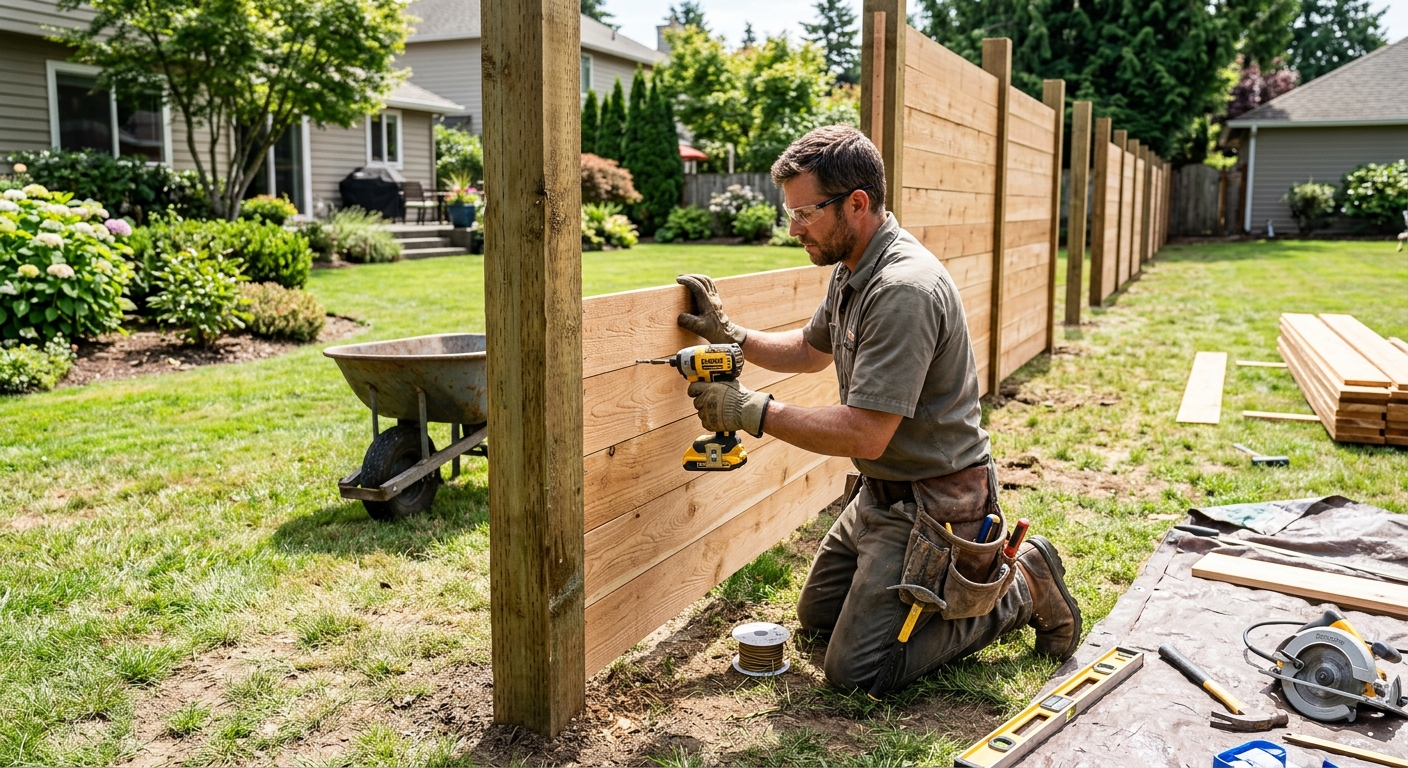
Fencing options and costs in Owen Sound
Owen Sound is a waterfront-to-farm community where fences have to handle cold winters, wet shoulder seasons, and the occasional gust off Lake Huron. With the regional housing stock skewing older—72.4% of homes were built before 1981 (Statistics Canada, 2021 Census)—many properties have aging boundaries or missing sections that owners want to replace. Demand is also supported by the large homeowner base: 58.0% of households own their homes (Statistics Canada, 2021 Census), which usually means more fence projects versus short-term rentals.
In the Stratford–Bruce Peninsula area, the biggest cost driver is frost depth. Practical residential installs typically set posts 0.9–1.2 m (3–4 ft) deep, often with concrete footings, to avoid heaving and misalignment in clay and mixed soils. Heavier systems (wood, vinyl, and ornamental metal) in more exposed locations around Owen Sound—especially near higher-wind open lots—generally need tighter post spacing and stronger hardware.
From a trade standpoint, fencing is especially in demand in neighbourhoods where lots are deeper and boundary lines are longer, such as the West Side and near the Sydenham Ward area. If you’re replacing an existing fence there, you’ll often see crews quoted for both post excavation depth and haul-away/disposal time.
Use the table below to compare material options and typical longevity so you can line up budget expectations before you review quotes.
| Material |
Lifespan |
Maintenance |
Privacy Rating |
Price per Linear Foot |
| Pressure-treated pine (standard wood) |
10–15 years |
Stain/seal every 2–3 years |
Medium–High |
$55–$85 |
| Cedar (natural rot resistance) |
15–20 years |
Light staining every 2–4 years |
High |
$65–$95 |
| Vinyl / PVC (no-maintenance) |
20–30 years |
Wash as needed |
High (with solid panels) |
$75–$115 |
| Chain-link (galvanized steel) |
20–35 years |
Occasional rinse; straighten posts if needed |
Low |
$35–$55 |
| Aluminum ornamental |
25–40 years |
No rust; rinse seasonally |
Low–Medium |
$90–$150 |
| Composite / recycled material |
20–30 years |
Wash only; inspect for hardware wear |
High |
$85–$140 |
Prices are estimates only and vary by project scope, site access and material selection.
What affects the price of fencing in Owen Sound
In Owen Sound and across the Stratford–Bruce Peninsula region, it’s common to see quotes for the “same” fence swing by 30–50% once you account for site conditions, post depth, and whether the contractor includes concrete setting, hardware upgrades, and disposal. That’s because winter frost isn’t just a “winter problem”—it drives how deep posts must be set to prevent heaving, which directly changes labour time, excavation size, and the amount of material used.
For cold Ontario sites, practical residential posts are often set about 4–6 inches below the design frost depth to keep them below the freezing zone. In the real world, that usually means posts going roughly 1.5–2.0 m into the ground, and many installs in Owen Sound use concrete-set footings for stability in clay and mixed soils. Longer posts cost more and add time to dig, brace, and backfill. Where wind exposure is higher—open farm fields or bluff-adjacent lots—contractors typically tighten post spacing and use sturdier panels and upgraded brackets, which can move a project from the “budget wood” band toward mid-range pricing.
Concrete examples: if you’re replacing an old fence in a yard with compacted soil and frost-prone ground, excavation is slower and concrete setting becomes non-negotiable, pushing wood or vinyl toward the higher end of the region’s wood and vinyl bands ($55–$85 for wood; $75–$115 for vinyl/PVC). If your run is short, flat, and well-accessed, chain-link can land near the low end of $35–$55 because it requires less labour per linear foot and has simpler hardware. Conversely, sloped property lines that need stepped panels add layout time and can nudge costs upward across materials.
Because 72.4% of homes were built before 1981 (Statistics Canada, 2021 Census), many projects involve older utilities, mature trees, and established grading—each of which can add labour even when your fence length stays the same.
| Price Factor |
Why It Matters |
Cost Impact |
| Fence length in linear feet |
The primary driver; labour and materials scale directly with length. |
Highest impact (often the biggest variance between quotes). |
| Post depth required |
Frost line determines how long posts must be and how large the holes need to be. |
Higher depth = more digging, concrete, and material cost. |
| Post setting method |
Concrete-set posts resist frost heave and improve alignment longevity. |
Concrete setting typically adds labour and material compared to gravel packs. |
| Material choice |
Different systems carry different panel weight, wind resistance, and hardware. |
Vinyl and aluminum cost more upfront; chain-link is usually lowest. |
| Gate count and type |
Gates require heavier frames, more hinges, and stronger bracing. |
Each gate adds cost; drive-through gates add the most. |
| Grade and terrain |
Slopes require stepped or raked panels and careful layout to keep alignment. |
Can add layout time and labour; affects all materials. |
| Old fence removal and disposal |
Uprooting posts and hauling debris is labour-heavy, especially with concrete bases. |
Often adds a noticeable line item if not included. |
| Permit fees and survey / property line locate |
Some fencing heights and property line uncertainty can trigger extra verification steps. |
May add administration and professional locating costs. |
Permits & regulations in Ontario
In Ontario, fence rules are tied to property lines, municipal setback/bylaw requirements, and—depending on height—whether a permit is needed. As a practical benchmark used by many Owen Sound homeowners, fences above a height threshold often require a building permit: rear yards commonly trigger permits around 2.0 m (6.5 ft), while front yard or corner-side fences are typically lower (often in the 1.0–1.2 m range of 3–4 ft). Exact thresholds can vary by municipality and fence location, so confirm before you dig.
Before you install any posts, plan for utility locates. In Ontario, call Ontario One Call and have underground services marked so you can dig safely. You should also verify the property line with your survey pins or a property line locate—especially if your old fence is crooked, on a shared boundary, or built long ago when lines were less precisely set.
Shared fence ownership is governed by provincial line-fences legislation. That matters when you’re replacing only part of a boundary, because the cost and responsibility may be shared where the fence is a shared boundary.
What DOES require a permit (typical): installing or replacing a fence over the common height thresholds (rear yard around 2.0 m; front/corner often lower) and any project that municipal rules classify as requiring approval. What typically does NOT: small, standard-height backyard fences within bylaw limits that do not alter significant site conditions.
To verify an Ontario-licensed contractor, ask for: (1) proof of Ontario licence/registration details where applicable (many trades use the Ontario directory of registered businesses and clear documentation in the estimate), (2) a current certificate of insurance with liability coverage matching your project risk, and (3) WSIB/WCB coverage evidence (or a clearance letter, where provided by the contractor’s coverage admin). Review the certificate for policy dates, insured party name, and coverage limits; don’t rely on “we’re covered” without paperwork.
Choosing the right fence material for Owen Sound
Choosing a fence in Owen Sound is about matching your priorities—privacy, low maintenance, budget, and lifespan—to the local reality of cold winters and frequent freeze–thaw cycles. Owen Sound sits in a climate where wood and metal both experience stress, but frost depth and moisture management decide how long the fence stays straight. Across the Stratford–Bruce Peninsula region, posts are commonly set deeper (often 0.9–1.2 m, with many installs using concrete footings around the 1.5–2.0 m effective post setting depth) to reduce heaving in clay and mixed soils.
Pressure-treated pine is the budget-friendly route, but you’ll typically need staining or sealing every 2–3 years to manage grey weathering and surface checks. Cedar is more naturally rot-resistant and usually looks better for longer, but it still benefits from periodic maintenance. Vinyl/PVC is popular for no-maintenance ownership; however, in extreme cold it can crack if panels are not supported correctly or if post spacing is too wide. Chain-link is the lowest upfront cost and very long-lived, but it won’t provide privacy without add-ons. Aluminum ornamental resists rust and stays attractive, yet it’s best for look and safety, not full privacy.
Where the price difference is justified: if you’re aiming for strong privacy and “set it and forget it,” moving from standard wood (often $55–$85 in the local band) to vinyl/PVC (often $75–$115) can be worth it because the maintenance burden drops and panels resist rot in wet seasons. On the other hand, if your priority is perimeter security at the lowest cost, chain-link can be the best value at roughly $35–$55, especially when privacy can be achieved using landscaping or selective screen sections.
Wind and snow load matter too: even without prairie-level gusts, open yards can act like sails, so solid privacy fences often need stronger bracing and closer post spacing. In Owen Sound’s older neighbourhoods, careful layout around established grades and trees is also essential, because it affects how straight panels remain through winter.
| Material |
Cold Tolerance |
Lifespan |
Annual Maintenance |
Best For |
Price Band |
| Pressure-treated pine |
Good (with proper post depth and sealing) |
10–15 years |
1–4 hours per section for touch-ups; stain every 2–3 years |
Budget privacy where maintenance is acceptable |
$55–$85 |
| Cedar |
Good (naturally durable, still moisture-sensitive) |
15–20 years |
Light staining/inspection every 2–4 years |
Natural appearance and better rot resistance |
$65–$95 |
| Vinyl / PVC |
Very good (panel support and spacing matter in extreme cold) |
20–30 years |
Wash as needed |
Low-maintenance privacy in wet and freeze–thaw cycles |
$75–$115 |
| Chain-link |
Excellent (galvanized steel performs well) |
20–35 years |
Minimal; occasional rinse and hardware checks |
Security and property definition on a budget |
$35–$55 |
| Aluminum ornamental |
Excellent (no rust) |
25–40 years |
Seasonal rinse; tighten hardware if needed |
Attractive perimeter fencing with safety |
$90–$150 |
| Composite / recycled |
Good (designed for freeze–thaw) |
20–30 years |
Wash only; periodic hardware inspection |
Privacy with reduced upkeep |
$85–$140 |
How to choose a fencing contractor in Owen Sound
When you’re choosing a fencing contractor in Owen Sound, start by verifying credentials and coverage—because fence failures often show up after winter, not on day one. In Ontario, reputable contractors can provide proof of their ability to do the work legally, plus liability insurance, and WSIB/WCB coverage documentation. What to look for: (1) an Ontario business registration/contractor identity that matches the quote and invoice, (2) a current certificate of insurance showing your contractor as the insured, active policy dates, and adequate liability limits, and (3) WSIB/WCB clearance evidence where available. If you can’t get these documents up front, treat it as a red flag.
Next, request 2–3 itemised written quotes. You want a line-by-line breakdown: excavation and post installation method (concrete-set vs. gravel pack), specific post size, rail thickness, panel type, gate hardware, and disposal/removal. Avoid lump-sum-only bids unless the scope is very specific. Confirm whether the contractor includes permit pulls (when required), utility locate responsibility, and property line locating costs if your fence is near a boundary dispute.
Warranty matters in fencing. Ask for two warranties: (1) a workmanship warranty (commonly covering post setting and alignment) and (2) a manufacturer/product warranty on the material system (vinyl, aluminum, or composite). Also ask whether warranties are transferable if you sell your home.
For payment scheduling, a smart approach is to never pay more than 10–15% upfront and to hold back a meaningful portion until the full job is complete and final grading is cleaned up.
Finally, get a start date and completion estimate in writing, including weather-related contingencies for Owen Sound’s winter-ready site constraints.
- Ask for WSIB/WCB clearance letter (or equivalent coverage proof) and keep a copy with your contract.
- Request a current certificate of liability insurance before work starts; confirm policy dates and insured name.
- Confirm workmanship warranty length and what it covers (posts, alignment, panel warping, hardware).
- Ensure the quote lists concrete setting vs gravel pack vs driven posts and the depth plan.
- Get exact materials listed: post sizes, panel type, gate frame hardware, and finish/coating.
- Ask whether disposal/removal of the old fence is included (especially with concrete bases).
- Check that utility locate responsibility is clear (Ontario One Call marks) and that digging won’t start blind.
- Verify permit responsibility in writing if your fence height may trigger approval needs.
- Confirm how they handle slopes: stepped vs raked panels and who measures the grade.
- Require a measured site plan or at least a sketch with linear footage and gate locations.
- Agree on payment milestones: 10–15% max upfront; holdback until gates work and cleanup is complete.
- Get a written timeline with weather delays described for the Owen Sound climate.
Red flags in Owen Sound: a contractor who won’t provide insurance/coverage paperwork; a quote that doesn’t specify post depth or footing method; “too good to be true” pricing that omits concrete setting despite frost-prone soils; vague scopes that exclude old fence removal without explaining disposal; and refusing to put warranty terms in writing.
Frequently asked questions — fencing in Owen Sound
Should fence posts be set in concrete here?
In Owen Sound and much of southwestern Ontario, concrete setting is commonly recommended because frost heave is a real risk in clay and mixed soils. In practical terms, frost protection often means posts are set below the freezing zone—typically achieved by setting posts about 4–6 inches below the design frost depth, which often works out to roughly 1.5–2.0 m of effective depth. Concrete footings improve stability and help keep fence lines straight after freeze–thaw cycles. That said, some projects may use a gravel pack or alternative methods where soil conditions, fence type, and local best practice align. The safest way to decide is to ask the contractor to describe their post depth plan, soil assumptions, and whether concrete is included in the quote.
What's the best fence for privacy?
For privacy in Owen Sound, solid-panel fences usually outperform “see-through” styles. Vinyl/PVC and wood privacy fences are common choices because they block sightlines and can be built in full-height configurations. Vinyl/PVC is a strong fit when you want low maintenance through wet seasons and winter freeze–thaw; local pricing for vinyl/PVC typically lands around $75–$115 depending on panel style, gate count, and post requirements. Cedar also delivers excellent privacy and appearance, but you should budget time for maintenance. If wind is a factor on your lot, ensure the contractor tightens post spacing and uses proper bracing so the solid sections don’t loosen over time.
How do I compare fencing quotes?
Compare quotes like a homeowner, not like a bargain hunter. First, make sure the quotes measure the same linear footage and include the same number of gates. Second, require an itemised breakdown: post size, post depth, footing method (concrete vs gravel pack), rails, panel height/style, and disposal/removal of the old fence. Third, confirm warranty terms and workmanship coverage. A quote that’s cheaper but omits concrete setting or uses smaller posts often ends up costing more when the fence shifts after winter. If one bid is in the wood band (roughly $55–$85) and another is in the vinyl band (roughly $75–$115), look at what’s driving the difference—usually maintenance expectations, material longevity, and hardware strength.
How long does fence installation take in Owen Sound?
Timing depends mainly on length, site access, and how many gates you’re adding. In Owen Sound, a straightforward backyard run with clear access can often be completed within a few working days, while projects with old fence removal, concrete-set posts, or complicated slopes can stretch longer. Concrete or heavy frost-prone footing work also affects progress because posts must be set, braced, and aligned before final assembly. If you’re near the start of the season, weather can influence excavation schedules—frosted or waterlogged ground adds time. Ask each contractor for a written start date, completion estimate, and how they plan around weather delays so you’re not surprised when the crew hits ground conditions in mid-winter.
Can I install a fence on a slope in Owen Sound?
Yes, you can install a fence on a slope in Owen Sound, but the approach matters. Most contractors use either stepped panels (each section changes height in small increments) or raked panels (one continuous angle). Stepped installation is common for keeping fence pickets or solid panels looking consistent while preserving the overall height relationship to grade. Sloped sites often require more layout time and may increase material consumption slightly due to custom cuts and remeasuring. Also, frost-protection planning still applies: the contractor should explain how they will set posts below the freezing zone even when ground height varies. If your yard is particularly uneven, ask to see how they handle drainage, topsoil removal, and final grading around each post.
What is the most weather-resistant fence for Owen Sound's climate?
For Owen Sound’s wet seasons and winter freeze–thaw, the most weather-resistant options tend to be materials that resist rot and corrosion, combined with correct post installation. Vinyl/PVC is popular because it doesn’t rot like wood and it performs well in Ontario moisture conditions, with typical local pricing around $75–$115 for many residential installs. Cedar can be very durable and rot-resistant too, but it still benefits from maintenance to preserve its finish. Chain-link (often $35–$55) is extremely resilient and long-lived, especially for perimeter security, though it won’t provide privacy on its own. Whatever you pick, insist on proper frost-depth post setting (often concrete-set in frost-prone ground) and sturdy hardware—those details often matter more than brand names in the long run.