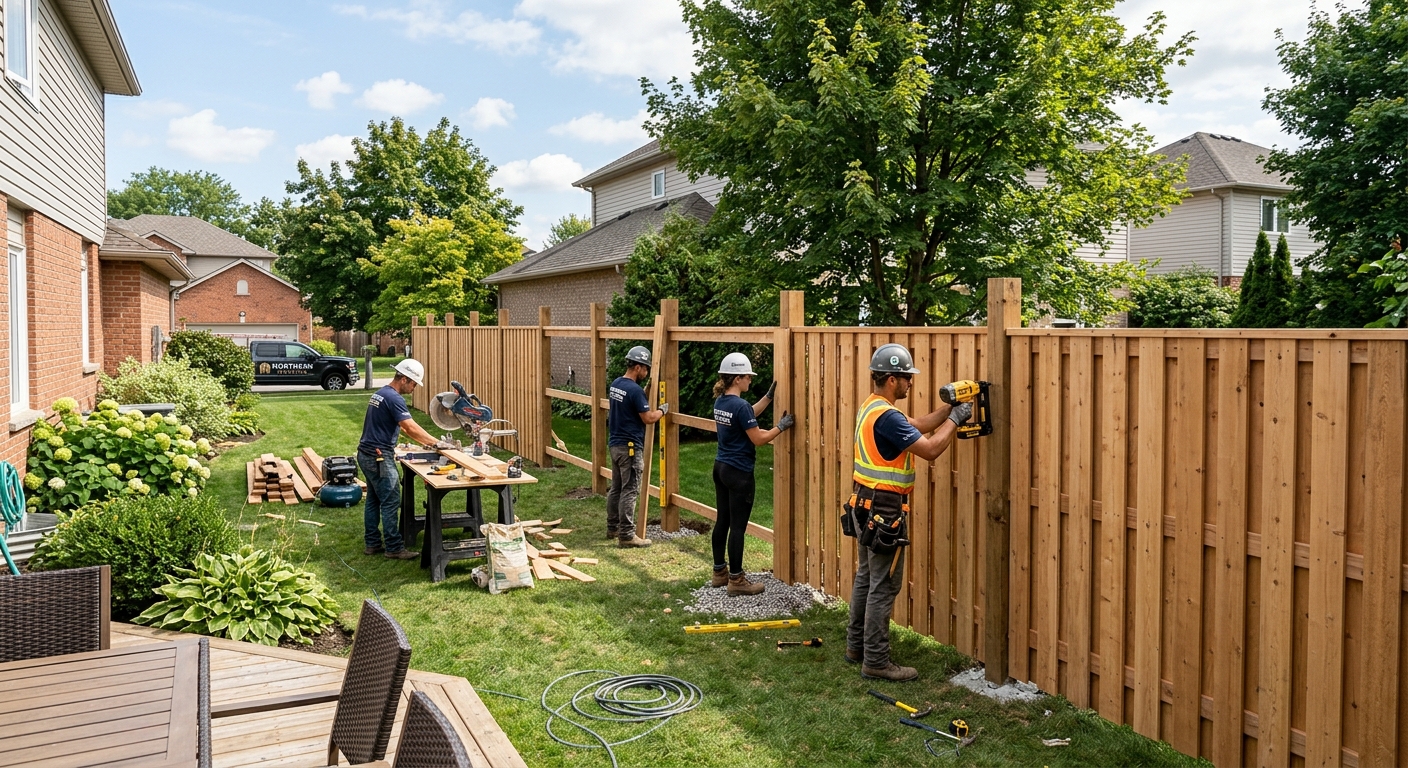
Fencing options and costs in Emo
Emo, Ontario is small, but the demand for fencing is steady—especially because most households are owner-occupied and many properties are detached (75.5% of households own; 89.5% of dwellings are single-detached) (Statistics Canada, 2021 Census). When you own a detached home in a colder region, a fence isn’t just a “nice to have.” It’s privacy, yard safety, and sometimes dog or snow-storage planning that you’ll live with for years, so residents tend to choose options that can handle our freeze-thaw cycles.
In Northwest Ontario, fencing prices typically run higher than in more sheltered southern areas because frost penetrates deeper. Contractors often need to set posts about 4 ft (1.2 m+) below grade (or deeper depending on design frost depth), usually with concrete, to reduce frost heave and movement. On top of that, wind exposure on open lots and along highway corridors pushes builders toward sturdier layouts—heavier panels, closer post spacing, and more robust footings—rather than “light-duty” installations.
In Emo, trade demand is particularly common around residential pockets like the Main Street and river-adjacent areas where wind gets channelled and yards are more exposed. If you’re planning a new privacy run, a replacement fence, or a backyard enclosure, your best next step is getting a local quote—then comparing options in a like-for-like way using the table below.
| Material |
Lifespan |
Maintenance |
Privacy Rating |
Price per Linear Foot |
Price Range |
| Pressure-treated pine (standard wood) |
12–18 years |
Stain/seal every 2–3 years |
High (solid-board) |
$15–$22 |
$55 – $90 |
| Cedar (natural rot resistance) |
18–25 years |
Light staining every 3–4 years |
High (solid-board) |
$18–$28 |
$70 – $110 |
| Vinyl / PVC (no-maintenance) |
25+ years |
Rinse occasionally; no staining |
Medium–High (solid infill) |
$22–$34 |
$70 – $110 |
| Chain-link (galvanized steel) |
20–30 years |
Minimal; periodic tension checks |
Low (visibility) |
$12–$18 |
$35 – $65 |
| Aluminum ornamental |
25–35 years |
Wash as needed; no rust |
Low–Medium (open pickets) |
$20–$36 |
$80 – $140 |
| Composite / recycled material |
20–30 years |
Low; occasional wash |
High (solid panels) |
$24–$40 |
$80 – $140 |
Prices are estimates only and vary by project scope, site access and material selection.
What affects the price of fencing in Emo
In Emo and across Northwest Ontario, it’s common to see quotes for the “same-looking” fence come in 30–50% apart. The difference usually isn’t the lumber or the brand—it’s the foundation work (how deep and how much concrete), how the crew manages wind-loading, and whether the installer is pricing for reality like clay soils, bedrock surprises, or a yard with limited access.
Start with frost. To prevent post movement and frost heave, local installs typically set posts close to the design frost depth—often by embedding posts about 4–6 inches below the design frost line. In cold regions of Ontario (and similarly in Alberta), that commonly means 1.5–2.0 m into the ground depending on the soil and frost depth design, which increases excavation time, uses longer posts, and adds concrete-setting labour. In open or wind-swept areas, crews also move toward tighter post spacing and heavier panels to keep the fence from racking during gusts.
Cost can swing both up and down with local conditions. For example: (1) clay or mixed soils may require a slightly belled footing or extra concrete to resist movement; (2) sandy/looser soils can sometimes be excavated faster, reducing labour; (3) if you’re replacing an older fence, removal and disposal can add time even when the new material is budget-friendly. If your base is pressure-treated pine, you might land near the wood band (for example, about $55 – $90). If you go vinyl or cedar with deeper, concrete-set posts, pricing can land in the $70 – $110 band, especially for privacy boards and gates.
| Price Factor |
Why It Matters |
Cost Impact |
| Fence length in linear feet |
Material and labour scale directly with footage. |
High impact (primary driver) |
| Post depth required |
Frost line determines post length and hole depth. |
Medium–High impact |
| Post setting method |
Concrete vs. gravel pack vs. driven posts affects labour and longevity. |
High impact |
| Material choice |
Vinyl vs. cedar vs. chain-link changes material cost and build complexity. |
Medium–High impact |
| Gate count and type |
Double drive-through gates need heavier hardware and alignment. |
Medium impact |
| Grade and terrain |
Sloped yards need stepped panels or raked rails. |
Medium impact |
| Old fence removal and disposal |
Haul-away time and debris handling add crew hours. |
Low–Medium impact |
| Permit fees and survey / property line locate |
Paperwork and locating pins prevents encroachment disputes. |
Low–Medium impact |
Permits & regulations in Ontario
In Ontario, permit requirements typically depend on fence height, location, and your municipality’s by-laws. As a practical homeowner guide: fences above a height threshold—often around 2.0 m (6.5 ft) at the rear and 1.0–1.2 m (3–4 ft) at the front or corner—may require a building permit. Property lines and setback requirements still apply, and the safest approach in Emo is to confirm the rules before posts go in.
Before any digging, call for utility locates. In Ontario, use Ontario One Call so marked utilities are respected. Then, get a survey or locate your property pins so your fence doesn’t drift onto a neighbour’s land. If you’re working near a shared boundary, remember that shared fence ownership and cost-sharing rules are governed by Ontario line-fences legislation.
What usually does require a permit: taller fences near front/corner setbacks, privacy solid-board fences that exceed common municipal thresholds, and any structure that the municipality classifies as higher-impact than a standard backyard run.
What typically does NOT require a permit: short, standard-height backyard fencing that stays under typical thresholds and conforms to setbacks (but you should confirm with your municipality).
To verify a contractor in Emo, check: (1) their Ontario licence/registration in the relevant business registry and confirm the fencing company is in good standing; (2) your certificate of insurance (General Liability with adequate limits) naming you as additionally insured if required; and (3) their WSIB/WCB clearance status (request a clearance letter or proof of coverage). A reputable contractor should provide these documents quickly—before work starts.
Choosing the right fence material for Emo
Choosing the right fence material in Emo is mostly about matching the product to our cold winters, wind exposure, and how often you want to touch up the finish. Pressure-treated pine is often the best budget starting point, but it needs staining every 2–3 years to limit greying and weathering in our wet-cold swings. Cedar has better natural rot resistance and typically looks better longer, but it still benefits from maintenance—especially at post tops and in splash zones. Vinyl/PVC is popular for low maintenance; however, in extreme cold the material can be more rigid and can crack if posts aren’t set properly or if the fence is under stress from wind. Chain-link is the least expensive and very long-lasting, but it offers little privacy unless you add slats or screening. Aluminum is rust-resistant and clean-looking, though it’s more mid-range and won’t give the same privacy as solid boards. Composite/recycled boards can deliver solid privacy with low maintenance, but the upfront cost is usually higher.
Because Northwest Ontario often needs deep, near-below-frost post embedment (often about 4 ft/1.2 m+ or more), concrete-set posts are common for stability. That foundation choice affects every material, so don’t select “cheaper” fence panels while assuming the post work can be lighter. Wind and snow load matter too: on open lots, heavier panels and closer post spacing reduce racking.
For a clear price justification example: if a pressure-treated pine privacy fence is budgeted in the $55 – $90 band, moving to vinyl or cedar can bring you into the $70 – $110 band. The higher cost is usually worth it when you want fewer maintenance weekends and better long-term appearance during freeze-thaw seasons, not just because the material is newer.
| Material |
Cold Tolerance |
Lifespan |
Annual Maintenance |
Best For |
Price Band |
| Pressure-treated pine |
Good when properly sealed and well post-set |
12–18 years |
Light inspection; stain/seal every 2–3 years |
Lowest initial cost for privacy |
$55 – $90 |
| Cedar |
Very good; handles cold and moisture well |
18–25 years |
Inspect; stain/light seal every 3–4 years |
Natural look with better rot resistance |
$70 – $110 |
| Vinyl / PVC |
Good, but requires strong bracing and proper spacing |
25+ years |
Rinse; occasional check of rails and posts |
Low maintenance in an exposed climate |
$70 – $110 |
| Chain-link |
Excellent; galvanization resists corrosion |
20–30 years |
Minimal; tension and hardware checks |
Security without privacy |
$35 – $65 |
| Aluminum ornamental |
Excellent; won’t rust |
25–35 years |
Wash as needed; check gate alignment |
Decorative fencing with clear sightlines |
$80 – $140 |
| Composite / recycled |
Good when installed to allow for expansion |
20–30 years |
Low; occasional wash and fastening checks |
Privacy with reduced maintenance |
$80 – $140 |
How to choose a fencing contractor in Emo
When you’re hiring a fencing contractor in Emo, you want proof—not promises—on three fronts: licensing/registration, insurance, and worker coverage. First, verify Ontario registration/licence for the business (check the public business registry and confirm it matches the company name on the quote). Second, request a certificate of insurance for General Liability (and ensure it’s current) and confirm whether you’ll be named additionally insured if required by your situation. Third, ask for WSIB/WCB clearance documentation (a clearance letter or proof of coverage). If they can’t provide it, pause—fencing isn’t just carpentry; you’re paying for excavation, concrete, and safe site practices.
Next, get 2–3 itemised written quotes. A good fence quote breaks labour and materials apart: rails, posts, panels, hardware, concrete, gates, and any removal/disposal. It should show whether permit pulls are included, and what’s excluded (for example, rock removal, extra excavation, or replacing damaged underground services).
Watch warranty terms. Ask for: workmanship warranty length (and what it covers), product/manufacturer warranty, and whether warranty transfers to future owners if you sell. For payment, never pay more than 10–15% upfront; use a holdback until substantial completion and final cleanup. Finally, lock in a timeline in writing: proposed start date, fence completion estimate, and what happens with weather delays in Northwest Ontario.
- Ask for WSIB/WCB clearance proof before signing.
- Confirm General Liability insurance is current (with certificate).
- Request itemised labour + materials pricing, not just totals.
- Make sure post depth / frost-depth embedment is written into the scope.
- Clarify concrete setting vs. gravel pack and how holes will be excavated.
- Confirm gate hardware quality and whether gates are included in the same post design.
- Check if old fence removal and disposal are included (and where it’s hauled).
- Verify property-line approach: survey/locate pins or how they handle uncertainty.
- Ask if permit pull is included where required by height/setback.
- Get warranty details in writing (workmanship + materials).
- Use a payment schedule with a holdback for final inspection.
- Request a written start/completion timeline and weather-delay plan.
Red flags I see in Emo are: (1) quotes that assume “shallow” post holes without frost-depth explanation; (2) no insurance/clearance documents provided up front; (3) lump-sum pricing with no line items for concrete, hardware, or gate work; (4) missing warranty terms or vague “as-is” language; and (5) asking for large upfront payments beyond 10–15%.
Frequently asked questions — fencing in Emo
What fence style offers the best wind resistance in Emo?
In Emo and across Northwest Ontario, wind-resistance usually comes down to structure: strong post embedment (often concrete-set below frost depth), good bracing at corners/ends, and panel design that reduces racking. For many exposed yards, solid privacy fences with properly spaced posts perform better than flimsy “see-through” frames, because the frame stays rigid when gusts hit—provided the installer uses heavier rails and correct fastening. If you’re in a more open area (common near road corridors), I often recommend tighter post spacing and heavier panel build-outs rather than thinner boards. A correctly built vinyl or cedar privacy fence can handle wind well, and it typically fits budget discussions around the $70 – $110 band when the foundation work is done right.
How much does a fence cost in Emo?
Fence pricing in Emo depends mainly on linear feet, post depth, and whether you’re installing solid privacy panels or a more open security style. As a practical reference for homeowners in the Northwest Ontario tier: pressure-treated wood installations commonly land in the $55 – $90 band, while vinyl/PVC, cedar, and many composite privacy builds often run in the $70 – $110 range. Chain-link is usually the budget option at $35 – $65, and aluminum ornamental is often the mid-to-higher option at $80 – $140. Deeper frost-depth posts and extra concrete can push costs toward the upper end of these bands, especially on windy lots or clay/mixed soils. (Statistics Canada, 2021 Census)
How deep should fence posts be for Emo's frost?
For Emo, the safest rule of thumb is to set posts close to the design frost depth so they don’t lift and shift with freeze-thaw cycles. In Northwest Ontario, that commonly means around 4 ft (1.2 m+) below grade, with many installs needing approximately 4–6 inches below the design frost depth. In practice, that often lands in the 1.5–2.0 m range once you account for local frost depth design and soil conditions, and it’s why concrete setting is frequently used. If a contractor suggests shallow holes to save time, ask for the frost-depth basis in writing and how they’ll prevent movement. Your post depth has a direct effect on excavation labour, concrete volume, and the longevity of any material you choose.
Wood vs vinyl vs aluminum fence — which is best?
“Best” depends on what you value most. Wood (pressure-treated pine) is usually best for upfront cost and good privacy, but you’ll want staining/sealing every 2–3 years to keep it looking clean through grey-weathering in our cold, wet season. Cedar looks nicer longer and resists rot better, but still needs periodic maintenance. Vinyl/PVC is best for low maintenance; it avoids staining, but it still needs a rigid build—especially deep frost-proof posts and good bracing—to prevent wind-induced stress. Aluminum ornamental is excellent for rust resistance and curb appeal, but it won’t give the same privacy as solid wood or vinyl. If privacy and minimal upkeep are top priorities, many Emo homeowners find solid vinyl or cedar worth budgeting into the $70 – $110 band.
Do I need a permit to build a fence in Ontario?
In Ontario, permits can be required depending on fence height and placement. A common threshold homeowners run into is around 2.0 m (6.5 ft) at the rear and roughly 1.0–1.2 m (3–4 ft) at the front or corner—fences above these typical levels may need a building permit, subject to your municipality’s by-laws. Even when a permit isn’t required, the fence still must respect property lines and setback rules. Before digging in Emo, call Ontario One Call for utility locates. Also consider getting a survey or locating your property pins so you don’t accidentally encroach. For shared boundaries, Ontario line-fences legislation is relevant to how costs and responsibilities are handled.
How long does a wood fence last in Emo?
A well-installed wood fence can last a long time in Emo, but longevity hinges on post embedment, soil, and maintenance. With proper below-frost post setting (often concrete-set) and good drainage around the base, pressure-treated pine commonly lasts about 12–18 years, while cedar can reach 18–25 years. Wood’s weak spot isn’t only cold—it’s moisture cycling at ground level and in splash zones, plus wind-driven wear on rails and fasteners. If you maintain it (stain/seal every 2–3 years for pine, and periodically for cedar), you slow down graying and surface breakdown. If you’re replacing a fence that’s failing early, ask your contractor what they’re doing differently with posts, concrete, and hardware, since that’s where most premature failures originate.