Fencing options and costs in Port Colborne
Port Colborne homeowners typically choose fencing based on privacy needs, maintenance tolerance, and how long the investment should last on local soil. With 72.7% of households owning their homes and single-detached houses making up 70.6% of dwellings (Statistics Canada, 2021 Census), there’s steady demand for both replacement fences and new boundary builds. Most homes here were built before 1981 (80.5%), which means many neighbourhoods have older fence lines that may be out of plumb, have undersized posts, or need re-setting rather than simply topping up pickets.
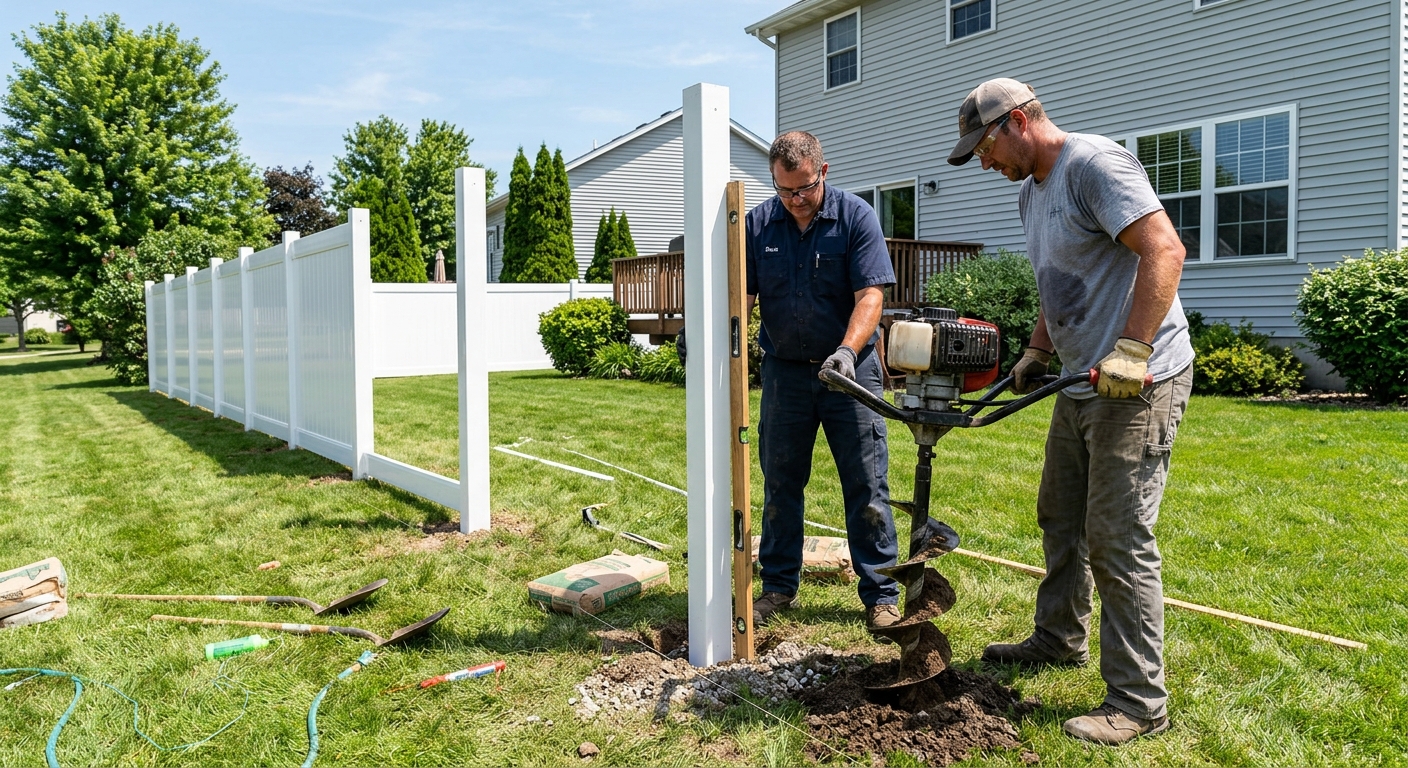
Pricing in the Hamilton–Niagara Peninsula is strongly shaped by frost behaviour: southern Ontario sees frost penetration of roughly 1.2 m (4 ft), so professional installs usually set post depths below that zone to prevent frost heave and gradual leaning. That typically pushes contractors toward deeper, longer posts and concrete-set installation for long-term stability. Access also matters in Port Colborne—narrow side yards, mature trees, and utility locate requirements can slow labour, which is why “the same fence” can land in different price tiers.
In areas with lots of mature landscaping and older property boundaries—like parts of central Port Colborne near older residential blocks—fence work is especially active because homeowners often want privacy upgrades without disrupting existing gardens. The comparison below helps you sanity-check quotes before you book a site visit.
| Material |
Lifespan |
Maintenance |
Privacy Rating |
Price per Linear Foot |
| Pressure-treated pine (standard wood) |
10–15 years |
Seal/stain every 2–3 years |
High (solid/board-on-board) |
$17–$30 |
| Cedar (natural rot resistance) |
15–25 years |
Light stain/finish every 2–4 years |
High (solid designs) |
$22–$38 |
| Vinyl / PVC (no-maintenance) |
25–35 years |
Rinse as needed; no staining |
Medium–High (board/closed picket) |
$25–$48 |
| Chain-link (galvanized steel) |
20–30 years |
Occasional rinse; tighten hardware |
Low (visual screening only) |
$15–$25 |
| Aluminum ornamental |
25–40 years |
Wash occasionally; inspect gates |
Low–Medium (decorative styles) |
$28–$55 |
| Composite / recycled material |
25–35 years |
Minimal cleaning; inspect fasteners |
High (privacy panels available) |
$27–$52 |
Prices are estimates only and vary by project scope, site access and material selection.
What affects the price of fencing in Port Colborne
In Port Colborne and across the Hamilton–Niagara Peninsula, it’s common to see fencing quotes swing by 30–50% for what looks like the same job. The biggest reason is structural requirements: fence cost isn’t just “materials per panel,” it’s also the post depth, post setting method, and labour time required to install correctly in frost-susceptible soils. Contractor availability can also play a role—during peak spring and early summer, scheduling pressure can push rates closer to the high end of the regional bands (and make site visits more selective).
Frost line depth is the primary technical cost driver. Ontario frost penetration is about 1.2 m (4 ft), and contractors typically set posts 4–6 inches below the effective design frost depth to help prevent heaving. In practical terms, that often means posts going around 1.5–2.0 m into the ground for typical 6 ft residential fencing, with concrete-set posts becoming standard for long-term stability in freezing conditions. Concrete adds material cost and labour—mixing, setting, and curing time—versus simpler tamped backfill, which is why two fence estimates can differ even with the same material.
Local conditions create real cost differences: for example, a clay-heavy lot with poor drainage may require careful hole preparation and longer posts for proper bearing; a sloped yard often means stepped or raked panels that increase layout labour; and a job with multiple gates (especially a double drive gate) adds hinge hardware and framing time. If your quote falls near wood at $45–$80 per labour band, it usually reflects straightforward post runs and standard gates; if you’re closer to vinyl/PVC at $70–$120, you’re typically paying for higher material cost plus the same frost-safe installation effort.
| Price Factor |
Why It Matters |
Cost Impact |
| Fence length in linear feet — the primary cost driver |
More panels and more posts mean more labour and materials |
High; often determines most of the total cost |
| Post depth required — frost line determines post length and hole depth |
Deeper holes and longer posts resist frost heave |
Medium–High; can add significant drilling time |
| Post setting method — concrete vs. gravel pack vs. driven posts |
Concrete-set posts are standard for long-term stability in freeze–thaw |
Medium; labour and mix cost increase |
| Material choice — vinyl vs. cedar vs. chain-link |
Materials vary widely in upfront cost and installation complexity |
Medium–High; biggest swing after length |
| Gate count and type — walk-through vs. drive-through (double) |
Gates require stronger framing, hinges, and sometimes electric-ready hardware |
Medium; can add several thousand dollars on larger projects |
| Grade and terrain — sloped yards require stepped or raked panels |
More cutting, layout time, and special alignment work |
Low–Medium; rises on steep lots |
| Old fence removal and disposal |
Hauling and extra labour to detach posts and manage debris |
Medium; can be a noticeable add-on |
| Permit fees and survey / property line locate |
Some higher fences and boundary work require documentation |
Low–Medium; varies by situation |
Permits & regulations in Ontario
In Ontario, fences are generally subject to municipal bylaw rules and property-line setbacks, and a building permit may be required when the fence exceeds typical height limits. As a practical rule of thumb, fences above about 2.0 m (6.5 ft) on the rear and about 1.0–1.2 m (3–4 ft) in the front or at corners often trigger permit requirements. Even when a permit isn’t required, you still must respect property lines and any setback requirements in the municipal bylaw for your lot. Because fence work involves digging, you should also treat utility locates as mandatory before any post hole excavation.
Step-by-step for Port Colborne homeowners:
- Call Ontario One Call before digging to mark buried services and keep your contractor compliant.
- Verify your property pins or get a property line locate/survey reference so the fence sits where it should—not where it “looks” right.
- Ask whether your fence height and location (rear vs. front/corner) require a building permit.
- Confirm how the contractor measures from finished grade and how they handle shared boundary situations.
For shared fence ownership, line-fences obligations are governed by Ontario provincial line-fences legislation; your contractor should clearly document whose side is built to whose standard.
To verify your contractor: check their Ontario business registration and relevant fencing/trades licensing information if applicable via official online registries, confirm they carry liability insurance (request a certificate of insurance), and ask for proof of WSIB/WCB coverage clearance or active account information before work begins. If they can’t provide clear documentation, treat it as a red flag and request it in writing.
Choosing the right fence material for Port Colborne
Choosing a fence in Port Colborne is about matching material performance to how you live—privacy, curb appeal, and how much maintenance you’re willing to do—while also accounting for Ontario freeze–thaw cycles. Pressure-treated pine is the budget-friendly option, but it typically needs staining or sealing every 2–3 years to prevent grey weathering and surface deterioration. Cedar looks better and resists rot more naturally, yet it still benefits from periodic finishing to keep colour and reduce surface checks. Vinyl/PVC offers low maintenance and doesn’t need staining, but in extreme cold it can become brittle if panels are stressed—so proper post alignment and spacing still matter.
Chain-link is usually the lowest upfront cost and very long-lasting, but it won’t provide privacy unless paired with slats or screening. Aluminum ornamental fencing won’t rust and holds up well in wet winters, but it’s not designed for high privacy. Composite/recycled materials often sit in the “privacy with low maintenance” category, though you should confirm fastener compatibility and post framing details.
On Hamilton–Niagara Peninsula fence builds, frost penetration is about 1.2 m (4 ft), so post depth planning is critical. Concrete-set posts are commonly used for long-term stability in freeze–thaw conditions, and that affects total cost for every material—not just wood. Wind and snow load also influence how rigid the system needs to be, especially on hilltop or windier lots near open areas where panel deflection can cause latch and hinge issues over time.
Where the price difference makes sense: if you’re choosing between pressure-treated wood and cedar, the extra upfront cost can be justified when you want longer-lasting appearance without replacing damaged sections early. For homeowners who want near-zero maintenance, vinyl can be worth it even though it costs more upfront than standard wood—especially when you factor the same frost-safe concrete set posts required for both.
| Material |
Cold Tolerance |
Lifespan |
Annual Maintenance |
Best For |
Price Band |
| Pressure-treated pine |
Good with proper posts and finishing |
10–15 years |
1–2 hours for inspection; stain/finish every 2–3 years |
Lowest initial cost with privacy-style boards |
$45–$80 |
| Cedar |
Good; handles freeze–thaw well when maintained |
15–25 years |
Inspect annually; finish every 2–4 years |
Natural look and better rot resistance |
$55–$95 |
| Vinyl / PVC |
Good; benefits from correct spacing and alignment |
25–35 years |
Rinse/clean as needed |
Low maintenance and long-term appearance |
$70–$120 |
| Chain-link |
Very good; galvanization resists weathering |
20–30 years |
Minimal; check tension and hardware |
Security with durable, budget control |
$35–$60 |
| Aluminum ornamental |
Good; powder-coated and stable in winter |
25–40 years |
Wash occasionally; inspect gate alignment |
Curb appeal with decorative boundary definition |
$80–$150 |
| Composite / recycled |
Good; stable boards when properly framed |
25–35 years |
Minimal; inspect fasteners |
Privacy with reduced upkeep |
$75–$130 |
How to choose a fencing contractor in Port Colborne
Choosing a contractor carefully is one of the best ways to control cost and avoid premature fence failure in Ontario. Start by verifying licensing and coverage. For Ontario work, ask for proof of liability insurance (request a certificate of insurance showing your property and coverage in force), and confirm they carry WSIB/WCB coverage or provide a clearance letter where required for their trade operations. You can also ask for their business registration and review any public complaint or performance history they maintain online.
Then get 2–3 itemised written quotes. A good quote breaks down labour and materials separately (post type and depth, concrete amount or setting method, number of gates, hardware, and removal/disposal). Avoid “lump sum” pricing that doesn’t specify what’s included. Confirm whether permit pulling, utility locate coordination, and property line locate costs are included or excluded. In Port Colborne, the difference between including fence removal/disposal and not including it can be material, especially when older posts are concreted in and require extra labour.
Warranty matters for workmanship and materials. Ask how long the installer’s workmanship warranty lasts, whether product warranties are separate from installation, and if those warranties are transferable to future homeowners. For payment, don’t pay more than 10–15% upfront; hold back a portion until the fence is complete and aligned. Finally, get a start date and a realistic completion timeline in writing.
- Request proof of liability insurance before signing.
- Ask for WSIB/WCB clearance or proof of coverage.
- Confirm fence post depth plan (how far down, and whether concrete-set is included).
- Get a written measurement method for linear feet and height.
- Require itemised materials (posts, panels, hardware type) and labour line items.
- Clarify what’s included for gates (frames, hinges, latches, alignment).
- Ask whether old fence removal and disposal are included.
- Confirm concrete setting vs. backfill method—especially in frozen ground areas.
- Ask who schedules or coordinates utility locates.
- Verify warranty details: length, what’s covered, and exclusions.
- Use a deposit cap (10–15%) and a holdback until completion.
- Get schedule details: start date, weather contingency, and completion estimate.
Red flags in Port Colborne include: contractors who refuse to show insurance/coverage documents, quotes that don’t specify post depth or setting method, using tamped backfill where concrete-set is needed for frost resistance, vague scope language like “everything included” without listing gates/removal/disposal, and pushing for large upfront payments (beyond 10–15%) without a written schedule.
Frequently asked questions — fencing in Port Colborne
How do I prevent wood fence rot in Port Colborne?
In Port Colborne, rot prevention starts with installation details that hold up through Ontario’s freeze–thaw cycles. Make sure posts are set deep enough for frost protection (typically around 4–6 inches below effective frost depth) and that they’re concrete-set where your soil and design require it—this helps prevent leaning that traps moisture at fence bases. Use pressure-treated or naturally rot-resistant lumber appropriately, and keep the top edges and cut ends sealed with a compatible stain/finish. For standard wood, plan on staining or finishing every 2–3 years to slow grey weathering and moisture penetration.
Also ask your contractor about clearance above grade. If panels sit too low in wet spots, airflow drops and rot speeds up. A maintenance check in late spring can catch early issues before they spread.
What is the cost per linear foot for fencing in Port Colborne?
For Port Colborne, the per-linear-foot cost depends on material, post depth, and gate count. As a quick guide based on local price bands, chain-link typically lands around $15–$25 per linear foot, while pressure-treated wood often comes in around $17–$30 per linear foot once posts and installation are included. Vinyl/PVC is commonly higher at roughly $25–$48 per linear foot because materials cost more, even though the frost-safe post work is similar. Aluminum ornamental usually sits around $28–$55 per linear foot.
If your quote looks “too low,” check whether it includes the deeper frost-safe post depth and concrete-set posts. Cutting corners there can lead to leaning and early repairs.
Should I repair or replace my old fence in Port Colborne?
Repair can be worth it when the fence is mostly sound—posts are solid (not loose or leaning), rails aren’t failing, and only a few panels or pickets need replacement. In older areas where fences were installed decades ago, repairs often become a phased replacement: new sections attached to compromised posts can still leave you with uneven alignment and recurring failure points.
Because Port Colborne homes have a lot of pre-1981 housing stock (80.5% built before 1981) (Statistics Canada, 2021 Census), many fences are affected by frost movement and hardware corrosion. If multiple posts are heaved, the fence line is out of plumb, or gates don’t close correctly after seasonal changes, replacement is usually the better long-term value. For budget planning, compare the total replacement quote against repair estimates for the number of affected posts and whether disposal of old fencing is included.
How do I handle a fence dispute with a neighbour in Ontario?
Start by documenting the issue with photos, measurements, and your property line reference. In Ontario, fences along boundaries often fall under provincial line-fences legislation principles for shared responsibilities, but local practice and municipal bylaw rules still matter for height and placement. Before digging or making changes, confirm the fence position relative to your property pins or get a property line locate.
When speaking with your neighbour, keep it factual: discuss how you’d like to remedy the problem (realignment, replacing damaged sections, or addressing maintenance). If the dispute is about encroachment, involve a surveyor/locate service rather than debating by eye. If you hire a contractor, ask them to build to the verified line and to keep records of the measurement method.
In Port Colborne, the fastest path is often to agree on a professional locate first, then discuss replacement scope and cost-sharing clearly in writing.
What fence style offers the best wind resistance in Port Colborne?
Port Colborne isn’t as wind-exposed as the open Prairies, but wind still affects fence longevity—especially on hilltop properties and lots with open views. For wind resistance, choose a design that reduces sail effect. Typically, solid privacy fences can catch more wind if they’re fully tight everywhere; a good alternative is a semi-closed pattern (or using the right panel spacing) so wind can pass through rather than applying maximum pressure to the entire span.
Beyond style, wind performance is driven by engineering details: closer post spacing in wind-prone runs, heavier or properly braced framing, and correct gate construction so latches don’t rack under load. Use concrete-set posts where needed for frost stability, because leaning increases the stress on rails and hinges.
If your property experiences frequent gusts, ask for a bracing plan and post configuration during the quote—not after the fence is already on-site.
How much does a fence cost in Port Colborne?
The total cost in Port Colborne depends on the length, material, gate count, and the post installation requirements for Ontario frost. If you want a quick planning range using local tier pricing bands, wood installations often land around $45–$80 and vinyl/PVC around $70–$120, while chain-link tends to be lower at $35–$60 and aluminum often higher at $80–$150 per the region’s typical installed range.
Two projects with the same “6 ft” height can still differ a lot. If your lot is sloped, has clay requiring extra prep, needs multiple gates, or requires old fence removal and disposal, the labour and hardware scope rises. The most important technical driver is that posts are set below frost depth with concrete-set installation for long-term stability in freeze–thaw conditions.
For the most accurate number, request an itemised quote after a site measurement and utility locate plan.