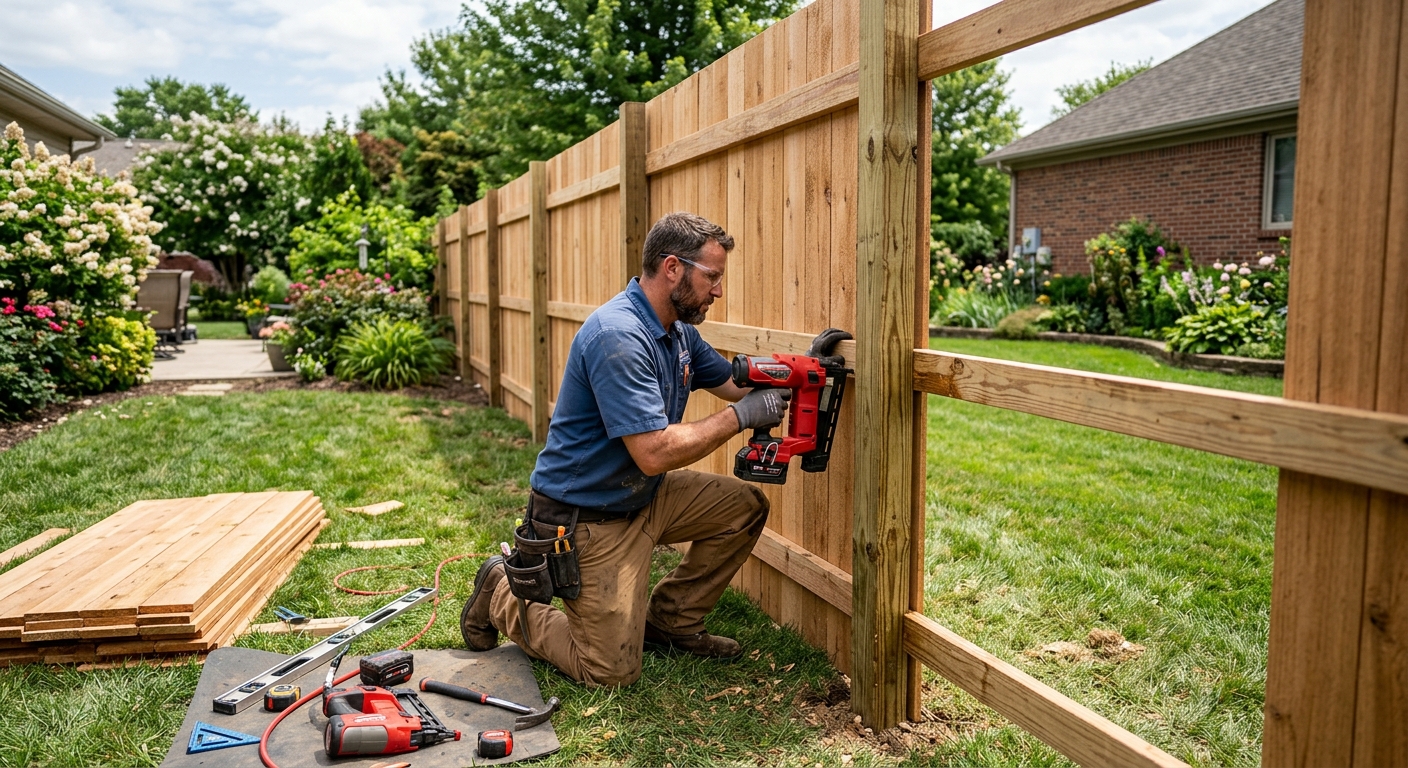
Fencing options and costs in Etobicoke West Mall
Etobicoke West Mall is a fast-moving, family-focused pocket of Toronto, and that shows up in fencing demand. With a local population of 11,848 (Statistics Canada, 2021 Census), there’s a steady mix of homeowners improving rear yards, adding dog runs, and replacing aging boundary fences. Many properties in this area are single-detached lots, which makes fencing one of the most common exterior upgrades—especially where neighbours want consistent privacy along rear property lines.
In the Toronto economic region, your fence cost is shaped as much by how posts are built as by what material you choose. Southern Ontario frost depth is commonly estimated around 42″–48″, so contractors typically set posts 3.5–4 ft deep for 6–8 ft privacy fences to reduce frost heave. That means most stable installations use concrete-set posts rather than simple driven posts. Labour availability also matters: in busier seasons, crews consolidate installs, which can affect scheduling and mobilization charges. Areas like the older residential pockets near the Kipling Avenue / Bloor Street corridor see especially frequent replacement work because many fences are reaching end-of-life after decades outdoors.
Below is a homeowner-friendly comparison of popular fence types you’ll see around Etobicoke West Mall, with realistic lifespan and typical pricing for Toronto-area projects.
| Material |
Lifespan |
Maintenance |
Privacy Rating |
Price per Linear Foot |
| Pressure-treated pine (standard wood) |
10–15 years |
Stain/seal every 2–3 years |
High (solid pickets/panels) |
$65 – $120 |
| Cedar (natural rot resistance) |
15–25 years |
Light staining every 2–4 years |
High (solid pickets/panels) |
$75 – $130 |
| Vinyl / PVC (no-maintenance) |
20–30 years |
Occasional wash only |
High (solid panels) |
$75 – $130 |
| Chain-link (galvanized steel) |
20–30 years |
Minimal; rinse and inspect tension |
Low–Medium |
$45 – $85 |
| Aluminum ornamental |
25–40 years |
Minimal; occasional cleaning |
Low (open/ornamental) |
$90 – $160 |
| Composite / recycled material |
20–30 years |
Minimal; wash and spot clean |
High (solid profiles) |
$90 – $160 |
Prices are estimates only and vary by project scope, site access and material selection.
What affects the price of fencing in Etobicoke West Mall
In Etobicoke West Mall (and across the wider Toronto economic region), two quotes for what looks like the same fence can land 30–50% apart. The difference is usually hidden in the details: post size, post depth and setting method, hardware grade, gate design, and whether old fencing is being removed and hauled away. Even small changes—like switching from driven posts to concrete-set posts—can move a project from a “budget” build to a long-term system designed for Toronto’s freeze-thaw cycles.
Toronto’s frost behaviour is a big driver. Contractors commonly set fence posts about 4–6 inches below the design frost depth logic—practically translating to roughly 1.5–2.0 m into the ground—especially for 6–8 ft privacy fences. Deeper holes mean more digging, more ready-mix/concrete, and often longer posts. Local mixed soils (often clay-heavy) also increase labour time because holes don’t always stay clean and straight. In calmer neighbourhood lots, you can sometimes use standard spacing; however, in exposed spots with higher wind from open corners or wider frontage, panel style and spacing are tightened to limit racking.
Here are a few realistic Etobicoke West Mall examples that typically raise or lower cost. A vinyl privacy fence with concrete-set posts often falls in the $75 – $130 per linear foot band, while a chain-link boundary typically lands closer to $45 – $85. If your yard is sloped and requires stepped sections, you’ll pay extra for raked panels and layout. If your existing fence is rotted at the posts, replacement costs climb because old bases must be fully removed, not just capped. Finally, projects with more gates (especially drive-through double gates) add both hardware and fabrication time.
| Price Factor |
Why It Matters |
Cost Impact |
| Fence length in linear feet |
Most materials and labour scale directly with length |
Major; often the largest line item |
| Post depth required |
Frost line determines hole depth and post length |
Major; deeper holes add excavation time and material |
| Post setting method |
Concrete vs gravel pack vs driven posts affects stability |
Moderate to major; concrete set usually costs more |
| Material choice |
Vinyl/cedar/chain-link/aluminum differ in hardware and longevity |
Can swing the total by a wide margin |
| Gate count and type |
Walk-through vs drive-through double gates change fabrication and hinges |
Moderate; gates add labour + stronger posts |
| Grade and terrain |
Slopes require stepped or raked panels and extra layout |
Moderate; often increases time and waste |
| Old fence removal and disposal |
Demolition, haul-away, and recycling/disposal fees |
Moderate; can be significant for dense scrap |
| Permit fees and survey / property line locate |
Some builds require permits; accurate boundary work prevents disputes |
Small to moderate; prevents rework costs |
Permits & regulations in Ontario
In Ontario, whether you need a permit often depends on fence height and location. A common threshold used in many municipal processes is about 2.0 m (6.5 ft) for rear yards; fences above this height often require a building permit. In front yards or corner-side areas, permits are more likely when fences exceed roughly 1.0–1.2 m (3–4 ft). Regardless of height, your fence must respect property lines and municipal setback requirements.
Before any post holes are dug, you must call for utility locates through Ontario One Call. This is non-negotiable for safety—especially in established Toronto neighbourhoods where buried services are common. Also, obtain a survey or a property pin locate so you can confirm the exact line. This matters because disputes often come down to “who built where” after years of drift and shifting fences.
Before hiring, verify shared fence ownership expectations as governed by Ontario’s line-fences legislation, including whether the neighbour contributes to the fence or repairs.
For contractor verification, a homeowner in Etobicoke West Mall should: (1) check the contractor’s Ontario business registration and any applicable municipal authorization, (2) request proof of general liability insurance and confirm the certificate matches the correct job address, and (3) confirm WSIB clearance (for the province’s required coverage). If you receive a certificate of insurance, ensure the coverage includes fencing work (not just general contracting) and ask for WSIB clearance documentation in writing. Then review the contract to confirm permit responsibility—pulling permits is typically included only when explicitly stated.
Choosing the right fence material for Etobicoke West Mall
Choosing the right fence in Etobicoke West Mall is mostly about balancing privacy, long-term maintenance, and how the material handles Toronto winters. Pressure-treated pine is the budget-friendly starting point, but it needs staining or sealing every 2–3 years to slow grey weathering and keep moisture from breaking down the wood. Cedar looks better longer and resists rot naturally, but it’s still a living material—expect maintenance every 2–4 years depending on sun exposure and staining quality. Vinyl/PVC is popular for low upkeep: you wash it occasionally and move on, but in extreme cold it can become more brittle, so post spacing and panel mounting hardware need to be done correctly.
Chain-link is the lowest upfront option with the longest practical life, but it won’t give you real privacy without add-ons. Aluminum ornamental provides rust-resistant strength and a clean look, with minimal maintenance, but it’s not a privacy solution. For taller privacy fences in Toronto, the real performance question is often the post system: Toronto’s frost conditions (commonly estimated at about 42″–48″) mean deeper, concrete-set posts are strongly recommended for stability with 6–8 ft fences. Wind and snow loads aren’t usually as severe as the Prairies, but solid panels still need solid framing, appropriate post size, and correct spacing to resist racking.
For a practical cost justification: if you’re looking at a solid wood privacy fence in the $65 – $120 band but you expect you’ll repaint/stain repeatedly or the fence will be exposed to harsh sun and driving rain, spending toward vinyl or cedar (often closer to the $75 – $130 band) can be worth it because you reduce repeat maintenance labour over the fence’s service life. If you want, I can also help you estimate the right post depth and panel height for your exact lot layout.
| Material |
Cold Tolerance |
Lifespan |
Annual Maintenance |
Best For |
Price Band |
| Pressure-treated pine |
Good with proper staining and post depth |
10–15 years |
Low in summer; stain/seal every 2–3 years |
Budget privacy and standard yards |
$65 – $120 |
| Cedar |
Good; responds well to Toronto freeze-thaw when sealed |
15–25 years |
Low to moderate; stain every 2–4 years |
Natural look with better rot resistance |
$75 – $130 |
| Vinyl / PVC |
Very good when installed with correct hardware and spacing |
20–30 years |
Occasional wash |
Low-maintenance privacy |
$75 – $130 |
| Chain-link |
Excellent; survives cold without coating issues |
20–30 years |
Minimal; inspect tension and posts |
Security with minimal wind load |
$45 – $85 |
| Aluminum ornamental |
Excellent; non-rusting finish |
25–40 years |
Minimal; occasional cleaning |
Attractive boundaries without privacy needs |
$90 – $160 |
| Composite / recycled |
Good; handles cold well with proper framing |
20–30 years |
Minimal; wash and check fasteners |
Solid privacy with reduced upkeep |
$90 – $160 |
How to choose a fencing contractor in Etobicoke West Mall
Choosing the right fencing contractor matters in Etobicoke West Mall because fence failures are often about workmanship: crooked posts, insufficient embedment, weak gate framing, and poor alignment during freeze-thaw. Start by verifying Ontario credentials and coverage. Ask for proof of general liability insurance—your certificate should show the policyholder, coverage limits, effective dates, and the work category. For WSIB coverage, request a current WSIB clearance document (or proof of exemption where applicable) and ensure it’s valid for the time of installation. If they can’t provide either promptly, that’s a red flag.
Next, get 2–3 itemised written quotes instead of a lump-sum. A real fencing quote should break down labour and materials separately (posts, rails, pickets/panels, hardware, concrete, gates, and removal/disposal). Confirm whether a permit pull is included when required, and whether old fence removal, stump/base removal, and haul-away are part of the price or billed separately.
Review warranty details carefully. Ask for (1) the length of the workmanship warranty (post setting and alignment), (2) the manufacturer warranty on material components, and (3) whether the warranty is transferable to you. Also confirm the payment schedule: never pay more than 10–15% upfront. Hold back the remainder until the fence is fully complete and inspected. Finally, require a written start date and a completion estimate—Toronto-area crews sometimes shift schedules, but you should still get a date range in writing.
- Confirm the contractor provides proof of general liability insurance before work begins.
- Request current WSIB clearance (or acceptable exemption documentation) and keep it in your records.
- Get itemised labour/materials quotes (not “one total” only).
- Ask for post depth and setting method (concrete set vs gravel pack vs driven).
- Verify gate hardware: hinges, latch type, and whether gates are reinforced.
- Check whether old fence removal and disposal are included.
- Confirm whether concrete and rebar (if used) are included in the price.
- Ask about fence line locating and whether a survey/locate is recommended.
- Make sure warranty terms are written and specify workmanship vs materials.
- Confirm payment schedule (10–15% upfront maximum) and holdback terms.
- Request a start date and completion estimate in writing.
- Ensure they include cleanup standards (leave site debris-free and remove excess materials).
Red flags I see in Etobicoke West Mall include contractors who won’t discuss post depth/concrete setting, quotes that omit gate and disposal scope, vague warranties (“we stand behind it” with no dates), demanding large upfront payments, or refusing to provide insurance/WSIB clearance documentation before scheduling. If any of those show up, slow down and ask for the missing details in writing.
Frequently asked questions — fencing in Etobicoke West Mall
Should I repair or replace my old fence in Etobicoke West Mall?
In Ontario and around Etobicoke West Mall, many “repairs” look cheaper at first, but they can be costly if the real issue is post movement. If your fence posts are leaning, lifting at the base, or the rails are separating due to freeze-thaw, replacement is often the smarter long-term option because the stability comes from proper embedment and hardware. If the posts are solid and only a few pickets or panels are damaged, patching can make sense—especially for chain-link where tension and vinyl slats are easy to swap. As a rough guide, if you’re close to replacement anyway, you’ll often see replacement in the $65 – $120 per linear foot range for wood or closer to $45 – $85 for chain-link. A site visit to check post depth, concrete condition, and rot at ground level usually clarifies the best path quickly.
How do I handle a fence dispute with a neighbour in Ontario?
Fence disputes in Ontario often start with boundary uncertainty—especially when fences have shifted or were built without locating pins. In Etobicoke West Mall, the first practical step is to confirm the property line using your survey or a pin locate before you argue about style or height. Then document everything: photos (including corners and gate positions), measurements, and your correspondence. Ontario’s line-fences rules deal with shared boundary responsibilities, but the concrete starting point is the boundary itself. If your fence is beyond the line or you believe it is, avoid demolition or “fixing” the fence until you have clarity—doing so can escalate the situation. A good contractor can also provide an evidence-based report (posts, setting depth, and layout) that helps you show exactly what was built and where, which often reduces conflict.
What fence style offers the best wind resistance in Etobicoke West Mall?
For Toronto-area wind, the best-performing option is usually a properly framed privacy fence (wood, vinyl, or composite) installed with deeper concrete-set posts and appropriate post spacing for solid panels. Even though Toronto doesn’t face the extreme open-field wind loads of the Prairies, taller solid fences can rack if posts are too shallow or panels are too light. In practice, I look for heavier post sizing and correct hardware, with 6–8 ft centres for many solid privacy builds (depending on panel span and fence height). Chain-link can handle wind better because it’s permeable, but it won’t deliver privacy unless you add slats or screening—those add some wind load back. The key is not just the material, but the system: embedment depth (about 1.5–2.0 m in many freeze-thaw builds), straight alignment, and secure gate reinforcement.
How much does a fence cost in Etobicoke West Mall?
In Etobicoke West Mall, typical fence pricing depends on material, fence height, gates, post depth and whether old removal is included. For the Toronto area, wood installation commonly lands in the $65 – $120 per linear foot range, while chain-link is often closer to $45 – $85 per linear foot. Vinyl/PVC privacy is frequently in the $75 – $130 range because posts, concrete setting, and hardware still need to be built for frost stability. Aluminum ornamental usually trends higher, often starting around the $90 – $160 range due to materials and install complexity. If you tell me your approximate linear footage, fence height, and number of gates, I can help you narrow down which band is most realistic and where the quote should land.
How deep should fence posts be for Etobicoke West Mall's frost?
In Southern Ontario, the commonly used frost line estimate is about 42″–48″. To reduce frost heave risk, posts are typically set at least 3.5–4 ft deep for privacy fences, and many crews plan for embedment roughly 4–6 inches below the design frost logic—often translating to about 1.5–2.0 m into the ground in cold-weather builds. Practically, that depth is why concrete-set posts are so common for 6–8 ft privacy fences in Etobicoke West Mall: it improves stability and helps prevent base movement during freeze-thaw cycles. The exact depth can vary with soil type, drainage, and local site conditions, so your contractor should confirm the setting method and hole depth in writing as part of the quote scope.
Wood vs vinyl vs aluminum fence — which is best?
“Best” depends on what you value most. Wood (pressure-treated pine or cedar) offers solid privacy and can fit most budgets, but it needs maintenance—stain/seal schedules can run every 2–3 years for pine and every 2–4 years for cedar to manage weathering and moisture. Vinyl/PVC is usually the lowest-maintenance privacy option after installation, and it tends to perform well in Toronto cold when the posts and spacing are built correctly; however, upfront cost is often higher (commonly within the $75 – $130 band). Aluminum ornamental is maintenance-light and rust-resistant, typically priced higher (often within the $90 – $160 band), but it’s more decorative than private. If your main goal is privacy along the yard boundary, vinyl or cedar/wood privacy systems usually win; if your goal is curb appeal with open visibility, aluminum is often the best match.