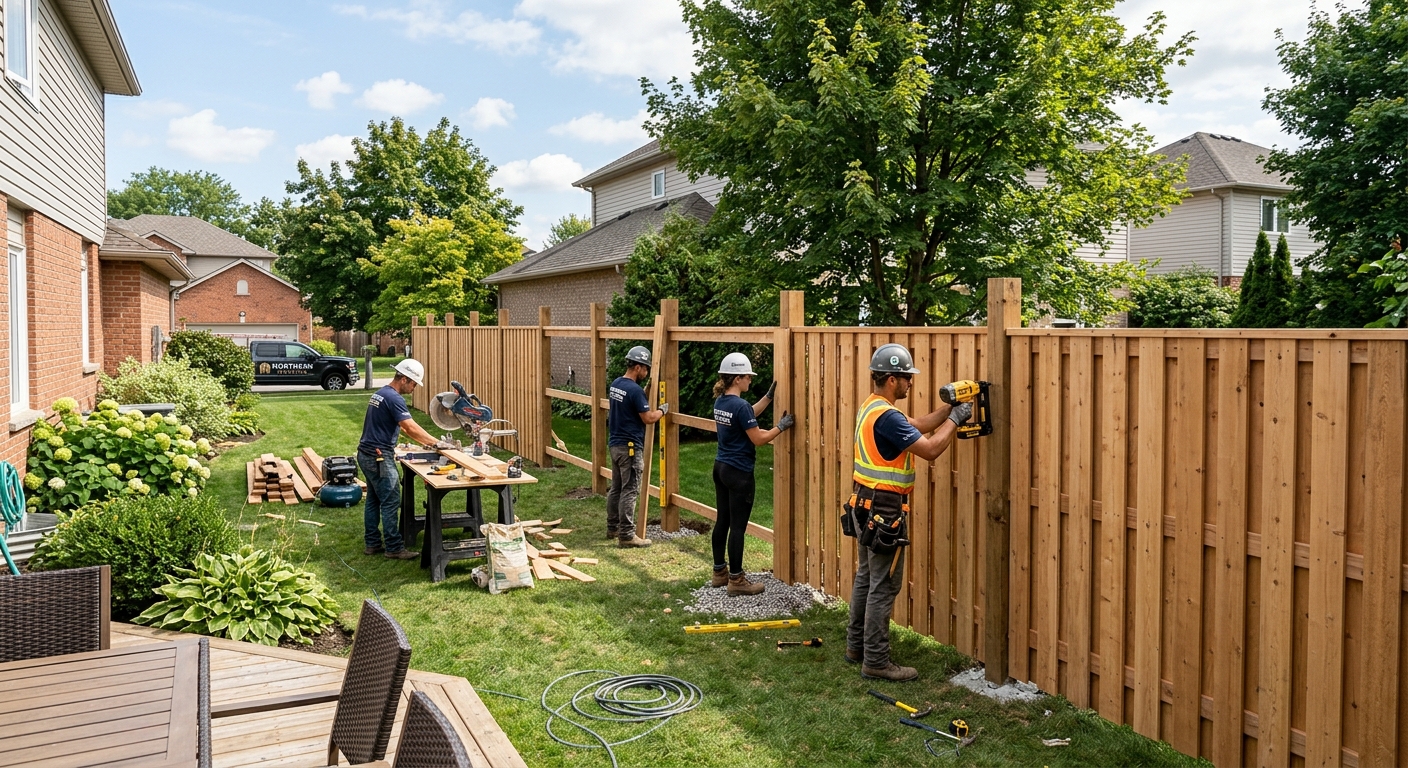
Fencing options and costs in Greely
Fencing in Greely comes down to having the right material for a northern Ottawa-region climate and pricing it for how deeply posts must be set. Greely’s demand is supported by steady homeownership: with 9,049 residents recorded in the 2021 Census (Statistics Canada, 2021 Census), and with many lots belonging to single households that typically fence their yard for pets, kids, and privacy. Each backyard fence is also part of a larger streetscape, so homeowners tend to want a clean, straight look that holds up through freeze–thaw seasons.
In the Ottawa economic region, contractors price for frost depth and soil movement. Ottawa-area frost is roughly 3.5–4 ft, so quality work generally buries posts close to 4 ft and uses concrete footings to reduce winter heave and leaning—especially in clay soils that shift during freeze–thaw cycles. That means more digging, longer post lengths, and more disposal time than milder parts of Canada. Wind loading also matters: even though Greely isn’t an exposed Prairie site, privacy fences still take gusty conditions and drifting snow loads, so spacing and panel strength can affect labour time and material selection.
Local trade demand is especially common around newer residential pockets near Greely Road, where homeowners are building out front and backyard boundaries and adding gates for driveways and side yards. Next, compare the most common options and typical installed cost ranges with an apples-to-apples view of lifespan, upkeep, and privacy performance.
| Material |
Lifespan |
Maintenance |
Privacy Rating |
Price per Linear Foot |
| Pressure-treated pine (standard wood) |
10–15 years |
Stain/seal every 2–3 years; tighten hardware as needed |
High (solid boards) |
$40 – $75 |
| Cedar (natural rot resistance) |
15–25 years |
Light re-staining or sealing every 2–3 years |
High (solid boards) |
$50 – $85 |
| Vinyl / PVC (no-maintenance) |
20–30 years |
Rinse/clean as needed; occasional panel alignment check |
High (solid/slat styles) |
$45 – $80 |
| Chain-link (galvanized steel) |
20–40 years |
Minimal; wash down; replace sections if hit |
Low–Medium (not private by itself) |
$25 – $50 |
| Aluminum ornamental |
25–40 years |
Occasional cleaning; inspect posts and gates |
Low–Medium (ornamental pickets) |
$70 – $120 |
| Composite / recycled material |
20–30 years |
Low; rinse/clean; check fasteners after extreme winters |
Medium–High (style-dependent) |
$55 – $100 |
Prices are estimates only and vary by project scope, site access and material selection.
What affects the price of fencing in Greely
If you receive two quotes for the “same” fence in Greely, the numbers can differ by 30–50% because installation conditions rarely match exactly: lot layout, access for a skid-steer or auger, number of gates, how the yard slopes, and how the fence ties into existing structures. Even when the material brand is similar, deeper post setting in Ottawa-area soils and the extra hours for accurate alignment can swing labour totals quickly.
The biggest driver is frost depth. In cold Ontario climates, posts typically need to be set about 4–6 inches below the design frost depth to prevent heaving. With Ottawa’s frost around 3.5–4 ft, that often translates to burying close to 4 ft and using longer posts plus concrete footings, especially in clay where freeze–thaw cycles move soil. Where milder regions might only require 2–3 ft depth, Greely installations commonly need 1.5–2.0 m of embedment, meaning more excavation time and higher disposal and concrete costs.
Wind exposure also changes build details. Privacy fences act like sails, so contractors may tighten post spacing and increase panel stiffness. Coastal BC may not demand deep frost setting, but it punishes wood with rot and moisture, while Prairie windy sites often increase structural elements for gusts—Ontario is a middle ground, but drifting snow can still load the fence.
Concrete examples from Greely jobs: (1) a 60 ft boundary in heavier clay often adds hours for auger rework and extra concrete, pushing wood projects toward the upper end of $40 – $75 per linear foot; (2) a simple chain-link run with fewer footings tends to stay nearer $25 – $50, especially if there’s clear access and no gates; and (3) removing an old fence section can add disposal and safe-demolition time that doesn’t show up on a material-only estimate. On older housing stock, buried drain tile or previous landscaping can also complicate digging and increase labour.
| Price Factor |
Why It Matters |
Cost Impact |
| Fence length in linear feet |
More panels and posts = more material, more labour, more concrete |
Primary driver; can move total by hundreds to thousands |
| Post depth required |
Frost line determines embedment depth, hole size, and post length |
Often one of the largest line items in Ottawa-area winters |
| Post setting method |
Concrete footings outperform gravel pack in freeze–thaw soils |
Concrete increases material cost and time; driven posts reduce set time but may not be appropriate for soil |
| Material choice |
Vinyl, cedar, chain-link, aluminum have different material and install profiles |
Switching materials can shift pricing by a major band (e.g., chain-link vs aluminum) |
| Gate count and type |
Gates need stronger hinges, posts, and bracing than standard runs |
Each additional gate can add significant labour and hardware |
| Grade and terrain |
Slopes require raked panels or stepped layout for code-compliant height and alignment |
Extra layout time; more cut material; longer install duration |
| Old fence removal and disposal |
Demo, hauling, and handling old fasteners can be time-consuming |
Can add a meaningful cost even if new fence materials are similar |
| Permit fees and survey / property line locate |
Locates and paperwork reduce the risk of boundary disputes |
Often a separate line; varies by situation and documentation needs |
Permits & regulations in Ontario
In Ontario, fences are governed by property line rules and municipal setback bylaws, and certain fence heights can require a building permit. As a practical starting point, rear yard fencing often triggers permit requirements at around 2.0 m (6.5 ft), while front or corner side yards may trigger at about 1.0–1.2 m (3–4 ft) depending on the municipal context and how the fence is classified. If you’re unsure, ask your contractor to confirm what applies to your lot before they dig.
Before any post holes get dug, you also must call for utility locates (Ontario One Call). This is not optional—hitting buried services is expensive and unsafe. Many disputes start with fence placement: get a survey or have pins located so your posts don’t encroach. In addition, shared fence ownership and maintenance rules are addressed under Ontario’s line-fences framework, which generally guides when one neighbour shares the cost for a fence that serves both properties.
What typically DOES require a permit: fences that exceed the local height threshold and may be classified as requiring review for structures, or projects involving significant new structures near setbacks. What typically does NOT require a permit: like-for-like replacement of an existing fence at similar height and location (still subject to property line and setback compliance), and routine minor repairs—though you should confirm with your municipality.
For contractor credibility in Greely, verify: (1) Ontario licensing/registration on the appropriate provincial registry (where applicable to their trade activity), (2) liability insurance showing you’re covered as an owner for work on your property, and (3) WSIB/WCB coverage proof. Where to look: request a current clearance letter (or equivalent coverage proof) and review the certificate of insurance for coverage limits and policy dates before work starts.
Choosing the right fence material for Greely
Choosing a fence material in Greely means balancing privacy, low maintenance, upfront budget, and winter durability. Ottawa’s freeze–thaw cycles are tough on posts and fasteners, so whatever you choose, the installation details—particularly post embedment near the regional frost depth—matter as much as the material. For many homeowners, the right answer depends on how much upkeep you’re willing to do and whether you want a solid privacy look.
Pressure-treated pine is usually the lowest upfront option, but it needs staining or sealing every 2–3 years to reduce greying and protect against moisture. Cedar has better natural rot resistance and often looks better longer; it still benefits from periodic sealing, especially along the ground line. Vinyl/PVC is a strong low-maintenance choice, but in extreme cold it can become brittle if panels are forced out of alignment—good post spacing and proper installation are key. Chain-link has the lowest cost and longest service life, but it won’t provide privacy unless you add slats, privacy mesh, or climbing screening. Aluminum ornamental is rust-resistant and clean-looking, yet it provides only low–medium privacy because of the open design. Composite/recycled materials often land in the mid-range for maintenance and can hold their appearance well.
On frost depth: with Ottawa’s roughly 3.5–4 ft frost, quality posts are commonly set close to 4 ft with concrete footings in Ontario clay. In Greely, that usually means all materials benefit from proper concrete setting—concrete-set posts are less about “wood only” and more about soil and longevity. Wind and drifting snow loads also influence post spacing and gate bracing, which affects all systems.
Where does the price difference make sense? If you’re comparing wood versus vinyl, a vinyl fence may sit higher within the $45 – $80 per linear foot range versus typical wood around $40 – $75. The extra cost can be justified when you want to avoid recurring staining and you plan to stay in the home long-term—particularly if your yard has heavy sun and weathering on the west-facing panels.
| Material |
Cold Tolerance |
Lifespan |
Annual Maintenance |
Best For |
Price Band |
| Pressure-treated pine |
Good with correct concrete-set posts; requires proper fasteners |
10–15 years |
Inspection seasonally; stain/seal every 2–3 years |
Best budget option with solid privacy panels |
$40 – $75 |
| Cedar |
Very good; handles moisture better in Ottawa freeze–thaw cycles |
15–25 years |
Light seal/stain every 2–3 years |
Natural appearance and longer aesthetics |
$50 – $85 |
| Vinyl / PVC |
Good when installed square and not forced in cold; avoid tight misalignment |
20–30 years |
Minimal; rinse/clean as needed |
Low maintenance privacy |
$45 – $80 |
| Chain-link |
Excellent; galvanized steel resists winter corrosion |
20–40 years |
Low; check tension and posts after storms |
Security and defining boundaries |
$25 – $50 |
| Aluminum ornamental |
Excellent; won’t rot and won’t rust like steel without coating |
25–40 years |
Minimal; wash and inspect annually |
Attractive curb appeal with durability |
$70 – $120 |
| Composite / recycled |
Good in cold when properly fastened; resilient to moisture |
20–30 years |
Low; rinse/clean and check fasteners |
Mixed privacy with low upkeep |
$55 – $100 |
How to choose a fencing contractor in Greely
Choosing a contractor in Greely is mostly about verifying proof and getting clarity up front. Start with Ontario compliance checks. First, confirm they can legally perform the fencing trade activity they’re advertising. Next, check liability insurance—you should see coverage limits, your job-site details, and that the policy is current. For worker protection, request proof of WSIB/WCB coverage and/or a clearance letter where applicable. Where to look: ask for the certificate of insurance and a clearance letter before any work begins, and verify policy dates so you’re not covered by expired documents.
Then, get 2–3 itemised written quotes instead of a lump sum. A good quote breaks out labour (excavation, setting posts, assembly), materials (posts, rails, panels, fasteners, gates), and any site work. Read the scope carefully: are permit pulls included, is disposal of old fencing included, and who handles utility locate scheduling? A strong contractor will specify whether they’ll remove the old fence and where debris will be hauled.
Warranty matters in Ontario winters. Ask for: (1) workmanship warranty length (for posts, alignment, and gate operation), (2) product/manufacturer warranty coverage, and (3) whether the warranty is transferable if you sell the home. For payments, never allow a full deposit—plan to pay only about 10–15% upfront and hold back the remainder until the job is complete and inspected. Finally, lock in the timeline: request a written start date and an estimated completion window, because weather can affect post-hole work in winter.
- Ask for itemised breakdowns: labour, materials, gates, and excavation.
- Confirm concrete-set approach for frost conditions and document embedment depth.
- Verify liability insurance with current dates and appropriate coverage limits.
- Request WSIB/WCB proof and a clearance letter where applicable.
- Ensure the quote includes utility locate responsibility (Ontario One Call).
- Confirm disposal/hauling is included if removal is part of your scope.
- Check how slopes are handled: raked panels vs stepped sections.
- Make sure gate hardware is specified (hinges, latches, reinforcement).
- Ask who is responsible for locating the property line/survey pins.
- Clarify start date, completion estimate, and weather contingencies.
- Get warranty terms in writing for workmanship and materials.
- Use a payment schedule that keeps 85–90% until completion and walkthrough.
Red flags I see in Greely include: quotes that don’t specify post embedment depth or footing type; refusal to provide a certificate of insurance or WSIB/WCB clearance proof; “cash-only” arrangements with no written scope; vague warranty wording that covers nothing beyond materials; and missing details on gates, disposal, or permit responsibility.
Frequently asked questions — fencing in Greely
How deep should fence posts be for Greely's frost?
In Greely and the Ottawa area, installers usually set posts deeper than many “southern Ontario” guides because winter frost can lift ground. With Ottawa-region frost depth around 3.5–4 ft, a common quality standard is to bury posts close to about 4 ft—typically 4–6 inches below the design frost depth—to reduce winter heave and leaning. If you’re on heavier clay or your lot has had frost movement before, contractors often use concrete footings rather than a gravel pack. Always ask your contractor to state the embedment depth in the quote and to explain their footing method. It’s also worth comparing material and install pricing: wood often falls within $40 – $75 per linear foot, but the real safety piece is how the posts are set for your soil.
Wood vs vinyl vs aluminum fence — which is best?
There isn’t one “best” for everyone in Greely—there’s a best fit for your priorities. Wood (pressure-treated or cedar) can be the best value for privacy and appearance, often landing around $40 – $75 for common installed ranges depending on species and scope. Vinyl/PVC is usually the best for low maintenance; it tends to fall around $45 – $80 and can handle Ottawa winters well when installed square and properly fastened for cold conditions. Aluminum is durable and rust-resistant, but it’s generally more ornamental, so privacy is limited; it often sits in the $70 – $120 band. For open lawns that catch wind or drifting snow, prioritize strong gate bracing and proper post setting regardless of material.
Do I need a permit to build a fence in Ontario?
It can be required, depending on height and location. In Ontario, many municipalities require a building permit when fencing exceeds typical thresholds—for example, rear-yard fences often around 2.0 m (6.5 ft), while front or corner areas may trigger earlier (about 1.0–1.2 m). Even when a permit isn’t triggered, your fence must still respect property lines and municipal setback bylaws. Before digging, you should also arrange utility locates through Ontario One Call. If you’re replacing an existing fence at similar height and location, permits are often less likely—but it still must comply. Ask your contractor to confirm the permit requirement for your exact plan and to include permit pull responsibility in the quote if it applies.
How long does a wood fence last in Greely?
With proper installation in Greely—deep post embedment near the regional frost depth, correct concrete setting in freeze–thaw soils, and quality fasteners—wood fences commonly last about 10–15 years for pressure-treated pine and closer to 15–25 years for cedar. Maintenance strongly affects real life: staining or sealing every 2–3 years helps slow weathering and moisture-driven wear. If your fence is in a shaded, damp corner or along a frequent snow-drift zone, expect more wear at the bottom rails and near post bases. When comparing budgets, wood can be attractive in the $40 – $75 band, but your long-term cost includes the maintenance you’re willing to do.
Who owns and maintains a shared fence?
In Ontario, shared fence ownership and cost-sharing are generally handled under provincial line-fences rules, but practical ownership can depend on whether the fence is built as a dividing fence and where it sits relative to your property boundary. If the fence is on or near the boundary, neighbours may have shared responsibilities for maintenance, and disputes often come down to whether both properties benefit from the fence and how the fence was originally constructed. In Greely, I recommend addressing this before construction starts: confirm the property line with pins or a survey, and agree in writing on repairs and who pays for replacement if a section fails. Your fencing contractor should also install directly on the correct alignment to prevent avoidable boundary conflicts.
How do I find my property line before fencing?
Before any post holes are dug in Greely, the safest approach is to confirm your boundary with survey pins or a recent survey. Many homeowners assume the “edge of the yard” equals the property line, but that’s a common source of encroachment disputes. Start by locating any visible markers/pins with your municipality or surveyor guidance, then document their positions. If you don’t have pins, hire a surveyor or request a property line locate so you know where the fence should be installed. This is especially important when fences are near setbacks or when you’re upgrading gates. Also, schedule utility locates via Ontario One Call before digging. A careful locate helps keep your project aligned and prevents costly rework that can push a job well beyond typical material bands like $25 – $50 for chain-link or $45 – $80 for vinyl.