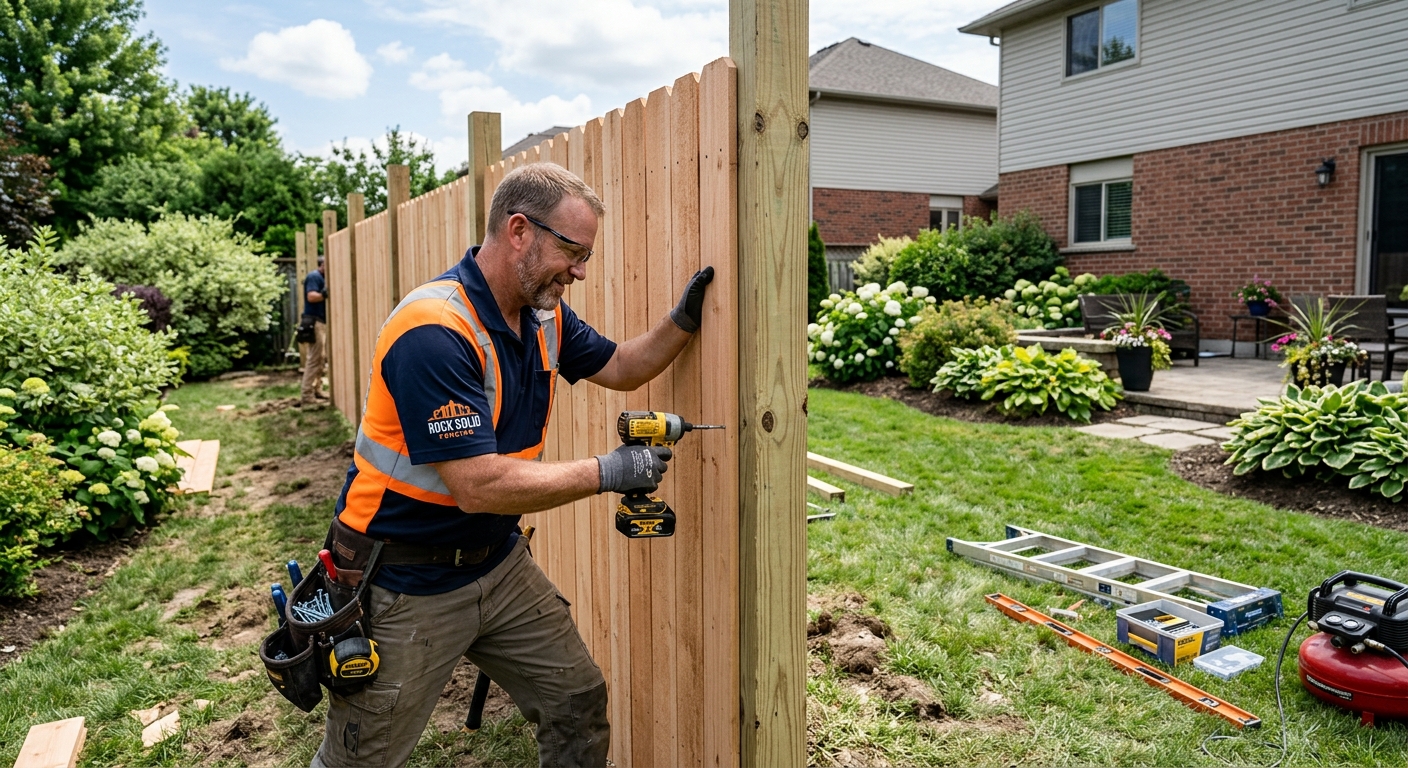
Fencing options and costs in Danforth East York
Danforth East York is a dense, established Toronto neighbourhood where homeowners often upgrade fencing as part of landscaping, backyard privacy, and pet safety. With a total population of 17,180 (Statistics Canada, 2021 Census), demand is steady, and it’s reinforced by the number of family properties that need perimeter coverage for kids and pets. In practice, that means many contractors know the local soil conditions, access constraints, and typical fence layouts—especially around Yonge Street and the side streets where lots are narrower.
Cost in Toronto is shaped by Southern Ontario winters. The region commonly uses a design frost line of about 42"–48", so fence posts usually need to be set roughly 3.5–4 ft down with concrete where required. That foundation work is one of the biggest reasons fencing quotes can feel higher than you’d expect from material alone. Access also matters: back lanes, tight gates, and removing an older fence can add labour even when the fence line is short. Around the Cedarvale Park and Don Valley corridor edges, wind exposure can be a little more noticeable, which pushes installers toward heavier posts and closer spacing for privacy panels.
Below are the typical options homeowners compare in Danforth East York—then we’ll break down what moves your quote up or down.
| Material |
Lifespan |
Maintenance |
Privacy Rating |
Price per Linear Foot |
| Pressure-treated pine (standard wood) |
10–15 years |
Stain/finish every 2–3 years |
High (solid board or close picket) |
$25 – $45 |
| Cedar (natural rot resistance) |
15–25 years |
Re-seal or stain every 3–4 years |
High (solid board or close picket) |
$32 – $60 |
| Vinyl / PVC (no-maintenance) |
20–30 years |
Wash only; inspect hardware |
High (solid panels) |
$30 – $65 |
| Chain-link (galvanized steel) |
25–40 years |
Occasional tension and rinse |
Low to medium (privacy slats optional) |
$18 – $30 |
| Aluminum ornamental |
30–45 years |
Rinse occasionally; touch-up as needed |
Low (open look) |
$35 – $75 |
| Composite / recycled material |
20–30 years |
Wash; minimal repairs |
High (solid privacy boards) |
$40 – $80 |
Prices are estimates only and vary by project scope, site access and material selection.
What affects the price of fencing in Danforth East York
In Danforth East York, two quotes for what looks like the same fence can easily differ by 30–50% because the labour is rarely identical: post footings, demolition, gate hardware, and the amount of detailed fitting for corners and gates are where crews spend time. In the Toronto economic region, pricing also reflects a strong demand cycle and consistent requirements for durable, frost-safe installs—especially for 6–8 ft privacy fences.
The biggest technical driver is frost protection. In Southern Ontario, the design frost line is commonly about 42"–48", and best practice usually places post depth roughly 4–6 inches below that finished frost depth to reduce heaving risk. Practically, that means posts often need to be set around 1.5–2.0 m into the ground. When concrete is used rather than driven posts, you’ll see higher labour time and ready-mix costs, but you gain long-term stability. Wind still matters in Toronto (less than the Prairies, but not “zero”), so privacy panels often require heavier posts and closer spacing to limit racking and uplift.
Concrete examples from local projects: (1) Replacing an old fence with set posts on a clay-mixed yard can raise labour by adding footing depth and cleanup; (2) A short run (say 20–30 ft) can look “cheap” until you add a double drive gate and heavier rails; gate hardware drives cost quickly. On the other hand, a chain-link line along a straight property boundary may stay closer to the lower band of $45 – $85 per job tier because materials are lighter and demolition is simpler.
Material choice changes the math too. If you’re choosing wood, many homes still fall into the wood installation tier of $65 – $120, but cedar and vinyl typically move toward the higher end once you factor post hardware and longer-lasting boards for Toronto’s freeze–thaw cycle.
| Price Factor |
Why It Matters |
Cost Impact |
| Fence length in linear feet |
More posts, rails, and labour scale directly with length |
Large (primary driver; biggest swing between quotes) |
| Post depth required |
Frost protection dictates hole depth and post length |
Medium to large (more excavation + more materials) |
| Post setting method |
Concrete vs gravel pack vs driven posts changes labour and longevity |
Medium to large (concrete-set costs more) |
| Material choice |
Different board/post weights affect labour, hardware, and spacing |
Medium (wood/cedar vs vinyl vs chain-link) |
| Gate count and type |
Gates require stronger framing, hinges, latches, and alignment time |
Medium (single walk-through vs double drive significantly) |
| Grade and terrain |
Slope requires stepping, raking, or custom panel cuts |
Small to medium (often noticeable in corners) |
| Old fence removal and disposal |
Disposal and haul-away add labour and dumpster or dump fees |
Medium (can be a major portion of a small project) |
| Permit fees and survey / property line locate |
Paperwork and locating prevent encroachment disputes |
Small to medium (varies by municipality and project) |
Permits & regulations in Ontario
In Ontario, fencing is often regulated by municipal by-laws and property line rules, and permits can come into play depending on height. As a homeowner guide for Danforth East York: rear fences above about 2.0 m (6.5 ft) and front or corner fences around 1.0–1.2 m (3–4 ft) may require a building permit, particularly where a proposed fence would exceed typical height allowances or affect visibility. Even when a permit is not automatically triggered, you still need to respect property lines and any applicable setback requirements.
Before any post hole is dug, arrange utility locates through Ontario One Call so you don’t hit underground services. Then, for accuracy and to reduce disputes, obtain a survey or locate your property pins prior to installation—especially on boundary-heavy lots where older fences may not have been placed perfectly. For shared fence ownership, Ontario’s line-fences principles generally govern neighbour responsibilities and cost-sharing, so it’s smart to confirm in writing if you’re replacing a boundary fence that your neighbour relies on.
To verify a contractor, start with licensing/registrations (where applicable for the scope) and ask for: (1) liability insurance certificate; (2) proof of WSIB coverage or applicable WCB clearance; and (3) a written workmanship warranty. Look for the policy to name the correct legal entity and request an insurer-issued certificate directly if it’s not clear. Step-by-step, you’re confirming coverage before work begins, not after an issue arises.
Choosing the right fence material for Danforth East York
Choosing a fence material in Danforth East York is mostly about matching your priorities—privacy, low maintenance, lifespan, and budget—to the reality of Toronto’s freeze–thaw weather and frequent yard drainage issues. Pressure-treated pine is the budget-friendly route, but it typically needs staining or sealing every 2–3 years to slow grey weathering and keep boards looking straight. Cedar looks warmer and resists rot better than pine, yet it still benefits from periodic staining or re-sealing to protect against moisture cycling.
Vinyl / PVC is attractive for low maintenance and consistent appearance, but it performs best when installed with proper post spacing and hardware rated for temperature swings; in extreme cold, some systems can become brittle if the wrong product is used or if panels are stressed. Chain-link offers the longest “set it and forget it” service life and lowest upfront cost, but privacy is limited unless you add slats or a top cover. Aluminum ornamental is great for rust resistance and curb appeal, and it doesn’t rot, but it’s generally open-style rather than a true privacy fence.
For post depth: because the frost line is commonly treated at about 42"–48", Toronto projects usually need concrete-set posts to reach roughly 3.5–4 ft down (often around 1.5–2.0 m hole depth depending on local conditions). That matters even more for taller privacy fences in gusty spots and near lanes where airflow can “catch” the panels.
A practical dollar example: if you’re considering wood vs vinyl for a similar privacy layout, wood may land closer to the wood tier of $65 – $120, while vinyl/PVC often runs higher within the $75 – $130 band. The difference is usually justified when you want fewer maintenance visits and long-term appearance, especially on fences that are difficult to access from the rear lane.
| Material |
Cold Tolerance |
Lifespan |
Annual Maintenance |
Best For |
Price Band |
| Pressure-treated pine |
Good (with proper sealing) |
10–15 years |
Light inspection; re-stain typically every 2–3 years |
Budget privacy with willingness to maintain |
$65 – $120 |
| Cedar |
Good (naturally moisture-resistant) |
15–25 years |
Inspect for surface wear; stain/re-seal every 3–4 years |
Better appearance privacy |
$75 – $130 |
| Vinyl / PVC |
Very good when installed correctly |
20–30 years |
Wash; inspect fittings (usually minimal yearly work) |
Low-maintenance privacy |
$75 – $130 |
| Chain-link |
Excellent (metal + coatings) |
25–40 years |
Occasional tension check and rinse |
Security with pet containment |
$45 – $85 |
| Aluminum ornamental |
Excellent (no rust) |
30–45 years |
Rinse; touch-up as needed |
Security + curb appeal |
$90 – $160 |
| Composite / recycled |
Good (material dependent) |
20–30 years |
Wash; periodic hardware checks |
Privacy with reduced upkeep |
$90 – $160 |
How to choose a fencing contractor in Danforth East York
When you’re hiring a fencing contractor in Danforth East York, licensing and coverage are your first safety checks. In Ontario, you should ask for a current certificate of liability insurance (confirm the correct business name and policy dates) and proof of WSIB coverage or applicable WCB clearance for their workers. Don’t accept “we have insurance” verbally—request documents and verify them before work starts. If you’re given only a quote without proof, treat that as a red flag.
Next, ask for 2–3 itemised, written quotes with a clear breakdown of labour, materials, and add-ons. You want to see things like fence footage, number of posts (and assumed depths), concrete or setting method, rail and gate hardware, and what’s included for end posts and corners. Confirm whether permits are included or excluded, whether old fence removal and disposal are part of the price, and what happens if a property line survey or access limitations change the layout. Clarity here prevents the kind of mid-project “adjustments” that cause most homeowner frustration.
Warranty matters too. Ask for a workmanship warranty length and whether it’s written, plus the manufacturer warranty for boards/posts and how long it lasts. If you sell the home, ask if the warranty is transferable. For payment, keep deposits reasonable: typically no more than 10–15% upfront, and hold back a portion until the job is complete and cleaned up. Finally, require a start date and estimated completion timeline in writing.
- Request proof of liability insurance (certificate copy) before work begins.
- Verify WSIB/WCB coverage documents or clearance letter.
- Confirm the quote is itemised: labour, materials, posts, concrete, and hardware.
- Ask what post depth and setting method is assumed for your yard.
- Confirm gate hardware grade and whether double gates use reinforced framing.
- Check if permits (where required) are included or billed separately.
- Ask whether old fence removal, hauling, and disposal are included.
- Ensure the scope specifies how slopes are handled (stepped vs raked panels).
- Verify who calls for utility locates (you or the contractor) before digging.
- Confirm the warranty: workmanship length and manufacturer coverage details.
- Agree on payment schedule: limit upfront to 10–15% and hold a completion holdback.
- Get a written schedule with start date, completion estimate, and communication plan.
Red flags I frequently see in Danforth East York: (1) vague “lump sum” quotes with no footing/post plan; (2) refusal to provide insurance/WSIB clearance in writing; (3) claims that posts can be simply driven with no concrete on taller fences; (4) no mention of utility locates or property line verification; and (5) pressure to pay large deposits up front (beyond 10–15%).
Frequently asked questions — fencing in Danforth East York
What fence style offers the best wind resistance in Danforth East York?
In Danforth East York, wind resistance is mostly about how much “sail” your fence creates. For privacy in gusty conditions, a solid board or closely spaced panel with properly spaced, concrete-set posts tends to perform better than highly open styles, because there’s less panel movement and racking. That said, extremely solid fences can catch wind differently than you’d expect, so installers should use heavier posts and the correct rail bracing at fence corners and along long runs. For most Toronto yards, I recommend concrete-set posts rather than driven posts for 6–8 ft privacy fences due to the freeze–thaw cycle and frost line depth expectations. If you want a more wind-flexible look, semi-private designs with carefully planned spacing can reduce stress on panels, but still require solid footing and hardware.
How much does a fence cost in Danforth East York?
Typical pricing in Danforth East York depends on length, height, gates, post depth, and whether you’re replacing an older fence. As a planning benchmark, the Toronto market often lands wood installs around $65 – $120 per the local tier, while vinyl/PVC typically runs higher, often in the $75 – $130 band depending on post/hardware and access. Chain-link tends to be the most budget-friendly, frequently in the $45 – $85 range, while aluminum ornamental is usually mid-to-high at $90 – $160. Your quote can move meaningfully if your yard needs deeper concrete-set footings, if you’re adding a double drive gate, or if demolition/disposal is included. A detailed itemised quote is the best way to compare apples-to-apples.
How deep should fence posts be for Danforth East York's frost?
For Danforth East York and the broader Toronto region, contractors commonly plan for a design frost line around 42"–48". Best practice usually means setting fence posts deeper by roughly 4–6 inches below that design frost depth to reduce the risk of frost heave—especially for tall privacy fences (6–8 ft). In practical terms, that often translates to about 1.5–2.0 m into the ground, with concrete setting being the safer choice on clay and mixed soils common around Toronto. The exact depth and footing size still depend on your soil and drainage, but if a quote proposes minimal depth or driven posts only for a tall solid fence, it’s worth asking how they’re addressing frost protection and long-term stability.
Wood vs vinyl vs aluminum fence — which is best?
“Best” depends on what you value most. Wood (pressure-treated pine or cedar) gives a classic look and strong privacy, but wood typically needs ongoing maintenance—staining/sealing every 2–3 years for pine, and often every 3–4 years for cedar. Vinyl/PVC is usually the low-maintenance winner for privacy: minimal yearly work and long-term appearance, though it generally costs more upfront (often within the $75 – $130 tier). Aluminum ornamental is excellent for rust resistance and curb appeal, but it’s usually not a true privacy fence; it’s more for security with a more open look and often falls into the $90 – $160 range. For Danforth East York’s climate and freeze–thaw cycles, whichever you choose, the stability of concrete-set posts and correct spacing for wind is what makes the biggest difference in how “good” it feels after several winters.
Do I need a permit to build a fence in Ontario?
In Ontario, a permit can be required depending on height and location (rear vs front/corner) and on local municipal by-laws. As a practical guideline used by many homeowners in the Toronto area: rear fences above about 2.0 m (6.5 ft) and front/corner fences around 1.0–1.2 m (3–4 ft) may trigger a permit. Even when a permit isn’t required, you still need to respect property lines, setbacks, and visibility rules. Before digging post holes, Ontario One Call utility locates are essential. Also, consider getting a survey or locating your pins before installation to avoid encroachment disputes, since older boundary fences aren’t always perfectly aligned. Your contractor should tell you whether a permit is expected for your specific project scope.
How long does a wood fence last in Danforth East York?
A wood fence lifespan in Danforth East York typically depends on the material quality, post setting method, and how well it’s maintained through Toronto’s freeze–thaw winters. Pressure-treated pine commonly lasts about 10–15 years with regular staining/finishing (often every 2–3 years) to slow weathering and moisture stress. Cedar is often longer—about 15–25 years—because of its natural rot resistance, though it still needs periodic sealing to protect the surface finish. The most important durability factor is the posts: using concrete-set posts to the appropriate frost-safe depth reduces heaving and keeps fence lines straight after winters. If you keep up with maintenance and start with proper frost protection, wood fences tend to perform well in this part of Toronto’s climate.