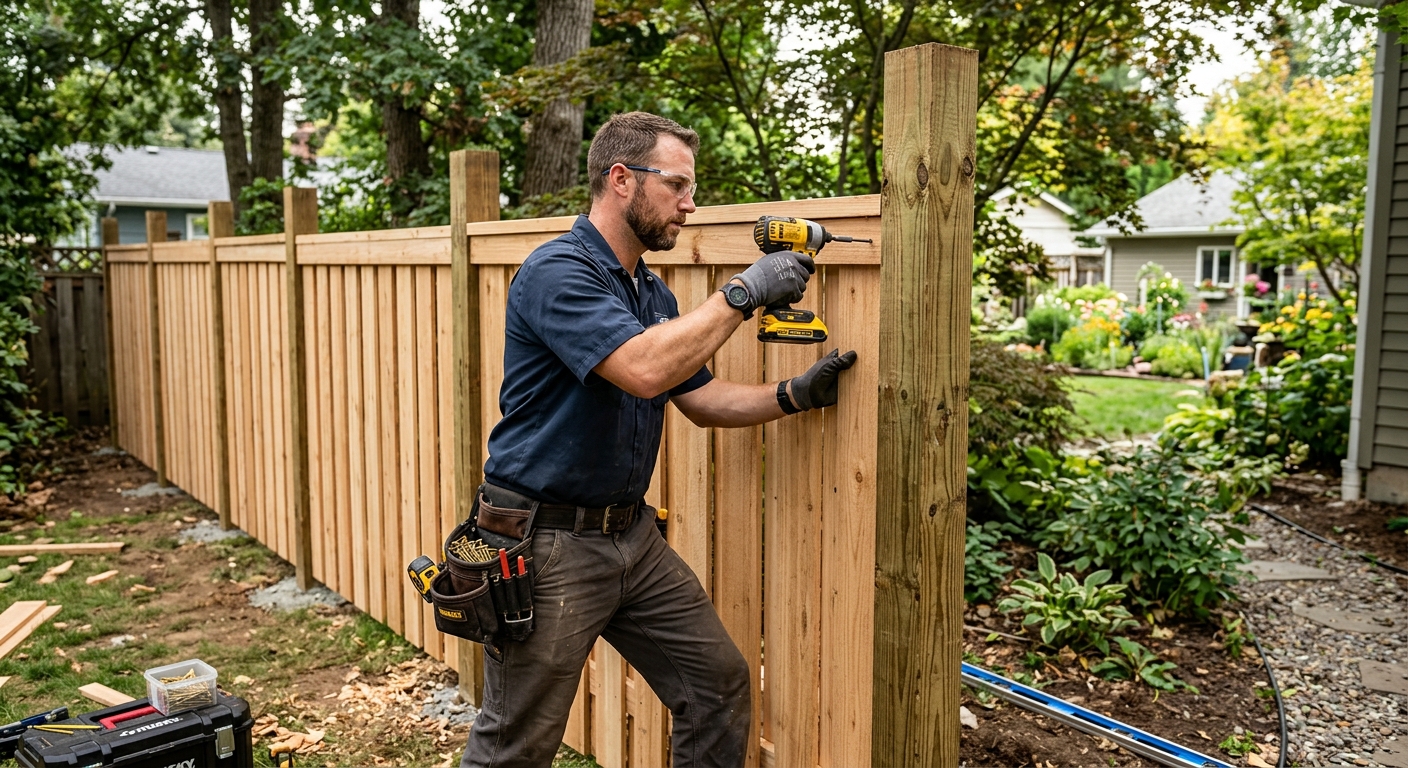
Fencing options and costs in East End
East End, Ontario is a neighbourhood-by-neighbourhood kind of market, and that shows up in fencing: what your neighbour picks for privacy and pets often becomes the local “standard.” In the East End profile, the population is 1,446 (Statistics Canada, 2021 Census), which may sound small, but it represents a steady stream of homeowners maintaining boundaries around detached properties and established residential streets. In practice, fencing demand is strongest where yards are enclosed for privacy and where homes see frequent spring and fall upgrades.
In the Toronto economic region, the two biggest cost drivers are soil conditions and freeze-thaw. A frost line is commonly estimated at about 42"–48" in Southern Ontario, so most installers recommend concrete-set posts set deeper—typically 3.5–4 feet—to reduce frost heave. For 6–8 ft privacy fences, that means more excavation, heavier posts and more labour than “quick set” jobs. Access also matters in East End; many lots have mature landscaping, and gate locations affect how long crews spend on layout and installation.
Trade demand is especially noticeable around established pockets in East York and the Don Mills area where older property lines and mature trees lead to repeat fence replacements. From there, you can compare the most common materials and what you should expect to budget before we talk design details and site conditions.
| Material |
Lifespan |
Maintenance |
Privacy Rating |
Price per Linear Foot |
| Pressure-treated pine (standard wood) |
10–15 years |
Stain/seal every 2–3 years |
High (solid boards) |
$65–$120 |
| Cedar (natural rot resistance) |
15–25 years |
Light stain every 2–4 years |
High (solid boards) |
$85–$130 |
| Vinyl / PVC (no-maintenance) |
25–35 years |
Rinse as needed |
High (solid panels) |
$75–$130 |
| Chain-link (galvanized steel) |
20–30 years |
Occasional wash; replace damaged sections |
Low (add privacy slats if desired) |
$45–$85 |
| Aluminum ornamental |
25–40 years |
Minimal; rinse 1–2 times/year |
Medium (open pickets) |
$90–$160 |
| Composite / recycled material |
20–30 years |
Minimal; no staining |
High (solid boards) |
$95–$155 |
Prices are estimates only and vary by project scope, site access and material selection.
What affects the price of fencing in East End
Even when two homeowners in East End ask for a “similar” fence, quotes can land 30–50% apart across Toronto and Ontario because fencing pricing isn’t just material—it’s the time required to dig to frost-safe depths, set posts correctly, and work around site constraints. In this market, the Toronto frost expectations drive deeper excavation than many people assume, especially for tall privacy fences.
Practically, frost line depth commonly translates to setting post holes about 4–6 inches below the design frost depth. That often means posts need to go about 1.5–2.0 m into the ground, which raises material cost (longer posts) and labour time (deeper holes and more concrete). For solid wood or vinyl privacy fences, crews also plan for wind and racking. While GTA conditions aren’t as extreme as Prairie exposure, still—taller panels generally require heavier posts (and closer spacing, typically 6–8 ft centres) to prevent sagging or lift.
Two concrete examples from East End: (1) a backyard replacing an 8 ft privacy fence on clay soil usually costs more than a 4 ft run of chain-link because the posts must be concrete-set and the heavier panels take longer to align; (2) a yard with a straight layout and easy access can come in closer to the lower wood band—while a job with tight gates, landscaping protection and extra trimming typically pushes the same wood material toward the upper end. If you’re comparing the wood band of $65–$120 versus vinyl/PVC at $75–$130, the “gap” is often justified when concrete-set stability and long-term finish performance reduce call-backs.
| Price Factor |
Why It Matters |
Cost Impact |
| Fence length in linear feet |
Most labour and materials scale directly with length. |
Major cost driver; can make up the majority of the total. |
| Post depth required |
Frost protection dictates hole depth and post length. |
Deeper holes increase excavation time and concrete volume. |
| Post setting method |
Concrete-set improves long-term stability in freeze-thaw. |
Concrete-set typically adds labour and ready-mix costs vs gravel/driven posts. |
| Material choice |
Different systems require different framing, hardware and installation time. |
Vinyl and cedar usually cost more than basic chain-link and many “budget wood” options. |
| Gate count and type |
Gates demand additional framing, hinges and often bracing. |
Each gate adds significant labour; double drive-through gates raise cost further. |
| Grade and terrain |
Slope requires racked panels or stepped installation. |
More layout time and custom cuts increase labour. |
| Old fence removal and disposal |
Demolition, hauling and disposal fees vary by debris and length. |
Can materially increase the total, especially with rails, posts and concrete bases. |
| Permit fees and survey / property line locate |
Some fence builds require municipal review and locating pins prevents encroachment. |
Survey and permits add direct costs and can affect schedule. |
Permits & regulations in Ontario
In Ontario, fence permits can come up when you’re building or upgrading beyond typical local thresholds. As a general rule of thumb in many Ontario municipalities, fences over about 2.0 m (6.5 ft) at the rear and around 1.0–1.2 m (3–4 ft) at the front or corner often require a building permit and/or municipal review. Regardless of height, your fence must respect property lines and any municipal setback bylaws, and it should be designed so it doesn’t create drainage or safety issues (especially near sidewalks and driveways).
Before digging any post hole, you must call for utility locates through Ontario One Call to protect service lines. That locate is separate from zoning/permit checks. If you don’t already know the exact boundary, obtain a survey or have your property pins located before installing. This helps avoid encroachment disputes that can become costly to fix after construction. Shared fence ownership is generally addressed under provincial line-fences legislation, but your agreement and how the fence sits on the line matters in practice.
Concrete “permit typically needed”: new tall privacy fences (often above 2.0 m at the rear) and any fence requiring municipal review due to height/location. Typically does not require a permit: smaller low fences that meet common height limits—however, municipal bylaws vary, so we still confirm.
To verify an Ontario contractor in East End: check the licensing registry for their status, request WSIB/WCB coverage proof, and review their liability insurance certificate (COI) for adequate limits and the correct insured parties. If they provide clearance letters for WSIB/WCB, keep them on file with your contract documentation.
Choosing the right fence material for East End
Choosing the right material in East End comes down to matching your priorities—privacy, low maintenance, budget and lifespan—to Ontario’s freeze-thaw cycle. Pressure-treated pine is often the most budget-friendly start, but it needs staining or sealing every 2–3 years to reduce grey weathering and protect boards from moisture cycling. Cedar has better natural rot resistance and generally holds its appearance longer, but it still benefits from periodic staining. Vinyl/PVC is popular for low maintenance and privacy panels, yet in extreme cold it can be more sensitive to improper installation tolerances; quality posts and correct fastening spacing help prevent issues. Chain-link is the lowest upfront cost and lasts well in Toronto’s seasons, but it won’t give true privacy without slats or an added screen.
Toronto’s frost expectations are why post depth matters as much as material. With Southern Ontario frost line estimates around 42"–48", concrete-set posts are usually the safer route for long-term stability—especially for 6–8 ft privacy fences where heavier panels increase racking forces. Proper post sizing, panel bracing and spacing (often 6–8 ft centres) help with winter wind and spring thaw sagging.
Cost-wise, a practical example: if you’re comparing wood versus vinyl for an 8 ft privacy run, moving from wood at $65–$120 to vinyl at $75–$130 is often justified when you want to minimize ongoing staining labour for 10+ years. If you’re on a tight budget and plan to maintain the finish, pressure-treated pine can still make sense—just budget for regular upkeep.
| Material |
Cold Tolerance |
Lifespan |
Annual Maintenance |
Best For |
Price Band |
| Pressure-treated pine |
Good (requires finishing) |
10–15 years |
Seasonal inspection; stain/seal every 2–3 years |
Lower upfront cost with routine maintenance |
$65–$120 |
| Cedar |
Good (warping risk reduces with proper installation) |
15–25 years |
Light stain 2–4 years; wash and inspect |
Attractive privacy with better rot resistance |
$85–$130 |
| Vinyl / PVC |
Very good with correct fastening |
25–35 years |
Minimal—rinse as needed |
Low-maintenance privacy fences |
$75–$130 |
| Chain-link |
Excellent (galvanized steel) |
20–30 years |
Occasional wash; replace damaged mesh |
Security around pets/driveways |
$45–$85 |
| Aluminum ornamental |
Excellent |
25–40 years |
Minimal—rinse 1–2 times/year |
Durable curbside aesthetics |
$90–$160 |
| Composite / recycled |
Good (still needs proper framing and spacing) |
20–30 years |
Minimal; periodic cleaning |
Low-maintenance privacy with wood-like look |
$95–$155 |
How to choose a fencing contractor in East End
When you’re selecting a fencing contractor in East End, start by verifying Ontario compliance and job readiness. Ask for their Ontario licence details and confirm they carry liability insurance with a current certificate of insurance (COI). For worker protection, request WSIB (WCB) coverage proof—either a clearance letter or documentation showing their account status. If they can’t provide both liability insurance and WSIB/WCB coverage, treat that as a serious gap.
Next, get 2–3 itemised written quotes. Ideally, the quote breaks down labour and materials separately (posts, rails, panels, concrete/setting method, hardware, removal/disposal, and any gate framing). Avoid “lump sum only” bids; you want line items so you can compare apples-to-apples. Read the scope carefully: what’s excluded (old fence removal, concrete base demolition, hauling, site restoration, landscape protection)? Is the permit pull included or charged separately? Make sure survey/property locate costs are addressed if locating pins is required.
Warranty matters in Toronto’s climate. Ask for (1) workmanship warranty length, (2) product/manufacturer warranty, and (3) whether the warranty is transferable to future owners. Payment should be staged—never more than 10–15% upfront. Use a holdback (commonly due at substantial completion and final walkthrough) so the contractor has incentive to finish to standard. Finally, get a written start date and a completion estimate that includes weather considerations and cure times for concrete-set posts.
- Provide licence proof and clear contact details that match the quote and invoice.
- Show current liability insurance COI before work begins.
- Provide WSIB/WCB coverage proof or clearance letter.
- Use itemised pricing (materials vs labour vs removal/disposal).
- Specify post setting method (concrete-set vs gravel pack vs driven).
- Confirm post depth plan for frost-safe installation in Southern Ontario.
- Include gate framing specs (hinge style, latch type, bracing).
- State whether disposal of old fencing is included.
- Clarify landscape protection and restoration scope (topsoil/seed/sod, if applicable).
- List all exclusions: permits, locates, survey, or any extra excavation surprises.
- Provide warranty terms in writing and confirm transferability.
- Confirm payment schedule: 10–15% max upfront; holdback until completion.
Red flags I see in East End: contractors who won’t provide a COI/WSIB proof, bids that don’t specify post depth or setting method, vague “permit included” wording without details, missing disposal/restoration scope, and requests for large upfront payments without a signed schedule or documented materials list.
Frequently asked questions — fencing in East End
How long does fence installation take in East End?
In East End, typical installation timelines depend on length, gate count and whether we’re removing an old fence. A straightforward chain-link or short wood run can be done in 1–2 working days, while a privacy fence with multiple gates often takes 3–6 days because of layout, post setting (including concrete-set cure time management), and careful panel alignment. If your yard has slopes requiring racked or stepped sections, or there’s limited access for equipment, plan extra time for excavation and restoration. Since Southern Ontario freeze-thaw affects scheduling, many crews focus on stable weather windows so posts are set properly and the fence doesn’t shift. The population profile for East End is small (1,446 people), but demand is steady around established streets, so booking ahead is smart—especially for weekends and late-season installs. (Statistics Canada, 2021 Census)
Can I install a fence on a slope in East End?
Yes, you can install a fence on a slope in East End, and it’s common in older residential streets where yards grade toward rear lanes or lower landscaped areas. The key is choosing the right method: racked panels (following the slope with stepped changes across the frame) or stepped installation (distinct height sections with level rails between). The best approach depends on your fence style, privacy needs and how straight you want the top line. For privacy fences, racking helps maintain a consistent visual height, but it needs careful measuring to ensure gates still align. Expect more labour time on sloped lots because layout and custom cuts increase installation hours and hardware alignment checks. It can also shift your per-linear-foot cost toward the higher end of your selected material band (for example, wood typically sits around $65–$120), because it’s less “plug-and-play.”
What is the most weather-resistant fence for East End's climate?
For East End’s Toronto freeze-thaw weather, the most reliable long-term choices are usually vinyl/PVC and properly installed cedar, assuming posts are concrete-set to frost-safe depths and the system is built to resist racking. Vinyl/PVC is engineered for low maintenance and tolerates moisture cycles well, while cedar offers excellent rot resistance and a natural look. Chain-link is also very weather-tough and tends to last well because galvanized steel handles moisture and winter conditions; it just doesn’t provide privacy without slats. The “most weather-resistant” answer also depends on foundation quality: if posts are too shallow or set with insufficient protection, even top-tier material can loosen over time. Because Southern Ontario frost is commonly estimated around 42"–48", concrete-set posts set about 3.5–4 feet down are a common best practice for tall privacy fences.
How do I prevent wood fence rot in East End?
Preventing rot in East End is mostly about moisture management and correct installation, not just choosing wood. First, use quality treated materials (and cedar if you want rot resistance with a better finish). Second, ensure posts are set correctly: concrete-set posts and proper drainage at the base reduce wicking and freeze-thaw damage. Third, keep end-grain and cut edges sealed or maintained with the right stain/sealer so water doesn’t absorb during wet Toronto springs. Fourth, don’t trap moisture against the fence—leave spacing from landscaping where possible and avoid constant pooling at the bottom. Finally, plan maintenance: pressure-treated pine typically needs staining/sealing every 2–3 years to prevent grey weathering and long-term deterioration, which keeps it closer to its expected lifespan. For reference, wood installation budgeting often falls around $65–$120 per linear foot depending on scope and whether removal/disposal and concrete-set posts are included.
What is the cost per linear foot for fencing in East End?
In East End, pricing is usually quoted by the total linear footage plus allowances for gates, removal and access. Based on Toronto economic-region pricing bands, wood fencing commonly lands around $65–$120 per linear foot, vinyl/PVC around $75–$130, chain-link around $45–$85, and aluminum/metal around $90–$160. Those ranges reflect the local realities of frost-safe post depths, labour time for accurate layout, and concrete setting in freeze-thaw conditions. If your yard needs extra excavation due to clay/mixed soils, has sloped terrain, or requires demolition and disposal, expect to move toward the upper end of the selected material band. The best way to narrow your real number is an itemised quote that specifies post depth, setting method and gate hardware—those details are where “cheap” quotes often hide.
Should I repair or replace my old fence in East End?
Repair is often worthwhile if the fence posts are sound, the framing isn’t rotted or loose, and the issue is limited to a few boards (or a damaged rail section). In East End, many failures happen at the bottom of posts where moisture sits and freeze-thaw expands and contracts the soil. If you’re seeing multiple loose posts, significant leaning, rot at the post bases, or repeated panel sagging, replacement is usually more cost-effective long term because you can reset post depth correctly and ensure consistent tension and alignment. Also consider the age of your existing fence: older wood fences may be at the point where “patching” delays the inevitable, and it can be harder to match materials. If the fence needs removal and disposal anyway, replacement tends to be cleaner and more predictable. A good contractor will assess the post integrity first; if posts were set shallow, even new boards won’t fix the root problem.