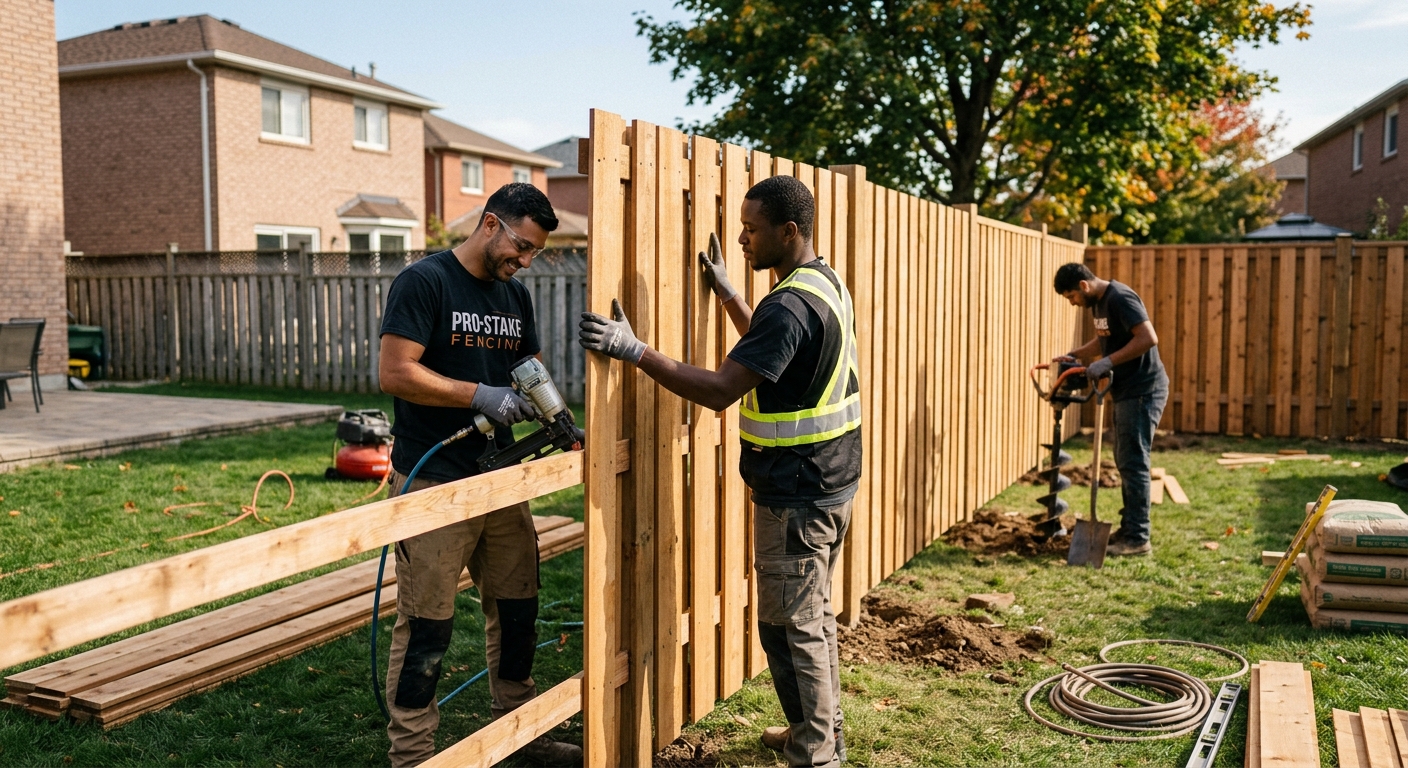
Fencing options and costs in Aylmer
Aylmer is a growing community where backyards are closely tied to daily life, and that shows in local fencing demand. With about 68.7% of households in the area owning their homes and 66.1% of dwellings being single-detached, you can think of each detached property as a potential fencing project at some point—whether it’s to add privacy, define pets, or replace aging rails. (Statistics Canada, 2021 Census.)
In the London, Ontario region, fencing prices are shaped by frost depth and ground conditions. Contractor posts must be set below the frost line to reduce freeze-thaw heaving, so you’ll often see longer posts and more digging time (and sometimes concrete setting) even for “standard” residential runs. Access also matters: neighbourhood lanes, mature landscaping, and whether crews can stage materials near the work line can swing labour time. In Aylmer, trade activity tends to be especially high around the older established residential pockets near the downtown area, where many fences were installed decades ago and often require replacement rather than touch-ups.
Below is a practical cost comparison by material, using typical install pricing ranges for this area and accounting for local posting and setup expectations.
| Material |
Lifespan |
Maintenance |
Privacy Rating |
Price per Linear Foot |
| Pressure-treated pine (standard wood) |
10–15 years |
Stain/seal every 2–3 years |
High (board-on-board or close picket) |
$40–$75 |
| Cedar (natural rot resistance) |
15–25 years |
Light staining every 2–4 years (often less effort) |
High (solid panels) |
$55–$95 |
| Vinyl / PVC (no-maintenance) |
20–30 years |
Occasional wash only |
High (with solid infill) |
$45–$80 |
| Chain-link (galvanized steel) |
25–35 years |
Minimal; occasional tension checks |
Low–Medium (with optional privacy slats) |
$25–$50 |
| Aluminum ornamental |
25–40 years |
Minimal; rinse occasionally |
Low (semi-privacy at best) |
$70–$120 |
| Composite / recycled material |
20–30 years |
Low; periodic cleaning |
High (solid pickets/boards) |
$60–$105 |
Prices are estimates only and vary by project scope, site access and material selection.
What affects the price of fencing in Aylmer
If you’re seeing very different quotes for the “same” fence in and around the London region, it’s usually not the material—it’s the buried work and site constraints. Even within southern Ontario, it’s common to see pricing vary by 30–50% because crews may need different post lengths, different post spacing, more labour for spoil removal, or extra time for gates and line changes. When frost-depth requirements meet clay-heavy ground, the time to dig and set posts is where costs climb, especially if concrete is needed to ensure stability through freeze-thaw cycles.
Here’s the practical part: local guides and our installs in Middlesex County often target about 2.5 to 3 feet as a working minimum for post embed, with some sites requiring deeper embeds where conditions are heavier or exposure is higher. Translating that to labour means longer posts, deeper holes, and more concrete or more thorough backfill. In weather and ground terms, Aylmer’s climate is the key driver for “extra digging,” not wind like the Prairies, and not the constant rot pressure you’d typically plan for in coastal BC.
To make it concrete: (1) a straight-run backyard in easier soil can land closer to the lower end of the wood band of about $40–$75 per linear foot if posts can be set efficiently; (2) a sloped yard that requires stepped panels and more hardware can push that closer to the higher end; and (3) adding two drive gates and removing a failed fence line can elevate costs into the vinyl/metal ranges even if the material choice stays budget-friendly. Since many homes in the area were built before 1981—about 58.2%—older property boundaries and buried remnants (old footings or posts) can also add excavation time. (Statistics Canada, 2021 Census.)
| Price Factor |
Why It Matters |
Cost Impact |
| Fence length in linear feet |
The biggest determinant of labour, posts, rails and materials |
Major; the quote scales directly with length |
| Post depth required |
Frost line dictates hole depth to reduce heaving |
Moderate to major; deeper embeds increase labour and post cost |
| Post setting method |
Concrete vs. gravel pack vs. driven posts affects stability and time |
Moderate; concrete setting typically costs more per post |
| Material choice |
Different material costs and different install complexity |
Moderate; e.g., vinyl often higher than standard chain-link |
| Gate count and type |
Gates require heavier framing, hinges, latches and alignment |
Moderate to major; drive gates cost more than walk gates |
| Grade and terrain |
Slopes require stepped, raked or custom panel layouts |
Moderate; waste and extra hardware can increase material use |
| Old fence removal and disposal |
Disposal fees plus labour for dismantling and loading |
Moderate; can add time even when the run is short |
| Permit fees and survey / property line locate |
Some projects need permits or documented property line confirmation |
Low to moderate; the work can still take schedule time |
Permits & regulations in Ontario
In Ontario, fence height rules commonly tie to building permit requirements. As a practical rule of thumb for many residential situations, fences above about 2.0 m (6.5 ft) at the rear and above 1.0–1.2 m (3–4 ft) near the front or corners are often the heights that trigger a permit requirement. Setbacks and exact thresholds can vary by municipality and lot conditions, so in Aylmer you should confirm the applicable limits with the local permitting office before you buy materials—especially for tall privacy fencing, decorative screen walls, or any corner visibility area.
Before anyone digs a post hole, you should also arrange utility locates via Ontario One Call. Utility strikes can be dangerous and expensive. Next, confirm your property line: a survey (or at minimum a locate of your property pins) helps you avoid encroachment disputes—an issue that becomes common when older fences were built without documented line confirmation.
Shared fence ownership is handled under Ontario’s line-fences framework: if fencing is used by both neighbours, you may have cost-sharing rights and responsibilities depending on circumstances and how the fence functions between properties.
Homeowner licence/coverage verification (how to check): Ask the contractor for (1) their Ontario contractor licence number (then confirm it in the provincial public registry), (2) a current certificate of liability insurance naming you as applicable and showing active coverage limits, and (3) WSIB coverage (or the appropriate coverage proof used by the contractor). You can also request the actual WSIB clearance letter number and verify it matches the contractor.
Work that typically does require a permit includes fences that exceed the height thresholds (often 2.0 m rear) and any project affecting corner visibility or requiring municipal approval. Work that typically does not require a permit is like-for-like replacement of an existing fence within height limits on the same footprint and property line (still subject to confirmation).
Choosing the right fence material for Aylmer
Choosing the right fence material for Aylmer is about matching your priority—privacy, maintenance level, budget and lifespan—to what southern Ontario does to fences every winter. Pressure-treated pine is usually the lowest upfront option, but it needs staining or sealing every 2–3 years to limit grey weathering and water absorption at joints. Cedar offers natural rot resistance and typically looks better as it weathers, but it still benefits from periodic maintenance if you want to keep the colour and reduce cracking at stress points. Vinyl/PVC is popular for low effort: it doesn’t require painting, but in extreme cold it can become more brittle and may show stress around posts if installation wasn’t flexible and properly set. Chain-link lasts a long time and is cost-effective, yet it doesn’t provide privacy unless you add slats or top screening. Aluminum ornamental looks sharp, resists rust, and typically holds up well through freeze-thaw, but it’s not a privacy choice in most designs.
For frost and post stability in the London area, the bigger question is whether posts are properly embedded below the frost line. In Aylmer builds, that often means deeper embed and careful post setting; concrete setting is commonly used where soil is heavy or the fence line is exposed. This matters regardless of whether you choose wood, vinyl, or metal—proper embed is what helps reduce heaving and keeps panels aligned after winter.
As a budget example: if chain-link fits your needs, you might be closer to $25–$50 per linear foot. If you want solid privacy and a longer “hands-off” plan, vinyl often lands in the $45–$80 per linear foot range where the additional cost is justified by fewer maintenance trips over the next decade.
| Material |
Cold Tolerance |
Lifespan |
Annual Maintenance |
Best For |
Price Band |
| Pressure-treated pine |
Good (if posts are set deep and boards are properly treated) |
10–15 years |
2–3 year staining cycle; quick inspections annually |
Lower upfront cost with privacy boards |
$40–$75 |
| Cedar |
Good (natural rot resistance) |
15–25 years |
Light staining/maintenance every 2–4 years |
Appearance + rot resistance |
$55–$95 |
| Vinyl / PVC |
Good (avoid flex/strain from poor post alignment) |
20–30 years |
Wash only; visual checks after freeze-thaw winters |
Low maintenance privacy |
$45–$80 |
| Chain-link |
Excellent (galvanized steel holds up) |
25–35 years |
Minimal; tension and hardware checks |
Security, pets, utility boundaries |
$25–$50 |
| Aluminum ornamental |
Excellent (non-rusting metal) |
25–40 years |
Occasional rinse; inspect for shifting posts |
Front curb appeal without rust |
$70–$120 |
| Composite / recycled |
Good (stiffness depends on design and post system) |
20–30 years |
Wash/cleaning; check fasteners and posts annually |
Privacy with reduced upkeep |
$60–$105 |
How to choose a fencing contractor in Aylmer
Choosing a contractor in Aylmer starts with verifying coverage. First, ask for their Ontario licence details (and confirm the number through the appropriate provincial public registry). Next, request a certificate of liability insurance; ensure it’s current, and that the policy covers fencing-related construction activities. Third, ask for proof of WSIB coverage or an applicable clearance/coverage letter—then check that the name and number align with the company on the quote and invoice. If a contractor can’t provide these documents promptly, treat it as a serious warning.
For pricing, don’t accept a single lump-sum without a breakdown. Get 2–3 itemised written quotes that separate labour, materials, concrete/post setting, gates, and any removal/disposal. Ask whether permit pulls are included if your fence exceeds height thresholds. Also confirm what’s excluded: tree trimming, grading beyond the fence line, buried obstructions, bringing in fill, or concrete repair on existing footings.
Warranty matters. Look for a workmanship warranty (often covering installation issues like leaning posts, misalignment and failure of hardware) and a separate manufacturer warranty for the product. Ask whether the workmanship warranty is transferable if you sell the house.
Payment schedule should be conservative: typically 10–15% upfront is reasonable for materials mobilisation, with the remainder due after key milestones. Avoid paying the full amount before completion—use a holdback until walkthrough and final adjustments are done. Finally, require a start date and completion estimate in writing, including weather impacts and scheduling assumptions for frost-depth excavation.
- Provide Ontario licence details and confirm them online before work starts.
- Share a current certificate of liability insurance (ask for policy dates and limits).
- Provide WSIB/coverage proof or a clearance letter number and match it to the company.
- Get itemised quotes showing labour vs. materials vs. concrete/post hardware.
- Confirm post depth approach for frost stability and whether concrete setting is included.
- Clarify how gates will be framed, aligned and latched (especially drive gates).
- Ask if old fence removal and disposal are included (dump fees and haul-away).
- Confirm whether a property line locate/survey is required and who supplies it.
- Check whether permit costs/paperwork are included or billed separately.
- Verify the warranty: workmanship length, manufacturer coverage and transferability.
- Use a staged payment plan with a holdback until final inspection.
- Confirm cleanup expectations and whether they restore grading or sod areas.
Red flags I commonly see in fencing jobs across the London region include: quoting without showing post-depth or setting method; refusing to provide insurance/WSIB documentation; offering only a lump-sum with no material list; pushing for large upfront payments (beyond 10–15%); and starting excavation without confirming property lines or arranging utility locates.
Frequently asked questions — fencing in Aylmer
What is the most weather-resistant fence for Aylmer's climate?
In Aylmer and the broader London, Ontario market, the most “weather-resistant” options are typically chain-link and aluminum, because they’re less affected by rot and they don’t require painting. That said, resistance isn’t only about material—it’s also about how posts are set. For freeze-thaw winters, posts should be embedded below the frost depth to reduce heaving, and that means proper post length and stable setting. If you want privacy and long service life, vinyl can also be durable when it’s installed correctly with solid post alignment and proper embed. As a baseline price reference, chain-link is often around $25–$50 per linear foot, while aluminum ornamental commonly falls into the $70–$120 range. (Statistics Canada, 2021 Census.)
How do I prevent wood fence rot in Aylmer?
Wood rot usually starts at joints and around post zones where moisture is trapped. In Aylmer, the winter freeze-thaw cycle makes it critical to set posts properly and keep water from pooling against the boards. Practical steps include: using pressure-treated components rated for ground contact, setting posts below the frost line (so the fence doesn’t heave and open gaps), and maintaining end grain with a suitable stain/sealer on a regular schedule (often every 2–3 years for pressure-treated pine). Cedar slows rot naturally, but it still benefits from periodic maintenance if you want consistent performance. Also ensure good drainage and avoid sprinklers blasting fence lines. If you’re comparing costs, cedar often costs more upfront than pine, but it can reduce how often you’ll be dealing with replacement sections.
What is the cost per linear foot for fencing in Aylmer?
Typical installed pricing in the Aylmer/London region depends on material, gate count, and how much buried work is required for frost stability. As a quick reference to budget: chain-link is commonly around $25–$50 per linear foot, pressure-treated wood often falls in the $40–$75 range, and vinyl/PVC is frequently about $45–$80. Aluminum ornamental can be higher, often about $70–$120, mainly due to material and framing hardware. Quotes can also shift when sites are sloped, when there’s old fence removal/disposal, or when concrete setting and longer posts are needed for heavier ground. If you’re comparing bids, ask every contractor to include the same post depth and setting method so the per-foot number is truly comparable.
Should I repair or replace my old fence in Aylmer?
Repair can be worthwhile when only sections are loose (for example, a few rails, one post, or hinge hardware), and the line is still plumb after freeze-thaw movement. Replace is usually the smarter option when posts are leaning from heaving, when rot has spread at multiple base points, or when the fence has widespread panel sagging that indicates structural failure. In Aylmer, many homes were built earlier—about 58.2% of dwellings were built before 1981—which often correlates with older fencing materials and more frequent foundation issues in the post zones. (Statistics Canada, 2021 Census.) If you choose replacement, ask for a plan that includes correct post embed depth and setting method rather than “patching” around the failing points—otherwise the new work can shift and fail sooner.
How do I handle a fence dispute with neighbour in Ontario?
Fence disputes in Ontario usually come down to property lines, fence height rules, and shared ownership questions. Start by documenting facts: take photos, measure from known reference points, and request a property line locate or survey if needed (especially if old fences were built without pins confirmed). Communicate in writing and keep it calm and factual; many issues are resolved once everyone agrees on the line and the intended fence use. Ontario’s line-fences framework can apply when a fence is treated as shared, affecting cost responsibilities depending on circumstances. If the dispute escalates, consult legal advice or your municipality for applicable bylaw guidance (height thresholds and setback rules). Avoid digging near borders until utility locates are done through Ontario One Call and your locate is verified, because errors can create new problems.
What fence style offers the best wind resistance in Aylmer?
In Aylmer, wind load is less of a “driver” than frost heaving, but wind still matters—especially for larger privacy panels. Generally, styles that reduce wind sail provide better performance: more open designs (like chain-link with optional slats that aren’t fully solid) or fences with pickets spaced slightly rather than fully solid sheets. If you need privacy, consider designs that use solid privacy with thoughtful bracing and properly spaced posts set below frost depth, plus gate hardware that’s built for load. Solid board-on-board can work well when posts are embedded correctly and spacing matches the product system, but it’s heavier and creates more resistance to wind. For best overall results, pair the right style with correct post embed and setting so movement doesn’t loosen panels after winter freeze-thaw cycles.