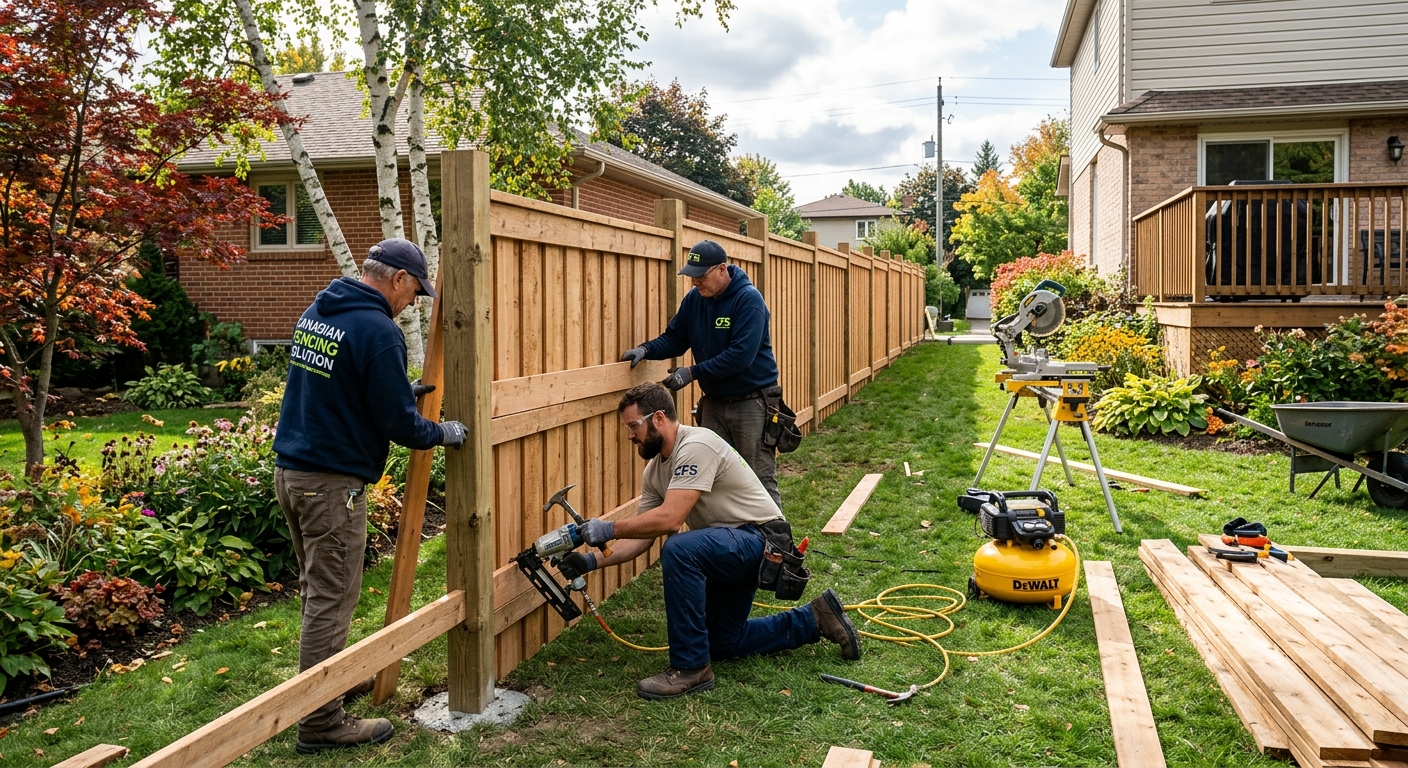
Fencing options and costs in Haliburton Village
In Haliburton Village, choosing a fence comes down to balancing privacy, maintenance, and the realities of Muskoka–Kawarthas weather. With a population of 1,149 (Statistics Canada, 2021 Census), your local demand is spread across a lot of residential properties, where each detached home is essentially a potential fence project. Just as important, Haliburton Village sits in a region where frost heave is a real contractor concern—our winters can push the frost line to roughly 4 ft, so posts often need to be set 42–48 inches deep to stay straight over time. That digging and concrete setting adds cost, but it’s also what protects your investment when the ground repeatedly freezes and thaws.
Across Muskoka–Kawarthas, fencing quotes can also vary depending on yard conditions. In more exposed lakeside or open-field settings, wind loading is higher, so we may recommend stronger posts or tighter spacing, especially for privacy boards or vinyl panels. In tighter areas around older established neighbourhoods—often where access is limited—excavation time can jump, and that labour shows up directly in the per-foot pricing.
Below is a practical comparison of common fence materials, with typical installed price ranges and how they perform in this climate. Use it to discuss trade-offs with your contractor before you sign off on a scope and footing plan.
| Material |
Lifespan |
Maintenance |
Privacy Rating |
Price per Linear Foot |
| Pressure-treated pine (standard wood) |
10–15 years |
Stain/seal every 2–3 years |
High |
$55 – $80 |
| Cedar (natural rot resistance) |
15–25 years |
Seal/stain every 2–4 years |
High |
$65 – $95 |
| Vinyl / PVC (no-maintenance) |
20–30 years |
Rinse as needed; inspect panels/hardware |
High (with solid panels) |
$65 – $95 |
| Chain-link (galvanized steel) |
20–35 years |
Occasional rinse; tighten hardware |
Low–Medium |
$40 – $65 |
| Aluminum ornamental |
25–40 years |
Wash; check footing anchors |
Low–Medium |
$70 – $110 |
| Composite / recycled material |
20–30 years |
Clean annually or as needed |
High (solid styles) |
$75 – $115 |
Prices are estimates only and vary by project scope, site access and material selection.
What affects the price of fencing in Haliburton Village
In Haliburton Village and the wider Muskoka–Kawarthas region, two quotes for the “same” fence can realistically land 30–50% apart. The biggest reasons are ground conditions, post depth, and how exposed your lot is to wind and snow loads. Frost depth is the driver: when the frost line is about 4 ft, posts generally need to be set 4–6 inches below the design frost depth to prevent heaving and gradual leaning. In cold Ontario winters, that often means 1.5–2.0 m into the ground, longer posts, more concrete, and extra labour, which pushes wood and vinyl installs up toward the upper end of their local bands (for example, wood can land within $55 – $80 per foot once proper footings are included).
Wind exposure can also shift pricing. Even though we don’t face prairie storm conditions here, open lots along lakes and farm edges can behave like gusty corridors—contractors may tighten post spacing, use heavier rails, or choose open styles like chain-link to reduce “sail” effect. Access matters too: clay pockets can require more excavation effort, while rockier spots can add time to auger and set posts; the net effect is more hours on-site.
Two common examples we see in the Haliburton Village area: (1) a privacy fence on deeper, wetter soil often needs more concrete and stable backfill, and (2) removing an older leaning fence can add dump fees and disposal time—especially when boards are partially buried by prior landscaping. On the flip side, a sheltered in-town yard with easy access can keep you closer to the lower end of regional ranges such as chain-link at $40 – $65 per foot.
With local housing stock that includes lots of older properties and established yards, the difference between “new build” conditions and “retrofit” work is where budgets most often stretch.
| Price Factor |
Why It Matters |
Cost Impact |
| Fence length in linear feet |
Labour and materials scale directly with total length |
Highest impact; often the difference between a $3,000 and $8,000 project |
| Post depth required |
Frost line determines how long posts must be and how deep holes go |
Deeper footings increase post length, concrete, and excavation time |
| Post setting method |
Concrete vs gravel pack vs driven posts affects stability |
Concrete setting is usually more labour/material but reduces frost-movement failures |
| Material choice |
Vinyl, cedar, and chain-link have different hardware and install approaches |
Can shift the per-foot range by tens of dollars (e.g., chain-link lower than vinyl) |
| Gate count and type |
Gates require heavier frames, hinges, and alignment work |
Additional gates often add a noticeable lump cost beyond the per-foot average |
| Grade and terrain |
Slopes require stepping, racking, or custom panel adjustments |
More fittings and labour; may require extra rails/posts |
| Old fence removal and disposal |
Hauling and disposal aren’t included in most material-only pricing |
Can add labour hours and dump fees; varies widely by length and condition |
| Permit fees and survey / property line locate |
Administration and locating stakes affect legal placement |
Adds administrative costs and may require additional site visits |
Permits & regulations in Ontario
In Ontario, many fencing projects do not need a building permit, but taller fences often do. As a rule of thumb, fences above about 2.0 m (6.5 ft) at the rear and around 1.0–1.2 m (3–4 ft) at the front or corner can trigger permit requirements under municipal zoning and fence-height rules. Even when a permit isn’t required, fences must be built within your property lines and comply with municipal setback requirements. Before any digging for post holes, homeowners should arrange utility locates through Ontario One Call to prevent strikes to buried services.
Shared fence responsibilities are also something to confirm early. In Ontario, line fences are governed by provincial line-fences legislation, and maintenance/ownership can depend on whether there is a shared wall, prior agreement, or the way the fence was originally built and accepted by neighbours. Practically, the safest approach is to confirm with neighbours in writing (at least by email/text) and agree on replacement scope, especially for gates and privacy panels.
Step-by-step verification for your contractor in Haliburton Village: (1) confirm they’re eligible to do the work and provide their company information; (2) request a certificate of insurance showing general liability and ensure the coverage is current; (3) ask for proof of clearance/coverage for workplace requirements (commonly WSIB/WCB status) relevant to their workforce; and (4) request the insurer certificate and any project-specific endorsements before work starts. A reputable fencing contractor will provide documentation quickly—no chasing, no vague “we have it somewhere.”
Choosing the right fence material for Haliburton Village
Choosing a fence material in Haliburton Village is really matching priorities to what this climate punishes: freeze–thaw movement, wind off open lots, and the time required to keep wood looking good. Pressure-treated pine is usually the most budget-friendly path, but it typically needs staining or sealing every 2–3 years to prevent grey weathering and reduce surface cracking. Cedar naturally resists rot better, so it generally looks better for longer and can be a good choice if you’re willing to do periodic maintenance. Vinyl/PVC has the advantage of low maintenance, but in extreme cold it can become brittle—so quality rails, proper post spacing, and correct hardware matter more than with wood. Chain-link is the lowest-cost option and lasts a long time, though it won’t deliver privacy unless you add slats or a privacy screen. Aluminum ornamental sits in the middle-to-higher price band and won’t rust, but it’s best for defining boundaries rather than blocking views.
Because Muskoka–Kawarthas frost conditions can be severe, your post depth and setting approach often matter more than the brand of fence. Whether you pick wood, vinyl, or composite, posts usually still require the deep set needed to sit below frost influence—often achieved with concrete setting in many residential installs. If you’re on a gustier lot, privacy styles (solid boards/panels) may need stronger posts, tighter spacing, or heavier rails so the fence doesn’t behave like a sail during winter winds.
Here’s a realistic decision example: if you’re comparing pressure-treated pine ($55 – $80 per linear foot) to vinyl ($65 – $95), the added $10–$25 per foot can be justified when you want fewer maintenance trips and a cleaner look—especially if your yard is far from a convenient stain pick-up and ladder access is tricky. If you’re comfortable maintaining wood, pine can still be a strong value.
| Material |
Cold Tolerance |
Lifespan |
Annual Maintenance |
Best For |
Price Band |
| Pressure-treated pine |
Good (with proper footing and staining) |
10–15 years |
Check annually; stain/seal every 2–3 years |
Budget-focused privacy with routine upkeep |
$55 – $80 |
| Cedar |
Good (better rot resistance) |
15–25 years |
Inspect yearly; seal/stain every 2–4 years |
Attractive privacy that holds up longer |
$65 – $95 |
| Vinyl / PVC |
Fair to good (depends on hardware and spacing) |
20–30 years |
Minimal; rinse and inspect hardware |
Low-maintenance boundaries and privacy panels |
$65 – $95 |
| Chain-link |
Very good |
20–35 years |
Minimal; tighten and rinse |
Security and long life on a budget |
$40 – $65 |
| Aluminum ornamental |
Excellent |
25–40 years |
Minimal; wash and check anchors |
Classic look with low corrosion risk |
$70 – $110 |
| Composite / recycled |
Good (stable boards; footing still critical) |
20–30 years |
Clean as needed; inspect boards/hardware |
Privacy with reduced wood-type maintenance |
$75 – $115 |
How to choose a fencing contractor in Haliburton Village
When you’re hiring a fencing contractor in Ontario, “licensed” isn’t the same as “protected.” Start by verifying insurance and workplace coverage. Ask for a current certificate of insurance (general liability) and confirm it’s valid for fencing work at your address. Next, request their WSIB/WCB clearance or proof of coverage relevant to their workforce—contractors should be able to provide this without delays. If they can’t, it’s a sign to keep looking.
For pricing, get 2–3 itemised written quotes that separate labour and materials. You want to see items like post supply, post depth/footings, rails, pickets or panels, gate hardware, and disposal. A lump-sum quote can hide the cost of site access, augering, rock/clay removal, or whether concrete setting is included for frost protection. Also confirm what is excluded: utility locating, permits, property line locate/survey locate, and any required reinstatement of landscaping are common points of mismatch.
Warranty matters in fencing. Ask for (1) workmanship warranty length and what it covers (posts shifting, rail sag, gate alignment), (2) product/manufacturer warranty details, and (3) whether the warranty is transferable to you as the homeowner. Payment schedule should be cautious: never pay more than about 10–15% upfront, and use a holdback until completion and punch-list items are addressed. Finally, require a start date and a realistic completion estimate in writing—winter-related schedule changes are common, but delays should be communicated clearly.
- Provide proof of general liability insurance (current certificate).
- Provide WSIB/WCB clearance or coverage documentation for workers.
- Include post depth and footing method in the written scope (below frost line).
- Itemise labour vs materials (no “one number” pricing).
- Confirm whether concrete setting and backfill compaction are included.
- Spell out gate type, width, hinges/hardware, and whether it’s self-latching.
- State who handles utility locates and whether they’re required before digging.
- Confirm property line locate approach (survey pins locate vs assumed lines).
- List what disposal/removal is included (old fence, excess materials).
- Check warranty terms in writing for both workmanship and products.
- Set payment milestones tied to measurable completion stages.
- Get a written timeline with crew days and material delivery assumptions.
Red flags to watch for in Haliburton Village: contractors who won’t state post depth or footing method; quotes that don’t mention permits/locates where required; insisting on large upfront payments (well beyond 10–15%); vague warranty wording (“industry standard” with no length/coverage); and lack of documentation—no insurance certificate, no proof of coverage, or no clear scope exclusions.
Frequently asked questions — fencing in Haliburton Village
Wood vs vinyl vs aluminum fence — which is best?
In Haliburton Village, “best” depends on what you value most. Wood (pressure-treated pine) is often the most budget-friendly way to get a solid privacy look, and it typically fits regional installed pricing around $55 – $80 per linear foot once proper frost-safe footings are included. Cedar lasts longer and resists rot better, but it still needs periodic sealing/staining. Vinyl is low-maintenance and can also land in the $65 – $95 range depending on style, but it relies on correct spacing and solid hardware for winter performance. Aluminum is a great low-corrosion choice, usually higher cost (commonly $70 – $110), but it won’t provide the same privacy as board-on-board fencing.
Do I need a permit to build a fence in Ontario?
Often, smaller fences do not need a permit, but in Ontario your fence height and location can trigger requirements. As a practical threshold, fences above about 2.0 m (6.5 ft) at the rear and around 1.0–1.2 m (3–4 ft) at the front or corner may require a building permit depending on municipal zoning and bylaw rules. Regardless of permitting, your fence must respect property lines and municipal setbacks. In Haliburton Village, the most common permit friction point is height—privacy fences that look “standard” online can still exceed local rules. Before digging, you also must complete utility locates via Ontario One Call, and it’s smart to confirm property line placement with a survey locate to avoid boundary disputes.
How long does a wood fence last in Haliburton Village?
For pressure-treated wood in Haliburton Village, a realistic expectation is about 10–15 years, assuming the posts are set with frost protection and the fence is stained or sealed on a schedule. If the posts aren’t set deep enough for Ontario’s freeze–thaw cycles (often roughly 4 ft frost influence here), fences can lean or sag sooner even if the wood is pressure-treated. Cedar typically lasts longer—commonly 15–25 years—because it resists rot better, but it still needs maintenance. The practical takeaway: in Muskoka–Kawarthas, your longevity is usually won or lost at the footing. That’s why “cheap wood” paired with shallow post holes can end up costing more over time than a slightly higher-per-foot install that includes proper post depth and concrete setting.
Who owns and maintains a shared fence?
Shared fence ownership and maintenance in Ontario is usually governed by provincial line-fences legislation and the specific circumstances of how the fence was established along the boundary. In simple terms, if a fence is shared, neighbours may share responsibility for maintenance and replacement, but the exact obligations can depend on boundary placement, prior agreements, and whether the fence was built as a joint improvement. For homeowners in Haliburton Village, the best approach is to confirm with your neighbour early—preferably in writing—what is being replaced (posts, rails, boards, and especially gates). You’ll also want to align on style/height choices so you’re not paying for changes you didn’t agree to. If there’s any doubt about the boundary, a survey locate is worth it before you start digging.
How do I find my property line before fencing?
Before fencing, the safest method is to use your survey or property pins (locate stakes) to verify the boundary. If you don’t have a recent survey, request a property line locate or hire a surveyor to re-establish the pins so you don’t build on someone else’s land. In Haliburton Village and across Ontario, this step matters because fences built even slightly over the line can create costly disputes and require partial removal. When contractors quote, ask whether they’re relying on existing pins/locates or whether they will coordinate a locate/survey item for the project. Also remember that before any post holes are dug, you must arrange utility locates through Ontario One Call so you don’t disturb buried services.
What's the most low-maintenance fence?
For most homeowners in Haliburton Village, vinyl/PVC or aluminum are the lowest-maintenance options because they don’t require annual staining. Vinyl is often selected for privacy styles that look consistent year-round; pricing typically sits in the $65 – $95 per linear foot range depending on panel style and installation details. Aluminum ornamental is also easy to maintain—no rust and minimal upkeep—and often falls in the $70 – $110 band. That said, in Muskoka–Kawarthas the real maintenance driver isn’t just material—it’s how posts are installed below frost influence to prevent heaving. Even a low-maintenance finish can fail early if the footing plan isn’t frost-safe.