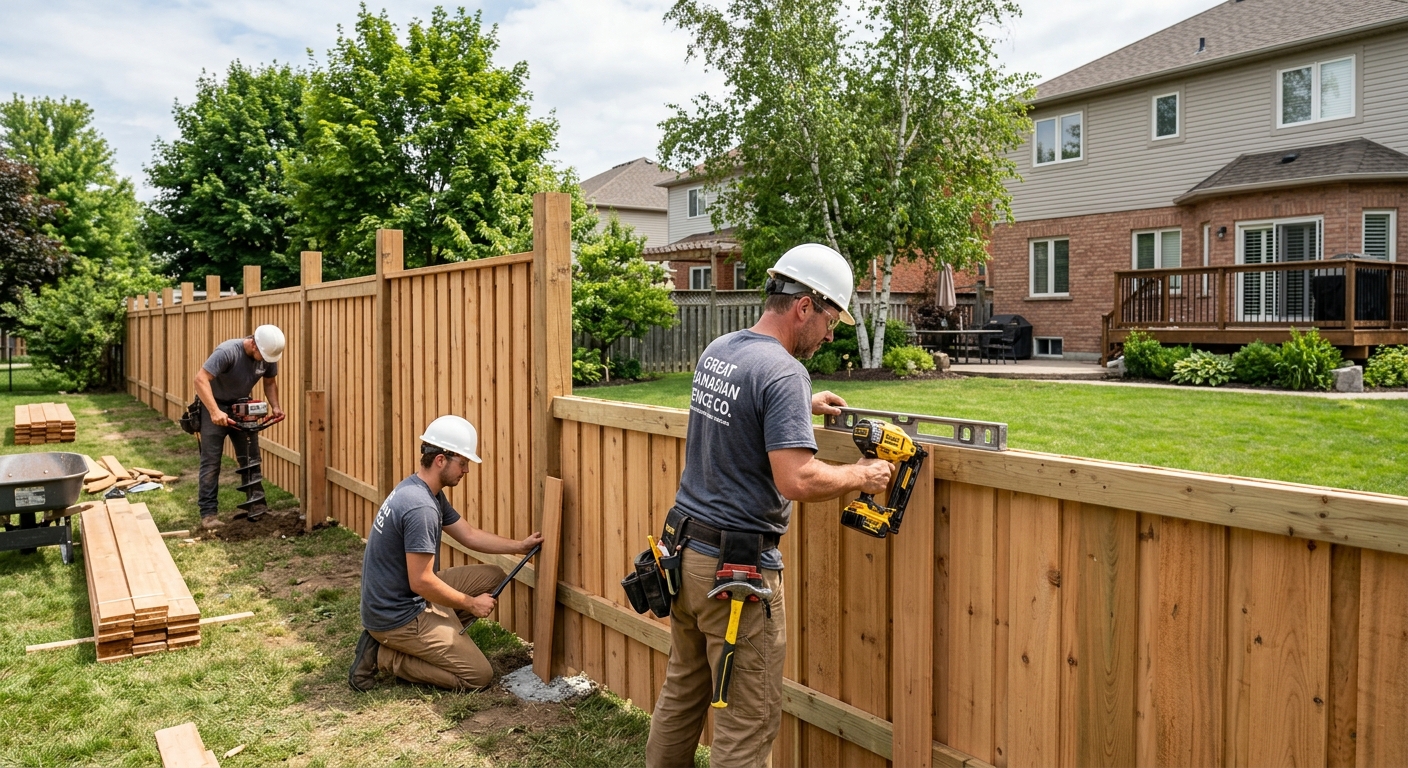
Fencing options and costs in East End-Danforth
In East End-Danforth, choosing the right fence starts with matching the material to how Toronto’s seasons behave around your property. East End-Danforth households sit within a wider Toronto demand pattern driven by strong owner interest in outdoor privacy and boundary definition; with a population of 21,381 (Statistics Canada, 2021 Census), there’s steady year-round work from homeowners and a consistent turnover of aging yards and replacement projects. Your neighbourhood’s housing mix also matters—detached properties in particular tend to have longer runs and more gates, which makes fencing one of the more noticeable home-exterior upgrades.
Pricing here is shaped by freeze–thaw and local building practice. In Southern Ontario, the frost line is commonly managed as roughly 42"–48", and posts for taller fences are typically set around 3.5–4 feet deep to reduce frost heave risk—especially for 6–8 ft privacy fences. That means concrete-set posts are standard for long-term stability, which increases labour time and ready-mix costs compared with simple driven-post installs. Wind still plays a role across the GTA (less extreme than the Prairies, but enough to matter for solid panel racking), so post size and spacing can raise costs when you want a taller, more rigid fence.
Trade demand is particularly high in pocket areas like Woodbine-Lumsden and around the Danforth corridor, where many yards back onto school grounds, busy lanes, or transit routes. Once you’ve picked your material and height, the next step is understanding the typical ranges—see the comparison table below.
| Material |
Lifespan |
Maintenance |
Privacy Rating |
Price per Linear Foot |
| Pressure-treated pine (standard wood) |
10–15 years |
Stain/seal every 2–3 years |
8/10 |
$65–$120 |
| Cedar (natural rot resistance) |
15–25 years |
Light staining every 2–4 years |
9/10 |
$85–$135 |
| Vinyl / PVC (no-maintenance) |
25–35 years |
None beyond occasional wash |
9/10 |
$75–$130 |
| Chain-link (galvanized steel) |
20–30 years |
Occasional rinse; inspect tension |
3/10 |
$45–$85 |
| Aluminum ornamental |
25–40 years |
Occasional wash; tighten hardware |
5/10 |
$90–$160 |
| Composite / recycled material |
20–30 years |
Minimal; spot-clean as needed |
8/10 |
$100–$170 |
Prices are estimates only and vary by project scope, site access and material selection.
What affects the price of fencing in East End-Danforth
In East End-Danforth and the wider Toronto area, quotes for the same fence can swing 30–50% because the job is rarely “just the panels.” Contractors price for how much digging is needed, how heavy the post system must be, what hardware upgrades are required for wind resistance, and how difficult the install is on your specific lot. Two yards that both measure “about 60 linear feet” can still land in different budgets if one has clay mixed soils, a slope, a second gate, or requires removal and disposal of an older fence.
Frost line depth is one of the biggest drivers. In cold Ontario conditions, posts are typically set about 4–6 inches below the design frost depth, which is why many installs end up with hole depths around 1.5–2.0 m (about 5–6.5 ft) for stability on 6–8 ft fences. That pushes labour time up and usually requires longer posts plus concrete-set installation methods. Compared to simpler driven-post approaches, concrete setting increases ready-mix and labour.
Wind and rigidity also matter. While Toronto doesn’t see the same open-field extremes as the Prairies, tall solid privacy fences still need heavier posts (and closer spacing) to limit racking and uplift. Meanwhile, Ontario’s freeze–thaw can accelerate fasteners loosening and surface wear on pressure-treated pine if it isn’t stained and sealed on schedule.
In East End-Danforth, two common examples that raise costs are: (1) clay or mixed soil that resists clean auger holes, slowing installation; and (2) fenced-in properties near laneways where access is tight and equipment needs careful staging. Costs can be lower when run lengths are straightforward (few corners), gate counts are minimal, and your existing fence is already at the correct line with easy removal. If you’re comparing budgets, many homeowners start in the wood or chain-link bands (for example, chain-link commonly falls within $45–$85 per linear foot), then move into vinyl/cedar territory ($75–$130 or higher) when they want longer-term privacy with less upkeep.
| Price Factor |
Why It Matters |
Cost Impact |
| Fence length in linear feet |
Materials and labour scale directly with total run length |
High (primary driver) |
| Post depth required |
Frost line determines hole depth and post length |
Medium–High |
| Post setting method |
Concrete-set posts cost more than gravel pack or driven posts |
Medium–High |
| Material choice |
Vinyl and cedar cost more upfront than chain-link; metal costs vary by grade |
Medium–High |
| Gate count and type |
More gates add framing, hinges, latches and sometimes stronger posts |
Medium |
| Grade and terrain |
Slope requires stepped or raked panels to maintain spacing and strength |
Medium |
| Old fence removal and disposal |
Disposal fees and labour increase if materials are mixed or in poor condition |
Medium |
| Permit fees and survey / property line locate |
Some installations require a permit and/or locating to avoid boundary errors |
Low–Medium |
Permits & regulations in Ontario
In Ontario, fences above a height threshold often need a building permit—commonly around 2.0 m (6.5 ft) for rear yards and roughly 1.0–1.2 m (3–4 ft) for front yards and corner side yards, depending on local rules. Even when a permit isn’t required, you still must respect property lines and municipal setback bylaws, and you must install without encroaching onto neighbours’ land or into easements.
Before you dig any post holes, call for utility locates. In Ontario you typically use Ontario One Call so hydro, gas, telecom and water lines are marked. Then confirm your boundary: if you’re unsure where the pins are, obtain a survey or a property line locate. This step is one of the easiest ways to avoid disputes later—especially in older East End-Danforth neighbourhoods where lot lines and fences may not have been installed uniformly over time.
Shared fence ownership is governed by Ontario’s line-fence concepts: where parties share costs and responsibilities can vary by agreement and circumstances, so document who owns or maintains what before work starts.
To verify your contractor in East End-Danforth, ask for proof of Ontario licensing where applicable, current liability insurance, and WSIB clearance (or the relevant coverage evidence for workers). You can typically check insurance certificates directly for policy validity, while WSIB clearance letters and any required licence information can be verified via the contractor’s documentation and the applicable provincial online registry listings.
Choosing the right fence material for East End-Danforth
In East End-Danforth, the best fence material is the one that fits your priorities—privacy, low maintenance, budget, and how long you want the fence to look good—because Toronto’s freeze–thaw cycle affects fasteners, finishes, and how posts behave after winter. Pressure-treated pine is the budget-friendly approach, but it usually needs staining or sealing every 2–3 years to prevent grey weathering and surface cracking. Cedar offers better natural rot resistance and a warmer appearance; it still benefits from periodic sealing to keep colour stable. Vinyl/PVC can be close to “wash and forget,” but in extreme cold it can become more brittle if installed with the wrong expansion allowances or if posts aren’t rigidly set.
For privacy fences, chain-link is typically the wrong choice unless you add privacy slats or screening. It’s affordable and long-lived, but visibility remains. Aluminum ornamental looks crisp and won’t rust like steel, though its open pickets lower privacy. Composite/recycled boards can be a strong middle-ground if you want a wood-like look with improved durability.
Post depth is critical in Toronto. With Southern Ontario frost management commonly treated at about 42"–48", most privacy fence posts end up set around 3.5–4 ft deep (often deeper depending on design and local soil conditions). In practice, that means concrete-set posts are the safest default for 6–8 ft fences, especially on clay and mixed soils where frost heave risk is higher. Wind and racking resistance also influence post sizing and spacing—solid panel styles generally require closer spacing and sturdier posts than picket-style designs.
Cost justification is usually about total upkeep. For example, if you’re deciding between pressure-treated pine and vinyl for a similar privacy layout, vinyl often sits around $75–$130 per linear foot while wood commonly falls within $65–$120. If you value not staining every couple of years (and you expect to keep the fence long-term), the added vinyl cost is frequently worth it.
| Material |
Cold Tolerance |
Lifespan |
Annual Maintenance |
Best For |
Price Band |
| Pressure-treated pine |
Good with proper finishing |
10–15 years |
Seasonal inspection; stain/seal every 2–3 years |
Budget privacy with willingness to maintain |
$65–$120 |
| Cedar |
Very good |
15–25 years |
Seasonal inspection; stain every 2–4 years |
Premium look and better rot resistance |
$85–$135 |
| Vinyl / PVC |
Good with correct installation |
25–35 years |
Wash as needed; check posts/hardware |
Low maintenance privacy |
$75–$130 |
| Chain-link |
Good |
20–30 years |
Rinse and inspect tension annually |
Security on a budget; add privacy screening if needed |
$45–$85 |
| Aluminum ornamental |
Excellent |
25–40 years |
Minimal; tighten hardware if needed |
Front-yard curb appeal with light privacy |
$90–$160 |
| Composite / recycled |
Good |
20–30 years |
Occasional wash; spot-check fasteners |
Wood-like look with durability |
$100–$170 |
How to choose a fencing contractor in East End-Danforth
When you’re selecting a fencing contractor in East End-Danforth, start by verifying the three essentials: Ontario licensing (where required for the contractor’s scope), liability insurance, and worker coverage (WSIB/WCB evidence). Ask for (1) a current certificate of insurance showing the policy is active and naming you or your property address if the contractor’s paperwork includes it, (2) a valid WSIB clearance letter or equivalent coverage documentation for their workforce, and (3) their contractor licence details if applicable. Request these before signing anything so you’re not guessing after the fact.
Next, get 2–3 written, itemised quotes—not a single lump sum. You want the breakdown by materials (posts, rails, panels, hardware) and labour (excavation, concrete, installation, alignment, gate hardware). Confirm what’s included: does the quote include the permit pull if one is required, and does it include property line locate or survey support? Make sure disposal is included (removal and haul-away of the old fence), and that the quote states how corners, slopes and fence offsets will be handled.
Warranty matters. Ask for the workmanship warranty length and the product/manufacturer warranty details separately, including whether the warranty is transferable if you sell the home. For payment, never pay more than 10–15% upfront; hold back part of the balance until completion and final walk-through. Finally, insist on a start date and a completion estimate in writing, because winter scheduling affects post setting and cure times.
- Provide proof of active liability insurance and WSIB/WCB coverage.
- Use site measurements and a sketch: length, height, number of gates, and corner conditions.
- Quote includes post depth assumptions for Toronto frost considerations.
- State whether posts are concrete-set or driven and why (soil and design).
- Itemise hardware and gate hardware (hinges, latches, reinforcement).
- Confirm access constraints: gates, driveway work, and staging requirements.
- Clarify old fence removal scope and disposal fees.
- Specify fence layout: panel orientation, top cap, spacing, and setbacks.
- Include warranty terms for both workmanship and materials.
- Use a payment schedule tied to milestones; avoid large upfront payments.
- Provide a timeline that includes weather-related contingencies.
- Give contact information for the project manager and site lead.
Red flags we see in East End-Danforth include: contractors who won’t discuss post depth or concrete-set foundations; quotes that omit gate hardware upgrades; vague “materials included” language with no unit pricing; demanding 50%+ upfront without a signed schedule; and refusing to provide WSIB/insurance documentation before work begins.
Frequently asked questions — fencing in East End-Danforth
How do I prevent wood fence rot in East End-Danforth?
In East End-Danforth, wood rot prevention starts below grade and in how the fence is finished. Make sure posts are set correctly for Southern Ontario frost (typically concrete-set for tall privacy runs), so water doesn’t pool around weak points. Use proper end-grain protection: bottoms of rails, post ends, and any cut surfaces should get the same treatment as the factory wood. For pressure-treated pine, staining and sealing on a regular schedule (often every 2–3 years depending on sun and exposure) slows grey weathering and reduces moisture penetration. Cedar helps naturally, but it still benefits from maintenance to keep surface condition stable during freeze–thaw.
What is the cost per linear foot for fencing in East End-Danforth?
Pricing in East End-Danforth usually lands in the same GTA bands, but your specific post system and access can shift the number. For example, wood fencing commonly comes in around $65–$120 per linear foot, while vinyl/PVC is often in the $75–$130 range when you’re doing a full privacy-style install with proper post setting. Chain-link tends to be lower, typically $45–$85, and ornamental aluminum is usually higher at $90–$160. Taller fences and additional gates raise costs because hardware and footing/post requirements increase.
Should I repair or replace my old fence in East End-Danforth?
Repair is usually the better choice when posts are still firm (no wobble at the base), boards/rails are mostly intact, and damage is limited to localized sections. In Ontario’s freeze–thaw cycle, however, you can see hidden failure: posts may look straight above grade while rot or frost heave has compromised the base. If you have multiple loose posts, recurring sagging, missing kickers/rails, or a fence that’s been patched repeatedly, replacement typically costs less over time. A quick inspection can also identify whether the fence line is out of alignment—especially useful in older East End-Danforth lots—because reworking an off-line fence can become more expensive than starting fresh.
How do I handle a fence dispute with a neighbour in Ontario?
Start with facts, not assumptions. In Ontario, fences must respect property lines and applicable setback rules, so confirm where the boundary is—ideally with a survey or property line locate using the pins. If the fence is “shared” and there’s an agreement about costs or ownership, that context affects how the repair/replacement decision should be made. For disputes, document everything: photos, measurements, and written notes of what each party agrees to. If needed, pause construction until the boundary is clear; moving forward based on incorrect assumptions creates legal and practical problems. A calm, written plan—scope, cost sharing, and timelines—goes a long way in neighbourhoods around the Danforth corridor.
What fence style offers the best wind resistance in East End-Danforth?
For wind resistance in East End-Danforth, the key is not only the style but the rigidity of the structure. Solid privacy fences can take stronger wind loads if they’re built with correctly sized posts, solid post spacing, and proper bracing/hardware. That usually means heavier posts and closer centres (often 6–8 ft) for tall solid sections, plus concrete-set posts to keep the system stable through freeze–thaw. Open styles like chain-link and ornamental aluminum catch wind differently; they may flutter less because the wind passes through, but they won’t provide the same privacy. If your yard is more exposed—like corners or open laneways—solid panel systems often need the most robust post and hardware approach.
How much does a fence cost in East End-Danforth?
Because fencing is priced per linear foot, your total cost depends on length, height, gate count, and whether old material must be removed and disposed. In East End-Danforth, a basic chain-link run may begin around $45–$85 per linear foot, while many privacy-focused installs with wood or vinyl land in the $65–$130 per linear foot range depending on height and post system. Ornamental aluminum often starts higher at about $90–$160 per linear foot. Taller fences may also require permits in Ontario and can increase post depth and concrete-set requirements, adding to the total.