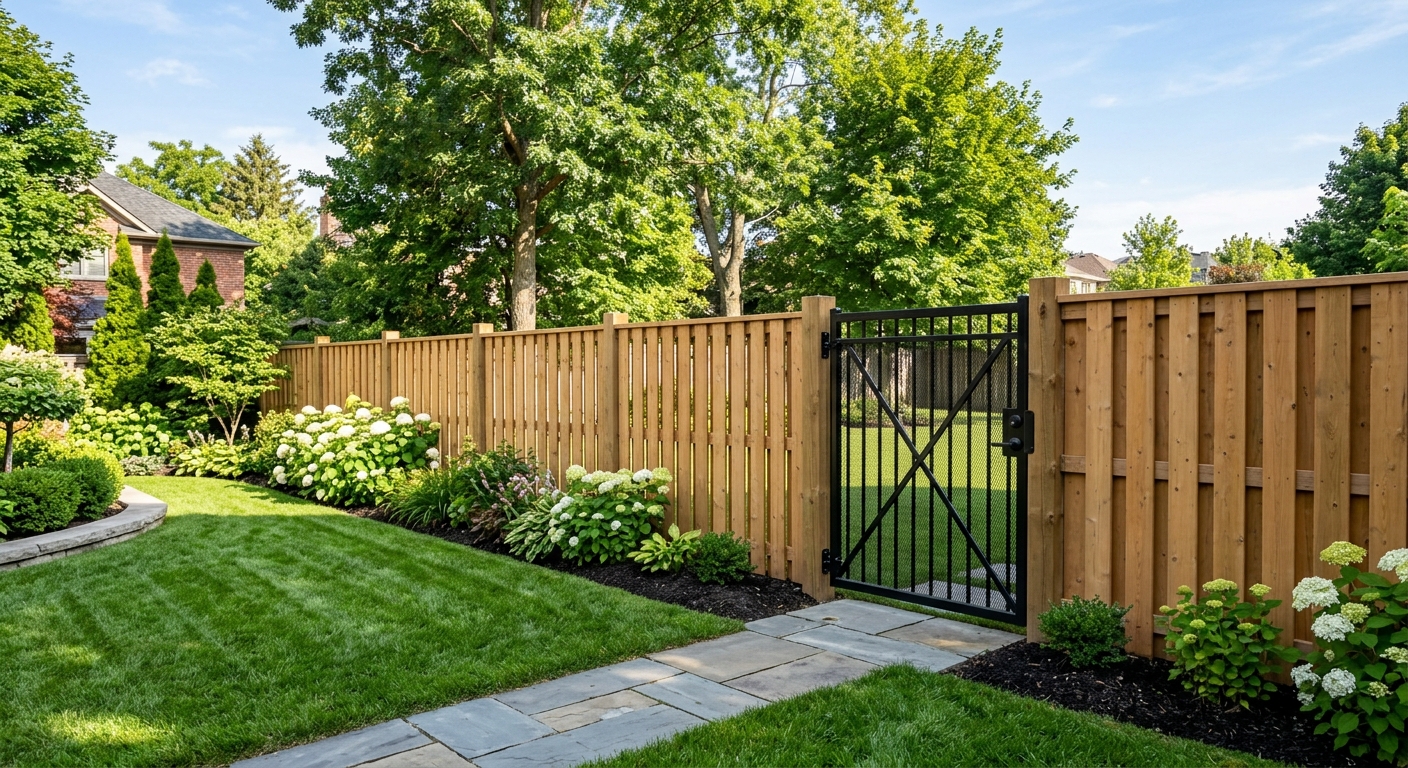
Fencing options and costs in Parkdale
Parkdale homeowners typically start their fence search by balancing curb appeal, privacy, and long-term durability on real Toronto lots. In Parkdale, the local demand is supported by the area’s housing mix—properties in Toronto’s older fabric tend to change hands and get updates often, and Parkdale’s population was recorded at 1,404 in the 2021 Census (Statistics Canada, 2021 Census). That means steady replacement and upgrade work, especially around backyards, laneways, and side-yard boundaries where people want a cleaner, more private outdoor space.
In the Toronto economic region, your quote is shaped heavily by frost depth and post stability. Contractors generally plan for posts set below the design frost depth (commonly about 42"–48" in Southern Ontario), so installation usually involves concrete-set footings and properly sized posts for 6–8 ft privacy fences. Climate also affects material choice: wet winters followed by freeze-thaw can accelerate wear on untreated wood, while solid panels must be braced to handle winter wind and spring gusts. In neighbourhood pocket areas like around Geary Avenue and the west end laneway backs, privacy fences are frequently requested because of how lots line up to neighbouring homes and shared sightlines.
Below are typical installed cost ranges and durability expectations for common options, before you compare your scope (length, gates, demolition, and access) with a contractor.
| Material |
Lifespan |
Maintenance |
Privacy Rating |
Price per Linear Foot |
| Pressure-treated pine (standard wood) |
10–15 years |
Stain or seal every 2–3 years; inspect posts annually |
High (solid boards) |
$65–$120 |
| Cedar (natural rot resistance) |
15–25 years |
Light staining/oiling every 3–4 years; fast spot repairs |
High (solid boards) |
$80–$130 |
| Vinyl / PVC (no-maintenance) |
25–35 years |
Rinse annually; replace damaged panels if hit |
High (solid or semi-solid) |
$75–$130 |
| Chain-link (galvanized steel) |
20–30 years |
Occasional wash; tighten hardware |
Low to Medium (open mesh) |
$45–$85 |
| Aluminum ornamental |
20–40 years |
Wash seasonally; touch-up paint if scratched |
Low to Medium (lattice/pickets) |
$90–$160 |
| Composite / recycled material |
20–30 years |
Minimal; clean and check for warping at fasteners |
High (solid composite boards) |
$100–$160 |
Prices are estimates only and vary by project scope, site access and material selection.
What affects the price of fencing in Parkdale
Even when two neighbours ask for the same fence height, length, and style, fencing quotes in the Toronto economic region can swing by 30–50%. That’s usually because the real scope is never identical: one lot needs deeper excavation for post stability, another has tighter access requiring different equipment, and another includes demolition, disposal, and gate hardware that changes the labour time. Material sourcing also plays a role—vinyl and composite runs can cost more upfront, while cedar or pressure-treated wood often vary by grade and board profile.
Ontario’s frost depth sets how deep posts must be set to prevent heaving. Best practice is commonly 4–6 inches below the design frost depth; in cold Southern Ontario and Ontario’s wider freeze-thaw cycle, that often translates to 1.5–2.0 m into the ground for typical fence heights. For a 6–8 ft privacy fence, the added depth means longer posts and concrete setting rather than simply driven posts, which increases both material cost and installation labour. Wind loading is not Prairies-level, but Toronto still demands proper post size and spacing for solid panels; tighter spacing and sturdier framing can add cost versus a lighter, open style.
Concrete examples in Parkdale: (1) a 50 ft run of solid wood in a clay-heavy backyard often requires extra digging and concrete-set footings, pushing you closer to the upper end of the $65–$120 wood band; (2) switching to vinyl or PVC can raise your material cost immediately, often landing nearer the $75–$130 band, but it can reduce long-term maintenance calls after the first few seasons. As a result, “same-looking fence” bids can differ by thousands once concrete volumes, post count, and gate framing are accounted for.
| Price Factor |
Why It Matters |
Cost Impact |
| Fence length in linear feet |
Most labour and materials scale directly with total run length |
Highest impact; typically the largest part of the total quote |
| Post depth required |
Frost protection drives hole depth and often post length |
Deeper holes and longer posts increase excavation and lumber/steel cost |
| Post setting method |
Concrete-set posts are steadier through freeze-thaw than gravel or driven posts |
Concrete volumes and curing time add labour and ready-mix expense |
| Material choice |
Vinyl, cedar, and chain-link differ in price, installation approach, and longevity |
Upfront material pricing can move the total by a noticeable margin |
| Gate count and type |
Gates need heavier framing, hinges/locks, and alignment work |
Each additional gate can add substantial labour and hardware costs |
| Grade and terrain |
Slope requires racked panels or stepped rails to keep a straight top line |
Extra cutting and layout time, plus potentially more posts and brackets |
| Old fence removal and disposal |
Haul-away, deconstruction, and disposal fees vary by material and condition |
Can materially increase cost versus install-only |
| Permit fees and survey / property line locate |
Some fences require documentation to verify setbacks and property limits |
Adds administrative cost and may add schedule time |
Permits & regulations in Ontario
In Ontario, a fence permit is often triggered when you plan a fence above local height thresholds—typically around 2.0 m (6.5 ft) at the rear and roughly 1.0–1.2 m (3–4 ft) at the front or corner. Even if your project is below that limit, fences still must respect property lines and municipal setback bylaws. For Parkdale homeowners, the practical goal is simple: build to the right boundary and don’t interfere with easements, sightlines, or required clearances.
Before digging any post hole, use a utility locate service (Ontario One Call) so crews can work safely around underground lines. It’s also smart to confirm your boundary with a survey or at least a documented property pin locate. Shared fence ownership is governed by Ontario’s line-fence principles, but the exact responsibilities can depend on how your property is set up and what exists along the boundary.
What typically requires a permit: taller fences near thresholds and any change that could affect setbacks or prescribed limits. What typically does not require a permit: like-for-like replacement of an existing fence that stays within the same height and does not alter placement, setbacks, or property line position (final confirmation should be done with your municipality).
To verify contractor credentials, check the Ontario licence status online, request a certificate of insurance naming you as additional insured, and confirm WSIB coverage (or equivalent provincial coverage where applicable). Ask for a clearance letter or proof of compliance before any excavation begins.
Choosing the right fence material for Parkdale
Choosing the right fence material in Parkdale comes down to matching your priorities—privacy level, maintenance effort, budget, and how long you want it to look “done” through Toronto’s freeze-thaw seasons. Pressure-treated pine is the usual budget entry point, but it needs staining or sealing every 2–3 years to avoid grey weathering and to protect the surface. Cedar offers a nicer appearance and natural rot resistance, but it still benefits from routine maintenance. Vinyl/PVC is popular for low maintenance: it won’t rot and typically only needs rinsing, but extreme cold snaps can make boards more brittle if the fence is undersized or improperly installed. Chain-link lasts a long time and is excellent for security, but it won’t give privacy unless you add slats or screening. Aluminum ornamental is rust-resistant and clean-looking, though it’s best for curb appeal rather than full privacy.
Toronto’s frost conditions also influence material performance because the fence must be structurally stable where it meets the ground. With the typical Southern Ontario frost line around 42"–48", posts often need to be set about 3.5–4 feet deep (or deeper depending on soil and design) with concrete-set footings. For taller solid privacy fences, wind and snow loading mean sturdier posts and closer framing; this applies regardless of whether you choose wood or vinyl.
Example: if your wood privacy fence bid lands near the $65–$120 band but vinyl comes in closer to $75–$130, the extra upfront cost can be justified if you want fewer annual maintenance trips and fewer concerns about surface treatment in rainy shoulder seasons.
| Material |
Cold Tolerance |
Lifespan |
Annual Maintenance |
Best For |
Price Band |
| Pressure-treated pine |
Good when posts are deep-set and protected at the base |
10–15 years |
Seasonal inspection; stain/seal every 2–3 years |
Budget privacy with routine upkeep |
$65–$120 |
| Cedar |
Good in Toronto’s freeze-thaw with proper fasteners |
15–25 years |
Light stain/oil every 3–4 years; spot repair as needed |
Premium look with manageable maintenance |
$80–$130 |
| Vinyl / PVC |
Very good; avoid undersized posts and weak post spacing |
25–35 years |
Rinse/clean; check hardware after heavy wind |
Low-maintenance privacy |
$75–$130 |
| Chain-link |
Good; galvanized components resist corrosion |
20–30 years |
Occasional wash; tighten and re-tension as needed |
Security and long service life |
$45–$85 |
| Aluminum ornamental |
Excellent; resists rust and winter exposure |
20–40 years |
Wash seasonally; touch-up if scratched |
Appearance-focused boundaries |
$90–$160 |
| Composite / recycled |
Good; best with correct framing and fastener specs |
20–30 years |
Minimal cleaning; check fixings after freeze-thaw cycles |
Solid look with reduced upkeep |
$100–$160 |
How to choose a fencing contractor in Parkdale
Choosing the right contractor in Parkdale is less about fancy marketing and more about verifiable proof and clear scope. Start by verifying Ontario licensing (where applicable for the work), then request a certificate of insurance and check that it’s current—ideally listing you as additional insured. For coverage, confirm WSIB compliance (and provide proof/clearance letter). If a contractor can’t produce documents quickly, assume they’re not set up for jobsite risk.
Next, get 2–3 itemised written quotes that separate labour, materials, post depth/setting method, concrete quantity assumptions, gate hardware, and any demolition/disposal line items. Avoid lump sums that don’t say what’s included. Read the scope for exclusions: Are permits handled or responsibility yours? Is disposal of old fencing included? Will the crew restore disturbed areas, and what happens if they find unexpected underground utilities or roots?
Warranty matters in fencing because Ontario weather exposes weak installs. Ask for two warranties: workmanship (how long the contractor guarantees posts, alignment, and hardware installation) and product/manufacturer warranty (what’s covered on material defects). Also ask whether warranties are transferable if you sell your home.
Payment schedules should be conservative. Never pay more than 10–15% upfront, and hold back a portion until final completion and punch-list items are done. Demand a start date and a realistic completion estimate in writing.
- Written quote with linear footage and number of posts/gates.
- Post depth plan stating concrete-set requirements for frost stability.
- Proof of WSIB coverage (or clearance letter) before excavation.
- Current liability insurance with you listed as additional insured.
- Clear scope for demolition and disposal (dump fees included?).
- Itemised hardware list: hinges, latches, brackets, tension bars.
- Gate framing details and whether gates are self-closing or not.
- Height measurement method (top of fence line and grade reference point).
- Specification for sloped lots: racked vs stepped panel approach.
- Permit responsibility explicitly stated (who pulls it, who pays?).
- Workmanship warranty length and what voids coverage.
- Schedule with start date, weather contingency, and completion window.
Red flags I see in Parkdale: crews who insist on driven posts only for tall privacy fences, quotes that don’t specify concrete-set depth, missing insurance/WSIB paperwork, “all-in” pricing without demolition/disposal detail, and no written schedule or warranty terms.
Frequently asked questions — fencing in Parkdale
How deep should fence posts be for Parkdale's frost?
For Parkdale (Toronto area), a common best-practice approach is to set posts below the local design frost depth so they don’t heave during freeze-thaw cycles. Southern Ontario’s frost line is often planned around 42"–48", and crews typically dig roughly 3.5–4 ft or deeper depending on soil and fence height—then concrete-set the posts for 6–8 ft privacy fences. In practical terms, many installs require around 1.5–2.0 m into the ground. This is one reason tall solid fences often land nearer the higher end of the wood or vinyl bands (for example, wood in the $65–$120 range), because deeper holes and concrete time increase labour and ready-mix costs.
Wood vs vinyl vs aluminum fence — which is best?
The “best” choice depends on whether you value privacy, appearance, or low maintenance most. Wood (pressure-treated pine or cedar) is often the best-looking budget path, but it needs upkeep in Toronto’s wet winters and freeze-thaw seasons—expect staining or sealing every 2–3 years for pressure-treated. Vinyl/PVC is usually best if you want a near-set-and-forget fence; it’s popular for privacy and long service life, though it still needs correct post spacing and a solid concrete-set base in cold weather. Aluminum ornamental is excellent for longevity and rust resistance, but it’s typically not as private as solid wood/vinyl unless you add screening. Cost-wise, aluminum often falls closer to the $90–$160 band, while wood often starts around $65–$120 depending on height, gate count, and post depth.
Do I need a permit to build a fence in Ontario?
In Ontario, permits are commonly required when fence heights exceed typical thresholds—often around 2.0 m (6.5 ft) at the rear and about 1.0–1.2 m (3–4 ft) at the front or corner. Exact requirements still depend on your municipality’s zoning and bylaws, and your lot’s location matters (especially at corners or where setbacks apply). Even when a permit isn’t required, the fence must still respect property lines and setbacks, and any excavation must follow utility locate requirements (use Ontario One Call before digging). For Parkdale projects, I recommend confirming the rule for your specific address and getting a survey/property locate if there’s any doubt about the boundary before you install posts.
How long does a wood fence last in Parkdale?
A wood fence in Parkdale can last anywhere from about 10–15 years for standard pressure-treated installations to 15–25 years for higher-quality cedar, assuming it’s built for Toronto’s conditions. The two biggest factors are post stability and maintenance. When posts are concrete-set deep enough for frost protection (often planned around 42"–48" frost depth and resulting hole depth), the fence resists sagging and heaving. When wood is not stained or sealed on a realistic schedule, it can grey, dry out, and deteriorate faster in wet winters. If your contractor is quoting near the wood band (for example, $65–$120), ask what they’re doing for fasteners, post setting, and the maintenance expectations for your specific material and height.
Who owns and maintains a shared fence?
Shared fence situations in Ontario generally follow line-fence principles, but the practical answer depends on where the boundary lies and what agreement exists (or has historically been used) between neighbours. In most cases, owners may share responsibility if the fence is on the boundary, but it’s not always automatic: the fence’s location relative to property lines, prior arrangements, and how the fence was originally erected can matter. For Parkdale homeowners, I recommend confirming the exact property line with pins or a survey before assuming shared ownership. If you’re making repairs or replacing a shared section, document the scope, share the plan with your neighbour, and keep communication clear about who is paying for materials and labour.
How do I find my property line before fencing?
Before fencing in Parkdale, start with any available documents you have: your purchase paperwork, any survey, or prior fencing correspondence. The most reliable method is to obtain a survey or a property pin locate so you can see the boundary lines on-site. If you don’t have current survey documentation, ask a surveyor to locate the pins and mark the corners; it helps prevent encroachment disputes and saves money later because you won’t have to rebuild due to a boundary mistake. While you’re preparing, remember that Ontario requires utility locates before digging—call Ontario One Call so crews can identify underground services. Once pins are located, you can finalise fence alignment, especially where gates and setbacks are involved.