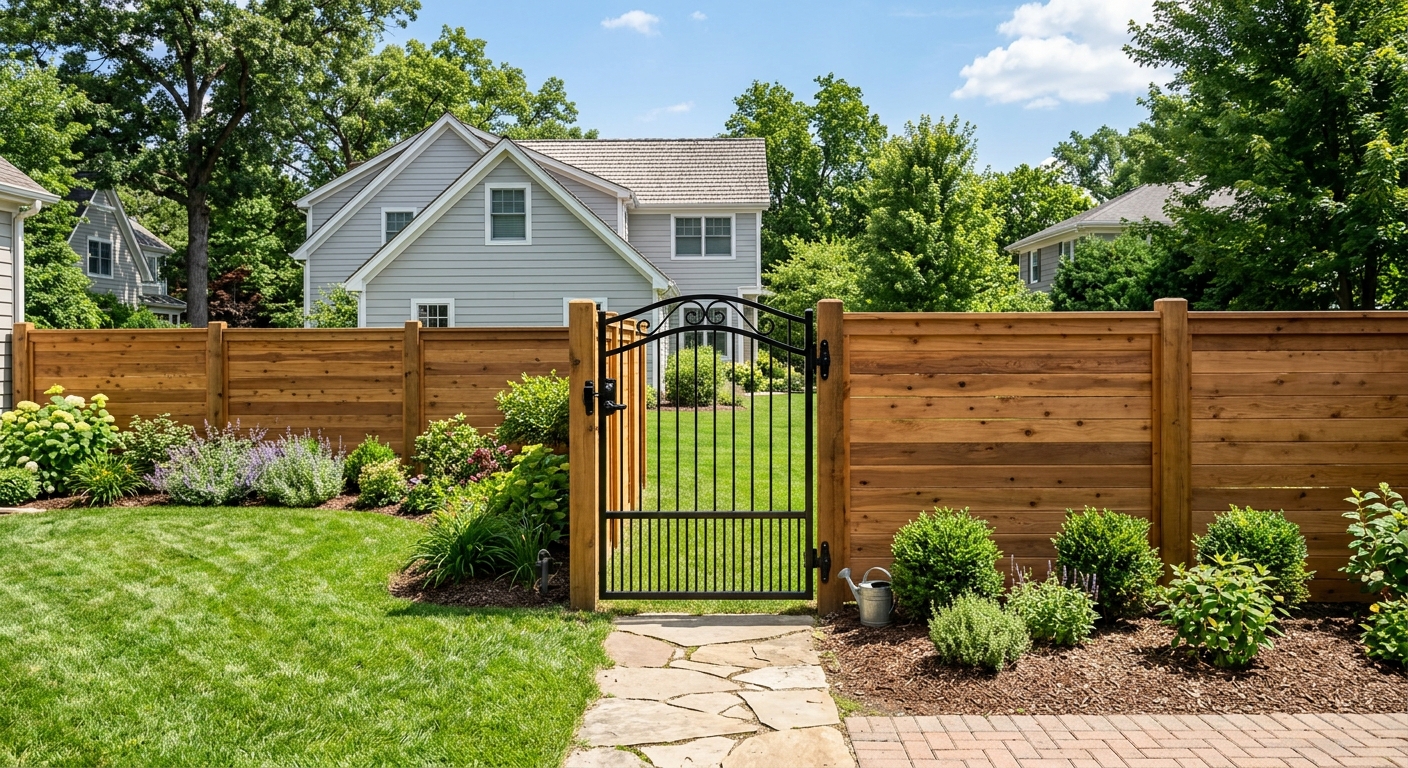
Fencing options and costs in Halton Hills
Halton Hills homeowners have a lot of choice when it comes to fencing, and the most common starting point is simply what you’re protecting: privacy, pets, garden beds, or property boundaries. With 18,610 homeowner households locally and 85.3% of households owning, fencing demand follows the housing market closely (Statistics Canada, 2021 Census). The mix also matters—single-detached homes make up 73.0% of dwellings, so many lots still need full perimeter privacy and boundary fencing, especially around back yards.
In the Toronto economic region, fencing costs are shaped heavily by freeze–thaw conditions and local site practices. The frost line in Southern Ontario is commonly treated at about 42"–48", so posts generally need to be set deep (typically 3.5–4 ft) to help prevent frost heave. That means concrete-set posts and labour time rise for taller fences, like 6–8 ft privacy styles. It also helps explain why many contractors in areas such as Georgetown (and surrounding neighbourhoods with similar soils and lot layouts) favour concrete setting and heavier hardware to reduce racking.
Material selection changes the price gap quickly. In this region, wood often competes on initial cost, while vinyl/PVC and metal options tend to cost more upfront but can smooth out long-term maintenance. Before you shop bids, it’s helpful to compare “like-for-like” items (post depth, panel type, gates, and removal). Use the table below as your baseline, then we’ll break down why quotes can swing meaningfully for the same fence.
| Material |
Lifespan |
Maintenance |
Privacy Rating |
Price per Linear Foot |
| Pressure-treated pine (standard wood) |
10–15 years |
Stain/seal every 2–3 years; occasional rail tightening |
8/10 (solid boards) |
$10 – $18 |
| Cedar (natural rot resistance) |
12–20 years |
Light staining every 2–4 years; less frequent minor repairs |
9/10 (solid boards) |
$14 – $24 |
| Vinyl / PVC (no-maintenance) |
20–30 years |
Wash as needed; check hardware tightening |
9/10 (solid privacy panels) |
$16 – $27 |
| Chain-link (galvanized steel) |
20–35 years |
Occasional post tensioning and rail straightening |
3/10 (limited privacy) |
$8 – $14 |
| Aluminum ornamental |
25–40 years |
Wash occasionally; no rusting |
5/10 (decorative pickets) |
$15 – $29 |
| Composite / recycled material |
20–30 years |
Rinse and spot-clean; periodic fastener checks |
8/10 (solid styles) |
$18 – $32 |
Prices are estimates only and vary by project scope, site access and material selection.
What affects the price of fencing in Halton Hills
It’s normal to see fencing quotes for the same approximate fence length vary by 30–50% across the Greater Toronto Area. The biggest reason is that “fence length” isn’t the whole job: post depth and spacing, gate count, demolition/removal, and whether the contractor allows for concrete-set posts versus faster set methods can change both labour hours and material costs. That difference becomes more pronounced in Halton Hills because local lots often include mature trees, uneven grade, and older housing stock—46.3% of homes were built before 1981 (Statistics Canada, 2021 Census), which frequently means tighter access and more boundary-pin complexity.
For Toronto-area frost conditions, the frost line is commonly treated at about 42"–48", and posts are typically set roughly 4–6 inches below the design frost depth to reduce heaving risk. Practically, that often means 1.5–2.0 m hole depth in cold Ontario, longer posts, and concrete—especially for 6–8 ft privacy fences. Where heavier wind loads are not as extreme as the Prairies, you still need proper post sizing, panel style choices, and hardware to resist racking and uplift.
Two real examples I commonly see around Halton Hills: first, switching from gravel-pack or short posts to concrete-set footings on a tall backyard privacy run can add noticeable labour and ready-mix cost, but it reduces call-backs in freeze–thaw seasons. Second, if your yard is sloped (common in and around parts of Georgetown), the contractor may need stepped panels or extra bracing, which increases materials even when total linear feet look similar. If you’re comparing wood at the lower Toronto band (often around $65–$120 installed) versus vinyl in the $75–$130 range, the price gap often tracks the post system and hardware as much as the sheet material.
| Price Factor |
Why It Matters |
Cost Impact |
| Fence length in linear feet |
Labour time, number of posts, and rails scale directly with length |
Highest; often the “baseline” of the quote |
| Post depth required |
Frost line determines post length and hole depth for stability |
Can add substantial cost on tall fences |
| Post setting method |
Concrete vs. gravel pack vs. driven posts affects materials and labour |
Concrete-set generally increases installed cost |
| Material choice |
Vinyl/cedar/chain-link differ in cost, labour, and hardware needs |
Vinyl often sits above wood; chain-link is lowest |
| Gate count and type |
Gates require stronger frames, hinges, latches, and sometimes bracing |
Each additional gate can meaningfully raise the total |
| Grade and terrain |
Sloped yards require stepped/raked panels or extra bracing |
Moderate-to-high depending on slope |
| Old fence removal and disposal |
Deconstruction, hauling, and post extraction change labour time |
Often adds a measurable line item |
| Permit fees and survey / property line locate |
Some projects need permits; others require a locate to confirm boundaries |
Varies, but can be a non-trivial add-on |
Permits & regulations in Ontario
In Ontario, fencing rules are primarily municipal, but permits can come into play for larger structures. As a practical benchmark homeowners use in Halton Hills, fences above a height threshold—often about 2.0 m (6.5 ft) at the rear and 1.0–1.2 m (3–4 ft) at the front or corner—may require a building permit depending on where you’re building and your municipal bylaw. Regardless of permit requirements, your fence must respect property lines and any local setback or sightline restrictions.
Before any digging, always arrange utility locates. In Ontario, homeowners typically use Ontario One Call so underground services can be marked before you set posts. Next, get a survey or at minimum confirm property pin locations so the contractor isn’t building on a neighbour’s land—these disputes are common when lots are older or markers are unclear. Shared fence ownership rules are governed by Ontario’s line-fences concepts, so it’s wise to document in writing any neighbour agreements about shared boundaries and maintenance responsibilities.
What DOES usually require a permit: a fence that exceeds typical height limits at the front/corner or rear (commonly around the 2.0 m rear guideline) and any project your municipality flags for compliance review. What typically does NOT require a permit: small, code-compliant privacy fences within municipal height limits, provided you’re respecting setbacks and boundaries.
How to verify a contractor before work starts: ask for their Ontario business registration/contractor authorization (where applicable), certificate of liability insurance (often with clear limits and jobsite wording), and their WSIB coverage details (or their WCB/coverage clearance depending on what applies to their situation). Look for a valid insurance certificate naming you (or confirming coverage for the contract) and check the coverage status number on the certificate or clearance paperwork. For fencing, also request a written scope that states who handles any permit pull and property locate support.
Choosing the right fence material for Halton Hills
Choosing a fence material in Halton Hills is mostly about matching your yard conditions to your willingness to maintain the fence. Pressure-treated pine is usually the budget-friendly option, but it needs staining or sealing every 2–3 years to prevent grey weathering and board splitting. Cedar looks better and has natural rot resistance, so it often reduces minor issues compared with pine, yet it still benefits from periodic maintenance. Vinyl/PVC is popular because it’s truly low maintenance, but in extreme cold snaps it can become brittle at cut edges if the installation details aren’t right—proper fastening, correct expansion room, and quality components matter. Chain-link is the longest-lasting lower-cost option but offers limited privacy unless you add slats or plant screening. Aluminum ornamental fencing has an attractive look, won’t rust, and performs well in the Toronto climate, but it’s not a high-privacy choice.
Post depth and stability are where Toronto climate turns “material choice” into real cost. With freeze–thaw and a frost line commonly treated around 42"–48", concrete-set posts are typically recommended for 6–8 ft privacy fences to reduce heaving and maintain alignment. Wind and occasional winter snow loading also support using proper post sizing and panel bracing, especially on longer straight runs or when you have open corners.
Where the price difference is justified: if you’re comparing a wood privacy fence installed in the $65–$120 band to vinyl/PVC in the $75–$130 band, the extra cost is often worth it when you want to avoid regular staining and want consistent appearance. For a backyard run of, say, 40 linear feet, even a $20/linear-foot spread can mean roughly an $800 difference—many homeowners accept that when they factor in maintenance time over several seasons and the expectation of fewer replacements.
| Material |
Cold Tolerance |
Lifespan |
Annual Maintenance |
Best For |
Price Band |
| Pressure-treated pine |
Good with proper top caps and staining |
10–15 years |
Plan on seasonal checks; stain/seal every 2–3 years |
Lowest upfront cost for privacy fences |
$65–$120 |
| Cedar |
Very good; handles freeze–thaw well when installed correctly |
12–20 years |
Light staining or sealing every 2–4 years |
Appearance-focused privacy with better rot resistance |
$80–$140 |
| Vinyl / PVC |
Good; needs correct fastening and expansion details |
20–30 years |
Minimal—rinse/wash as needed; hardware checks |
Low maintenance and clean, consistent look |
$75–$130 |
| Chain-link |
Good; galvanized components resist cold-related stress |
20–35 years |
Low—periodic tension/straightening |
Security and containment (pets/kids) |
$45–$85 |
| Aluminum ornamental |
Good; no rust cycling issues |
25–40 years |
Very low—wash periodically |
Decorative security with curb appeal |
$90–$160 |
| Composite / recycled |
Good; depends on fastening and product quality |
20–30 years |
Low—wash/spot-clean; fastener checks |
Durable privacy with reduced rot concerns |
$95–$165 |
How to choose a fencing contractor in Halton Hills
Choosing the right fencing contractor in Halton Hills starts with verification. In Ontario, request their liability insurance certificate (and confirm it covers the work type, with a clear policy term) and documentation of their WSIB coverage status for workers. If the contractor provides subcontractors or specialized crews, ask how coverage is handled for each work stream. To verify coverage, look at the certificate itself for policy details and confirm the coverage number and effective dates; reputable firms can also provide a clearance letter or a current statement of coverage when requested.
Next, get 2–3 itemised written quotes. You want a labour-and-materials breakdown: post materials, concrete/aggregate, rails, pickets/panels, hardware, gates, and any removal/disposal charges. Avoid a quote that’s only a lump sum—without a line-by-line scope, you can’t compare apples to apples. Read what’s excluded: permit pull responsibility, utility locate costs, saw-cutting if required, concrete disposal, and whether old fencing includes post extraction or only surface removal.
Warranty should be clear and separated into workmanship versus product warranty. Ask the length of workmanship coverage, what it covers (settlement/racking, fastener failures, alignment), and whether the manufacturer warranty is transferable if you sell your home. For payment, a safe schedule is to never pay more than 10–15% upfront; hold a portion until the fence is complete and inspected. Finally, insist on a start date and completion estimate in writing so you’re not left waiting through Ontario weather delays.
- Ask for certificate of insurance and confirm it’s current for the job period.
- Confirm WSIB coverage for workers (or provide a coverage clearance letter).
- Require itemised quote lines for posts, concrete/aggregate, rails, boards/panels, and hardware.
- Make sure the quote states post depth/hole depth and whether posts are concrete-set.
- Confirm gate count, swing direction, latch type, and whether gate framing is included.
- Check whether slope handling (stepped/raked panels) is included and how it’s priced.
- Verify whether permit pull (if needed) is included or billed separately.
- Confirm utility locates are included or that the homeowner must arrange them.
- Ensure old fence removal includes post extraction, hauling, and disposal.
- Request a warranty document in writing, including workmanship term and exclusions.
- Avoid deposits above 10–15%; hold back until final cleanup and alignment are confirmed.
- Get a written schedule and communication plan for weather-related delays.
Concrete red flags I’ve seen on Halton Hills fence installs: (1) quotes that don’t state post depth or concrete vs. gravel method, (2) “same price no matter what” language despite gates/slope/height differences, (3) no written warranty terms for workmanship, (4) refusal to provide insurance/WSIB documentation, and (5) deposits that are too high or schedules that lack a written completion target.
Frequently asked questions — fencing in Halton Hills
How do I prevent wood fence rot in Halton Hills?
In Halton Hills, rot prevention is mostly about installation details that survive freeze–thaw and winter moisture. First, insist on properly set posts (often concrete-set for stability) so boards don’t sit in ground-level moisture. Use correct board spacing and include post caps/top rails to keep water from pooling. For pressure-treated pine, staining or sealing every 2–3 years is the practical rhythm; skipping that step leads to grey weathering and faster fibre breakdown. Cedar resists rot better, but it still needs periodic care, especially on fence faces exposed to heavy rain and snow melt. Finally, ask whether the contractor uses galvanized or exterior-rated fasteners and whether they leave clearance so panels aren’t trapped against damp trim. (Statistics Canada, 2021 Census)
What is the cost per linear foot for fencing in Halton Hills?
Halton Hills fencing pricing varies by material, height, gates, and post system, but a practical homeowner range is helpful. In the Toronto area, many installed wood fences land around the $65–$120 band, while vinyl/PVC commonly sits around $75–$130 installed. Translating that into per-linear-foot pricing for like-for-like panels/posts, wood often falls roughly into the high single digits to low double digits per foot, and vinyl/PVC tends to be higher. The biggest “cost per foot” swing usually comes from whether posts are concrete-set to manage frost heave risk. If your fence run is tall (6–8 ft privacy), add gates, or includes slope work, the effective per-foot price can move toward the top of the band. For a precise figure, request an itemised quote that states post depth and concrete quantities.
Should I repair or replace my old fence in Halton Hills?
Often the decision is structural, not cosmetic. If the fence posts are stable and only the boards have aged, repair can be cost-effective—replace split boards, tighten rails, and treat/stain where needed. If you’re seeing leaning sections, missing post anchoring, or repeated frost-related movement, replacement usually wins in the long run because the problem isn’t just the wood; it’s the post system. In older Halton Hills properties (nearly half of homes were built before 1981), boundary fences are frequently installed with shorter or less stable posts, so repairs can become patchwork every season. As a rule of thumb, if repairs would involve more than about 30–40% of boards and multiple post resets, replacement is commonly better value. Get a quote that separates “board-only” repairs from “full post reset” scope so you can compare properly.
How do I handle a fence dispute with a neighbour in Ontario?
Fence disputes in Ontario usually come down to boundaries, shared maintenance expectations, and who pays for what. Start by confirming the property line with a survey or by locating property pins so you have a factual reference—don’t rely on assumptions or old marker opinions. Next, review what was installed and whether your neighbour is treating it as a shared fence; Ontario’s line-fence concepts generally influence how costs and responsibilities may be discussed. Keep communication calm and in writing. If you believe the fence is on the wrong side of the boundary, stop work and get a professional determine/locate before re-adjusting. If the dispute persists, consider mediation or legal advice rather than arguing through crews. Document everything: photos, measurement notes, contractor reports, and any written neighbour agreements.
What fence style offers the best wind resistance in Halton Hills?
In Halton Hills, you typically want a style that balances stiffness and airflow. Fully solid panels (wood or vinyl privacy fences) can act like a large sail during strong winds, so they must be built with proper post sizing, correct post spacing, and solid hardware to prevent racking. For best wind resistance, I often recommend a sturdier privacy layout: correctly set concrete-set posts, heavier rails, and tighter post centres (commonly around 6–8 ft depending on system and height). Where you can’t go heavier hardware, consider a semi-private style (lattice with partial openness) so wind can pass through and reduce uplift. Also consider snow load management—if snow accumulates high against a solid privacy fence, the added pressure can stress weak frames. The best approach is to match fence height and panel type to post depth and framing, not just “more material.”
How much does a fence cost in Halton Hills?
Total fence cost depends mainly on length, height, gate count, and whether posts are concrete-set for frost stability. As a starting point, Halton Hills fencing is often priced within Toronto-area installed bands: wood typically lands around $65–$120 installed per linear foot, vinyl/PVC often around $75–$130, chain-link around $45–$85, and aluminum/metal around $90–$160 (material and installation quality both matter). Your actual total will move within those bands based on post depth requirements tied to Ontario frost conditions, site access, and disposal of an old fence. For example, a tall backyard privacy project that includes concrete-set posts and one or two gates will usually price closer to the upper end of the wood or vinyl range. If you want a tighter estimate, ask for an itemised quote that lists post depth, concrete/aggregate quantity, panel spacing, and all gate hardware.