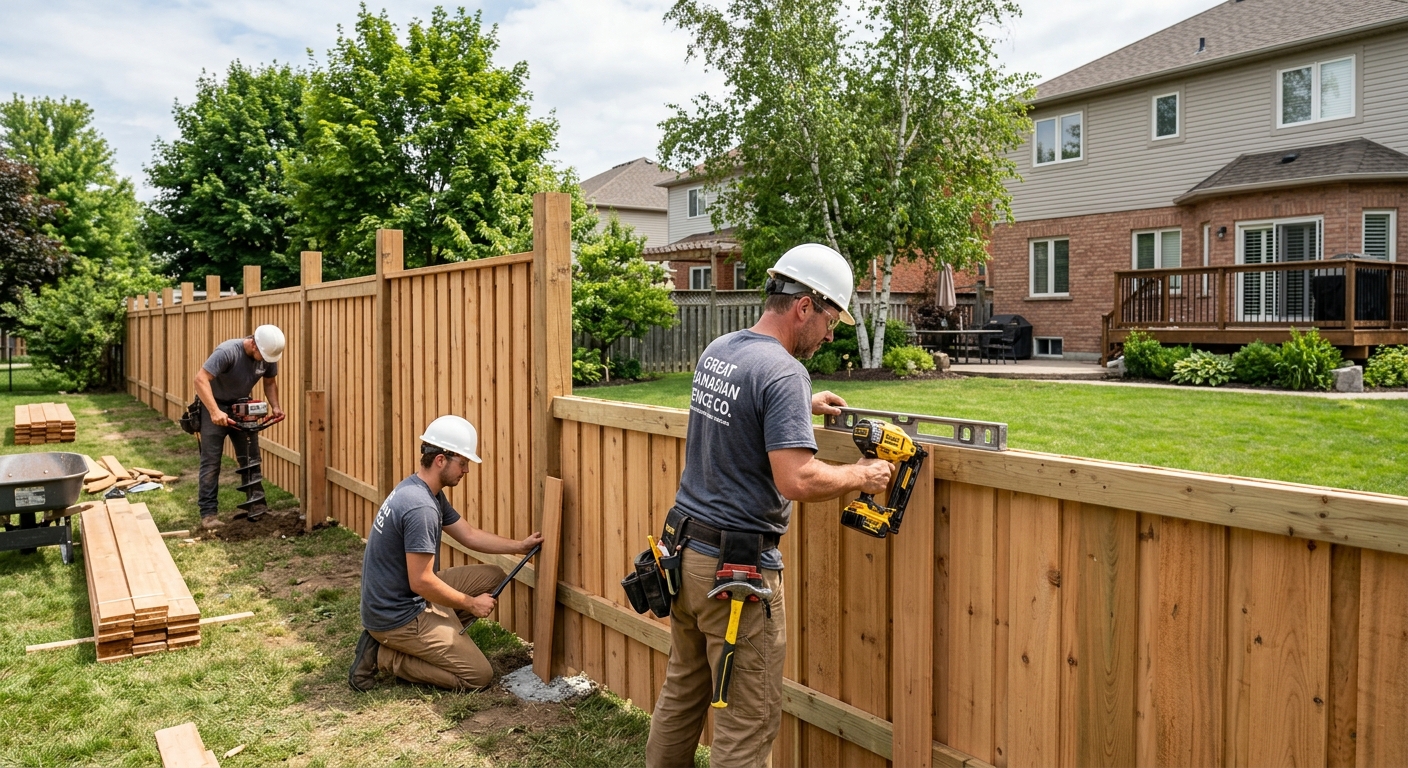
Fencing options and costs in Highland Creek
Highland Creek is a fast-growing, established community in the Toronto area (population 12,494, Statistics Canada, 2021 Census), and that mix of mature lots plus ongoing infill creates steady demand for backyard privacy and side-yard security fencing. In practice, fencing sales track closely with how many homes have detached yards that need boundary definition—every new or replacement fence is also an “outdoor comfort” upgrade for day-to-day living and resale appeal. The Toronto market also means you’ll see lots of 2-storey homes, long rear lots, and frequent upgrades around driveways and corner properties where wind can push at taller panels.
In Southern Ontario, pricing is strongly shaped by climate and local building practice. Contractors plan for frost-related movement even though the region isn’t as harsh as parts of the Prairies; a common rule of thumb is a frost-line range around 42”–48” in the GTA. That typically translates into posts set about 3.5–4 ft deep for 6–8 ft fences, usually using concrete-set posts rather than simple driven posts—more labour, more excavating, and higher material cost, but better long-term stability. Accessibility also matters a lot in Highland Creek: crews charge more when gate widths or backyard access limit how much they can stage materials and remove old fencing.
If you’re in the more active pockets near major arterials—especially around the family-heavy corridors where lots back onto collector roads—privacy fences tend to be in highest demand. Below are the most common options and realistic cost ranges to help you compare quotes before you book a site visit.
| Material |
Lifespan |
Maintenance |
Privacy Rating |
Price per Linear Foot |
| Pressure-treated pine (standard wood) |
10–15 years |
Stain/seal every 2–3 years; inspect posts annually |
High (solid boards) |
$65–$120 |
| Cedar (natural rot resistance) |
15–20 years |
Stain/seal every 2–4 years; periodic hardware checks |
High (solid boards) |
$75–$130 |
| Vinyl / PVC (no-maintenance) |
20–30 years |
Minimal (wash annually or as needed) |
High (solid pickets/boards) |
$75–$130 |
| Chain-link (galvanized steel) |
20–30 years |
Rinse as needed; check tension and bottom gaps |
Low–Medium (not a privacy solution) |
$45–$85 |
| Aluminum ornamental |
25–40 years |
Wash as needed; inspect fasteners |
Low–Medium (decorative; limited screening) |
$90–$160 |
| Composite / recycled material |
20–30 years |
Low (wash; inspect for fastening issues) |
High (solid styles) |
$85–$150 |
Prices are estimates only and vary by project scope, site access and material selection.
What affects the price of fencing in Highland Creek
Even when two neighbours order “the same” fence, quotes across Toronto can differ by 30–50%. The biggest reasons are not just the material choice—they’re the job realities: excavating conditions, required post depth for frost stability, wind-and-panel engineering, and the amount of time spent on prep (old fence removal, line location, and disposal). In Highland Creek specifically, you’ll often see long runs that require careful layout around driveways and landscaped beds, and crews must work within typical backyard access constraints.
Toronto’s frost line commonly sits around 42”–48”, and best practice is to set posts deeper than that—often about 4–6 inches below the design frost depth. In practical terms for many 6–8 ft privacy fences, that means posts generally need to go roughly 1.5–2.0 m into the ground. Because deeper holes usually require longer posts and concrete-set installation, labour and ready-mix costs rise versus lighter, shorter fences. Chain-link pricing can stay lower because it typically needs less heavy privacy-panel engineering and usually involves different post hardware and tensioning.
Local wind considerations also affect pricing. While Highland Creek isn’t as exposed as open Prairies sites, taller solid fences still need stronger posts and closer spacing to resist racking and uplift. If you’re near more open corners or have an exterior lot line with more exposure, it can mean additional bracing and hardware.
Here are a few local examples that move cost up or down: (1) Soft clay with mixed fill can slow trenching/augering, adding labour and sometimes requiring better backfill; (2) a yard with lots of buried landscaping ties up crew time and increases restoration; (3) if your run includes two gates plus a corner, you’ll pay for heavier framing and more robust posts. For budget comparisons, a typical wood privacy run may land in the $65–$120 band, while vinyl often sits in the $75–$130 band—yet vinyl’s longer lifecycle can justify the upgrade when you’re planning to stay in the home several years.
| Price Factor |
Why It Matters |
Cost Impact |
| Fence length in linear feet |
Most labour and materials scale directly with total run length |
Largest driver; can account for the majority of total project cost |
| Post depth required |
Frost line determines hole depth and post length |
Deeper, concrete-set posts increase excavation, labour and materials |
| Post setting method |
Concrete vs. gravel pack vs. driven posts affects stability and time |
Concrete-set posts typically cost more but last longer |
| Material choice |
Vinyl vs. cedar vs. chain-link have different stock, hardware and install methods |
Switching materials can shift the job by tens of dollars per foot |
| Gate count and type |
Gates need stronger frames, hinges, and often different bracing |
Walk-through gates and drive-through (double) gates add substantial labour |
| Grade and terrain |
Slopes require stepped or raked panels and extra layout time |
More cutting, more posts and more hardware adjustments |
| Old fence removal and disposal |
Demolition time, hauling fees and recycling/disposal requirements |
Can add a noticeable line item, especially with debris or concrete remnants |
| Permit fees and survey / property line locate |
Documentation reduces the risk of encroachment disputes |
Varies by scope; surveys/locates can be a meaningful add-on |
Permits & regulations in Ontario
In Ontario, fencing is usually straightforward, but permits can be triggered by height and location. As a practical guideline, fences above a height threshold—commonly around 2.0 m (6.5 ft) at the rear and about 1.0–1.2 m (3–4 ft) at the front or corner—may require a building permit depending on how and where the fence is built. Regardless of permit needs, your fence must respect property lines and any municipal setback bylaws. Because Highland Creek projects often involve long boundary lines and landscaped beds, the property-line question is frequently where delays—and extra cost—show up.
Before any post hole gets dug, call for utility locates through the appropriate One Call process (Ontario One Call in Ontario). Also consider obtaining a survey or confirming the locations of property pins so you can avoid encroachment disputes that can force expensive rework. Shared fence ownership rules are governed by provincial line-fences legislation, which can affect who pays for repairs if a boundary fence is involved.
To verify whether a permit is likely required, your contractor should ask for the fence height, where the fence sits (rear vs. front/corner), and how it’s attached. Typically, a short, lower fence in the rear may not require a permit, while taller fences and those closer to the front/corner often do. For licencing and safety checks in Ontario, review your contractor’s Ontario licensing information (where applicable), request a current certificate of insurance for liability coverage, and confirm WSIB/WCB coverage. Where you can, verify coverage details directly on the certificate and keep those documents with your agreement, so you’re protected if anything goes wrong on-site.
Choosing the right fence material for Highland Creek
Choosing a fence in Highland Creek is mostly about matching the material to your priorities: privacy, low maintenance, budget control, and the lifespan you want. Toronto’s winters mean freeze-thaw cycles, and the GTA’s common practice is to set privacy fence posts deep enough to resist frost movement. That matters because a fence that looks good at install but shifts at the base will rack, loosen rails, and shorten its service life—especially on 6–8 ft solid styles.
Pressure-treated pine is often the best entry option. It’s typically the lowest upfront in the local wood pricing band, but you should plan on staining or sealing every 2–3 years to prevent grey weathering and keep moisture from cycling through the boards. Cedar costs more initially but brings better rot resistance and a naturally attractive look, so many homeowners accept moderate maintenance to get a warmer appearance that complements older lots and landscaping.
Vinyl/PVC is the lowest-effort choice: no routine staining, just wash-down as needed. Its trade-off is higher upfront cost and the need for proper installation details so panels and posts can handle cold snaps without stress. Chain-link is the long-life, lowest-price option when you need boundary security more than privacy; it won’t screen views effectively without added elements. Aluminum ornamental is mid-range and offers clean curb appeal with no rust concerns, though privacy is inherently limited.
Regarding frost-line performance: for a typical Toronto privacy fence, concrete-set posts are usually recommended because the post depth required by the frost-line rule of thumb pushes you into deeper hole excavation and heavier hardware anyway. That’s exactly where workmanship and footing quality justify the cost more than chasing the cheapest material. For example, spending an extra amount within the $75–$130 vinyl band instead of the $65–$120 wood band can be worth it if you’re tired of annual inspections and periodic staining during a longer stay in your home.
| Material |
Cold Tolerance |
Lifespan |
Annual Maintenance |
Best For |
Price Band |
| Pressure-treated pine |
Good when posts are properly set and hardware is corrosion-resistant |
10–15 years |
Inspect yearly; stain/seal every 2–3 years |
Budget-friendly privacy with willingness to maintain |
$65–$120 |
| Cedar |
Very good; tolerates moisture cycling better than standard pine |
15–20 years |
Inspect yearly; stain/seal every 2–4 years |
Rot-resistant privacy with a premium look |
$75–$130 |
| Vinyl / PVC |
Good; can become brittle if installed improperly in extreme cold |
20–30 years |
Wash-down as needed (typically low seasonal effort) |
Low-maintenance privacy |
$75–$130 |
| Chain-link |
Excellent; galvanized steel handles freeze-thaw well |
20–30 years |
Check tension and posts as needed |
Security, pets, and boundary definition |
$45–$85 |
| Aluminum ornamental |
Excellent; powder-coated systems handle Canadian winters |
25–40 years |
Wash as needed; check fasteners |
Decorative curb appeal with durable fencing |
$90–$160 |
| Composite / recycled |
Good; best performance when installed with proper allowances |
20–30 years |
Low; periodic cleaning and hardware checks |
Solid privacy with reduced upkeep |
$85–$150 |
How to choose a fencing contractor in Highland Creek
When you’re hiring a contractor in Highland Creek, verification is how you avoid surprises. Start with Ontario licencing information (where applicable) and ask for proof of liability insurance so you’re covered if someone is hurt or a vehicle or feature is damaged during excavation. Next, confirm WSIB coverage (or equivalent required coverage documentation) for workers on the job—request a current clearance or proof document rather than relying on verbal reassurance. For safety and accountability, make sure the insurance certificate is valid for the exact project dates listed in your agreement.
Then get 2–3 itemised written quotes. Not just “lump sum”: you want separate line items for labour, materials, post setting (concrete-set vs. gravel pack), hardware (hinges, latches, brackets), gate framing, and any demolition/removal. A proper fence quote should also specify whether a permit pull is included (when required) and whether disposal of old fencing is included—hauling fees are often an overlooked add-on.
Warranty should be clear and in writing. Ask how long the workmanship warranty lasts (not just the product warranty), whether it covers post movement, sagging panels, or hardware replacement, and if it’s transferable if you sell the home. For payment scheduling, never pay more than 10–15% upfront; hold back a portion until the fence is complete and cleaned up. Finally, insist on a written timeline with a start date and estimated completion—Toronto crews can be affected by weather and material deliveries, so schedules should be documented.
- Verify insurance certificate includes fencing work and the correct address/job site.
- Confirm WSIB coverage with current clearance/proof documentation.
- Ask for an Ontario contract and written scope before any materials are ordered.
- Ensure quotes are itemised: labour, posts, concrete, rails, pickets, hardware, gates.
- Confirm post-depth plan based on frost-related best practice and concrete-set method.
- Check whether old fence removal and disposal are included.
- Ask how the contractor locates the property line (survey pin locate vs. assumptions).
- Get clear details on gate types, latch options and hinge size/grade.
- Confirm how they handle slopes: stepped vs. raked panels and who measures grade.
- Review warranty terms for both workmanship and product; ask what’s covered in writing.
- Agree on payment milestones; limit upfront payment to 10–15%.
- Require a completion date estimate and cleanup/restoration plan (including landscaping protection).
Red flags we see too often in the Highland Creek market: (1) contractors who refuse to itemise quotes and only offer a single total number; (2) no proof of liability insurance or WSIB clearance; (3) a plan that proposes driven posts for a tall privacy fence without discussing frost depth and concrete-set stability; (4) vague warranty language (no workmanship coverage specifics); and (5) asking for large upfront payments before excavation and footing details are confirmed.
Frequently asked questions — fencing in Highland Creek
How long does fence installation take in Highland Creek?
Most Highland Creek residential fence installs are completed in about 2–5 working days, depending on fence length, gate count and whether there’s old fence removal. A straight run with no demolition can be faster, while 6–8 ft privacy fences need extra footing time because posts are commonly set deep enough for frost stability and durability. That typically means concrete-set posts, which adds time for excavation, bracing/alignment and cure considerations. If your yard has a slope or limited access, expect more layout and trimming time. For example, a mid-size backyard privacy fence with one gate often lands around the 3–4 day range, while multiple corners and a drive-through gate can stretch longer.
Can I install a fence on a slope in Highland Creek?
Yes, you can install a fence on a slope in Highland Creek, and in Toronto-area yards it’s very common. The key is how the contractor addresses the grade: stepped panels (stair-step elevations) or raked panels that follow the slope. Stepped styles usually look cleaner around property lines when the grade changes in distinct sections, while raked sections can reduce the “step” look but require careful measuring to keep the top line straight. Because tall privacy fences face wind pressure, the spacing and post alignment still need to be engineered for stability. Also, frost-line footing matters at each post location—holes should be sized for proper depth, and backfill should be compacted so the fence doesn’t settle unevenly.
What is the most weather-resistant fence for Highland Creek's climate?
For Highland Creek winters and freeze-thaw conditions, the most weather-resistant options are usually vinyl/PVC and properly installed cedar—assuming posts are set with frost-depth best practice. Vinyl is popular because it won’t rot and typically holds up well to moisture cycling; wood can still last long, but it must be maintained to avoid premature weathering. Chain-link is also very durable in Ontario climates, especially if your priority is security rather than privacy. In terms of cost bands you’ll see in Highland Creek, wood privacy often falls in the $65–$120 range, while vinyl/PVC typically lines up closer to $75–$130. The higher upfront cost can be justified when you want fewer yearly tasks.
How do I prevent wood fence rot in Highland Creek?
Wood rot in Ontario is mostly about moisture control at the base and good installation details. Start by using proper pressure-treated or cedar boards paired with corrosion-resistant hardware. The second step is foundation work: posts should be set at an appropriate depth for frost stability (commonly requiring concrete-set posts for tall privacy fences) so the fence doesn’t shift and trap moisture around the footings. Avoid leaving gaps where water pools, and make sure rails and pickets shed water rather than holding it against end grain. Plan for maintenance: stain or seal on a regular cycle (often every 2–3 years for pine) so the surface doesn’t keep absorbing moisture. Finally, have a contractor inspect annually for loosening boards—small movement becomes rot faster than many homeowners expect.
What is the cost per linear foot for fencing in Highland Creek?
In Highland Creek, fencing cost per linear foot generally tracks Toronto-area pricing bands and the installation realities (post depth, gate count and disposal). As a homeowner reference, wood privacy fences are often in the $65–$120 per linear foot band, while vinyl/PVC privacy typically lands in the $75–$130 band. Chain-link usually sits lower in the $45–$85 range when privacy isn’t required. Aluminum ornamental fences are commonly higher at about the $90–$160 band. Your final number can swing based on how many posts are needed, whether the job includes old fence removal, and whether your run needs extra bracing for height and wind resistance.
Should I repair or replace my old fence in Highland Creek?
In Highland Creek, the decision usually comes down to how many structural elements are failing, not just how the fence looks. If rot is limited to a few boards and the posts/rails are solid (no leaning, minimal movement, and hardware still tight), repairs can be a cost-effective option. But if you see multiple post failures, significant sagging, or widespread rot at the lower rails, replacement often saves money over the next few years—because the same foundation work issues will keep reappearing. Also consider whether repairs would still align the fence to property line and current best practice for frost-related stability. If your existing fence was installed with shallow or driven posts and is now shifting, replacement with concrete-set posts is typically the more durable fix in the GTA climate.