Fencing options and costs in Osgoode
Osgoode is a small community within the Ottawa economic region (population 2,578, Statistics Canada, 2021 Census), and fencing demand tracks closely with everyday residential needs like backyard privacy, pet control, and keeping property boundaries clear. In neighbourhood pockets where detached homes are common—along local stretches of rural roads—homeowners frequently upgrade aging fences, add gates, or swap to more weather-resilient materials. That’s important here because Ottawa-area freeze–thaw cycles can be rough on fence posts and footings.
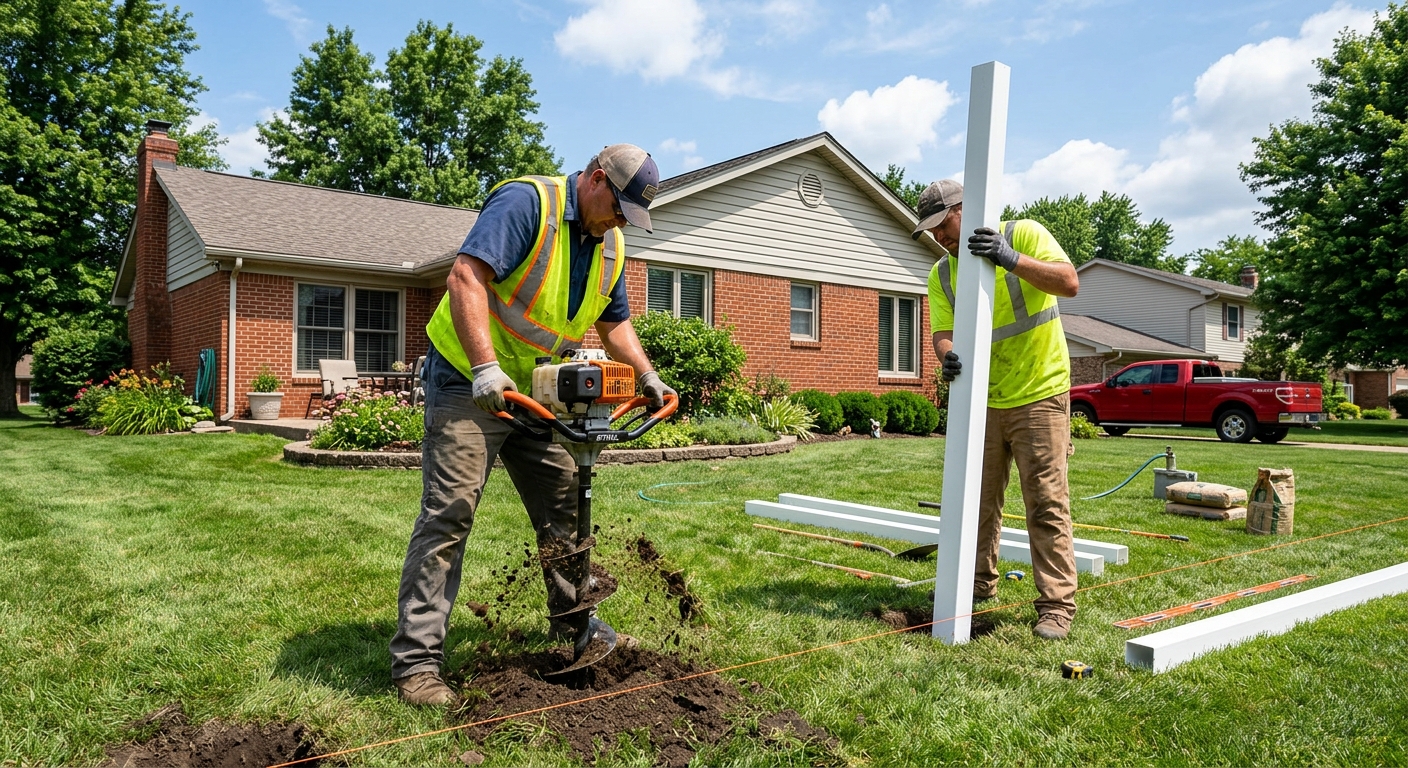
In Osgoode, fence pricing is shaped by frost depth and soil movement. Contractors typically dig and set posts close to 4 ft (about 3.5–4 ft regional frost depth), often using concrete footings in clay-heavy ground to reduce winter heave and prevent leaning. Wind and drifting snow also matter for privacy fences: even though this isn’t open Prairie exposure, gusts can load panels like a sail, so spacing and hardware selection affect both longevity and labour time.
Another reason you’ll see different quotes is that the “same” fence can require different foundations and longer install days depending on access (driveways, gate widths, and how far crews must haul materials) and on whether you’re removing an old fence. Repairs may be quick, but full replacements in exposed lots can take extra excavation and disposal handling.
To compare common options realistically for Osgoode homeowners, use the table below as a baseline before we tailor the design to your yard and footing requirements.
| Material |
Lifespan |
Maintenance |
Privacy Rating |
Price per Linear Foot |
| Pressure-treated pine (standard wood) |
10–15 years |
Stain/seal every 2–3 years; check posts after winters |
High (solid or close-board) |
$40 – $75 |
| Cedar (natural rot resistance) |
15–25 years |
Periodic staining/finishing; inspect for warping |
High (solid or close-board) |
$50 – $85 |
| Vinyl / PVC (no-maintenance) |
20–30 years |
Rinse occasionally; no painting |
Medium–High (style-dependent) |
$45 – $80 |
| Chain-link (galvanized steel) |
20–30 years |
Minimal; occasional tension/hardware checks |
Low (open mesh) |
$25 – $50 |
| Aluminum ornamental |
25–40 years |
Occasional wash; inspect gates/hardware |
Low–Medium (pickets) |
$70 – $120 |
| Composite / recycled material |
25–35 years |
Low; keep fasteners secure |
High (slat/solid styles) |
$85 – $130 |
Prices are estimates only and vary by project scope, site access and material selection.
What affects the price of fencing in Osgoode
In Osgoode, two contractors can price the same fence very differently—often by 30–50%—because their assumptions about groundwork, material type, and wind-ready construction vary. Even within the Ottawa region, access and soil conditions can change quickly from one property to the next, and those differences hit your quote directly through labour hours, machine time, and disposal. One crew might price a “standard” post install; another might correctly account for deeper excavation and concrete set for frost protection in clay, which is common around parts of Ottawa-area lots.
The biggest driver is frost depth. Ottawa’s regional frost depth is about 3.5–4 ft, and quality installations typically bury posts close to 4 ft to reduce winter heave. In practical terms, that means deeper holes (often roughly 4–6 inches below the design frost line) and longer posts, plus more concrete when crews use proper footings. That added digging can also increase cleanup and haul-away costs, pushing wood or cedar projects upward toward the upper end of the $40 – $75 wood range.
Wind exposure affects post spacing, rail sizing, and panel strength. In colder months, drifting snow can increase effective wind loads on privacy fences, so contractors may space posts a bit closer and increase bracing. That’s one reason vinyl or PVC—which sits firmly when installed correctly—can still come in near $45 – $80 per foot even though material is higher: labour and stronger installation details matter as much as the panel itself.
Concrete examples from Osgoode installs: (1) clay soils that “shift” during freeze–thaw often require concrete footings rather than a gravel-only pack, adding cost but reducing leaning; (2) a backyard that’s accessible only through a narrow side gate may slow equipment setup and increase labour hours; (3) a sloped yard that needs stepped panels increases layout time and sometimes waste materials—especially with composite and vinyl systems.
| Price Factor |
Why It Matters |
Cost Impact |
| Fence length in linear feet |
Most labour and materials scale directly with total run |
High (primary driver; drives the majority of your total) |
| Post depth required |
Frost line determines post length and hole depth to prevent heave |
Medium–High (often adds concrete, digging and longer materials) |
| Post setting method |
Concrete vs. gravel pack vs. driven posts changes durability |
Medium (concrete and mixing raise cost but improve stability) |
| Material choice |
Vinyl vs. cedar vs. chain-link varies in cost, install time and hardware |
High (can shift you between price bands) |
| Gate count and type |
Drive-through double gates cost more in framing and hardware |
Medium–High (gates are labour-intensive and require stronger posts) |
| Grade and terrain |
Slope requires stepped/raked panels and more layout/waste |
Low–Medium (can rise if the run is complex) |
| Old fence removal and disposal |
Deconstruction, hauling and dump fees affect total time |
Medium (can add noticeable cost on replacement projects) |
| Permit fees and survey / property line locate |
Requirements vary by height and location of boundary |
Low–Medium (avoidable if you already have documentation) |
Permits & regulations in Ontario
In Ontario, fence rules are tied to height limits, property line location, and (in many cases) whether the fence is considered part of a structural boundary. As a homeowner in Osgoode, plan on permits for fences above a typical height threshold—often around 2.0 m (6.5 ft) along rear yards, and roughly 1.0–1.2 m (3–4 ft) near front yard areas or corners—though exact thresholds can vary by municipal bylaw. The safe approach is to confirm your lot’s zoning and bylaw requirements with your municipality before you buy materials or schedule excavation.
Shared fence ownership is governed by Ontario’s line-fences framework, so if the fence is on or near a shared boundary, clarify responsibilities in writing with the neighbour before removal or replacement. Also remember: all fences must respect property lines and municipal setback requirements.
Before any post-hole digging, call for utility locates through Ontario One Call (utility marking) to avoid hitting buried services. You should also obtain a survey or locate your property pins so you don’t encroach—fence disputes often start with “we thought it was on the line” assumptions.
Licence and insurance checks are practical, not optional. Ask for proof of contractor licence status (where applicable), certificate of liability insurance showing the policy is active, and evidence of WSIB coverage/clearance or the applicable workers’ compensation account status. Verify directly by requesting the clearance letter or coverage documentation and matching the named business to the quote and invoice.
Choosing the right fence material for Osgoode
Choosing the right fence material in Osgoode is mostly about matching your priorities—privacy, low maintenance, budget, and lifespan—to how our winters stress fences. With Ottawa-area frost depth driving deep post setting (often close to 4 ft) and freeze–thaw pressure on soil, the material you choose matters—but the installation quality and footing matter just as much.
Pressure-treated pine is the budget-friendly option, but it typically needs staining or sealing every 2–3 years to prevent grey weathering and to keep the surface stable through wet snow and melt cycles. Cedar usually costs more upfront yet holds up better visually thanks to natural rot resistance, and many homeowners like its look without needing the same level of structural replacement as cheaper wood—still, it benefits from periodic staining/finishing. Vinyl/PVC can be a good low-maintenance choice because you don’t paint it, but extreme cold can make poor installation (weak post anchoring or wrong spacing) show up as cracking or warping over time.
For the lowest cost and long service life, chain-link is hard to beat, but it doesn’t provide privacy unless you add slats or screening. Aluminum ornamental is durable and rust-resistant, but it’s more mid-range and generally offers less privacy. Composite/recycled systems often provide excellent privacy and colour stability, but they can be higher priced and still require correct post depth and good bracing for snow and gust loads.
Here’s where dollars make sense: if you’re comparing standard wood at roughly $40 – $75 per linear foot versus cedar that can land around $50 – $85, the extra you pay for cedar is justified when you want a better long-term appearance and you’re willing to maintain it to preserve the look. If you truly want minimal upkeep and steady performance through Osgoode winters, vinyl around $45 – $80 often competes well once you factor in maintenance savings—especially if your fence line is inconvenient to access for staining.
| Material |
Cold Tolerance |
Lifespan |
Annual Maintenance |
Best For |
Price Band |
| Pressure-treated pine |
Good with correct post depth and sealant |
10–15 years |
Light: inspection after freeze–thaw; stain as needed every 2–3 years |
Budget privacy with a willingness to maintain |
$40–$75 |
| Cedar |
Good; handles moisture swings better than many softwoods |
15–25 years |
Light–Moderate: stain/finish periodically |
Premium look and better natural rot resistance |
$50–$85 |
| Vinyl / PVC |
Very good when installed with proper bracing and post anchoring |
20–30 years |
Very low: occasional wash and hardware checks |
Low maintenance privacy in cold Ontario |
$45–$80 |
| Chain-link |
Excellent; galvanized steel resists cold and impact |
20–30 years |
Low: tension and post hardware checks |
Security with minimal cost |
$25–$50 |
| Aluminum ornamental |
Excellent; coating protects in freeze–thaw |
25–40 years |
Low: rinse and inspect for loose fittings |
Front-yard aesthetics and durability |
$70–$120 |
| Composite / recycled |
Good; performance depends on correct install and ventilation design |
25–35 years |
Low: periodic cleaning and fastener checks |
Privacy with long-term colour stability |
$85–$130 |
How to choose a fencing contractor in Osgoode
When you hire a fence contractor in Ontario, verify the basics first: liability insurance, workers’ compensation coverage (WSIB/WCB), and—where applicable—licensing for the business performing the work. Start by requesting certificates of insurance that list the correct legal business name and show the policy is active for the work term. For workers’ compensation, ask for proof of WSIB clearance or coverage status for the contractor (and any named subcontractors). Don’t accept vague “we’re covered” statements—ask to see the documentation.
Next, get 2–3 itemised written quotes rather than lump sums. Good quotes break down labour and materials (posts, rails, pickets/panels, fasteners, concrete, gates, and removal/disposal). Read what’s excluded: for example, is concrete included for post setting? Is permit handling included if the height triggers one? Is old fence removal and dump disposal priced in, or billed separately after site access is confirmed?
Warranty matters. Ask for both workmanship warranty length and the product/manufacturer warranty, and confirm whether the warranty is transferable if you sell the home. Also discuss payment scheduling: never pay more than about 10–15% upfront, and use a holdback until completion and cleanup are verified. Finally, insist on a written start date and an estimated completion timeline so you can plan around weather delays—important in Osgoode where winter access and frost conditions can affect excavation schedules.
- Ask for certificate of insurance and confirm active coverage dates.
- Request WSIB clearance/coverage proof (and subcontractor coverage if used).
- Verify the quote is itemised: materials, labour, posts, rails, hardware, concrete, and gates.
- Confirm post depth approach for Ottawa-area frost (typically near 4 ft) and whether concrete is used.
- Clarify disposal: is old fence removal and dump cost included?
- Confirm whether a property line locate/survey is required or recommended.
- Ask who pulls permits if height thresholds require them and whether fees are included.
- Ensure gates are quoted with the stronger framing and correct latch/hardware.
- Require a detailed scope for slopes (stepped vs. raked panels) and how measurements are taken.
- Get warranty details in writing (workmanship and product) and ask if it’s transferable.
- Use a payment plan with only 10–15% upfront and a holdback until the fence is complete.
- Ask for a written start/completion estimate and how weather impacts scheduling.
Red flags to watch in Osgoode: (1) they won’t discuss post depth or footing method for frost; (2) they provide a vague lump-sum without listing concrete, hardware, and gate framing; (3) they ask for large upfront payments or refuse a holdback; (4) they can’t produce insurance and WSIB/coverage documents on request; (5) they dismiss utility locates or property line accuracy as “not a big deal.”
Frequently asked questions — fencing in Osgoode
What is the cost per linear foot for fencing in Osgoode?
In Osgoode, typical installed pricing depends heavily on material and footing requirements, especially because posts usually must be set deep enough to handle Ottawa-area frost (often close to 4 ft). As a practical baseline, wood fences generally land around $40 – $75 per linear foot, while vinyl/PVC is commonly $45 – $80 per linear foot. Chain-link is usually the lowest at about $25 – $50 per linear foot, and aluminum ornamental often comes in higher around $70 – $120 per linear foot. Final totals swing with fence length, gate count, soil conditions (especially clay), and whether you’re removing and disposing of an old fence.
Should I repair or replace my old fence in Osgoode?
Repair can make sense when the fence posts are still solid and only panels/rails are failing, which is common after a single winter season. If you’re seeing leaning posts, repeated loosening at the base, or rot where the fence meets ground level, replacement is usually the better long-term value—because deeper post setting and correct footing protect against heaving from frost–thaw cycles in Ontario. For an older fence, also check whether the layout can be improved: adding correct bracing and adjusting post spacing can improve wind stability even in less extreme exposure areas. A quote that itemises post replacement versus panel-only repairs will clarify whether you’re paying for healthy structure or just patching a boundary that will keep failing.
How do I handle a fence dispute with a neighbour in Ontario?
Start with facts: confirm the property line using survey pins/locates rather than relying on who built the fence first. In Ontario, shared boundary responsibilities can fall under line-fences legislation concepts, but disputes usually come down to what’s on the boundary and what each party is responsible for. In Osgoode, I recommend you document everything (photos, measurements, and any prior correspondence) and keep communication calm and written. If the fence is encroaching, a contractor can help by mapping the proposed alignment—yet only a surveyor can definitively confirm pins. Avoid digging until utility locates are done through Ontario One Call. If needed, consider mediation or legal advice rather than unilateral changes that could worsen the dispute.
What fence style offers the best wind resistance in Osgoode?
For Osgoode’s Ottawa region, wind resistance is mainly about how the fence “acts” under gusts and drifting snow loads. Solid privacy styles (wood close-board, vinyl privacy with proper bracing, or composite panels) can perform well when posts are set correctly and rails/bracing are sized for the load, rather than relying on wide post spacing. If the fence is too open, strong winds can still stress posts through turbulence; if it’s too weak, solid panels can rack. In practice, the best results come from correct post spacing, deeper frost-protected footing (often near 4 ft), and hardware that doesn’t loosen over freeze–thaw. Chain-link generally endures wind well structurally but won’t provide privacy, so it’s often used with screening if privacy is also a goal.
How much does a fence cost in Osgoode?
Total fence cost in Osgoode depends on linear footage, height, material, gates, and whether you need removal/disposal. Per-foot ranges help set expectations: wood is commonly $40 – $75, vinyl/PVC is around $45 – $80, chain-link is about $25 – $50, and aluminum ornamental often lands at $70 – $120 per linear foot. Two yards with the same length can still differ by 30–50% because post depth and footing method must suit Ottawa-area frost and soil—especially when clay requires concrete-set posts. If you have a double drive gate or complex sloping terrain, budget extra for framing and layout time beyond the per-foot baseline.
How deep should fence posts be for Osgoode's frost?
For Osgoode and the Ottawa economic region, you should plan post holes deep enough to resist winter heave caused by frost depth of about 3.5–4 ft. In quality installs, that typically means setting posts close to 4 ft and, in many designs, digging roughly 4–6 inches below the design frost depth so the footing sits below the heaving zone. Practically, that often requires about 1.5–2.0 m into the ground depending on the exact site and design approach, plus longer posts and more excavation. Many contractors use concrete setting where soil movement is likely (particularly clay) to keep posts stable through repeated freeze–thaw cycles. Always ensure a contractor confirms the depth and footing method in writing before work begins.