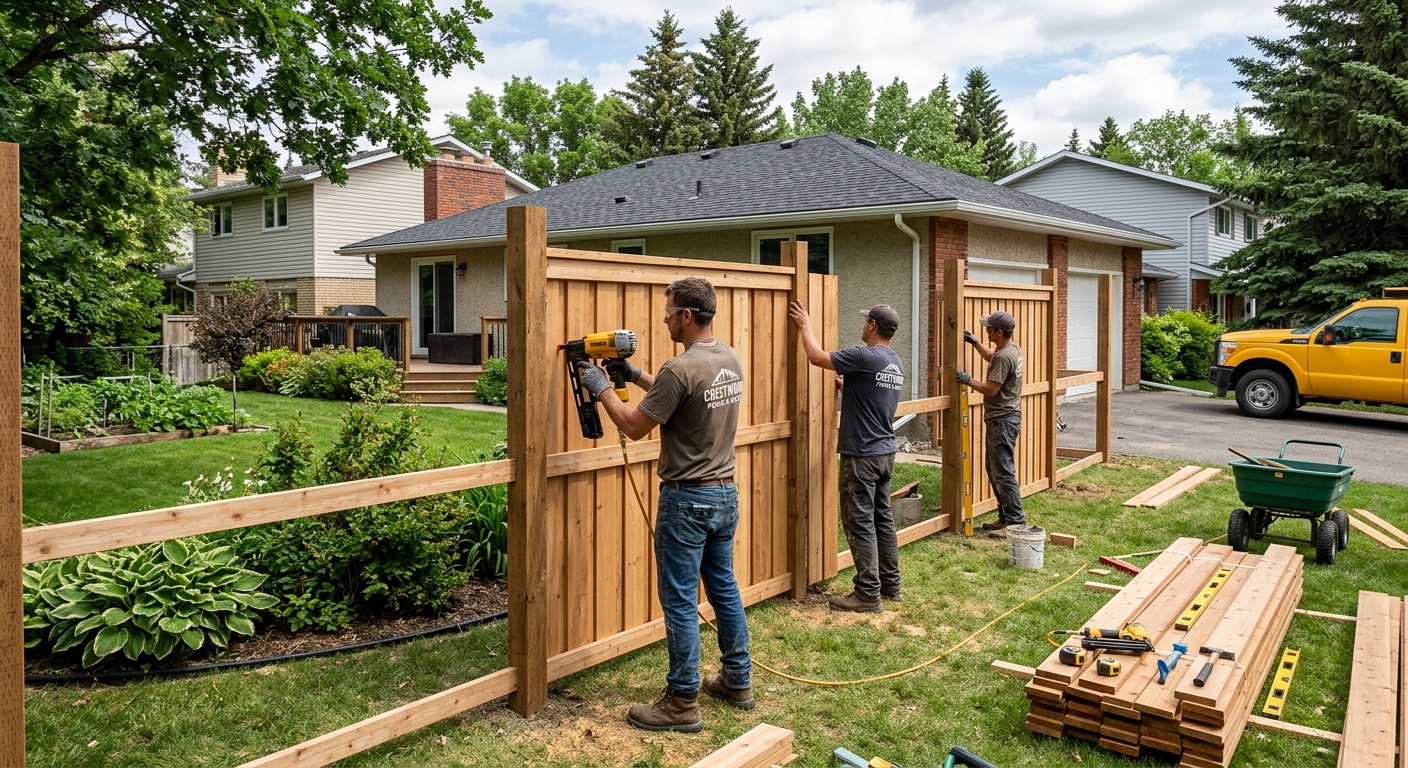
Fencing options and costs in Southwood
In Southwood, Ontario, the right fence is usually less about style and more about what keeps working through freeze-thaw cycles, winter snow, and windy spring days. With a population of 4,751 (Statistics Canada, 2021 Census), the neighbourhood may be smaller than central Toronto, but fencing demand is steady because detached homes are a common draw for families who invest in boundary privacy. In the broader Toronto economic area, the mix of older housing stock and new infill means contractors often see both full fence replacements and targeted section repairs.
Cost in Southwood follows Toronto best practice: frost protection drives deeper concrete-set footings, especially for 6–8 ft privacy fences. The commonly used frost line guideline in Southern Ontario is about 42"–48", so posts are typically set a minimum of 3.5–4 ft deep to reduce frost heave risk—this adds labour time and increases ready-mix costs. On top of that, local soil conditions (including clay/mixed soils around the GTA) affect excavation effort and how much concrete is needed. If you’re in the busier pocket of town near Southwood Boulevard where driveways and corner lots are common, gate upgrades and longer privacy runs are especially in demand, which can also influence pricing.
Below is a practical comparison of the main material options you’ll see in Southwood and across the Toronto region, including typical lifespan and expected per-linear-foot pricing.
| Material |
Lifespan |
Maintenance |
Privacy Rating |
Price per Linear Foot |
| Pressure-treated pine (standard wood) |
10–15 years |
Stain/paint every 2–3 years to slow grey weathering |
High (solid boards) |
$65 – $120 |
| Cedar (natural rot resistance) |
15–25 years |
Seal/stain every 2–4 years depending on exposure |
High (solid boards) |
$85 – $135 |
| Vinyl / PVC (no-maintenance) |
20–30 years |
Occasional rinse; no staining |
High (solid privacy panels) |
$75 – $130 |
| Chain-link (galvanized steel) |
20–35 years |
Rinse/inspect ties and tension; minimal other work |
Low–Medium (not true privacy unless added screening) |
$45 – $85 |
| Aluminum ornamental |
25–40 years |
Wash 1–2 times per year; check gate hardware |
Low (open pickets) |
$90 – $160 |
| Composite / recycled material |
20–30 years |
Low; clean as needed (varies by brand) |
High (solid/composite boards) |
$95 – $160 |
Prices are estimates only and vary by project scope, site access and material selection.
What affects the price of fencing in Southwood
In the Toronto economic region, two quotes for what sounds like the “same” fence can differ by 30–50% because the underlying installation realities aren’t the same: footing depth, post spacing, gate complexity, and how hard the ground is to excavate. Even within Ontario, labour and material availability in the Toronto area can swing quickly when crews are booked for spring and early fall installs. The result is that a smaller material upgrade can look minor on paper, but it changes how crews set posts, fasten panels, and manage waste.
Frost depth is the first big lever. In cold Ontario conditions, posts usually must go about 1.5–2.0 m into the ground (roughly 5–6.5 ft) to sit below the frost heave zone. To do that safely, contractors use longer posts and a more concrete-heavy footing approach—so wood fences that might be inexpensive on the lumber list can climb toward the $65–$120 band once concrete-set construction is included. Gate-heavy privacy fences also typically land in the $75–$130 range for vinyl/PVC and can exceed it when heavier hardware is required for tall panels.
Southwood-specific examples that often raise costs include clay pockets that slow augering, tight rear access that requires more manual digging, and yards with multiple levels where crews must step or rack panels. Costs can drop when you’re replacing only a section with good straight-line access and minimal grading, because footing work and demolition are reduced. Local wind is generally less punishing than prairie exposure, but taller solid privacy runs still need appropriate post size and spacing to prevent racking—especially during spring thaw storms.
| Price Factor |
Why It Matters |
Cost Impact |
| Fence length in linear feet — the primary cost driver |
Most costs scale directly with how many feet of fence need building |
High (largest driver) |
| Post depth required — frost line determines post length and hole depth |
Deeper holes and longer posts increase excavation and materials |
High (major change from “shallow” installs) |
| Post setting method — concrete vs. gravel pack vs. driven posts |
Toronto best practice usually favours concrete-set for stability |
Medium–High |
| Material choice — vinyl vs. cedar vs. chain-link |
Different material pricing and different hardware/post requirements |
Medium–High |
| Gate count and type — walk-through vs. drive-through (double) |
Gates require reinforced framing, hinges, latches, and often different posts |
Medium (can be high for drive-through) |
| Grade and terrain — sloped yards require stepped or raked panels |
Slopes affect layout, cutting, and panel angle/stepping |
Medium |
| Old fence removal and disposal |
Demo time, dump fees, and hauling vary by condition |
Medium (sometimes high if heavily damaged) |
| Permit fees and survey / property line locate |
Administrative and locating work can be mandatory depending on height/location |
Low–Medium |
Permits & regulations in Ontario
In Ontario, whether you need a permit often depends on fence height and its location. As a practical rule of thumb, fences above a height threshold—commonly around 2.0 m (6.5 ft) at the rear and 1.0–1.2 m (3–4 ft) at the front or corner—may require a building permit, especially where the fence affects sightlines. Regardless of permit requirements, all fences must respect property lines and municipal setback bylaws.
Before any digging, you should also call for utility locates through Ontario One Call. Post-hole excavation can intersect buried services, and hitting a line can halt your project and create expensive repairs. If you’re unsure where the boundary is, get a survey or locate your property pins before installing. This is one of the most common ways homeowners avoid costly disputes with neighbours.
For shared fencing, Ontario line-fences rules typically govern who owns the fence and who is responsible for maintenance, depending on how the fence was constructed and the neighbour agreements in place. For your contractor verification: you’ll want to confirm they have the right Ontario business licensing for fence contracting and that they can provide liability insurance and proof of coverage consistent with their work (including WSIB/WCB clearance where applicable). A simple way to check is to request their certificate of insurance and clearance letter, then verify coverage details before work begins.
Choosing the right fence material for Southwood
In Southwood and across the Toronto market, your best fence material is the one that matches your priorities: privacy, low maintenance, and how long you want to wait before a full replacement. Pressure-treated pine is usually the lowest upfront option, but it needs staining or painting every 2–3 years in Ontario to prevent grey weathering and surface degradation. Cedar looks better longer and resists rot naturally, yet it still benefits from periodic sealing—especially on fence faces exposed to prevailing wind and winter sun-snow cycles.
Vinyl/PVC is the low-maintenance choice for homeowners who don’t want to keep staining. The trade-off is that in extreme cold, some vinyl products can become brittle; good installation (proper spacing, post reinforcement, and correct temperature handling) helps. Chain-link is the most economical and long-lasting, but it doesn’t deliver privacy unless you add privacy slats or screening. Aluminum ornamental offers a rust-resistant, mid-range path with attractive curb appeal, though it’s not designed for privacy. Composite/recycled boards can provide solid privacy with low maintenance, but costs often sit higher than basic wood.
Because Toronto’s frost guideline is about 42"–48", you should plan for concrete-set posts rather than simple driven posts on taller privacy fences. That means the “material savings” of wood sometimes shrink once correct post depth and labour are included. For example, moving from chain-link in the $45–$85 band to a solid wood privacy fence in the $65–$120 band can be justified if you need day-to-day privacy and wind resistance—not just boundary definition.
| Material |
Cold Tolerance |
Lifespan |
Annual Maintenance |
Best For |
Price Band |
| Pressure-treated pine |
Good with proper post depth and regular coating |
10–15 years |
Light inspection; stain/paint every 2–3 years |
Budget privacy with a willingness to maintain |
$65 – $120 |
| Cedar |
Very good; performs well through wet winters when sealed |
15–25 years |
Wash as needed; seal/stain every 2–4 years |
Premium wood look and better natural rot resistance |
$85 – $135 |
| Vinyl / PVC |
Good; needs correct installation in deep cold |
20–30 years |
Minimal (rinse/inspect hardware) |
Low-maintenance privacy |
$75 – $130 |
| Chain-link |
Excellent; galvanized steel resists Ontario moisture |
20–35 years |
Inspect tension and re-secure posts as needed |
Security and long-term value with limited privacy |
$45 – $85 |
| Aluminum ornamental |
Excellent; powder coating holds up to winter |
25–40 years |
Occasional rinse and hardware checks |
Curb appeal and durability |
$90 – $160 |
| Composite / recycled |
Good; performance depends on product design |
20–30 years |
Low (cleaning and occasional hardware inspection) |
Solid privacy with reduced upkeep |
$95 – $160 |
How to choose a fencing contractor in Southwood
Choosing a contractor in Southwood is mostly about proof. First, verify their Ontario business presence and confirm they can provide liability insurance with the certificate showing the insured limits and job address. Then check that they have the appropriate WSIB/WCB clearance for their workers (request the clearance document rather than relying on a verbal statement). If a contractor can’t provide these documents promptly, that’s a quality red flag right away.
Next, request 2–3 itemised written quotes—not lump sums. You want a breakdown that separates lineal materials, labour hours, post excavation/set method, concrete/footings, gates and hardware, and disposal/dump fees. Make sure the quote states whether permits are included (where needed), whether a property-line locate is included, and whether the price assumes existing fence removal. Look for warranty details in writing: a workmanship warranty term (often on the installation), plus any manufacturer product warranty and whether it’s transferable if you sell the home.
For payment scheduling, never pay more than 10–15% upfront. Hold back a portion until the fence is complete and passes final alignment/grade checks. Finally, ask for an exact start date and a completion estimate in writing; if the schedule isn’t clear, budget overruns become likely once trenching and concrete curing start.
- Request COI (certificate of insurance) before signing
- Ask for WSIB/WCB clearance letter (for their workers) and confirm dates
- Get 2–3 itemised quotes with labour vs materials listed
- Confirm post depth and the setting method (concrete-set for privacy in winter zones)
- Verify gate reinforcement, latch type, and hinge hardware included
- Check whether disposal of old fencing is included
- Confirm who pulls permits (if required by height/location)
- Include a scope statement for property line locate/survey responsibility
- Ask for a workmanship warranty term and what it covers
- Ensure product warranty details are included (brand/model and terms)
- Clarify payment schedule and retainage/holdback
- Get a written start date and completion timeframe
Red flags in Southwood typically include: vague “all-in” pricing without line-item breakdowns, refusal to show insurance/WSIB documents, promising concrete-set stability while writing “driven posts” in the fine print, requesting a large deposit upfront, and avoiding questions about utility locates or property line confirmation.
Frequently asked questions — fencing in Southwood
How deep should fence posts be for Southwood's frost?
For Southwood and the broader Southern Ontario frost conditions, plan on setting fence posts deep enough to sit below the frost heave zone. A common best-practice guideline is that posts go about 1.5–2.0 m into the ground (roughly 5–6.5 ft), which aligns with the region’s typical 42"–48" frost line assumption and adds a safety buffer. For taller 6–8 ft privacy fences, this is where many projects justify concrete-set posts rather than driven posts, because the heavier panels and wind forces can stress shallow foundations. If your soil is clay-heavy or you’ve had heaving before, deeper is even more important. Your contractor should clearly state post depth and setting method in the written scope before you compare prices (whether you’re in the $65 – $120 wood range or $75 – $130 vinyl range).
Wood vs vinyl vs aluminum fence — which is best?
“Best” depends on what you want most. If you need privacy and can handle periodic upkeep, wood (pressure-treated pine or cedar) often delivers the strongest privacy feel per dollar; pressure-treated pine typically fits the $65 – $120 band, while cedar usually lands higher. If low maintenance is your priority, vinyl/PVC is usually the easiest ownership experience in Ontario—its typical band sits around $75 – $130, and you’ll mostly do occasional rinsing and hardware checks. Aluminum ornamental is best when curb appeal matters more than privacy; it’s usually priced in the $90 – $160 range and works well where you want durability without heavy visual screening. For winter performance, the real “tie-breaker” is installation quality: correct post depth and proper hardware matter as much as material choice in Southwood.
Do I need a permit to build a fence in Ontario?
Often, yes—sometimes. In Ontario, fences above common height thresholds (often around 2.0 m (6.5 ft) at the rear and about 1.0–1.2 m (3–4 ft) near the front or corner) may require a building permit, depending on the municipality and how the fence affects sightlines and setbacks. Even when a permit isn’t required, you still must follow property line rules and municipal setback bylaws. Before digging, always call for utility locates through Ontario One Call. Also consider confirming your property boundary via survey or property pins to prevent encroachment disputes. When you request quotes in Southwood, ask whether permit pulling is included in the scope (and who is responsible for it) so you can compare apples-to-apples, especially when pricing sits anywhere from $45 – $85 for chain-link up to the $90 – $160 metal range.
How long does a wood fence last in Southwood?
A well-built wood fence in Southwood typically lasts about 10–15 years for pressure-treated pine and 15–25 years for cedar, assuming correct post depth, proper drainage around footings, and ongoing surface protection. The Toronto-area freeze-thaw cycle can accelerate wear if posts are too shallow or if fasteners aren’t installed correctly, which can lead to loosened boards and faster rot at stress points. Maintenance plays a big role: for pressure-treated pine, staining/painting every 2–3 years helps slow grey weathering and moisture penetration. For cedar, sealing every 2–4 years is a common approach depending on sun and wind exposure. If you’re budgeting, it’s worth remembering that the installed cost for a correct concrete-set build in Southwood typically aligns with the $65 – $120 wood pricing band rather than “lumber-only” expectations.
Who owns and maintains a shared fence?
In Ontario, shared fence ownership and maintenance responsibilities are generally handled under Ontario line-fences legislation and the circumstances of how the fence was built or agreed upon with the neighbour. In practice, that means who maintains it can depend on whether the fence is on the property line, whether both parties agreed to it, and whether any cost-sharing arrangement exists. If you’re unsure, check for any past agreements, documents from the original installation, and whether the fence is truly located along the boundary (this is why surveys or property pin locates matter). When planning work in Southwood, it’s wise to confirm with your neighbour before demolition so you don’t end up rebuilding at your own expense due to a boundary misunderstanding. A professional quote should also clearly state demolition and disposal scope so both parties can agree on what’s included.
How do I find my property line before fencing?
Start with the most reliable method: a survey or locating your property pins. Property pins (or the legal boundary markers) show the true line better than “what the neighbours say.” If you don’t have a recent survey, ask your contractor whether they can arrange a locate/survey as part of the project scope—many quotes in Southwood include this only when needed. Before any post-hole digging, confirm the utility service locations through Ontario One Call so you can dig safely along the boundary. Also, request a clear site layout plan (measurements and fence alignment) from your contractor, because even good fencing can become expensive if it’s installed on the wrong line. If the contractor won’t talk about property line verification up front, treat it as a warning—especially for taller privacy fences that may need permits.