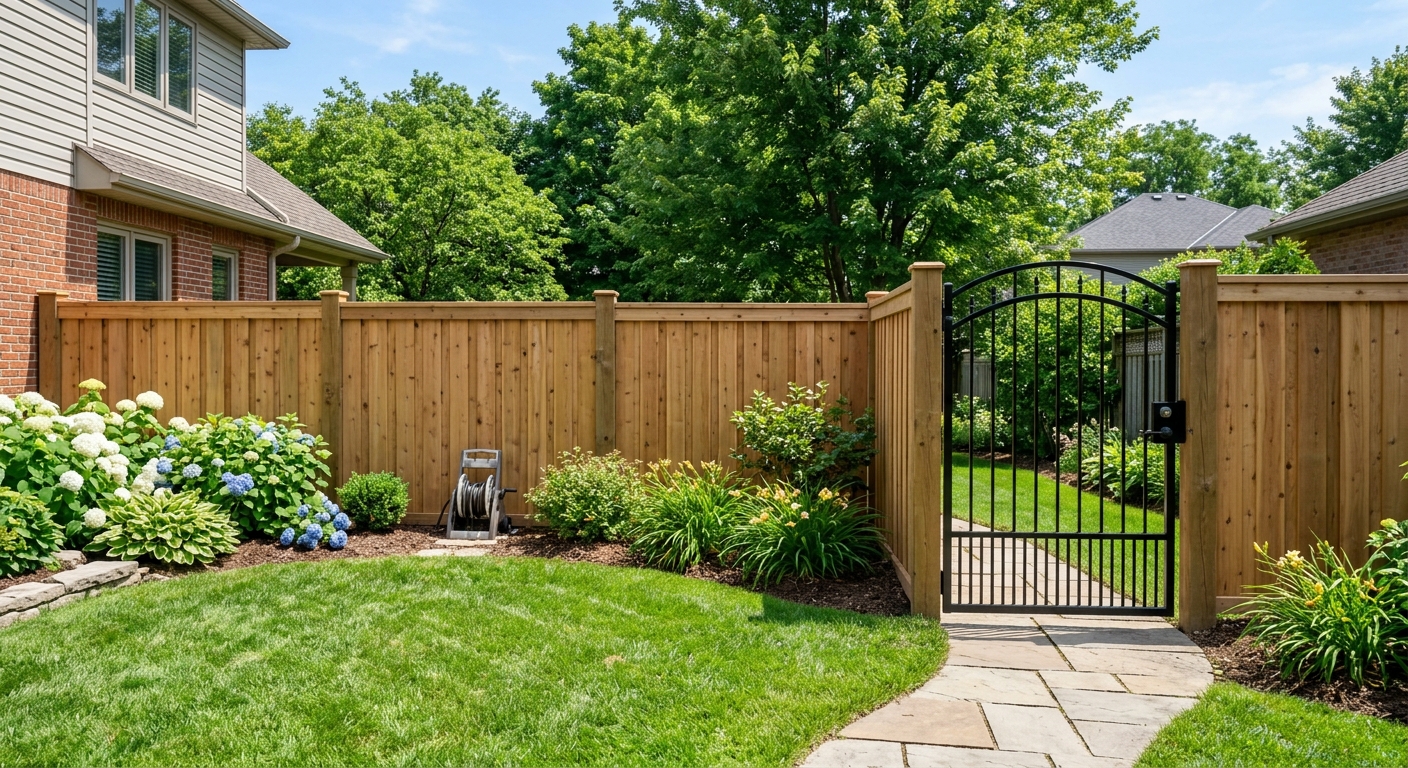
Fencing options and costs in Lindsay
Lindsay, Ontario has a steady mix of family properties and older lots, and that steady demand shows up in fencing availability. With a population of 20,354 (Statistics Canada, 2021 Census), most projects here come from homeowners looking to tidy sideyards, replace aging back fences, or add privacy near back decks. In neighbourhoods where single-detached homes are common, each backyard fence line becomes a practical “must-do,” especially where kids, pets, or summer gatherings increase day-to-day use.
Pricing in the Kingston–Pembroke economic region is strongly shaped by frost line depth and freeze–thaw movement. Southern and eastern Ontario frost penetration is commonly taken at about 1.2 m, so contractors typically set posts 36–48 inches deep to reduce heaving. Along clay and silty areas—where water can sit—many crews favour deeper auger holes and concrete-set posts for structural sections and gates, which increases labour and materials. Wind also plays a role: while Lindsay isn’t as exposed as some Prairie sites, sections near Lake Ontario and the Bay of Quinte can see stronger gusts, so privacy fences may need tighter post spacing or more robust framing.
In Lindsay’s growing areas like north-side pockets off Durham Street (including the wider corridors leading toward the Highway 35 area), demand tends to spike for privacy styles and replacement projects where existing rails have shifted. Use the table below to compare typical options and price bands by material.
| Material |
Lifespan |
Maintenance |
Privacy Rating |
Price per Linear Foot |
| Pressure-treated pine (standard wood) |
10–15 years |
Stain/seal every 2–3 years to slow grey weathering |
8/10 (solid boards) |
$55–$95 |
| Cedar (natural rot resistance) |
15–25 years |
Light staining or sealing every 2–4 years |
8/10 (solid boards) |
$75–$115 |
| Vinyl / PVC (no-maintenance) |
20–30 years |
Rinse off dirt; no staining or painting |
8–9/10 (solid privacy panels) |
$90–$140 |
| Chain-link (galvanized steel) |
20–40 years |
Occasional wash; keep tension on top rail |
2–4/10 (screening required for privacy) |
$40–$80 |
| Aluminum ornamental |
25–40 years |
Minimal; wash and check hardware |
3–5/10 (open pickets) |
$95–$160 |
| Composite / recycled material |
20–30 years |
Low; occasional cleaning |
7–9/10 (solid styles) |
$85–$135 |
Prices are estimates only and vary by project scope, site access and material selection.
What affects the price of fencing in Lindsay
In Lindsay and across the Kingston–Pembroke economic region, it’s common to see quotes for the “same” fence swing by 30–50% once you compare post depth, gate complexity, and how difficult the ground is. Factors that change the quote include how far the posts must be set below frost, how windy the run is, and whether the installer needs to concrete-set structural sections. Ontario’s larger swings in labour and material costs also reflect current lumber, PVC resin, and steel pricing, which can move faster than most homeowners expect.
Frost line depth is the first driver. In this region, southern and eastern Ontario frost penetration is commonly taken at about 1.2 m, so installers often set posts 4–6 inches below that “design frost” depth to limit heaving. That frequently means posts are installed roughly 1.5–2.0 m into the ground, especially with clay or silty soil that holds moisture through freeze–thaw cycles. Longer posts and deeper auger work raise material cost and slow production, pushing solid privacy fences toward the higher end of the wood range (often near $55–$95 for standard wood) and, for more robust builds, beyond.
Wind exposure matters too. Where gusts are higher (notably near lake-influenced corridors), contractors may reduce post spacing or upsize rails and framing—often necessary for 6–8 ft privacy fences—to prevent racking and sagging. For a wood privacy fence that would normally fall nearer $55/ft, adding structural bracing and deeper concrete-set posts can justify paying toward the top of the band.
Concrete examples from local conditions in and around Lindsay: (1) clay-heavy ground can increase concrete and auger time because holes hold water and need more prep; (2) yards that hit hardpan or rock may require hand-digging or coring, increasing per-foot labour; (3) tight side yards off residential streets can force more labour time for moving materials and setting posts, even if total linear feet are unchanged.
| Price Factor |
Why It Matters |
Cost Impact |
| Fence length in linear feet |
Most material and labour are scaled directly by total length |
Highest impact across all budgets |
| Post depth required |
Frost line determines hole depth and required post length |
Can raise costs materially when moving from shallow to frost-depth setting |
| Post setting method |
Concrete vs. gravel pack changes labour, concrete volume, and cure time |
Concrete-set posts typically increase cost and schedule |
| Material choice |
Vinyl, cedar, and chain-link use different components and install methods |
Shifts the project between wood (~$55–$95/ft) and vinyl (~$75–$140/ft) |
| Gate count and type |
Gates require heavier hardware, framing, and often diagonal bracing |
More gates generally adds both materials and labour |
| Grade and terrain |
Sloped yards need stepped bases or raked panels to maintain clearance |
Adds layout time and increases offcuts |
| Old fence removal and disposal |
Demolition, haul-away, and recycling/disposal fees vary by condition |
Often a meaningful add-on versus install-only quotes |
| Permit fees and survey / property line locate |
Locates and permits reduce risk of encroachment disputes |
Small to moderate cost, but can prevent expensive redesign |
Permits & regulations in Ontario
In Ontario, fences over certain heights may trigger a building permit requirement—commonly around 2.0 m (6.5 ft) at the rear and roughly 1.0–1.2 m (3–4 ft) at the front or corner, depending on your location and how the fence relates to the street. Even when a permit is not required, all fences must respect the property line and municipal setback requirements that apply in your area of Lindsay. A practical rule: if your plan is a tall privacy fence near a corner lot, confirm the applicable setbacks before you order materials.
Before any post holes are dug, homeowners should arrange utility locates through Ontario One Call. This is essential for safety and to avoid damaging buried services. Next, confirm where your property pins or boundary line are—either by using an existing survey or requesting a property locate—because encroachment disputes are one of the most common ways fences become expensive mid-project.
Shared fence ownership is also governed by Ontario’s line-fences legislation, so if you’re tying into an existing fence or repairing a shared boundary, clarify ownership and responsibility before construction starts.
What typically DOES require a permit: installing a fence above the local height threshold (often around 2.0 m rear and 1.0–1.2 m front/corner), or making changes that increase the fence height materially.
What typically does NOT require a permit: replacing an existing fence with the same or lower height in essentially the same location, and routine repairs that don’t alter height or footprint—though you should still verify with the municipality if you’re unsure.
To verify your contractor in Ontario, ask for: (1) their Ontario business licence (or municipal compliance if applicable), (2) proof of general liability insurance (certificate of insurance), and (3) proof of WSIB coverage or the applicable clearance/coverage documentation for workers. Where to check: the contractor’s insurance certificate should list policyholder and coverage amounts; WSIB clearance can be requested directly (or referenced through the WSIB clearance letter they provide); and licensing information is usually available through provincial or municipal contractor/business portals depending on the contractor’s structure. Don’t rely on “we’re insured” as a phrase—ask to see the paperwork before work begins.
Choosing the right fence material for Lindsay
Choosing a fence material in Lindsay is mostly about matching your priorities—privacy, low maintenance, budget, and lifespan—to local climate realities. Kingston–Pembroke’s freeze–thaw cycles mean post durability matters as much as the picket or board material. In practice, that usually means frost-depth post setting, often with concrete-set posts for structural runs and gates.
Pressure-treated pine is the budget-friendly starting point. It’s workable and widely available, but it needs staining or sealing every 2–3 years to prevent grey weathering and to maintain the wood’s surface protection. Cedar offers a better natural rot-resistant profile and typically keeps its appearance longer, but it still benefits from periodic sealing in Ontario’s damp shoulder seasons. Vinyl/PVC is the low-maintenance choice: no staining and easier cleaning, though extreme cold snaps and impacts can crack thinner boards, so a quality install with proper framing and hardware is key. Chain-link is usually the longest-life value—galvanized steel resists rust—but it doesn’t give privacy unless you add slats, screening, or a higher-coverage insert system. Aluminum ornamental provides durability and a clean look without rust, but it’s open by design, so it’s not the best pick for full backyard privacy.
For frost-depth setting in this region, concrete-set posts are often used even for “just a wood fence,” particularly at gates and structural corners. In a typical 6–8 ft privacy run, that means the installation can land closer to the upper wood pricing band near $55–$95 per linear foot when you factor deeper holes and bracing. A specific trade-off example: if vinyl quotes you near the $75–$140 per linear foot range, you’re mainly paying for long-term maintenance savings and resistance to warping—often justified when you want “install once, maintain less” for 15–25+ years.
| Material |
Cold Tolerance |
Lifespan |
Annual Maintenance |
Best For |
Price Band |
| Pressure-treated pine |
Good (surface protection is key) |
10–15 years |
Low to moderate (stain/seal 0.33–0.5 times per year) |
Budget-focused privacy or boundary fencing |
$55–$95 |
| Cedar |
Good (rot resistance helps in wet cycles) |
15–25 years |
Low to moderate (seal every 2–4 years) |
Looks-first privacy with better natural decay resistance |
$65–$115 |
| Vinyl / PVC |
Very good (quality hardware and thickness matter) |
20–30 years |
Minimal (rinse/inspect hardware) |
Low maintenance, long-term privacy panels |
$75–$140 |
| Chain-link |
Very good |
20–40 years |
Minimal (wash and check tension) |
Security with pets/kids containment |
$40–$80 |
| Aluminum ornamental |
Very good |
25–40 years |
Minimal (occasional wash) |
Curb appeal and boundaries where openness is okay |
$80–$160 |
| Composite / recycled |
Good (depends on product formulation) |
20–30 years |
Minimal (cleaning and inspections) |
Privacy with reduced wood-like maintenance |
$85–$135 |
How to choose a fencing contractor in Lindsay
Choosing the right fencing contractor in Lindsay starts with documentation and a clear scope. First, verify Ontario licensing and insurance. Ask for a certificate of general liability insurance showing the policyholder name, coverage limits, and active dates. For worker protection, confirm WSIB coverage—request a WSIB clearance/coverage letter if your contractor works with employees or tradespeople. If the contractor is sub-contracting, ask who carries what coverage and ensure you’re not being left holding the risk if something goes wrong.
Next, get 2–3 itemised written quotes. The best quotes separate labour and materials and list each major component: posts (including frost-depth setting method), rails, panels or pickets, concrete/aggregate amounts, gate hardware, and any surface finishing. Avoid “lump sum only” offers because they make it harder to compare apples to apples. Confirm what’s excluded: does the quote include disposal of the old fence, regrading or backfilling, and any adjustments for uneven ground? If permits are needed for a tall fence, clarify whether the contractor pulls the permit or whether you do.
Warranty matters in fencing because workmanship issues show up after freeze–thaw seasons. Ask for the workmanship warranty length (how long the company stands behind alignment, sagging, or loosening hardware) and whether the product/manufacturer warranty is separate and transferable if you sell your home.
For payment, never pay more than 10–15% upfront. Hold back a portion until the job is complete and cleaned up. Finally, insist on a written timeline: a start date and an estimated completion date reduce the risk of long idle periods, especially when ground conditions and material deliveries affect scheduling.
- Request WSIB coverage proof (or clearance letter) before the first post hole.
- Ask for a current certificate of insurance with liability limits and active dates.
- Confirm whether they are licensed/registered for the business activity in Ontario (and provide evidence).
- Get 2–3 itemised quotes with labour and materials broken out.
- Ensure post depth and setting method are specified (concrete-set vs gravel pack).
- Confirm gate hardware type and whether gates are braced/hinged for wind loading.
- Ask how they handle slopes (stepped vs raked panels) and who adjusts it on-site.
- Clarify demolition scope: is old fence removal and disposal included?
- Confirm disposal haul-away costs and whether debris is left behind.
- Check whether they include property line locate guidance or recommend a survey.
- Read exclusions: buried services issues, rock, or coring—what happens if encountered?
- Get warranty terms in writing and confirm transferability if you sell.
Red flags I see too often in Lindsay: (1) they won’t show insurance/WSIB paperwork; (2) they propose shallow post holes “because the ground is fine,” ignoring frost-depth setting; (3) vague quotes with no breakdown for gates, posts, or disposal; (4) asking for large upfront deposits (well beyond 10–15%); and (5) no written start/completion dates or no clear warranty terms.
Frequently asked questions — fencing in Lindsay
What is the most weather-resistant fence for Lindsay's climate?
For Lindsay and the broader Kingston–Pembroke region, the most weather-resistant overall tends to be vinyl/PVC or properly installed galvanized chain-link. Vinyl/PVC holds up well to Ontario’s freeze–thaw cycling because it doesn’t absorb moisture the way wood does, and it won’t rot in wet spring thaws. Chain-link is also extremely durable because it’s steel with corrosion protection, and the key is correct post setting and tensioning. In practice, the “best” pick is the one that pairs the right material with frost-depth installation: posts set about 36–48 inches deep (often deeper where needed) help prevent heaving. Pricing usually starts around $75–$140 per linear foot for vinyl/PVC and $40–$80 for chain-link, depending on gates and ground conditions.
How do I prevent wood fence rot in Lindsay?
Wood rot in Lindsay is usually about moisture management and surface protection, not just the species. Start with pressure-treated pine or cedar, then use proper installation: frost-depth posts, concrete-set structural posts where appropriate, and keep the bottom rails/pickets from staying in contact with standing water. Seal or stain on a schedule—pressure-treated pine commonly needs staining every 2–3 years to slow grey weathering, while cedar typically needs periodic sealing every 2–4 years. Ensure good drainage at the base of posts and avoid planting vines right against the fence that trap moisture. Finally, choose quality hardware and leave correct ventilation gaps so the boards can dry after rain. If you’re budgeting, wood projects often land around $55–$95 per linear foot, but proper prep and finishes are what protect that investment.
What is the cost per linear foot for fencing in Lindsay?
In Lindsay, installed fencing costs typically cluster within Ontario’s normal band ranges, with local frost-depth post setting and gate complexity pushing higher when ground is clay-silty or when rock or tight access adds labour. As a rough guide, standard pressure-treated wood often comes in around $55–$95 per linear foot, while vinyl/PVC is frequently higher at $75–$140 per linear foot. Chain-link tends to be lowest, commonly $40–$80 per linear foot, while aluminum ornamental often sits in the mid-to-upper range at $80–$160 per linear foot. Your exact total depends on linear footage, post depth requirements, whether concrete-set posts are specified, number of gates, and whether old fence removal is included.
Should I repair or replace my old fence in Lindsay?
Repair is often the best route when only a few sections are damaged, posts are still stable (not leaning or lifted by heaving), and the rails/hardware haven’t deteriorated across the whole line. Replace is usually smarter when you see multiple failing posts, widespread warping, rot at the bases, or repeated sagging after winter freeze–thaw cycles—especially if the fence was installed with shallow post depth. In Lindsay, frost movement can expose weak installation faster than homeowners expect, so a fence that “mostly holds” might still be costing you in ongoing repairs. A practical approach is to have a contractor assess post stability and measure how much alignment is off. Budget-wise, if you’re rebuilding privacy sections, wood often sits around $55–$95 per linear foot, but replacing with a more durable material (like vinyl) can be higher at $75–$140 while reducing future maintenance.
How do I handle a fence dispute with a neighbour in Ontario?
In Ontario, fence disputes usually come down to property lines and responsibility for the boundary. Start by confirming where the boundary actually sits: use an existing survey or request a property line locate if pins aren’t clear. Avoid “eyeballing” corners—especially on older lots where lines can be confusing. If the fence is shared, Ontario’s line-fences legislation can govern shared fence ownership and responsibilities, but the details can vary by situation. Keep communication calm and in writing (texts/emails), and document everything with photos and measurements. If you believe the fence is encroaching, you may need a formal surveyor confirmation before any changes. For resolving, consider mediation or a mutual agreement on repair/replacement scope. In the meantime, don’t dig near boundaries without proper utility locates to prevent service strikes and escalation.
What fence style offers the best wind resistance in Lindsay?
In Lindsay’s Ontario conditions, wind resistance is mostly about how “open” the fence is and how well the framing handles gust loads. Solid privacy fences can catch wind like a sail, so they often need tighter post spacing, stronger rails, and properly braced gate frames—particularly on runs that face prevailing gusts. The most wind-friendly styles are those with partial openness (for example, certain open picket or lattice-lite designs with controlled gaps), because wind passes through rather than creating full uplift and racking forces. That said, if you need privacy, you can still design for wind by using a sturdier privacy system and frost-depth concrete-set posts at structural points. The key is engineering the run, not just choosing a “sturdy-looking” panel. If you’re building 6–8 ft privacy, expect installers to add structural components, which is one reason costs can lean toward the upper end of typical ranges like $55–$95 for wood or higher for vinyl depending on the build.