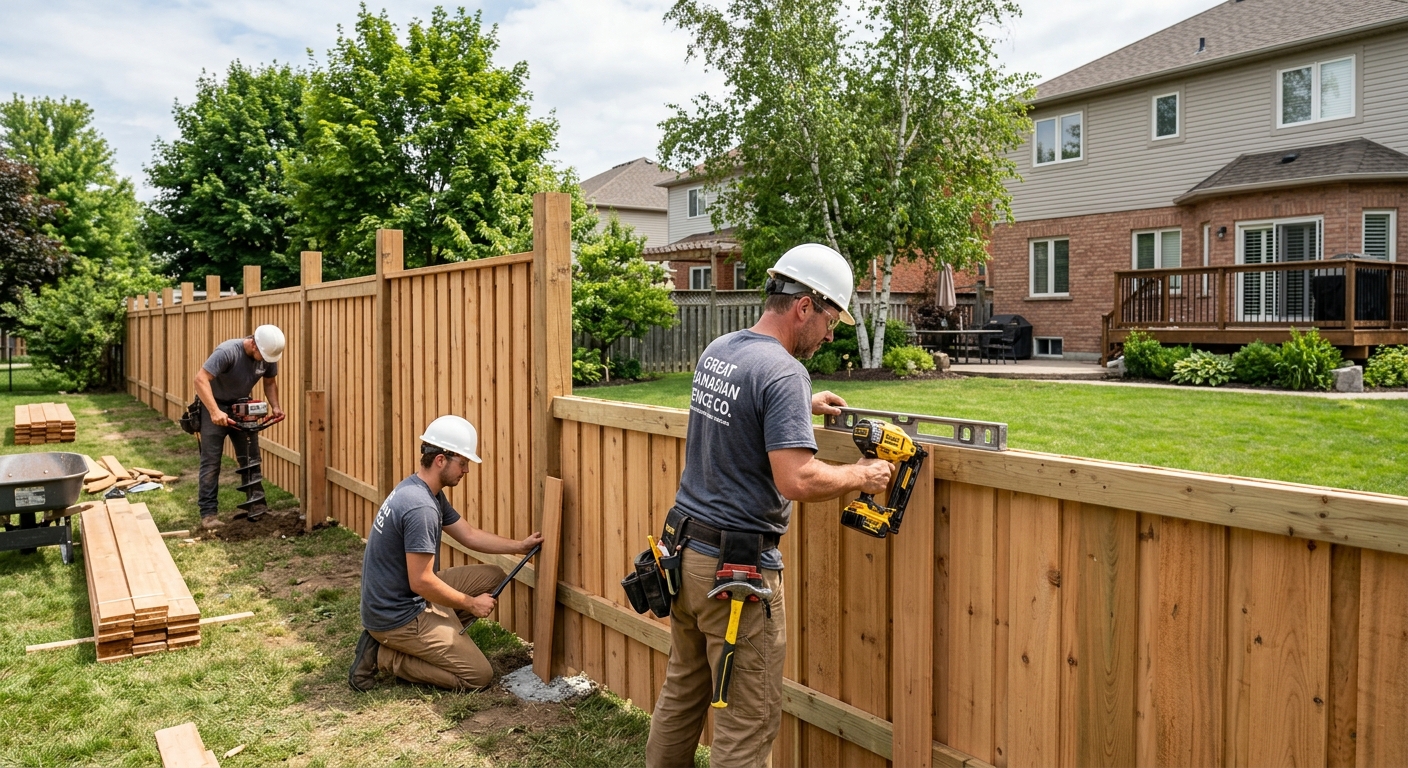
Fencing options and costs in Danforth
Danforth is a neighbourhood where fencing gets discussed for both practical privacy and curb appeal—especially on residential streets with mature trees, side-yard access, and changing elevations. With a population of 9,666 in the local profile area (Statistics Canada, 2021 Census), most fencing demand clusters around the ongoing turnover and landscaping refreshes typical of Toronto’s established housing stock. In practical terms, each detached property represents a potential boundary and privacy project, and that steady owner-initiated work keeps local crews busy.
In the Toronto economic region, costs are shaped by frost depth and how contractors build for it. Southern Ontario’s frost line is commonly treated as about 42"–48", which means posts often need to be set roughly 4–6 inches below the design frost depth to reduce the risk of heaving. For common 6–8 ft privacy runs, that translates into deeper holes, more concrete, and longer posts—so even two jobs that look “the same length” can price differently once labour time is included. Neighbourhoods with tighter lots and frequent side-yard gate access also influence crew time and equipment choice, which is why fencing trade demand tends to run high around the Danforth Village–Leaside area for privacy upgrades and boundary replacements.
Below is a homeowner-friendly comparison of common materials, typical lifespan expectations, and typical installed price bands per linear foot—then you can align the right option to your budget and maintenance tolerance.
| Material |
Lifespan |
Maintenance |
Privacy Rating |
Price per Linear Foot |
| Pressure-treated pine (standard wood) |
10–15 years |
Stain/paint every 2–3 years; inspect posts annually |
8/10 (solid boards) |
$65–$95 |
| Cedar (natural rot resistance) |
15–20 years |
Light stain/seal every 2–4 years |
9/10 (solid boards) |
$80–$120 |
| Vinyl / PVC (no-maintenance) |
20–30 years |
Wash only; check fasteners after extreme cold |
8–9/10 (solid panels/rails) |
$75–$130 |
| Chain-link (galvanized steel) |
20–35 years |
Minimal; rinse and check tension |
2–3/10 (visibility) |
$45–$85 |
| Aluminum ornamental |
25–40 years |
Occasional rinse; inspect gates/hardware |
3–4/10 (decorative pickets) |
$90–$160 |
| Composite / recycled material |
20–30 years |
Low; clean as needed; inspect for warping |
8/10 (boards similar to wood) |
$90–$150 |
Prices are estimates only and vary by project scope, site access and material selection.
What affects the price of fencing in Danforth
In Danforth and across the broader Toronto area, you can easily see the same fence described with 30–50% price swing, even when the “style” looks identical. The biggest driver is how frost depth and post construction translate into real labour: most Toronto projects require concrete-set posts rather than simple driven posts, because deeper holes and extra ready-mix time add cost. Material availability also matters—vinyl and composite can have longer lead times, while pressure-treated stock is often quicker to source.
Frost line depth sets how deep posts must be set. In Southern Ontario, contractors typically plan to set posts about 4–6 inches below the design frost depth, which commonly lands around 3.5–4 feet of embedment for taller privacy fences. That embedment often means 1.5–2.0 m hole depth in colder builds, plus deeper post lengths and more concrete. If you’re comparing quotes, the crew’s labour assumptions (hole drilling method, concrete mix quantity, and cure time) often explain a large portion of the gap. Wind is another factor: while GTA exposure is not as extreme as the Prairies, solid 6–8 ft privacy fences still need heavier hardware and closer spacing (commonly 6–8 ft centres) to reduce racking, which can push up labour and fastening costs.
Concrete examples in Danforth: (1) A 60 ft privacy fence on clay/mixed soils with deeper post holes and gate reinforcement will usually land closer to the upper end of the wood band ($65–$120 total typical wood installation range) because of extra excavation and bracing; (2) swapping to vinyl can be justified when you expect longer ownership and want to avoid painting, but the price commonly moves into the vinyl band ($75–$130 typical installed range), especially when panels must be engineered for tighter spacing.
Age and layout of local homes also impact cost. Older lots often have irregular ground, buried services, and mature landscaping that slows down access—meaning more time is spent on careful excavation, protection, and cleanup. Even if the fence is “only” 40–80 linear feet, these site realities can move the quote materially.
| Price Factor |
Why It Matters |
Cost Impact |
| Fence length in linear feet |
Labour and materials scale directly with run length |
Largest variable; can swing totals by hundreds to thousands |
| Post depth required |
Frost line determines embedment and hole depth |
Deeper holes increase excavation, concrete, and post length |
| Post setting method |
Concrete-set posts outperform gravel pack or simple driven posts in frost |
Concrete-set typically raises labour and ready-mix costs |
| Material choice |
Vinyl/cedar require different hardware and framing approaches |
Can shift between wood and vinyl/chain-link price bands |
| Gate count and type |
Gates add bracing, hinges, latches, and sometimes double-gate drives |
Each gate often increases both materials and skilled labour |
| Grade and terrain |
Sloped yards require stepped sections or raked panels |
More layout time and custom cutting increases cost |
| Old fence removal and disposal |
Demolition time and hauling depend on debris and post condition |
Can add significant labour and dump/hauling fees |
| Permit fees and survey / property line locate |
Paperwork and verification reduce encroachment risk |
May add administrative cost; survey can be a meaningful line item |
Permits & regulations in Ontario
In Ontario, fence permits are typically triggered when you’re planning taller structures—most commonly when the finished height exceeds municipal thresholds (often around 2.0 m / 6.5 ft for the rear, and about 1.0–1.2 m / 3–4 ft in the front or corner, depending on the specific location). Beyond height, you must respect property lines and municipal setback bylaws. Before you dig any post holes, you also need utility locates so you don’t hit buried services. In Ontario, use Ontario One Call for locating buried utilities.
Step one for Danforth homeowners is to confirm your property boundary. If you don’t have a recent survey, ask the contractor whether a locate or survey is recommended for your lot and corner/through-yard situation. This reduces disputes over encroachment and prevents redesign after excavation starts.
Step two is permitting clarity. A permit is commonly required for taller fences (not for typical low garden fencing), and sometimes for features that may affect sightlines near intersections. Your contractor should tell you whether the job falls into the “permit likely required” category before they start. Finally, verify the shared line-fence expectations: in Ontario, shared fence ownership and responsibility are addressed through provincial line-fences legislation, so it’s wise to document who maintains what.
Contractor verification in Ontario: (1) licensing—check the contractor’s business details and registration where applicable; (2) liability insurance—request an up-to-date Certificate of Insurance naming you appropriately; (3) WSIB coverage—ensure the contractor carries WSIB clearance/coverage if required for the scope. Your contract should also clearly state who pulls any necessary permits and who is responsible for compliance.
Choosing the right fence material for Danforth
Choosing fencing material in Danforth comes down to balancing privacy, low maintenance, budget, and how the material handles Toronto’s freeze–thaw cycles. Pressure-treated pine is usually the cheapest route, but it needs regular staining or painting every 2–3 years to limit grey weathering and help with longevity. Cedar is a step up: it naturally resists rot and often looks better for longer, though it still benefits from periodic sealing.
Vinyl/PVC is popular for homeowners who want fewer touch-ups and consistent appearance. The trade-off is upfront cost, and you must ensure a proper post-and-rail system—especially in deep frost regions—so fasteners and panels perform through winter expansion and contraction. Chain-link is the longest-life “set and forget” option in many cases, but it offers limited privacy unless you add privacy slats or grow-through landscaping. Aluminum ornamental gives a clean look without rust and stays stable, but it’s primarily decorative rather than private.
For most Toronto privacy fences, post-depth and concrete setting matter more than people expect. Because Danforth winters can heave poorly set posts, concrete-set posts are often recommended for 6–8 ft runs when the embedment needs to land safely below frost. That said, even with concrete-set posts, wind and snow load can encourage tighter framing and reinforced bracing for solid panels.
A practical dollar example: if your comparison is between pressure-treated wood and vinyl for a similar 6 ft privacy run, the installed total frequently shifts toward the vinyl band ($75–$130) versus wood installation bands ($65–$120). If you expect to keep the home long-term and would rather avoid repeated staining, that higher upfront spend often pencils out. If you’re selling sooner and want the lowest initial cost, pressure-treated pine can be the smarter short-to-mid-term move.
| Material |
Cold Tolerance |
Lifespan |
Annual Maintenance |
Best For |
Price Band |
| Pressure-treated pine |
Good with proper sealing and correctly set posts |
10–15 years |
Inspect posts; plan staining/painting every 2–3 years |
Budget privacy with acceptable upkeep |
$65–$95 |
| Cedar |
Very good; handles moisture swings better than pine |
15–20 years |
Inspect annually; seal/stain every 2–4 years |
Better appearance and rot resistance |
$80–$120 |
| Vinyl / PVC |
Good; needs correct thermal expansion allowances |
20–30 years |
Wash and inspect hardware after freeze seasons |
Low-maintenance privacy |
$75–$130 |
| Chain-link |
Excellent for freeze–thaw; galvanized resists corrosion |
20–35 years |
Minimal (rinse, check tension) |
Security on a budget |
$45–$85 |
| Aluminum ornamental |
Excellent; coated metal resists corrosion |
25–40 years |
Low (occasional rinse) |
Front-yard curb appeal |
$90–$160 |
| Composite / recycled |
Good; performance depends on quality bracing and fastening |
20–30 years |
Low; periodic wash and visual checks |
Wood-like look without heavy upkeep |
$90–$150 |
How to choose a fencing contractor in Danforth
Choosing a fencing contractor in Danforth starts with proof. In Ontario, ask for their Ontario business/labour credentials (as applicable), liability insurance, and proof of WSIB/WCB coverage. To check each: (1) licensing/business details—request their legal business name and confirm it matches their contract documents; (2) liability insurance—obtain a current Certificate of Insurance and ensure the effective dates cover your start-to-finish schedule; (3) WSIB—ask for a WSIB clearance letter or current coverage confirmation before work begins. If a contractor hesitates or can’t provide documents, that’s a major warning sign.
Next, don’t accept “lump sum” quotes without a breakdown. Get 2–3 itemised written quotes that separate labour, concrete/post materials, panels, gates, hardware, and any demolition/disposal. Read the scope carefully: what’s excluded (old fence removal, uneven ground adjustments, permit handling, or utility-locate costs)? Confirm whether disposal is included and who hauls debris away. For warranties, ask for both workmanship warranty duration and the manufacturer’s product warranty terms—also confirm whether the warranty is transferable if you sell your home.
Payment schedule matters. Never pay more than about 10–15% upfront; hold back the remainder until the job is complete and inspected. Also insist on a written timeline with a start date and a realistic completion estimate; fencing projects can shift due to frost conditions, material deliveries, and inspection/locate timing.
- Request written quotes with line-by-line labour and material breakdown (not just a total).
- Confirm post depth plan for Southern Ontario frost conditions and whether concrete is included.
- Ask if gates include proper diagonal bracing and adjustable hardware.
- Verify disposal/hauling of old fencing is included (or clearly excluded).
- Confirm utility locate cost is allocated and who schedules Ontario One Call.
- Get the warranty in writing: workmanship length and what “failures” cover.
- Ask whether a site visit includes grading/stepping plan for slopes.
- Check insurance dates and that you’re named correctly as certificate holder (if required).
- Verify WSIB clearance/coverage documentation before work starts.
- Set expectations on permit handling—who submits and who pays if required.
- Require a clear materials list (wood grade, post size, panel type, coatings).
- Use a payment schedule with a holdback until final measurements and cleanup are complete.
In Danforth, common red flags include: a contractor who won’t provide proof of insurance/WSIB paperwork, quotes that don’t specify post embedment and concrete quantities, vague scopes that exclude demolition/disposal without stating so clearly, bait-and-switch material grades after pricing, and pressure to take a large upfront deposit before the contract and timeline are finalized.
Frequently asked questions — fencing in Danforth
What's the best fence for privacy?
For privacy in Danforth, the best-performing options are solid-board wood (pressure-treated or cedar) or vinyl/PVC privacy fences with close spacing. In a typical Toronto frost setup, privacy fences (often 6–8 ft) benefit from concrete-set posts and solid panel framing that resists racking during wind and freeze–thaw cycles. If you’re comparing budgets, you’ll usually see pressure-treated wood in the general wood installation band of $65–$120, while vinyl privacy commonly lands in the $75–$130 range depending on post spacing and gate count.
How do I compare fencing quotes?
Start by comparing apples-to-apples: fence length in linear feet, fence height, panel style, and—most importantly—post embedment and setting method. Frost depth requirements in Southern Ontario usually mean posts need to be set deep (often around 3.5–4 feet embedment for taller runs), and most stable designs use concrete-set posts. A quote that’s cheaper but uses shorter posts or a driven-post approach can look good short term and cost more after heaving or leaning. Also compare what’s included: old fence removal, concrete supply, hardware, disposal, and whether permit steps are handled when required.
How long does fence installation take in Danforth?
Timing depends on length, access, and whether there’s demolition. For a straightforward backyard privacy fence on level ground with good side-yard access, many installations can be completed in 1–3 working days. If your project includes old fence removal and haul-away, expect additional time. Cold weather can also affect progress: in winter, concrete setting and scheduling can be impacted, and some crews wait for workable temperatures to ensure proper cure. For multi-gate projects or lots with difficult grading, plan for a longer layout and build period so the final line stays straight and hardware is properly tensioned.
Can I install a fence on a slope in Danforth?
Yes—fences can absolutely be installed on slopes in Danforth. The key is choosing the correct method: stepping with consistent height changes, or using raked panels that maintain a uniform bottom line. Sloped yards require more layout time and careful measurement to prevent “bowing” or uneven sightlines. In strong freeze–thaw conditions, the foundation still matters: even on a slope, each post location must be set to the frost-safe depth plan, and the framing must match local soil stability. A good quote should explain how they’ll handle grading and what materials they’ll use to keep the fence plumb and secure.
What is the most weather-resistant fence for Danforth's climate?
For Danforth’s winter conditions, the most weather-resistant choices are typically vinyl/PVC privacy fences (low rot risk and minimal surface maintenance), properly built cedar (natural rot resistance), and galvanized chain-link for durability. Wood can last a long time, but it must be maintained—staining and inspections matter because freeze–thaw cycles can stress poorly sealed boards and posts. If you want the lowest maintenance footprint, vinyl privacy often stands out; it’s commonly priced in the $75–$130 range installed. For maximum longevity with minimal upkeep, galvanized chain-link is often competitive in the $45–$85 range, though it won’t provide true privacy without additional screening.
How do I prevent wood fence rot in Danforth?
Preventing rot starts below ground. In Ontario, you reduce heaving risk by setting posts deep enough for frost conditions and using concrete-set posts where best practice calls for it. Above ground, use proper fastening and don’t trap moisture against the wood—allow airflow behind the fence where possible and keep sprinklers from repeatedly wetting pickets and rails. Choose quality pressure-treated pine for budget and cedar for better natural rot resistance, then commit to maintenance: plan staining or sealing on a schedule (often every 2–3 years for pressure-treated in Toronto weather). Finally, inspect annually for loose rails, soft post sections, and drainage issues so you address problems before they turn into widespread rot.