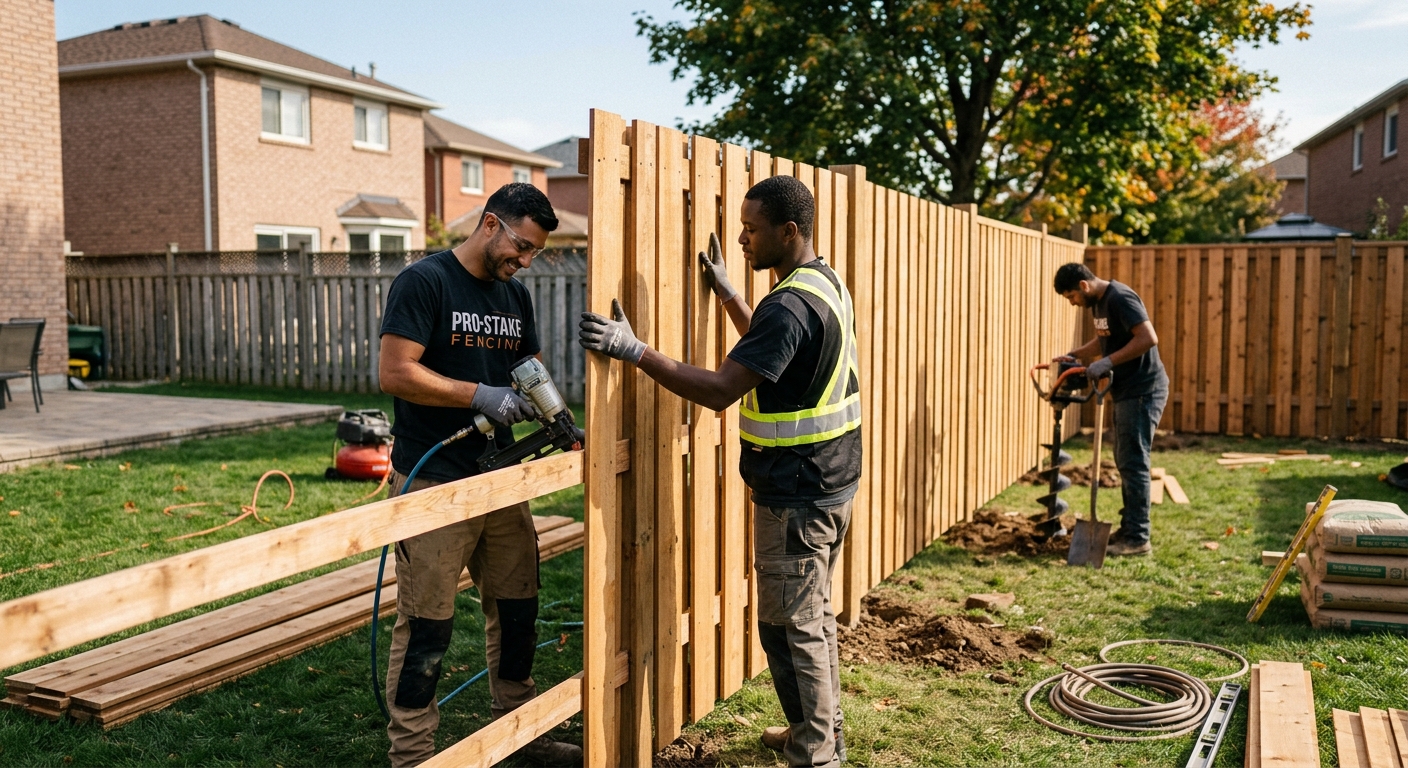
Fencing options and costs in Welland
Welland is one of those Niagara Region cities where most homeowners have a clear idea of what they want from their fence—privacy for backyards, safer play areas for kids, and better definition along side yards. With 55,750 residents in 2021 and a homeowner base that makes up 69.0% of households (Statistics Canada, 2021 Census), you’ll also see strong day-to-day demand in neighbourhoods with a high share of detached properties—those homes are often the first to need panel replacement, new gates, or a fresh privacy upgrade. In Welland, the “what you pay” story is shaped by the Hamilton–Niagara Peninsula climate and soil conditions: freeze–thaw cycles drive deeper post requirements, and contractors in our area typically concrete-set posts for stability. Frost penetration in southern Ontario is roughly 1.2 m (4 ft), so post holes are commonly dug below the frost line (often 36–42 inches for a typical 6 ft residential fence), which adds drilling time and concrete/mix costs—especially on heavier clay or where access is tight.
That’s also why contractor availability can feel “surge-y” during peak spring installs: crews tend to schedule around thaw windows, utility locates, and old fence removals. Areas like West Welland and the older residential pockets near the Welland Canal frequently see add-on projects (privacy extensions, gate replacements, or re-setting leaning sections). The result is that pricing varies by material and system, even when the fence length is the same.
Use the table below to compare common choices and realistic per-foot budgeting for Welland, then we’ll break down the exact factors that move bids up or down.
| Material |
Lifespan |
Maintenance |
Privacy Rating |
Price per Linear Foot |
| Pressure-treated pine (standard wood) |
12–18 years |
Stain or seal every 2–3 years; replace warped boards as needed |
8/10 (solid board layouts) |
$14 – $22 |
| Cedar (natural rot resistance) |
18–25 years |
Seal or stain periodically (typically 2–4 years depending on sun/finish) |
9/10 (solid board layouts) |
$18 – $30 |
| Vinyl / PVC (no-maintenance) |
25–35 years |
Rinse/wash as needed; inspect for any impact damage |
7/10 (depends on slat/solid style) |
$20 – $38 |
| Chain-link (galvanized steel) |
20–30 years |
Low; occasional tightening and rust inspection (vinyl slats help) |
3/10 (add privacy slats if needed) |
$12 – $20 |
| Aluminum ornamental |
30–40 years |
Low; rinse and inspect gate hardware annually |
5/10 (ornamental pickets) |
$22 – $45 |
| Composite / recycled material |
25–35 years |
Very low; clean periodically; check for panel fastening |
8/10 (solid designs) |
$24 – $40 |
Prices are estimates only and vary by project scope, site access and material selection.
What affects the price of fencing in Welland
In Welland and across the Hamilton–Niagara Peninsula, it’s common to see two quotes for a “same height, same length” fence that still differ by 30–50%. The biggest reason isn’t just material—it’s what it takes to install posts correctly through Ontario’s freeze–thaw cycle and local soil conditions, plus the cost of labour time when access is awkward or when the job includes removal and re-grading.
First, the frost line sets the post depth. Even though design requirements are often discussed in terms of frost penetration, in practice we plan holes so posts sit about 4–6 inches below the design frost depth to help prevent heaving and gradual leaning. In southern Ontario conditions (and similar cold-weather impacts), that typically means posts pushed to around 1.5–2.0 m (roughly 60–79 inches) for longer-term stability—especially with concrete-set posts. Concrete setting is now standard for long-term performance here, and it increases mix cost and labour versus tamped backfill, particularly when holes must be drilled deeper or in heavier clay.
Second, wind and panel loading matter. Welland isn’t a high-exposure prairie location, but hilltop and lakeshore lots still see strong seasonal winds; that can require closer post spacing, sturdier rails, and heavier hardware to avoid panel racking and gate sag. Third, local pricing includes the realities of older neighbourhoods: utility locates, disposal, and the time to work around mature landscaping.
Concrete examples: on an older West Welland lot with clay and a grade change, deeper drilled holes and step/rake detailing can add labour equivalent to a material upgrade—often shifting a “vinyl-looking” budget closer to midrange wood pricing. Conversely, a straight run on firm soil with easy access can keep a wood job closer to the lower end (for example, the wood band around $45–$80 for installation-type budgeting), while complex clay + concrete setting can pull the same project toward the higher end. On the privacy side, if you’re comparing chain-link at roughly $35–$60 installation-type expectations to a solid privacy board layout, the added rails, thicker posts, and gate hardware are what justify the premium.
| Price Factor |
Why It Matters |
Cost Impact |
| Fence length in linear feet — the primary cost driver |
More lineal footage means more posts, rails, and labour time |
High (often drives 60–75% of total project cost) |
| Post depth required — frost line determines post length and hole depth |
Deeper holes and longer posts increase drilling and material |
Medium to high (can noticeably change bids in freeze zones) |
| Post setting method — concrete vs. gravel pack vs. driven posts |
Concrete-set posts resist heaving and leaning over time |
High (concrete + labour time) |
| Material choice — vinyl vs. cedar vs. chain-link |
Different material pricing and rail/hardware requirements |
Medium to high (material deltas are significant) |
| Gate count and type — walk-through vs. drive-through (double) |
Gates require heavier frames, hinges, latch systems, and reinforcement |
Medium to high (a few gates can equal extra fence runs) |
| Grade and terrain — sloped yards require stepped or raked panels |
Slopes increase cutting, layout time, and sometimes extra rails |
Medium (often adds labour even with the same materials) |
| Old fence removal and disposal |
Demolition time, hauling costs, and disposal fees |
Medium (can add a meaningful “second trade” component) |
| Permit fees and survey / property line locate |
Administrative costs and time to confirm boundaries |
Low to medium (but can affect schedule and compliance) |
Permits & regulations in Ontario
In Ontario, fence rules are generally tied to height and location, and in many cases fences above the typical threshold of about 2.0 m (6.5 ft) in rear yards and 1.0–1.2 m (3–4 ft) in front or corner areas can require a building permit. The best way to avoid rework is to confirm the applicable municipal bylaw for your property in Welland before you book the post-hole drilling. Even when a permit isn’t required, fences must respect property lines and municipal setback requirements, and you’ll still need to locate utilities before any digging.
What typically DOES require a permit: taller fence installations, particularly where you’re exceeding common local height thresholds (often around 2.0 m rear / 1.0–1.2 m front/corner). What typically does NOT: basic low fencing that stays under the common height limits, and fence replacements like-for-like (but you should still verify height/location because bylaws can differ by street/lot context).
Step-by-step for Welland homeowners: (1) Call for utility locates using Ontario One Call before you dig any post holes. (2) Obtain a survey or a property line locate so you know where pins are and can avoid encroachment disputes. (3) Check whether your height triggers a permit. (4) Verify your contractor: confirm they have appropriate Ontario business registration/licensing (where applicable), provide a current certificate of insurance (general liability for your project), and show they have coverage for worker protection through the appropriate provincial workplace coverage documentation (WSIB/WCB). Ask for these documents before signing—your installer should provide them without pressure.
Choosing the right fence material for Welland
Choosing the right fence in Welland is really about matching material to how you live—privacy needs, maintenance tolerance, and your expected lifespan—while respecting what our cold winters do to posts and rails. Pressure-treated pine is often the budget starting point, but it usually needs staining or sealing every 2–3 years to slow grey weathering and board splitting. Cedar looks great and naturally resists rot better than many pressure-treated options, but it still benefits from periodic sealing to keep colour and reduce surface checking. Vinyl/PVC is popular for low maintenance because it generally doesn’t need staining, yet in extreme cold it can become more brittle than wood if impacted, so you still want solid installation practices and correct hardware. Chain-link is the longest-lasting low-cost barrier, but it offers limited privacy unless you add privacy slats or a secondary privacy screen. Aluminum ornamental fences resist rust and keep looking tidy, but they’re not designed for full privacy.
For Hamilton–Niagara Peninsula installations, frost depth drives your underlying system. Many contractors plan post holes below frost influence (often achieved with about 36–42 inches for typical residential layouts, with deeper/concrete-set execution where soils require it). Concrete-set posts are commonly used for long-term stability through Ontario’s freeze–thaw cycles; they cost more up front, but they’re a key reason fences stay straighter over time.
Wind and snow load also matter. Welland lots exposed to gusts can need stronger rails and appropriate post spacing to prevent racking; that’s true for solid board privacy systems and gate areas in particular.
Budget example: if you’re deciding between pressure-treated pine and vinyl, the labour and post installation can be similar, but vinyl can add meaningful upfront cost—often pushing projects toward the higher end compared with the wood installation band (and vinyl material pricing). You justify that premium when you want near-zero maintenance, especially if you don’t want to re-stain around the pre-winter season.
| Material |
Cold Tolerance |
Lifespan |
Annual Maintenance |
Best For |
Price Band |
| Pressure-treated pine |
Good (needs proper sealing and installation) |
12–18 years |
Low to moderate (seasonal visual checks; stain every 2–3 years) |
Lower upfront cost and classic privacy |
$45 – $80 |
| Cedar |
Good (excellent rot resistance when finished) |
18–25 years |
Low to moderate (seal/stain typically 2–4 years) |
Attractive privacy with fewer rot worries |
$55 – $95 |
| Vinyl / PVC |
Good (avoid impact; correct fastening helps) |
25–35 years |
Very low (wash/rinse as needed) |
Low maintenance and clean curb appeal |
$70 – $120 |
| Chain-link |
Good (galvanized strength remains reliable) |
20–30 years |
Very low (tighten and inspect; add slats if needed) |
Perimeter security and budget control |
$35 – $60 |
| Aluminum ornamental |
Good (no rust; handles freeze well) |
30–40 years |
Very low (hardware checks) |
Front yards, pets, and tidy appearance |
$80 – $150 |
| Composite / recycled |
Good (dense boards; impact-resistant than some plastics) |
25–35 years |
Very low (clean periodically; check fasteners) |
Privacy with minimal upkeep |
$80 – $140 |
How to choose a fencing contractor in Welland
When you hire a contractor in Welland, start by verifying the basics: Ontario coverage and proof that they’re set up to do the work safely. Ask for a certificate of insurance (general liability naming you where appropriate) so you’re not exposed if something is damaged during installation. For worker protection, confirm their provincial workplace coverage documentation (WSIB/WCB as applicable) and ensure it’s current for the time period of your project. You can also request their business details and licence information through appropriate online sources and cross-check consistency between their quote, business name, and documentation.
Next, get 2–3 itemised written quotes rather than a single lump sum. You want a labour/material breakdown that clearly lists: post depth assumptions, concrete quantity or setting method, rails/hardware, fence style and material grade, gate hardware, and what’s included for old fence removal and disposal. Scope gaps are where costs creep in.
Read the warranty carefully: confirm workmanship warranty length (how long they stand behind installation), product/manufacturer warranty coverage (what fails and what’s excluded), and whether warranties are transferable to future owners. For payment, follow a conservative schedule—never pay more than 10–15% upfront; keep a holdback until completion and final cleanup/adjustments.
Finally, lock in the timeline: request a start date and a realistic completion estimate in writing. For colder months, ask what happens if weather or ground conditions delay drilling and setting.
- Confirm post-depth and setting method in the quote (concrete-set vs. alternative).
- Ask for a site plan note showing fence line layout and gate locations.
- Verify insurance certificate and worker coverage before work begins.
- Require itemised materials and labour (posts, rails, pickets/slats, gates, hardware).
- Check whether utility locates are your responsibility or theirs (and confirm it’s included).
- Confirm disposal is included if you’re removing an old fence.
- Get details on how they handle sloped yards (stepped vs. raked panels).
- Ask how they protect landscaping and driveway surfaces during installation.
- Ensure permit responsibility is specified: who pulls permits if height triggers it.
- Clarify warranty: workmanship term, manufacturer term, and exclusions.
- Use a written payment schedule with a holdback after final inspection.
- Request a written completion date window and weather-delay communication plan.
Concrete red flags we see in the Welland market: (1) quotes that don’t specify post depth or setting method, (2) contractors who won’t provide insurance/coverage proof before signing, (3) “lowest price” bids that exclude removal/disposal or assume easy access without confirming site conditions, (4) contracts with no workmanship warranty details, and (5) refusing to put the timeline and scope in writing.
Frequently asked questions — fencing in Welland
Wood vs vinyl vs aluminum fence — which is best?
In Welland, “best” depends on your priorities. If you want privacy and can handle maintenance, pressure-treated pine or cedar are strong choices; wood typically lands around $45–$80 for installation-type budgeting depending on style, rails, and gate work. If you want the least upkeep, vinyl/PVC is usually the easiest long-term option and often sits closer to $70–$120 for installation-type budgeting. Aluminum ornamental is great for front yards and pet containment but it’s rarely a true privacy solution because of picket spacing. Also consider the post system: in the Hamilton–Niagara Peninsula freeze–thaw zone, well-installed concrete-set posts help fences stay plumb even on older housing lots. If you tell us your fence length, height, and whether you have a gate, we can narrow it to the most cost-effective match.
Do I need a permit to build a fence in Ontario?
Often, yes—if the fence is tall. In Ontario, fences above common thresholds (frequently about 2.0 m (6.5 ft) for rear areas and around 1.0–1.2 m (3–4 ft) for front/corner locations) can require a building permit. Even when a permit isn’t triggered, you still must follow property line rules and municipal setbacks, and you must respect your neighbour’s rights if the fence is shared. Before digging any post holes in Welland, you should also complete utility locates through Ontario One Call. If your contractor is reputable, they’ll confirm the fence height/location up front and tell you whether they include permit pulling or whether you handle it. Avoid contractors who start drilling without confirming these items.
How long does a wood fence last in Welland?
A well-installed wood fence in Welland commonly lasts around 12–18 years for pressure-treated pine and 18–25 years for cedar, assuming normal wear and proper post setting. The big Ontario factor is freeze–thaw: if posts aren’t set below frost influence and don’t have robust anchoring (often concrete-set in our area for long-term stability), you’ll see leaning and gaps earlier. Maintenance matters too—wood should be sealed or stained on a cycle (often every 2–3 years for pine, depending on sun and finish) to reduce weathering and board cracking. Homes built before 1981 make up a large portion of the local housing stock (Statistics Canada, 2021 Census), and older yards often have soil and access conditions that can accelerate wear if the installation isn’t tailored to them.
Who owns and maintains a shared fence?
For shared fences, ownership and maintenance typically depend on the property line situation and any prior agreements between neighbours. Ontario’s shared line-fence concepts are governed by provincial line-fences legislation, but the practical reality is that many disputes start when one property owner assumes the fence is “theirs” without confirming boundaries. In Welland, the safest approach is to confirm the property line (survey or locate your pins) before ordering materials. If it’s truly a shared fence along a boundary, discuss responsibilities in writing—who pays for repairs, who controls contractor scheduling, and how costs are split. A good contractor should be willing to coordinate measurements on the boundary and note fence placement clearly in the quote. If a fence is leaning or boards are failing, get both neighbours involved early to avoid repeated contractor visits.
How do I find my property line before fencing?
The reliable method is a survey or a property line locate that identifies your boundary pins—don’t rely only on old stakes, fence records, or “what looks right.” In Welland, where older neighbourhoods and lot layouts are common, fences are sometimes positioned historically but not exactly on the current legal line. Before digging post holes, confirm boundaries so you avoid encroachment disputes and costly rework. Also complete utility locates through Ontario One Call before any trenching or drilling. Then, when you meet a contractor, have them mark the proposed fence line on-site and confirm the gate openings and setback expectations. A detailed site layout note in the quote helps too. If you don’t have a recent survey, ask about a locate service option before you schedule drilling.
What's the most low-maintenance fence?
For most homeowners in Ontario—including Welland—the most low-maintenance option is usually vinyl/PVC or aluminum. Vinyl is especially attractive when you want privacy without periodic staining; it typically sits around $70–$120 for installation-type budgeting, but you trade a higher upfront cost for minimal ongoing work. Aluminum is similarly low-maintenance (no rust), often with mid-range pricing around $80–$150 for installation-type budgeting depending on height and gate complexity. Chain-link can also be low maintenance, but it doesn’t provide privacy unless you add slats or a secondary privacy element. Keep in mind the cold-weather performance still depends on installation quality: correct post depth and secure setting matter across all materials, because freeze–thaw cycling affects post stability even when the panels are low-maintenance.