Fencing options and costs in Hawkesbury
In Hawkesbury, fencing decisions usually start with the same reality: most homes are single-detached (35.8% of dwellings), so property owners are actively maintaining front and backyard boundaries year after year. With homeowner households making up 51.5% of all households (Statistics Canada, 2021 Census), local demand stays steady and you’ll typically find more quoting activity in the spring and early summer. That said, Hawkesbury’s fencing costs still track the broader Ottawa economic region, where deeper frost protection, freeze–thaw soil movement, and snow-driven wind exposure affect how contractors build and how much they excavate.
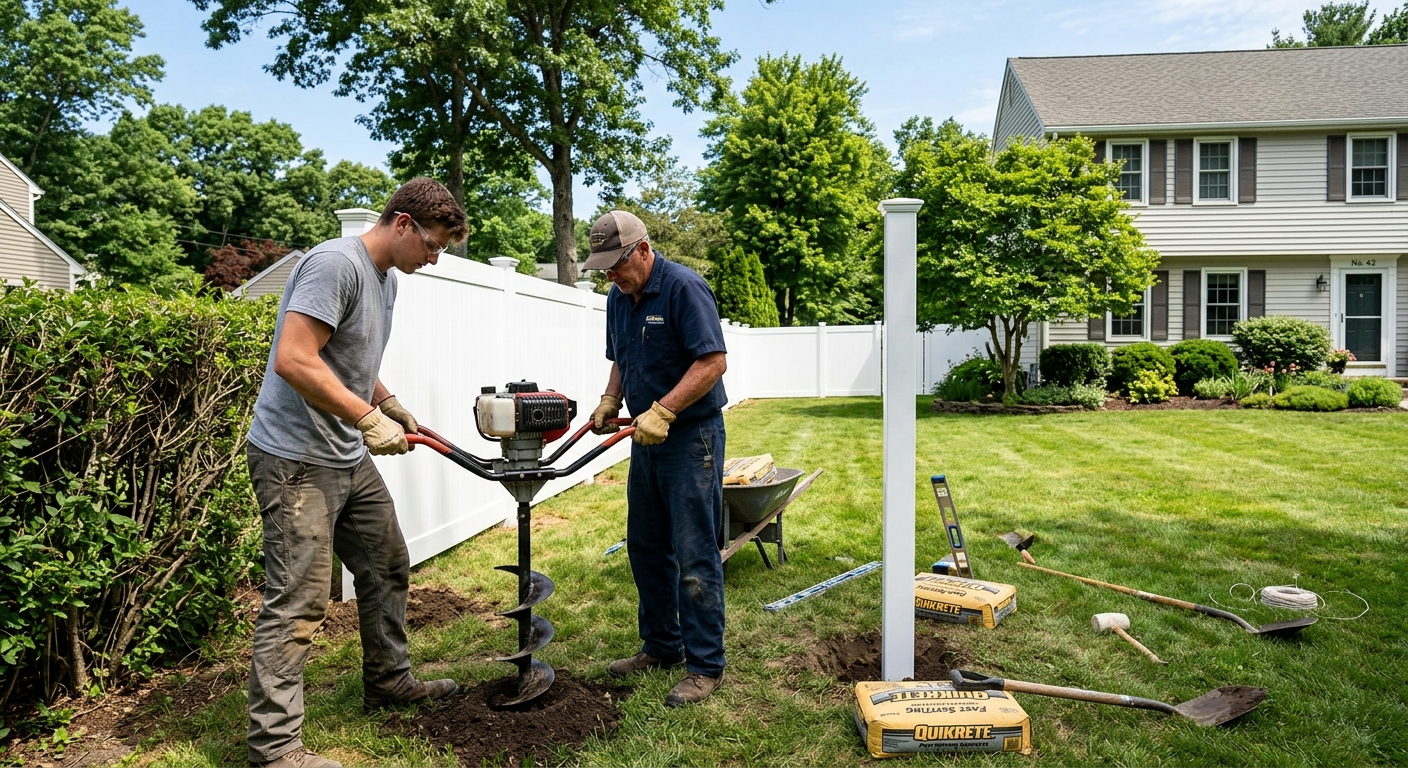
Because the Ottawa frost depth is roughly 3.5–4 ft, quality installations commonly set posts close to 4 ft and use concrete footings to reduce winter heave and leaning. In clay-heavy areas, that means longer digging time, extra labour, and more disposal/haul-away weight—factors that can push total pricing toward the top of typical Ontario residential ranges. If you’re located near Des Érables or around the Hawkesbury core where lots tend to have mature trees and tighter access, expect more time for equipment positioning and panel alignment.
Below is a practical comparison of common materials for Hawkesbury, using realistic installed price bands per linear foot so you can compare apples-to-apples before site measurements.
| Material |
Lifespan |
Maintenance |
Privacy Rating |
Price per Linear Foot |
| Pressure-treated pine (standard wood) |
10–15 years |
Stain/seal every 2–3 years |
High (solid boards) |
$40 – $75 |
| Cedar (natural rot resistance) |
15–25 years |
Light staining every 2–4 years |
High (solid boards) |
$55 – $95 |
| Vinyl / PVC (no-maintenance) |
20–30 years |
Rinse as needed; occasional panel replacement |
High (solid or lattice options) |
$45 – $80 |
| Chain-link (galvanized steel) |
20–35 years |
Occasional tension checks; rinse |
Low–Medium (no privacy unless privacy slats added) |
$25 – $50 |
| Aluminum ornamental |
25–40 years |
Wash as needed; occasional paint touch-up (rare) |
Low (open pickets) |
$70 – $120 |
| Composite / recycled material |
25–30 years |
Minimal; no staining |
High (solid fencing styles) |
$90 – $145 |
Prices are estimates only and vary by project scope, site access and material selection.
What affects the price of fencing in Hawkesbury
Two homeowners in the Ottawa area can receive quotes that differ by 30–50% even when the fence line looks similar on a map. The biggest reason is that installers price for risk: frost-depth digging requirements, footing type, wind exposure, and how much time is lost to access constraints. Hawkesbury’s older housing stock also plays a role—60.1% of homes were built before 1981 (Statistics Canada, 2021 Census), and many of those properties have established landscaping, uneven grades, and buried/unknown service risks that slow down layout and post-setting.
In Ottawa, the frost line depth is about 3.5–4 ft, so good practice is setting posts roughly 4–6 inches below the design frost depth. Practically, that often means posts go 1.5–2.0 m into the ground, with concrete setting—more labour, more material, and more disposal compared with regions where 2–3 ft can be adequate. Wind loading also matters: privacy fences act like sails, so contractors may use closer post spacing and sturdier frames, particularly where snow drifts or gusts hit fence faces. In contrast, mild but wet coastal climates accelerate wood rot unless treated properly; that can make “cheap-looking” wood choices more expensive over time if maintenance is skipped.
Concrete examples in Hawkesbury: (1) a long run through clay that holds water usually increases excavation time and concrete volume; (2) a yard with a steep slope often requires stepped panels or raked styles, adding fabrication time; and (3) a job with multiple gate openings typically increases framing and hardware costs. Those factors are why a standard wood quote may sit closer to the low end of the wood band (around $40 – $75), while upgrades like cedar or denser privacy framing can move you toward the vinyl/PVC and higher installed ranges seen across Ontario (commonly $45 – $80 for PVC per linear foot, depending on height and options).
| Price Factor |
Why It Matters |
Cost Impact |
| Fence length in linear feet |
Primary cost driver—more posts, rails, and materials |
Typically scales directly; small increases can move totals fast |
| Post depth required |
Frost line determines post length and hole depth to reduce heaving |
Deeper holes increase labour and concrete; often raises cost |
| Post setting method |
Concrete vs. gravel pack vs. driven posts changes stability |
Concrete footings usually add cost but reduce failure risk |
| Material choice |
Different longevity and framing strength requirements |
Vinyl vs. cedar vs. chain-link can vary widely per foot |
| Gate count and type |
Gates require heavier hardware, braces, and accurate alignment |
Walk-through is cheaper; double drive-through is often the biggest add-on |
| Grade and terrain |
Sloped yards require stepping or raking panels |
More cut pieces and labour; can add significant time |
| Old fence removal and disposal |
Demolition, hauling, and recycling/disposal fees |
Can add days and truckloads, raising total price |
| Permit fees and survey / property line locate |
Compliance work and accurate layout prevent boundary disputes |
Varies by site; can add direct administrative and professional costs |
Permits & regulations in Ontario
In Ontario, whether you need a permit can depend on fence height, location (front vs. rear), and how the fence is positioned in relation to property lines and municipal rules. As a common guideline, fences above about 2.0 m (6.5 ft) at the rear and about 1.0–1.2 m (3–4 ft) at the front or corners often require a building permit. Even when a permit isn’t required, you still must respect property lines and any municipal setback by-laws.
Before any post-hole digging in Hawkesbury, call for utility locates through Ontario One Call so you don’t hit buried services. You’ll also want a survey or at least a professional property pin locate before installing, especially on older lots where boundaries and markers may have shifted over time.
Shared fence ownership is handled under provincial line-fences rules, typically requiring coordination between neighbours on maintenance responsibilities (and sometimes costs) depending on how the fence was established and where it sits.
Step-by-step for verifying your contractor in Ontario: (1) confirm they are properly licensed for their trade/activities (many fence contractors fall under business licensing and may not be “contractor-of-record” in the way general contracting is, so check the number they provide and business registration details); (2) request a certificate of liability insurance naming you as an additional insured where possible; (3) ask for WSIB/WCB clearance documentation; and (4) ensure these documents are current dates, not expired copies. If the job includes permit work or any engineering/locate services, ask whether the permit pull is included in the quote and who submits it.
Choosing the right fence material for Hawkesbury
Choosing the right fence material in Hawkesbury is mostly about matching your priorities to Ottawa’s winter realities: frost depth, freeze–thaw soil movement, and wind-driven snow loads. For pressure-treated pine, the upfront price is often easiest on the budget, but wood can grey and warp if it’s not stained. In practice, homeowners usually need a stain/seal cycle every 2–3 years to keep it looking sharp and to reduce surface breakdown. Cedar is naturally rot-resistant and holds up nicely in Canadian seasons, but it still benefits from maintenance and can cost more at the start. Vinyl/PVC looks low-effort on paper—no staining—but extreme cold can make some systems more brittle at thin sections, so you want a reputable installer, proper framing, and correct post spacing. Chain-link is the long-life budget choice, but it offers little privacy unless you add slats or switch to a different privacy system. Aluminum ornamental is attractive and rust-resistant, with mid-range pricing and no rot issues, but it won’t provide the privacy most suburban homeowners want.
Because posts often need to be set close to the frost line (roughly 1.5–2.0 m in the ground) in the Ottawa region, concrete-set posts are commonly used for stability—especially in clay soils that shift during freeze–thaw. That foundation requirement reduces “material savings” differences: even a budget chain-link installation still needs solid footing to avoid leaning. Wind matters too: in exposed stretches, privacy panels may be reinforced and post spacing tightened to prevent racking.
A practical example: if you compare pressure-treated wood at roughly $40 – $75 per linear foot to vinyl/PVC around $45 – $80, the overlap means the decision can come down to maintenance tolerance. If you’d rather avoid repeated staining and don’t mind paying slightly more up front, vinyl often justifies itself over the first decade—especially for homeowners who don’t want to schedule labour in peak summer windows.
| Material |
Cold Tolerance |
Lifespan |
Annual Maintenance |
Best For |
Price Band |
| Pressure-treated pine |
Good (with correct sealing and proper post setting) |
10–15 years |
Light inspections; stain/seal every 2–3 years |
Budget-first privacy |
$40 – $75 |
| Cedar |
Good (natural rot resistance in wet-dry cycles) |
15–25 years |
Stain/light maintenance every 2–4 years |
Longer-lasting privacy with a premium look |
$55 – $95 |
| Vinyl / PVC |
Very good (use quality components in cold snaps) |
20–30 years |
Rinse; check hardware |
Low maintenance and consistent appearance |
$45 – $80 |
| Chain-link |
Very good (galvanized coatings) |
20–35 years |
Rinse; tension checks |
Security with minimal upkeep |
$25 – $50 |
| Aluminum ornamental |
Excellent (no rust with proper coatings) |
25–40 years |
Wash as needed; rare touch-ups |
Curb appeal without rot |
$70 – $120 |
| Composite / recycled |
Good (stable materials; proper framing required) |
25–30 years |
Minimal; wash when needed |
Premium low-maintenance privacy |
$90 – $145 |
How to choose a fencing contractor in Hawkesbury
Choosing a fencing contractor in Hawkesbury should start with proof, not promises. Ask for their Ontario business registration details and confirm they’re operating as a legitimate business (not just a personal work crew). Next, request a current certificate of liability insurance—check the policy dates and ensure it covers work performed at your address. Then ask for WSIB/WCB coverage documentation (or a clearance letter if applicable) so you’re not responsible if a worker is injured on-site. If the contractor can’t provide these documents promptly, treat it as a major warning sign.
For pricing, don’t accept a vague lump sum only. Get 2–3 itemised written quotes that break out labour and materials separately, including post type, depth assumptions, concrete quantity allowances (if used), rail spacing, gate frames/hardware, and any provision for slope or uneven ground. Clarify exclusions in writing: is old fence removal included? Is disposal included? Are utility locate costs or permit pull included (where required)?
Warranty matters for both workmanship and materials. Ask how long the workmanship warranty lasts (commonly 1–2 years), whether the product warranty covers components only or installation too, and if the warranty transfers to future owners. For payments, never pay more than about 10–15% upfront; keep a holdback until the fence is complete, lines up properly, and gates swing correctly. Finally, ensure the start date and an estimated completion window are in writing.
- Verify insurance certificate dates and confirm coverage limits match fencing work risk.
- Request WSIB/WCB clearance or documentation in writing before work begins.
- Ask for an itemised quote (materials vs labour) and an explanation of post depth assumptions.
- Confirm whether posts are concrete-set and how the contractor handles clay/freeze–thaw conditions.
- Ensure utility locate is included or clearly coordinated before digging.
- Check how they locate property lines (survey vs pins locate) to avoid boundary disputes.
- Get details on gate framing, latch type, and whether hardware is included.
- Ask how they handle slope: stepped vs raked panels, and whether extra material is required.
- Confirm post spacing and fence height measurements (including how they account for grade).
- Review scope exclusions for old removal, hauling, and disposal (and confirm tipping fees where applicable).
- Ask what’s included in cleanup—especially concrete debris and backfill grading.
- Confirm warranty terms: product warranty vs workmanship warranty, and whether transfer is allowed.
Common red flags I see in Hawkesbury include: missing or expired insurance/WSIB documentation, quoting without discussing frost-depth post setting, refusing to itemise labour/materials, promising “same-day” installation for large runs without a plan, and asking for the majority of payment upfront before posts are set and aligned.
Frequently asked questions — fencing in Hawkesbury
Do I need a permit to build a fence in Ontario?
In Ontario, permits often depend on the fence height and where the fence sits on your property (front/corner vs rear). A common guideline is that fences above about 2.0 m (6.5 ft) at the rear and above roughly 1.0–1.2 m (3–4 ft) at the front or corner may require a building permit, but municipal rules can vary by location and specifics. In Hawkesbury, I recommend you verify the height and placement with your municipality before you order materials. Regardless of permits, you must respect property lines and setbacks, and you should call Ontario One Call before digging post holes. A good contractor will also be clear about whether they pull the permit (when required) or if you’re responsible.
How long does a wood fence last in Hawkesbury?
With proper installation and maintenance, a pressure-treated pine fence in the Hawkesbury/Ottawa region typically lasts around 10–15 years. The biggest determinant isn’t just the wood—it’s post setting and how the fence survives winter freeze–thaw. In our climate, quality installs usually set posts near the regional frost depth (often close to 4 ft) and use concrete footings to reduce heaving and leaning. If you neglect staining, wood surfaces can grey and degrade faster, especially near areas that hold moisture after rain and snow melt. If you’re comparing budgets, pressure-treated options often fall around $40 – $75 per linear foot, while cedar can extend lifespan and look better with less aggressive weathering.
Who owns and maintains a shared fence?
Shared fence ownership in Ontario is guided by provincial line-fences legislation and the circumstances of how the fence was established. In plain terms: if a fence is truly on or jointly used along a boundary, neighbours may share responsibilities for maintenance, and cost sharing can depend on who benefits and how the fence was constructed. Practically, in Hawkesbury disputes usually come from unclear placement—fence panels slightly over a line, or a fence built before pins were accurate. Before you sign off on a quote, ask the contractor to confirm how they’ll locate the property line and whether you’ll be ordering a locate/survey if pins aren’t visible. A written agreement with your neighbour helps clarify who maintains or upgrades the fence.
How do I find my property line before fencing?
The best approach is to locate your boundary pins through a survey or professional property-pin locate, especially if you have an older property where markers may be missing or moved. In Ontario, don’t rely on approximate measurements from older fences or trees—fences sometimes end up offset because the original layout wasn’t precise. For Hawkesbury homeowners, I recommend you start by pulling your documents and confirming pin locations with a surveyor or locate service. Then, coordinate utility locates via Ontario One Call before digging. A reliable fencing contractor will work from accurate line information and will often ask for confirmation of line location before they order materials or finalize the layout, so you don’t end up with encroachment issues or rework costs.
What's the most low-maintenance fence?
For low-maintenance in Hawkesbury’s winters, vinyl/PVC and aluminum are usually the top picks. Vinyl/PVC typically requires little more than occasional rinsing and hardware checks, and it won’t need staining like wood. Aluminum is also low-maintenance because it doesn’t rot and generally won’t rust when properly coated. Chain-link can also be very low maintenance, but it doesn’t provide privacy unless you add slats or another privacy solution. Price-wise, PVC commonly aligns with the $45 – $80 per linear foot band, while aluminum ornamental often sits higher, around $70 – $120. The “most low-maintenance” choice also depends on whether you want privacy: vinyl tends to win for privacy without yearly upkeep.
How tall can my fence be in Hawkesbury?
Fence height limits in Ontario usually depend on whether the fence is at the front, side/corner, or rear of your property. As a general guideline, rear fences above about 2.0 m (6.5 ft) may require a permit, while front/corner fences often need to stay around 1.0–1.2 m (3–4 ft) to avoid permit requirements. For Hawkesbury homeowners, the safest path is to measure exactly where your fence will sit relative to the front lot line and corners, then confirm the applicable threshold with the municipality before installation. Also remember that wind exposure can be a safety factor—taller privacy fences act like sails in our Ottawa region—so even if height is allowed, the contractor should design proper post spacing and sturdy framing to resist snow and gust loads.