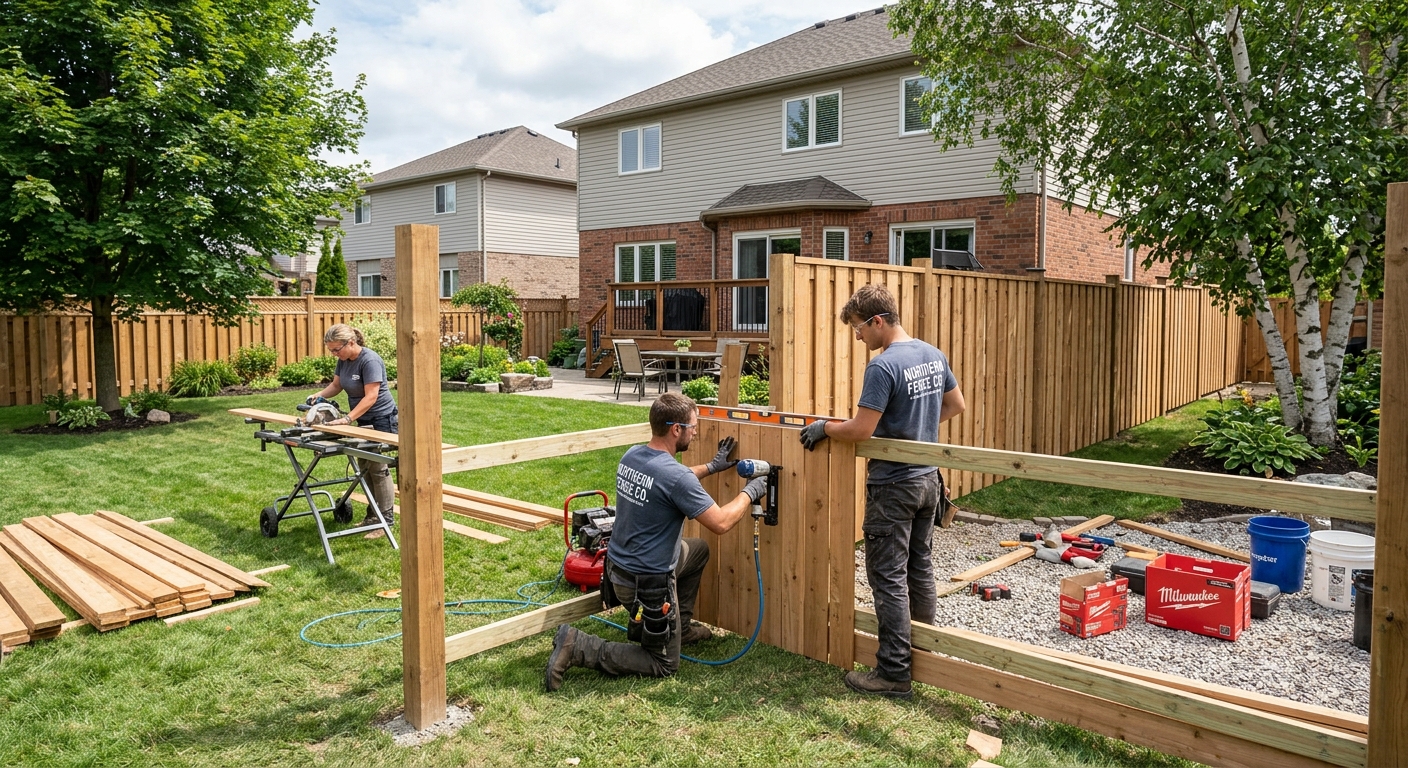
Fencing options and costs in Wychwood
Wychwood is one of those neighbourhoods where homeowners want fencing that looks sharp on mature lots but still holds up through Toronto’s freeze–thaw cycles. With a 2021 population of 14,349 (Statistics Canada, 2021 Census), demand is steady, and most fenced properties cluster around residential streets off St. Clair and along the belt of older, established homes. That housing mix matters: when detached homes are common, long frontages and backyard enclosures drive consistent work for privacy and boundary fencing.
In the Toronto economic region, the big cost driver is how deep posts must be set. Frost depth in Southern Ontario is commonly taken at about 42"–48", so contractors typically set posts a minimum of 3.5–4 feet down (often with concrete-set footings). For 6–8 ft privacy fences, that extra labour and ready-mix adds up quickly, especially when you’re installing on clay or mixed soil that doesn’t drain cleanly.
Material choice then shapes both price and the day-to-day effort you’ll spend maintaining it. In Wychwood, trades are particularly busy for solid privacy fencing near the busier corridors and wherever properties back onto laneways that experience more wind and weather exposure. So, instead of just picking the cheapest line item, most homeowners compare lifespan and maintenance alongside the installed price. Below is a practical comparison to help you budget before you request quotes.
| Material |
Lifespan |
Maintenance |
Privacy Rating |
Price per Linear Foot |
Price Range |
| Pressure-treated pine (standard wood) |
10–15 years |
Stain/seal every 2–3 years; check posts annually |
High (solid boards) |
$65–$120 |
$65–$120 |
| Cedar (natural rot resistance) |
15–20 years |
Seal/stain as needed (often every 2–4 years) |
High (solid boards) |
$75–$130 |
$75–$130 |
| Vinyl / PVC (no-maintenance) |
20–30 years |
Wash occasionally; inspect for impact damage |
High (solid or board-style) |
$75–$130 |
$75–$130 |
| Chain-link (galvanized steel) |
25–35 years |
Minimal; occasionally tighten/replace mesh sections |
Low–Medium (privacy slats needed) |
$45–$85 |
$45–$85 |
| Aluminum ornamental |
25–40 years |
Wash annually; no rust, check hardware |
Low (decorative pickets) |
$90–$160 |
$90–$160 |
| Composite / recycled material |
20–30 years |
Low; occasional cleaning and hardware check |
High (board-style) |
$85–$145 |
$85–$145 |
Prices are estimates only and vary by project scope, site access and material selection.
What affects the price of fencing in Wychwood
In Wychwood and across the Toronto economic region, two quotes for the “same” fence can differ by 30–50% because fencing pricing is a mix of measurable inputs (linear feet, post footage, gates) and site-specific conditions (soil, access, removal, grade). The crew’s production rate also changes depending on how many corners you have, how tight the driveway access is, and how much digging is needed in clay-like ground common to the area. That’s why the same model of 6 ft privacy fence can land in different price bands when the contractor has to concrete-set every post deeper for frost protection.
Frost line depth is the first technical reason costs swing. The region’s frost depth is commonly around 42"–48", and best practice generally sets posts about 4–6 inches below design frost depth to prevent frost heave. Practically, that means many installations require roughly 1.5–2.0 m into the ground. Concrete-set posts use more labour per hole and add ready-mix and hardware costs, so a privacy fence typically prices closer to the higher end of the $65–$120 (wood) or $75–$130 (vinyl/PVC) ranges when you’re doing proper footings.
Local condition examples in Wychwood: (1) a backyard with heavier clay often needs slower, cleaner excavations and more concrete to stabilize—pushing costs up; (2) if the fence line is accessible from an open laneway, crews dig and pour faster—pushing costs down; (3) if you have many gates or frequent gate hardware upgrades, the hardware and time increase even when the fence length stays the same. Transition boards, steeper grades, and old fence removal can add several days, not just hours, so your total can rise quickly even if your material choice stays “mid-range.”
| Price Factor |
Why It Matters |
Cost Impact |
| Fence length in linear feet |
The most direct input: materials, posts, rails and labour scale linearly. |
High (often the majority of total cost) |
| Post depth required |
Frost depth dictates hole depth and required post length to avoid heaving. |
Medium–High (adds footing time + materials) |
| Post setting method |
Concrete-set posts outperform driven/gravel-pack on Toronto soils for long-term stability. |
High (concrete + labour) |
| Material choice |
Vinyl, cedar, and chain-link differ in unit pricing, installation steps, and hardware needs. |
Medium–High (drives the baseline) |
| Gate count and type |
Each gate adds framing, hinges, latches, and sometimes heavier bracing. |
High (especially drive-through double gates) |
| Grade and terrain |
Slopes often require stepping sections or raked panels; waste increases. |
Medium (more labour + material cut loss) |
| Old fence removal and disposal |
Demolition time, hauling, and any salvaging agreement affect total cost. |
Medium (can add days and truck trips) |
| Permit fees and survey / property line locate |
Administrative and locate work prevents encroachment and misplacement disputes. |
Low–Medium (depends on your situation) |
Permits & regulations in Ontario
In Ontario, whether you need a permit depends mostly on fence height and location. As a rule of thumb in many Toronto-area bylaws, fences above about 2.0 m (6.5 ft) in the rear and about 1.0–1.2 m (3–4 ft) in the front or at a corner often trigger a permit requirement. Even when a permit isn’t required, you still must respect property lines and any municipal setback rules. If a contractor digs posts without confirming your exact line, you can end up paying to correct the fence location later.
Before any post holes: call utility locates through Ontario One Call. Utility marking is non-negotiable, and it protects you from service disruption and liability. Also, obtain a survey or verify property pins/locates before installation—especially in older Wychwood properties where lot lines can feel “in-between” fences that existed for decades.
Shared fence ownership is addressed under Ontario’s line-fences framework: it affects who can require maintenance or cost-sharing. The step-by-step homeowner checklist is: (1) ask the contractor whether the project needs a permit; (2) verify they can pull the permit if required; (3) request proof of contractor licensing/registration if applicable in your area; (4) check liability insurance for fence work and site protection; and (5) confirm workplace coverage documentation such as WSIB where required for the contractor and their workers. Always request the certificate of insurance directly and confirm coverage dates match your start date.
Choosing the right fence material for Wychwood
Choosing a fence material in Wychwood comes down to matching what you care about—privacy, low maintenance, budget, and lifespan—to Toronto’s climate realities. Our winters bring repeated freeze–thaw, so post stability matters as much as the surface material. For that reason, many Toronto-area installs use concrete-set posts set to avoid frost heave; it’s especially common for 6–8 ft privacy fences where wind uplift and panel racking are concerns.
Pressure-treated pine is usually the best starting point for budget, but it needs staining or sealing every 2–3 years to slow grey weathering and moisture cycling at joints and pick edges. Cedar offers better natural rot resistance and a nicer finish, yet it still benefits from periodic staining. Vinyl/PVC is the low-maintenance winner for many homeowners—no staining, easier cleaning—but it can crack if impacted and it still requires correct post spacing and solid framing for cold-season rigidity. Chain-link is typically the lowest cost and longest-lasting option, but it’s weak for privacy unless you add slats or privacy mesh. Aluminum ornamental looks crisp and won’t rust, but it won’t provide the same privacy as a solid board fence. Composite/recycled boards are often a middle-to-higher upfront choice with strong durability and low annual upkeep.
Concrete-set posts are usually justified in Wychwood because frost depth is commonly taken at about 42"–48", and posts often need roughly 1.5–2.0 m down for stability. For example, if you’re choosing between standard wood and vinyl/PVC, a typical Toronto swing can be roughly $65–$120 per linear foot for wood versus $75–$130 for vinyl—an extra cost that can make sense when you want fewer maintenance trips and a longer service life. If your property line is windy or you have more corners, heavier posts and closer panel spacing are also more important than chasing the cheapest material.
| Material |
Cold Tolerance |
Lifespan |
Annual Maintenance |
Best For |
Price Band |
| Pressure-treated pine |
Good if properly sealed and installed on stable footings |
10–15 years |
Low–Medium (inspection; stain/seal every 2–3 years) |
Budget privacy with regular upkeep |
$65–$120 |
| Cedar |
Good; manages moisture better than pine |
15–20 years |
Low–Medium (seal/stain as needed) |
Better curb appeal and longer natural resistance |
$75–$130 |
| Vinyl / PVC |
Very good in cold; needs impact-smart installation |
20–30 years |
Low (wash; check hardware) |
Low-maintenance privacy |
$75–$130 |
| Chain-link |
Excellent; galvanized steel handles temperature swings well |
25–35 years |
Very low (tighten/repair sections) |
Security with visibility |
$45–$85 |
| Aluminum ornamental |
Excellent; won’t rust |
25–40 years |
Low (wash; hardware checks) |
Attractive, durable boundary fencing |
$90–$160 |
| Composite / recycled |
Good (stable boards; still relies on solid posts) |
20–30 years |
Low (cleaning + occasional hardware checks) |
Long-term privacy with minimal upkeep |
$85–$145 |
How to choose a fencing contractor in Wychwood
Picking the right fencing contractor in Wychwood starts with verifying coverage and credibility before you sign anything. In Ontario, ask for proof of liability insurance and confirm they carry appropriate workplace coverage such as WSIB (or the applicable coverage status for their workers and subcontractors). Then, verify their authorization/registration details through official channels that correspond to fencing contracting work in Ontario. Where to look: (1) their certificate of insurance showing coverage dates and your project address or wording that matches the job; (2) the contractor’s WSIB clearance letter/confirmation (or exemption documentation if they claim one); and (3) any online registry entry for licensing/registration, where available.
Next, get 2–3 itemised written quotes instead of a lump sum. The breakdown should list labour, materials, post size and spacing, fence height, gate count and hardware, excavation depth assumptions (especially frost setting), and disposal/removal. Read the exclusions: does the quote include permit pulling (when required), hydro/utility locate coordination, and hauling for old fence debris? Ask whether the contractor is doing concrete-set posts—because in Toronto soils and cold-season frost conditions, that can change the real installed value.
For warranty, confirm workmanship coverage length, product/manufacturer warranty terms, and whether it’s transferable if you sell the home. Payment schedules matter too: never pay more than about 10–15% upfront, and hold back enough to protect you until the job is complete and inspected. Finally, require a written start date and completion estimate so winter scheduling and material lead times don’t become surprises.
- Request a written scope that states exact fence height, style, and panel layout.
- Confirm post size, spacing (centres), and whether posts are concrete-set to frost-safe depth.
- Ask who handles utility locates and whether locate tickets are documented.
- Verify insurance with a current certificate and confirm liability coverage includes contractors at residential sites.
- Check WSIB coverage status via clearance letter/documentation before work begins.
- Get an itemised quote showing materials, labour, and disposal—no “allowance” gaps.
- Clarify whether permits are included (when height thresholds require them) or quoted separately.
- Confirm how gates are framed and the exact hinge/latch hardware included.
- Ask how slopes are handled (stepped vs. raked) and whether you’ll pay extra for grade conditions.
- Make sure the quote states assumptions about access (laneway entry, equipment placement, pathway protection).
- Review the workmanship warranty length and what failures it covers (posts, rails, alignment, hardware).
- Agree on a payment schedule with a clear holdback until final cleanup and walk-through completion.
Red flags I commonly see with fencing crews in Wychwood: vague “installed” pricing with no linear-foot basis, refusal to show concrete-set/frost-depth assumptions, missing or expired insurance/WSIB documentation, quotes that exclude old fence disposal while assuming “you’ll haul it,” and no written schedule—just “we’ll fit you in.”
Frequently asked questions — fencing in Wychwood
How do I prevent wood fence rot in Wychwood?
To prevent wood rot in Wychwood, focus on the details that survive freeze–thaw: correct post depth, solid post setting, and protecting the wood where moisture collects. In Southern Ontario, contractors typically set posts well below the frost line (often around 1.5–2.0 m into the ground) and use concrete-set posts to reduce movement that tears fasteners and lets water sit. For the boards, use proper pressure-treated lumber or quality cedar, keep top rails tight, and ensure there’s ventilation so the boards don’t stay constantly damp. Staining matters: with pressure-treated pine, plan for sealing every 2–3 years to slow grey weathering and moisture cycling. If your fence has damaged bottom boards or leaning posts, fix those quickly—rot usually starts where wood touches soil or where the fence has gaps that trap water.
What is the cost per linear foot for fencing in Wychwood?
In Wychwood, most installed fence pricing lands in Toronto’s regional bands. A typical installed wood privacy fence comes in around $65–$120 per linear foot, while vinyl/PVC privacy commonly sits around $75–$130 per linear foot. Chain-link is usually lower, around $45–$85 per linear foot, because it uses less material and simpler framing, though it offers less privacy without slats. Aluminum ornamental is typically mid-to-higher, around $90–$160 per linear foot, due to hardware and fabrication. Your exact number depends on post setting (concrete-set for frost stability), fence height, gate count, and whether old fencing needs removal. If you’re seeing unusually low per-foot pricing, it’s often because post depth or concrete setting is being under-scoped.
Should I repair or replace my old fence in Wychwood?
Repair vs. replace depends on what’s failing and how much of the fence has been moving. In Wychwood’s climate, a fence that’s leaning or has posts lifted from frost movement often needs more than board replacement—because if posts shift, new boards won’t stay aligned and fasteners will loosen again. If the rails are sound and only a few sections are rotted or damaged, targeted repairs can be cost-effective. However, if you have multiple compromised posts, repeated rot at the bottom edges, or widespread sagging (especially across several fence panels), replacement is usually the better long-term value. A common approach we use is to assess post stability first: if concrete-set footings are compromised, replacement is often the only way to “reset” the system. Budget-wise, compare the cost of repairs against the ongoing maintenance burden for pressure-treated wood versus lower maintenance options like vinyl/PVC.
How do I handle a fence dispute with a neighbour in Ontario?
Fence disputes in Ontario usually come down to property line location, shared responsibility, and what each neighbour agreed to when the fence was first installed. Start by documenting what you have: take clear photos, measure fence alignment against your survey pins or locate info, and keep copies of any correspondence. Before any work, verify the property line through a survey or property pin locate—especially in older neighbourhoods in and around Wychwood where fences may not match modern lot lines. Ontario’s shared fence ownership approach under line-fences legislation can guide who pays for repairs or replacement, but the practical step is to try a written agreement first. If you and your neighbour disagree on line placement or costs, consider mediation or professional advice rather than starting demolition. A contractor can help by providing written measurements and a documented scope, but they can’t decide legal boundaries for you.
What fence style offers the best wind resistance in Wychwood?
In Wychwood, wind typically isn’t as punishing as the Prairies, but taller fences can still rack if the posts and framing aren’t engineered for the load. For best wind resistance, choose a solid privacy fence only if it’s built with proper spacing, sturdy posts, and proper bracing—especially for 6–8 ft heights. Concrete-set posts set below frost depth reduce movement, which is what otherwise amplifies wind stresses. Panel design matters too: heavier panels with closer post spacing (commonly 6–8 ft centres depending on the system and height) hold shape better. If you want reduced wind load and don’t require full visual privacy, a semi-open style (like some lattice or certain board spacing) can behave better in gusts while still offering partial screening. Either way, ensure your contractor accounts for local conditions around corners and any areas more exposed to prevailing winds.
How much does a fence cost in Wychwood?
Total fencing cost in Wychwood depends primarily on length and gates, then on whether the contractor includes frost-safe concrete-set posts, removal, and any needed locating work. As a planning baseline, wood privacy often prices around $65–$120 per linear foot, and vinyl/PVC privacy around $75–$130 per linear foot, with chain-link typically around $45–$85 per linear foot. Taller fences (like 6–8 ft privacy) usually cost more because they require sturdier posts and more robust bracing to resist racking. Gates add notable cost due to framing and hardware—one gate isn’t the same as adding 6–10 ft of fencing. If you’re replacing an old fence, disposal and demolition can add several hundred to over a thousand dollars depending on debris volume and access. Get an itemised quote that shows linear footage, post depth assumptions, and whether permit work is included when your height triggers it.