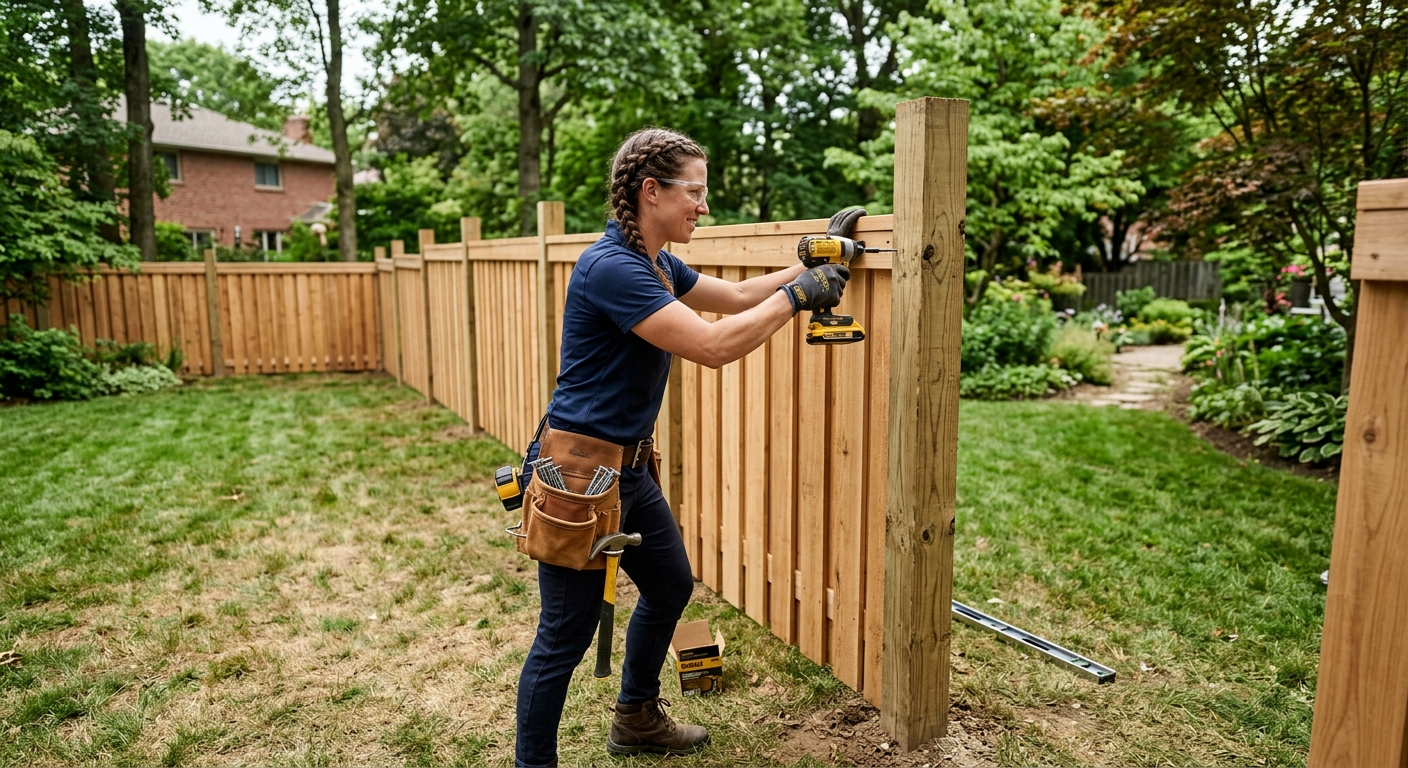
Fencing options and costs in Wasaga Beach
Wasaga Beach is a great place to fence in, especially with so many single-detached homes—about 82.7% of dwellings are detached (Statistics Canada, 2021 Census), meaning most residents are dealing with private yards, driveways and boundary maintenance year-round. In addition, the area has a strong base of homeowner households: 9,235 homeowner households, or 85.4% of households (Statistics Canada, 2021 Census). That ownership mix is one reason fencing work stays steady across the season, from pool enclosures to backyard privacy upgrades.
In the Kitchener–Waterloo–Barrie economic region, fencing costs are shaped by Ontario freeze–thaw cycles and the way posts must be installed below frost risk. Contractors typically use concrete-set posts for most wood, vinyl and aluminum fence builds because shallow/dry-set posts can shift or lean during repeated winter thaws and thaws that follow. For privacy fences (often 6 ft), installers commonly tighten post spacing (roughly 6–8 ft centres) and use sturdier rails or panel systems to reduce racking and wind “blow-out” movement in open stretches of developing subdivisions.
In Wasaga Beach, demand is especially strong in neighbourhood pockets where lots are newer and tree cover is limited—commonly along the busier residential lanes near Beachwood Road and the surrounding inland subdivisions. Homeowners there are often balancing privacy, wind exposure, and the need for longer-lasting installations when soil is wet or sandy near drainage features.
Below is a practical comparison of common fence materials and what Wasaga Beach homeowners typically budget per linear foot.
| Material |
Lifespan |
Maintenance |
Privacy Rating |
Price per Linear Foot |
| Pressure-treated pine (standard wood) |
10–20 years |
Stain/seal every 2–3 years; quick spot repairs |
High (good with solid boards) |
$45 – $70
|
| Cedar (natural rot resistance) |
15–25 years |
Still benefits from sealing; manageable board replacement |
High (excellent with tight pick spacing) |
$55 – $85
|
| Vinyl / PVC (no-maintenance) |
25–35 years |
Rinse wash; minimal repairs |
High (solid privacy styles) |
$60 – $90
|
| Chain-link (galvanized steel) |
20–30 years |
Occasional tension/rail checks |
Low to medium (privacy screen needed) |
$35 – $60
|
| Aluminum ornamental |
25–40 years |
Hose-off cleaning; rare hardware service |
Low to medium (ornamental, not a privacy wall) |
$60 – $110
|
| Composite / recycled material |
20–30 years |
Low maintenance; occasional hardware inspection |
High (board-and-rails privacy styles) |
$70 – $105
|
Prices are estimates only and vary by project scope, site access and material selection.
What affects the price of fencing in Wasaga Beach
Even when two neighbours in Wasaga Beach want the “same” fence, quotes can land 30–50% apart across the wider Kitchener–Waterloo–Barrie region and Ontario overall. The biggest reason is that the same length of fence can have very different realities: post depth requirements, soil hardness or wetness, gate complexity, and how much labour is needed to get straight lines on uneven ground.
In this part of Ontario, frost depth typically forces post holes to go about 4–6 inches below the design frost depth to reduce heaving risk. Translating that into field practice: many installs need posts in the 1.5–2.0 m range, which means deeper augering and more concrete per post. Deeper holes raise both material and labour costs, particularly on longer privacy runs. Wind exposure in local open lots (new builds near limited tree lines) also influences engineering decisions—tighter post spacing and sturdier rails/pickets on tall wood and vinyl fences help prevent racking, which adds cost versus a basic short run.
Concrete examples from Wasaga Beach sites: (1) If you have clay-silty soil that holds water, contractors often spend extra time on trench/auger work and may require heavier concrete consistency to lock posts—pushing the job toward the upper end of the $45 – $70 wood range. (2) If you’re replacing an older fence with decades of concrete footings or broken bases, removal and disposal can be the difference between a mid-band $35 – $60 chain-link budget and a higher wood/vinyl price. (3) If you want a wide double drive gate, the stronger posts and hardware required can move the total from “typical” mid-range into the higher end even when the rest of the line is standard.
Finally, housing age matters. With 23.6% of homes built before 1981 (Statistics Canada, 2021 Census), older properties sometimes have less documentation, more encroachments discovered by locate work, and longer timelines for accurate property-line placement—each adds cost.
| Price Factor |
Why It Matters |
Cost Impact |
| Fence length in linear feet |
Materials and labour scale directly with linear footage |
Largest driver; small scope changes compound quickly |
| Post depth required |
Frost risk determines how deep posts must sit for stability |
Deeper holes increase drilling time and concrete use |
| Post setting method |
Concrete set posts resist heaving better than dry-set in cold cycles |
Concrete generally adds cost but improves long-term alignment |
| Material choice |
Vinyl/cedar/aluminum vary widely in material and hardware pricing |
Switching from chain-link to vinyl can raise total budget substantially |
| Gate count and type |
Gates need heavier frames, hinges and latch hardware |
More gates or a double drive gate increases labour and materials |
| Grade and terrain |
Sloped yards require stepped posts or raked panels to look straight |
More layout time and extra components for alignment |
| Old fence removal and disposal |
Disposal fees and labour add up, especially with embedded posts |
Can noticeably change the final price versus a “new build” install |
| Permit fees and survey / property line locate |
Accurate line location avoids rework and disputes |
May add a fixed cost plus scheduling time |
Permits & regulations in Ontario
In Ontario, many fencing projects require a building permit when the proposed fence height exceeds typical thresholds—often around 2.0 m (6.5 ft) at the rear, and roughly 1.0–1.2 m (3–4 ft) at the front or corner, depending on the exact location and municipal rules. Even when a permit isn’t required, fences must respect property lines and municipal setback bylaws. Because Wasaga Beach homes often sit close to lot edges (and older properties can have less-clear documentation), I recommend treating property-line accuracy as mandatory for a smooth job.
Before you dig a single post hole, arrange utility locates by calling Ontario One Call. For boundary accuracy, get a survey or have your property pins located so your contractor can build to the correct line. Shared fence ownership rules are governed by provincial line-fences legislation; if the fence is on or near a shared boundary, it’s wise to confirm expectations with your neighbour before ordering materials.
What typically requires a permit: taller privacy fences (commonly near or above 2.0 m at the rear) and installations that trigger municipal height/location conditions, particularly at front corners. What typically does NOT: smaller, standard height boundary fences in typical rear yard contexts—though the exact rule depends on where the fence sits and how tall it is.
To verify an Ontario contractor, ask for: (1) an Ontario business registration or trade licensing proof if applicable, (2) a certificate of insurance showing general liability with the right limits, and (3) WSIB (where applicable) or WCB coverage information. Look for the current clearance letter or coverage confirmation directly on their documentation—don’t accept “we’re covered” without paperwork.
Choosing the right fence material for Wasaga Beach
Choosing a fence material in Wasaga Beach is really about matching your priority—privacy, low maintenance, budget, or lifespan—to what freeze–thaw and winter moisture will do to the structure. Pressure-treated pine is the budget-friendly route, but it needs periodic staining or sealing (typically every 2–3 years) to reduce grey weathering and to keep moisture from working into the wood. Cedar looks better from day one and naturally resists rot more than pine, but it still benefits from maintenance if you want to keep colour and limit surface breakdown. Vinyl/PVC is popular because it’s low maintenance and stays looking “finished,” though it can crack if impacted or if installed with poor post support in severe cold; it also costs more upfront.
Chain-link is the lowest cost and generally the longest-life security option, but it provides low privacy unless you add a screen or slats. Aluminum ornamental fencing is great for curb appeal and rust resistance, and it typically holds up through winter salts and moisture, but it’s not a true privacy solution because of its open pick design. Composite/recycled materials sit between wood and vinyl in appearance and maintenance effort, often appealing for homeowners who want board-like privacy with less upkeep.
For post depth in the Kitchener–Waterloo–Barrie market, the practical takeaway is that concrete-set posts are standard in many Wasaga Beach installs for stability: frost risk drives deeper holes and longer posts, and that makes rail strength and alignment more important than “surface-only” choices. Tight spacing and solid framing help with wind and snow-load effects—especially where winter winds can push tall panels.
Dollar-wise, it can be justified to pay more for cedar or vinyl when you’re building a long 6 ft privacy run that you don’t want to repaint repeatedly. For example, upgrading from a pressure-treated wood privacy fence budgeted around $45 – $70 per linear foot to vinyl around $60 – $90 can make sense when you expect 10–20 years of service and want fewer maintenance weekends.
| Material |
Cold Tolerance |
Lifespan |
Annual Maintenance |
Best For |
Price Band |
| Pressure-treated pine |
Good with proper concrete-set posts and sealing |
10–20 years |
Light inspections; stain/seal every 2–3 years |
Budget-conscious privacy with willingness to maintain |
$45 – $70
|
| Cedar |
Excellent; handles Ontario moisture cycles well |
15–25 years |
Seal periodically; occasional board replacement |
Natural look privacy with moderate upkeep |
$55 – $85
|
| Vinyl / PVC |
Good; resists rot in wet winters (avoid impacts) |
25–35 years |
Rinse/clean as needed; inspect posts/hardware |
Low-maintenance privacy and clean lines |
$60 – $90
|
| Chain-link |
Very good; galvanized coatings hold up well |
20–30 years |
Occasional tightening and coating touch-ups |
Security on a budget; good for side yards |
$35 – $60
|
| Aluminum ornamental |
Excellent; doesn’t rust |
25–40 years |
Clean with water; hardware check every few years |
Curb appeal and durable front/edge fencing |
$60 – $110
|
| Composite / recycled |
Good; stable boards when installed correctly |
20–30 years |
Low—inspect fasteners and clean as needed |
Privacy look with reduced maintenance |
$70 – $105
|
How to choose a fencing contractor in Wasaga Beach
To choose confidently in Wasaga Beach, verify three things up front: licensing where applicable, liability insurance, and worker coverage (WSIB/WCB). Start by asking for documents before you sign anything. For the insurance certificate, look for current coverage, the insured name matching the contractor, and general liability limits appropriate for exterior construction risk. For WSIB/WCB, request clearance proof or a coverage letter that shows the account is active—this matters if a worker is injured while drilling or setting posts.
Next, get 2–3 itemised written quotes rather than a lump-sum number. A good quote breaks down labour and materials separately, specifies post size and setting method (concrete-set versus gravel pack), and lists rail/panel components. Clarify what’s excluded: permit pulls (if required), survey/property line locate, utility locates, and disposal of your old fence. If old fence removal is included, the quote should state how it’s handled—cut and haul, or reuse/disposal, and whether dumping fees are covered.
Warranty matters too. Ask for (1) workmanship warranty length (often for post setting and installation), (2) product/manufacturer warranty terms, and (3) whether the warranty transfers if you sell your home. Also confirm the payment schedule: never pay more than about 10–15% upfront; insist on a holdback until the job is complete and cleaned up.
Finally, timeline should be written. Get a start date and a realistic completion estimate, plus what weather delays could do (frost-limited excavation windows are common in Ontario).
- Use a written contract with a detailed scope (materials, post depth/setting method, fence height and style).
- Confirm insurance certificate dates and that the named insured matches the contractor.
- Request WSIB/WCB clearance proof or active coverage letter.
- Ask for proof of experience with privacy fences and gate installs (photos of similar Wasaga Beach projects).
- Require itemised labour/materials—not just a single total.
- Confirm whether utility locates and any survey locate fees are included or billed separately.
- Verify if old fence removal/disposal is included (and how).
- Ensure the quote specifies post size, spacing, and whether posts are concrete-set.
- Check that the plan includes gates with exact widths and hardware (hinges, latches, self-closing if requested).
- Confirm how they handle slopes (stepped vs raked panels) and layout corrections.
- Get warranty terms in writing and ask if it’s transferable to new homeowners.
- Agree on payment milestones (small deposit, progress payments, holdback on completion).
Red flags I commonly see in Wasaga Beach fencing scams or “hurry-up” bids: they won’t provide written itemisation, they refuse to show insurance/clearance documentation, they quote unrealistic “dry-set posts” for 6 ft privacy in frost conditions, they skip property-line verification or utility locate steps, and they ask for large upfront payments beyond 10–15%.
Frequently asked questions — fencing in Wasaga Beach
How do I compare fencing quotes?
Start by comparing apples to apples in Ontario: same fence height, same style (privacy vs ornamental), same post spacing, and—most importantly—same post setting method. Ask each contractor for an itemised quote that separates labour from materials and specifies post depth and whether posts are concrete-set (a common standard in cold Ontario to limit heaving). In Wasaga Beach, soil can be damp near drainage areas, so quotes that ignore excavation time or concrete quantities often understate the real cost. Also compare what’s included: permit pulls (if triggered by height/location), utility locates, property line locate/survey, and disposal of an old fence. If two quotes both land in a similar wood budget like $45 – $70, the better one is usually the one with clearer specs and fewer exclusions, not just the lowest number.
How long does fence installation take in Wasaga Beach?
Most residential installs in Wasaga Beach take from 1 to 3 working days for straightforward runs, assuming access is reasonable and holes can be excavated without surprises. Longer privacy projects with multiple corners, a gate, and old fence removal can stretch to 3 to 6 days. Weather matters in Ontario: heavy rain can slow excavation, and frozen ground can delay deeper post-hole work until conditions improve. A well-prepared contractor should provide a written start date and completion estimate, and outline what counts as “finished” (posts set, panels secured, gates aligned, hardware adjusted, and jobsite cleaned). If your property has sloped grade requiring stepped or raked panels, expect extra layout time so the fence looks straight rather than “wavy.”
Can I install a fence on a slope in Wasaga Beach?
Yes, you can install a fence on a slope in Wasaga Beach, but the build method matters for both appearance and stability. Contractors typically use stepped posts (keeping panel tops level in sections) or raked panels that follow the grade. Stepped construction is common for privacy fences where you want a clean, straight look from the road and neighbours’ viewpoints. Raked panels can work well too, but the quote should specify how they’ll manage the slope so spacing stays consistent and gates still operate smoothly. In Ontario’s freeze–thaw conditions, the post depth still needs to respect frost risk—sloped yards don’t remove the need for proper concrete-set posts. Ask your contractor to describe the layout approach and to include it in the contract scope before work begins.
What is the most weather-resistant fence for Wasaga Beach's climate?
For Wasaga Beach’s Ontario winters and wet freeze–thaw cycles, the most weather-resistant choices are usually vinyl/PVC for low rot risk and cedar for rot resistance with natural durability. Proper installation is the real differentiator: concrete-set posts, correct post depth, and sturdy rail framing that resists racking. If you want a “set it and forget it” approach, vinyl privacy styles are popular because they don’t rot like wood. If you prefer natural material, cedar is a strong performer when maintained appropriately. Chain-link is also very durable for security, but it won’t give you privacy without a screen. Budget-wise, vinyl often sits around $60 – $90 per linear foot, while wood options may start lower—so your best choice depends on how much maintenance you want to manage over the years.
How do I prevent wood fence rot in Wasaga Beach?
Wood rot prevention starts below the surface. Ensure posts are installed to proper frost-depth requirements with concrete set when appropriate for cold Ontario conditions; dry-set posts can shift and create gaps that trap moisture. Above ground, use correct ventilation by avoiding solid board contact where water can pool, and leave the fence bottom slightly off the soil where possible. Seal or stain on a schedule—typically every 2–3 years—because grey weathering is often the first sign that protective coating is failing. Also, treat cut ends and damaged boards promptly instead of waiting for rot to spread. For older lots with damp soil, ask your contractor about site drainage and whether soil conditions around post holes might stay waterlogged. Quick repairs early are far cheaper than replacing multiple rotten rails.
What is the cost per linear foot for fencing in Wasaga Beach?
In Wasaga Beach, pricing generally follows the Ontario region market bands. Wood fence installations often land in the $45 – $70 per linear foot range depending on privacy height, board type, and how much excavation/concrete is needed for frost stability. Cedar and other premium wood or composite options can be higher, while chain-link tends to be the most economical at about $35 – $60 per linear foot. Vinyl/PVC privacy systems commonly sit around $60 – $90 per linear foot, and aluminum ornamental fencing often increases to the $60 – $110 band. Your final number depends on linear footage, gate count, slope work, old fence removal, and the depth/setting method used for posts to handle freeze–thaw conditions.