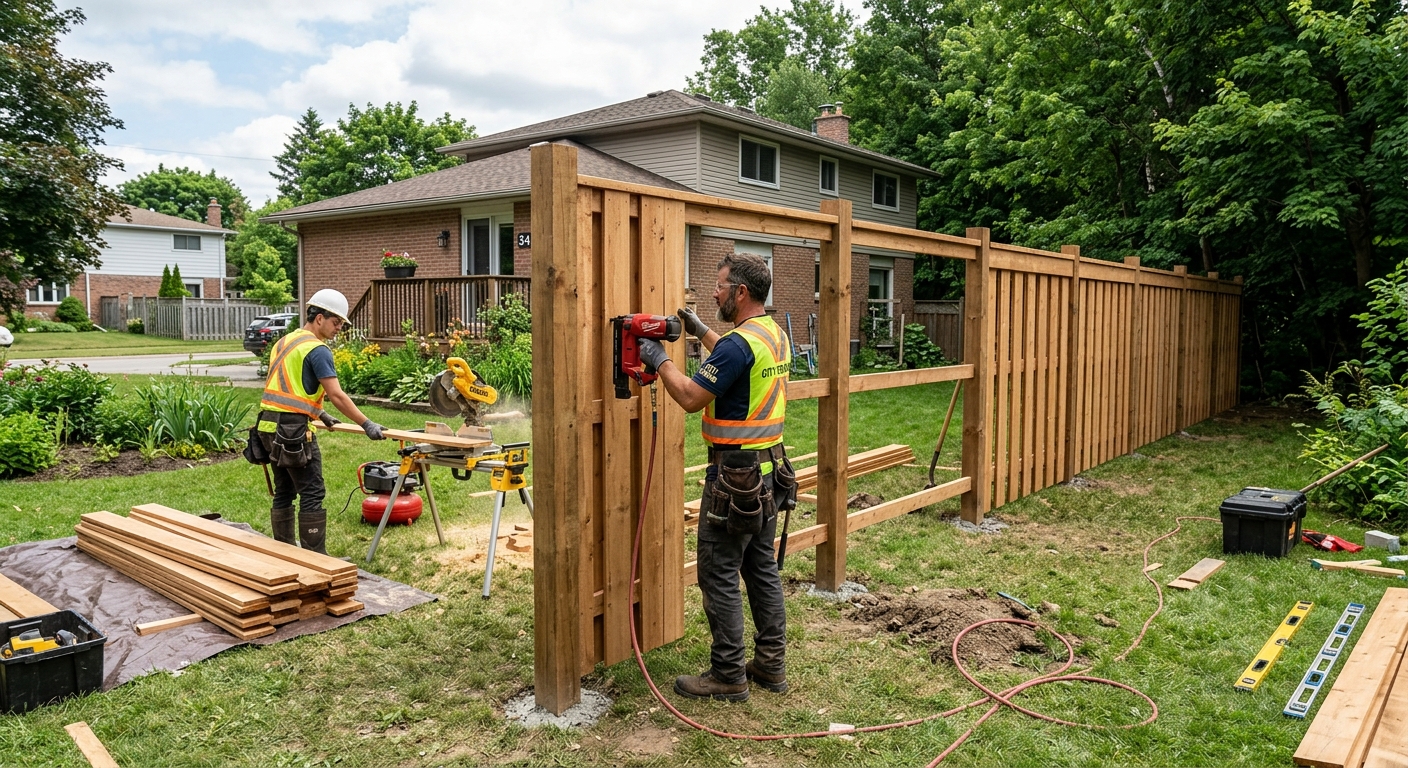
Fencing options and costs in Concord
Concord homeowners often start their search for fencing by comparing looks, privacy, and maintenance, and then reality-check the budget. With a 2021 population of 8,255 (Statistics Canada, 2021 Census), Concord is still closely tied to the Toronto housing market—so contractor availability and material pricing generally track GTA demand rather than purely local supply. Another driver is housing type: in communities like Concord, many lots are associated with single-family neighbourhoods where boundary fences are a common expectation, which keeps steady demand for privacy and backyard enclosures.
In the Toronto economic region, fencing costs are shaped heavily by freeze–thaw cycles. Frost is commonly planned around 42"–48" in Southern Ontario, which means most 6–8 ft privacy fences need concrete-set posts and deeper hole excavation to resist frost heave. That extra labour and ready-mix cost is why you’ll often see wood and vinyl projects cluster toward the upper end of typical price bands, especially when access is tight or there’s soil that doesn’t compact well.
In Concord, trades are particularly in demand in established residential pockets where backyards are enclosed on both sides and gates are more frequent—areas around the more built-up suburban streets where property lines are clearly defined and fences are upgraded in stretches. For these typical backyards, the quickest way to compare bids is to look at per-linear-foot pricing by material, since post depth, spacing, and hardware selection can shift the total.
Use the table below to benchmark common options, then we’ll break down what moves a quote up or down.
| Material |
Lifespan |
Maintenance |
Privacy Rating |
Price per Linear Foot |
| Pressure-treated pine (standard wood) |
10–15 years |
Stain/seal every 2–3 years |
High (solid boards) |
$65 – $120 |
| Cedar (natural rot resistance) |
15–25 years |
Light stain/seal every 2–4 years |
High (solid boards) |
$75 – $130 |
| Vinyl / PVC (no-maintenance) |
20–30 years |
Rinse as needed; no staining |
High (solid panels) |
$75 – $130 |
| Chain-link (galvanized steel) |
25–35 years |
Occasional tension/hardware checks |
Low to medium |
$45 – $85 |
| Aluminum ornamental |
25–40 years |
Occasional cleaning |
Low to medium |
$90 – $160 |
| Composite / recycled material |
20–30 years |
Minimal cleaning; no staining |
High (solid boards) |
$90 – $160 |
Prices are estimates only and vary by project scope, site access and material selection.
What affects the price of fencing in Concord
In Concord, two neighbours can receive quotes for what looks like the same fence and still see a 30–50% swing, largely because fencing is never a one-size installation. In the Toronto economic region, contractors price for real-world job conditions: soil type, how much excavation is required, gate hardware, and whether posts must be set to withstand Southern Ontario’s freeze–thaw movement. Labour rates and the cost of ready-mix concrete also influence pricing, and those fluctuate with GTA demand. When crews are booked around school-year and spring contractor schedules, material ordering and scheduling efficiency can shift the total.
The biggest technical driver is frost-line depth. Even though the exact frost depth varies by design, Southern Ontario is commonly planned at about 42"–48". In practice, posts are typically set roughly 4–6 inches below design frost depth to reduce heaving—often meaning 1.5–2.0 m into the ground in cold Ontario conditions. That requirement increases the length of posts, the amount of concrete, and the time spent on hole digging and alignment. For tall privacy fences, heavier posts and tighter panel spacing (often 6–8 ft centres) help reduce racking and uplift, especially after snow loads and freeze-thaw cycles.
Concrete examples that commonly raise costs in Concord: (1) clay-heavy or rocky ground that requires more excavation time, leading to higher labour and more concrete; (2) a long run that includes two gates and a corner return, which adds bracing and heavier hardware; and (3) replacing fence sections near older homes where footing clearance is tight. Conversely, a shorter run on easy access with straightforward gates can keep the project closer to the lower end of the wood or vinyl bands (for example, wood often starts around $65 – $120 per linear foot range depending on scope).
Because most privacy installations in the GTA rely on concrete-set posts for long-term stability, it’s common to land nearer the mid-to-upper end of typical material ranges like vinyl/PVC ($75 – $130) or cedar/wood, rather than the absolute low-cost assumptions people hear from online comparisons.
| Price Factor |
Why It Matters |
Cost Impact |
| Fence length in linear feet |
The longer the run, the more posts, rails, brackets, and fasteners |
Primary driver; scales total project cost directly |
| Post depth required |
Frost line determines hole depth and required post length |
Longer posts and deeper excavation increase labour and material |
| Post setting method |
Concrete vs. gravel pack vs. driven posts affects stability in Ontario freeze–thaw |
Concrete-set posts typically increase cost but reduce long-term movement |
| Material choice |
Vinyl and composite can cost more upfront; cedar is natural but still maintenance-aware |
Can shift overall budget by tens of percent even with identical geometry |
| Gate count and type |
Drive-through double gates need heavier bracing and more hardware |
Often adds significant cost beyond fence line materials alone |
| Grade and terrain |
Slopes require stepping, racking, or custom board lengths |
Extra labour and waste; can add framing time |
| Old fence removal and disposal |
Demolition includes hauling and often additional labour for deconstruction |
May add a noticeable but variable line item |
| Permit fees and survey / property line locate |
Documents prevent encroachment and clarify setback requirements |
Rarely huge, but can affect timelines and total budget |
Permits & regulations in Ontario
In Ontario, fences can fall under permitting rules based on height and location, and in Concord you should plan for this if you’re targeting a tall privacy fence. A common threshold is a building permit often being required for fences above about 2.0 m (6.5 ft) at the rear, while front or corner fencing is frequently subject to lower limits around 1.0–1.2 m (3–4 ft), depending on municipal bylaws and the specific lot context. Even when a permit isn’t required, you still must respect property lines, easements, and any municipal setback rules.
Before digging any post holes, call for utility locates through Ontario One Call. That step is about avoiding expensive damage to buried services (and it protects your project schedule). Next, verify your boundary: get a survey or locate your property pins so you’re not building on a neighbour’s land. Shared fence ownership is governed by Ontario’s line-fences legislation, so disagreements about who pays for repairs or replacement aren’t “negotiated later”—they’re anchored to the rules.
What typically DOES require a permit: new fences over the common height thresholds (especially in rear yards), any fence plans that may affect accessibility sightlines, and situations where the municipality flags the structure due to size or proximity to property boundaries. What typically does NOT: replacing like-for-like fencing within standard height limits, or repairs to an existing fence that don’t increase height or footprint.
To verify a contractor in Ontario, confirm they have the right business authorization for fencing work, and ask for proof of liability insurance. Get their certificate of insurance (COI) and ensure coverage is active for the project address. For worker protection coverage, ask whether they hold WSIB/WCB coverage (or the applicable clearance documentation if they use qualifying subcontract labour). Where to look: request the COI directly, and for licence/clearance checks, use the relevant online registries and clearance listings available to the public. Always keep copies for your records.
Choosing the right fence material for Concord
Choosing fence material in Concord is mostly about matching your priorities—privacy, low maintenance, and budget—to a local climate that repeatedly freezes and thaws. Pressure-treated pine is the most budget-friendly “start option,” but it typically needs staining or sealing every 2–3 years to reduce grey weathering and slow surface breakdown. Cedar looks better longer and has natural rot resistance, yet it still benefits from maintenance and proper airflow through the pickets/boards (and correct post setting) to avoid early failure near the ground line.
For true low-maintenance installs, vinyl/PVC and composite/recycled materials are popular in the GTA because they don’t require staining. That said, vinyl can be less forgiving if it’s installed without the right temperature-aware fastener practices or if posts aren’t aligned well—extreme cold can contribute to cracking at stress points. Chain-link is the longest-life low-cost approach and performs well against Ontario weather, but it won’t provide meaningful privacy unless you add slats or privacy screens. Aluminum ornamental fences provide a clean, rust-resistant look with good durability, but they offer limited privacy by design.
In Toronto’s frost-line conditions, post depth matters more than people expect. For most privacy fence heights, posts are commonly set using concrete at depth roughly related to design frost planning (often 1.5–2.0 m into the ground), which supports stable alignment through winter heave cycles. Taller, more solid systems should also be built with wind and snow movement in mind—meaning sturdier posts (or correct post size) and closer spacing.
Here’s a practical cost example: if you’re deciding between standard pressure-treated wood around $65 – $120 and vinyl in the $75 – $130 range, vinyl can be justified when you want to avoid repeat staining and you’re staying in the home long enough to recover the upfront difference. If budget is tight and you’re willing to maintain, wood can still be an excellent choice—especially with concrete-set posts and a proper finish plan.
| Material |
Cold Tolerance |
Lifespan |
Annual Maintenance |
Best For |
Price Band |
| Pressure-treated pine |
Good with correct post setting and finish |
10–15 years |
Stain/seal every 2–3 years (plan for cost) |
Budget privacy where you’ll maintain the finish |
$65 – $120 |
| Cedar |
Good; naturally resistant to rot |
15–25 years |
Light re-stain/seal every 2–4 years |
Attractive privacy with better natural durability |
$75 – $130 |
| Vinyl / PVC |
Very good; avoid stress at fasteners in cold |
20–30 years |
Rinse as needed; minimal upkeep |
Low-maintenance privacy and long-run looks |
$75 – $130 |
| Chain-link |
Excellent |
25–35 years |
Occasional tension/hardware checks |
Security on a budget, with optional screening |
$45 – $85 |
| Aluminum ornamental |
Excellent |
25–40 years |
Occasional cleaning |
Front/side appearance with durability |
$90 – $160 |
| Composite / recycled |
Good; depends on system build quality |
20–30 years |
Minimal cleaning; no staining |
Privacy with low-maintenance boards |
$90 – $160 |
How to choose a fencing contractor in Concord
Hiring in Concord should start with verification: in Ontario, a legitimate contractor can provide proof of liability insurance and worker coverage, and they should be comfortable discussing how posts will be set to handle Southern Ontario freeze–thaw. Liability insurance: ask for a certificate of insurance (COI) that lists the project address and coverage date range. Coverage/worker protection: ask whether they hold WSIB/WCB coverage (and request clearance documentation where applicable). Where to check: COIs are provided by the contractor, and for licence/clearance confirmation you can use the relevant public online registries and clearance listings available in Ontario.
Next, get 2–3 itemised, written quotes. “Itemised” matters: you want a breakdown that separates labour (excavation, post setting, build/install, alignment), materials (posts, rails, boards/panels, hardware), and any gate-specific hardware. Avoid lump sums that hide whether concrete-set posts are included, especially since Toronto projects often require deeper, concrete-set foundations to resist frost heave. Also clarify inclusions: permit pull included or not, property line locate/survey allowance, and disposal/hauling of old fencing.
Look for a workmanship warranty that’s clearly stated (how long, what’s covered, and how to file a claim). Confirm whether the product/manufacturer warranty transfers to you and what conditions apply (for example, installation methods and approved hardware). Payment schedule should protect you: never pay more than 10–15% upfront, and hold back a portion until the job is complete and aligned to your acceptance standards. Finally, insist on a written start date and completion estimate tied to site readiness and weather windows.
- Ask for COI showing liability coverage and project-address listing
- Request WSIB/WCB coverage proof or clearance documentation
- Confirm the post-depth approach for frost stability (concrete-set expected for privacy runs)
- Get quotes with labour and materials separated (no “all-in” only)
- Verify whether old fence removal and disposal are included
- Confirm gate hardware is upgraded for the correct gate size and type
- Ask who handles permits (and whether permit fees are included)
- Ensure property line locate/survey steps are described
- Check if boards/panels are specified (thickness, type, grade) not just “wood fencing”
- Ask about warranty length for workmanship and product coverage transferability
- Set expectations on schedule in writing, including weather delays
- Use a payment plan with 10–15% maximum upfront and a holdback
Red flags I see too often in Concord include contractors who: (1) refuse to provide a COI or WSIB/WCB documentation; (2) quote “driven posts only” for tall privacy fences without discussing frost-line stability; (3) provide a vague scope that doesn’t specify concrete setting, gate hardware, or disposal; (4) ask for most payment upfront before installation begins; and (5) won’t put start dates, warranty terms, and material specifications in writing.
Frequently asked questions — fencing in Concord
What is the most weather-resistant fence for Concord's climate?
For Concord and the broader Ontario freeze–thaw cycle, the most weather-resistant options tend to be vinyl/PVC, aluminum, and high-quality chain-link—especially when posts are installed to handle frost movement. Chain-link generally outlasts most materials because it’s galvanized and doesn’t rot, though it won’t give privacy unless you add slats or screening. Vinyl and aluminum handle moisture and winter exposure well, but proper installation matters (alignment, correct post setting, and proper hardware). If your priority is privacy plus durability, vinyl/PVC privacy systems often perform best over time and typically fall within the $75 – $130 range per linear foot depending on height, gates, and layout. In all cases, concrete-set posts for privacy heights help reduce heave-driven misalignment in winter.
How do I prevent wood fence rot in Concord?
Wood rot usually starts where moisture sits—near the ground line and around fasteners—so in Concord the prevention strategy is both material choice and installation. First, plan for concrete-set posts (common practice in Southern Ontario) so the portion of the post that contacts soil is less likely to stay wet and shift during freeze–thaw. Second, use pressure-treated lumber that matches the intended application and keep boards off soil where possible with proper spacing and alignment. Third, maintain the finish: even with pressure-treated pine, staining or sealing every 2–3 years helps slow weathering that opens the surface to water. Cedar is naturally more rot-resistant, but it still benefits from periodic maintenance. If your quote is around the $65 – $120 range for wood, factor in maintenance so you can budget over time rather than just comparing upfront price.
What is the cost per linear foot for fencing in Concord?
In Concord, costs typically land in banded ranges depending on material and how complex the job is (gates, post depth, disposal, and access). For quick benchmarking, wood fencing installs are often quoted within $65 – $120 per linear foot, vinyl/PVC typically sits around $75 – $130, and chain-link commonly comes in lower at about $45 – $85. Aluminum ornamental usually runs higher, roughly $90 – $160. The reason your “per linear foot” can move upward in Ontario is usually the foundation work: deeper post holes for frost stability, more concrete, and extra labour for straight alignment on sloped yards. If you want the most accurate cost, ask for an itemised quote that lists post setting method and gate hardware details.
Should I repair or replace my old fence in Concord?
Repair makes sense when the posts are still solid, the rails haven’t loosened, and the fence failure is limited to boards or a small section. In Ontario, I usually recommend evaluating frost and moisture damage by checking which posts have movement—if posts are heaving or leaning, repairs rarely hold long-term and you may end up redoing the same sections. Replacement is often the better value when more than a third of the run shows rot at the base, hardware failure, or significant sagging—especially for privacy fences where wind and snow loads can push the system further out of alignment. If you’re seeing rot but only on a small section, you can sometimes replace boards and reset hardware, but only if the post depth and setting method for new work matches the stability requirements used elsewhere. If your new option is in the $75 – $130 range for vinyl or $65 – $120 for wood, compare total expected service life plus maintenance time, not just today’s invoice.
How do I handle a fence dispute with a neighbour in Ontario?
In Ontario, fence disputes often come down to property lines, shared responsibility, and whether the fence is on the correct side of the boundary. Start by documenting the issue (photos, measurements, and where the fence sits relative to pins or a survey). Then verify the property line through a survey or by locating property pins—this is where many disputes get resolved before money changes hands. If the fence is shared or you’re asking for a cost split, Ontario line-fences legislation governs how shared fencing responsibilities are approached. Avoid “agreeing” verbally without clarity; ask for the specific portion being disputed and any proposed changes in writing. If a fence was installed too far over the line, the resolution can become a matter of re-alignment rather than just repairs. For Concord homeowners, the best next step is to keep it evidence-based and bring the contractor to mark proposed adjustments only after boundary clarity.
What fence style offers the best wind resistance in Concord?
In Concord, the fence style that usually offers the best wind resistance is a well-built privacy fence with the correct structural balance: solid or near-solid panels with heavier posts and closer spacing, supported by properly set footings. Because wind can rack tall panels, the solution isn’t just “make it taller”—it’s ensure the post size and spacing match the height and exposure. Where Ontario lots have open corners or backyard wind corridors (even within the GTA), a privacy fence that uses reinforced rails, appropriate bracing, and tight spacing (often 6–8 ft centres) will outperform a lightweight build. Chain-link is more wind-permeable and can flex, but it won’t provide visual privacy without additions that can change wind behaviour. If you want max wind stability with privacy, budget for a system that aligns with privacy-style material bands such as wood around $65 – $120 or vinyl around $75 – $130, and ensure the contractor describes how posts are set for frost and winter movement.