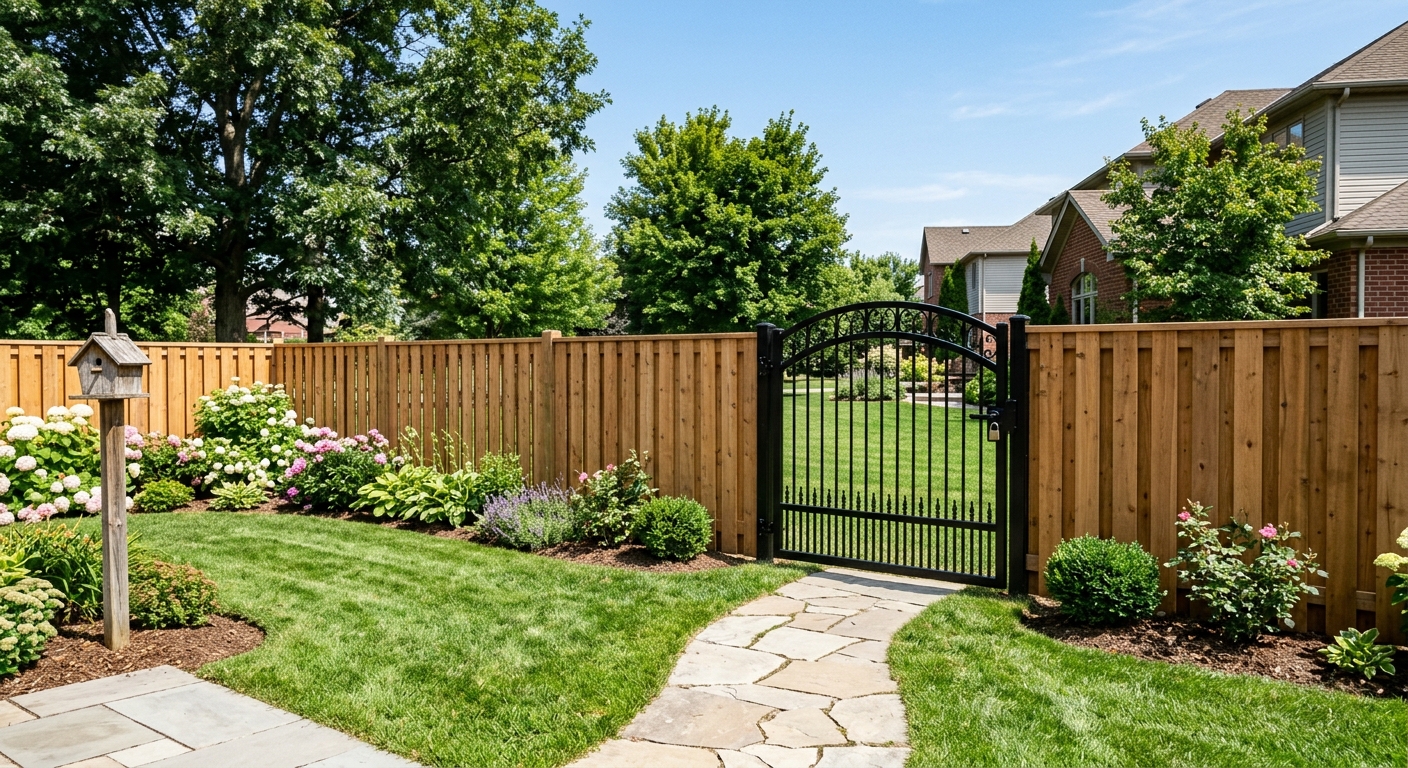
Fencing options and costs in Essex
In Essex, fencing is one of those home-improvement jobs that looks simple on paper but gets priced differently once frost depth, wind, and access are factored in. Essex’s housing stock is heavily dominated by single-detached homes (84.6% of dwellings), which means you’ll see constant demand for backyards, side-yard privacy, and boundary fencing as owners maintain and upgrade properties over time. With 63.1% of homes built before 1981 (Statistics Canada, 2021 Census), many projects also include replacement of older, weathered runs—often after boards warp or posts loosen in freeze-thaw cycles.
In the Windsor–Sarnia corridor, the biggest cost driver is installing posts deep enough to resist frost heave. Our frost-line design is roughly 1.2 m (about 4 ft), so many contractors plan for 4 ft embedment in exposed or clay-heavy soils, plus concrete setting on many jobs. Even though southern Ontario isn’t as wind-exposed as the Prairies, areas closer to open fields and the lake-influenced wind patterns can experience gusts that push up material and labour—especially for taller privacy fences and larger gates. Contractor availability can also vary: higher-volume replacement seasons (spring to early summer) can tighten schedules, which affects how quickly labour crews can mobilize.
If you’re in the LaSalle–Essex corridor style of neighbourhood build patterns—think more side-yard fencing, frequent gate work, and older perimeter runs—this trade tends to be especially busy. The right way to compare options is to look at installed material choices, then match them to lifespan and maintenance needs.
| Material |
Lifespan |
Maintenance |
Privacy Rating |
Price per Linear Foot |
| Pressure-treated pine (standard wood) |
10–15 years |
Stain/seal every 2–3 years; inspect posts and rails annually |
High (solid boards) |
$45 – $80 |
| Cedar (natural rot resistance) |
15–25 years |
Stain or seal every 2–4 years (helps prevent greying and warping) |
High (solid boards) |
$60 – $105 |
| Vinyl / PVC (no-maintenance) |
20–30 years |
Rinse annually; occasional panel cleaning |
High (solid or semi-solid designs) |
$65 – $110 |
| Chain-link (galvanized steel) |
20–40 years |
Occasional wash; check tension and hardware |
Low–Medium (can add privacy slats) |
$30 – $55 |
| Aluminum ornamental |
25–40 years |
Wash as needed; touch up hardware if required |
Low–Medium (ornamental pickets) |
$70 – $130 |
| Composite / recycled material |
25–35 years |
Minimal cleaning; inspect for fastener wear |
High (solid boards) |
$90 – $135 |
Prices are estimates only and vary by project scope, site access and material selection.
What affects the price of fencing in Essex
In the Essex area, you can see quotes for the same “typical” fence run vary by 30–50% across Windsor–Sarnia and elsewhere in Ontario because the ground conditions and the construction details change the labour hours. Two crews can price the same linear footage differently if one must dig deeper footings, pour more concrete, or work around utilities and landscaping. The difference is often less about the fence itself and more about the foundation work, gate hardware, and site complexity.
Frost line depth sets how deep posts must be set. In cold Ontario winters, the typical rule of thumb is to set posts roughly 4–6 inches below the design frost depth to prevent heaving. In practice, that often means posts are installed about 1.5–2.0 m into the ground, which increases excavation time, pushes up concrete volume, and requires longer posts—raising both labour and material costs. On windy lots (especially near open fields or lake-influenced exposure), we tighten post spacing and may upsize rails or switch to more wind-relieving styles. That can move a project into the higher end of the $45 – $80 wood band or the higher end of the $65 – $110 vinyl band even when the fence “looks” similar.
Concrete examples from Essex projects: a clay-heavy side yard usually needs more footing depth and careful compaction, which costs more than sandy ground where holes can be excavated faster and drain better. A replacement that includes demolition of an old fence and hauling it away often adds a measurable disposal and labour line item—sometimes enough to offset the upgrade from pressure-treated pine toward cedar. Finally, a tall privacy run with a double gate typically requires heavier posts and more gate hardware, so the installation cost climbs faster than a simple boundary run.
| Price Factor |
Why It Matters |
Cost Impact |
| Fence length in linear feet |
Labour and materials scale directly with total footage |
Highest impact—often the biggest portion of the quote |
| Post depth required |
Frost line determines post length and hole depth |
Can materially increase labour + post/material length costs |
| Post setting method |
Concrete vs. gravel pack vs. driven posts affects stability and time |
Concrete-set posts typically cost more but improve long-term performance |
| Material choice |
Vinyl, cedar, and chain-link differ in supply cost and installation effort |
Switching materials can shift the total into different price bands |
| Gate count and type |
Double-drive gates and wide openings need heavier posts/hardware |
Often increases cost disproportionately versus extra fence panels |
| Grade and terrain |
Slopes require stepped or raked panels, plus extra layout time |
Adds labour time and sometimes more materials |
| Old fence removal and disposal |
Demolition time, haul-away, and disposal fees vary by site |
Can add a separate cost line equivalent to several panels of labour |
| Permit fees and survey / property line locate |
Locates and any required permits prevent boundary disputes and rework |
Often modest, but prevents expensive corrections later |
Permits & regulations in Ontario
In Ontario, whether a fence requires a building permit depends mainly on the fence height and its location on the lot. As a practical rule homeowners use in Essex: fences above about 2.0 m (6.5 ft) at the rear, and roughly 1.0–1.2 m (3–4 ft) at the front or corner, often trigger a building permit requirement. Even when a permit isn’t required for your specific height, the fence still must respect property lines, municipal setback bylaws, and any applicable easements.
Before any post hole is dug, call for utility locates. In Ontario, homeowners typically use Ontario One Call to mark buried and near-surface utilities. If you don’t have a clear boundary, obtain a survey or locate the property pins—this is one of the most common ways fencing projects get delayed (or corrected) after disputes.
Shared fence ownership rules are governed by provincial line-fences legislation, so document agreements with your neighbour if you’re building on or near the boundary and consider setting terms in writing (even a simple signed note helps).
What DOES typically require a permit: taller fences (around/above the thresholds above), and any design that effectively acts like a barrier in areas covered by municipal rules. What typically does NOT: standard-height replacement of an existing fence in a like-for-like footprint where bylaw thresholds aren’t exceeded—still, confirm with your municipality before digging.
To verify your contractor in Essex, ask for: (1) proof they hold the right Ontario business registration for their trade work and provide a contactable licence/credentials if applicable, (2) certificate of liability insurance naming you as additional insured, and (3) clearance/coverage documentation for WSIB (or equivalent coverage if they’re not required). Request the insurance certificate and check expiry dates, and confirm the company name matches the contract. Always keep copies of these documents with your signed estimate.
Choosing the right fence material for Essex
Your best fence material in Essex comes down to balancing privacy, low maintenance, budget, and expected lifespan through freeze-thaw winters. Pressure-treated pine is usually the lowest upfront choice, but it typically needs staining or sealing every 2–3 years to prevent heavy grey weathering and to reduce surface checking. Cedar looks and weathers better than basic pine thanks to its natural rot resistance, but it still benefits from periodic sealing to keep it looking sharp. Vinyl/PVC offers no-sanding, no-staining convenience, yet extreme cold snaps can make panels more brittle if the system isn’t installed correctly—especially around corners and gate hardware. Chain-link is the lowest cost and long-lived, but it doesn’t provide privacy unless you add slats or a mesh privacy screen. Aluminum ornamental is rust-resistant and tidy-looking, but it’s mid-range to higher cost and generally not a full privacy solution.
Frost-line performance should be front of mind regardless of material. In Windsor–Sarnia, the frost-line design is roughly 1.2 m, so post embedment commonly needs to be well below that—often around 4 ft where conditions are exposed or clay-heavy—plus concrete setting on many projects. Concrete-set posts aren’t always required for every scenario, but they are common when you want better resistance to post movement over time, especially on older yards with uneven ground.
Wind and snow load also matter. A solid privacy fence catches wind; in exposed locations we may tighten post spacing or choose board-on-board patterns that reduce sail effect. For a dollar reality check: if you’re budgeting around the wood band ($45 – $80), upgrading to vinyl can push you toward $65 – $110. That price difference can be justified when you want fewer maintenance weekends—particularly if your yard needs fence repairs every other year with wood.
| Material |
Cold Tolerance |
Lifespan |
Annual Maintenance |
Best For |
Price Band |
| Pressure-treated pine |
Good in cold when posts are properly embedded and boards are sealed |
10–15 years |
Low to moderate (stain/seal every 2–3 years; annual inspection) |
Budget-friendly boundary or privacy where you’re okay with upkeep |
$45 – $80 |
| Cedar |
Very good; handles freeze-thaw well with correct installation |
15–25 years |
Low to moderate (stain/seal every 2–4 years) |
Longer-lasting privacy with better appearance |
$60 – $105 |
| Vinyl / PVC |
Good in cold; choose quality profiles and correct fastening |
20–30 years |
Very low (rinse/clean as needed) |
Low-maintenance privacy with a cleaner long-term look |
$65 – $110 |
| Chain-link |
Excellent for Ontario winters when tension and posts are set correctly |
20–40 years |
Very low (wash and check tension/hardware) |
Security per dollar; boundary fencing and pet containment |
$30 – $55 |
| Aluminum ornamental |
Excellent; coatings resist salt and winter moisture |
25–40 years |
Very low (occasional wash) |
Attractive, clean-looking front yards and pool perimeters |
$70 – $130 |
| Composite / recycled |
Good if installed with proper expansion allowance |
25–35 years |
Very low (cleaning; check fasteners) |
Durable privacy where you want minimal maintenance |
$90 – $135 |
How to choose a fencing contractor in Essex
Choosing a fencing contractor in Essex starts with proof, not promises. First, verify Ontario business credentials as applicable to the company and request a certificate of liability insurance; your certificate should show active coverage and the company name that matches the quote/contract. For worker protection, confirm WSIB clearance (or the appropriate WCB coverage if your contractor is in a covered category) and request the clearance letter or proof of coverage. Never rely on verbal assurance—ask for documents and keep copies with your paperwork.
Next, get 2–3 written, itemised quotes. Look for a breakdown that separates labour (digging, post setting, alignment), materials (rails, boards/pickets, concrete if included), and hardware (hinges, latch, gate reinforcement). A good quote also states what’s excluded: for example, permit pull responsibility, disposal of old fence materials, or utility locating (even if homeowners call it in, the contractor should coordinate footing work around marks). Compare like-for-like scope—otherwise you’re comparing apples to fence posts.
Warranty matters: ask for the length of the workmanship warranty (how long they’ll come back to correct installation issues like post movement or sagging) and the manufacturer warranty for product components. Confirm whether warranty coverage is transferable if you sell your home.
Payment schedule should be conservative. A common safe practice is not paying more than 10–15% upfront. Hold back the remainder until the fence is complete, straight, gates operate correctly, and cleanup is done. Also require a written start date and a completion estimate—fencing projects can slip if footing materials or longer lead-time gates aren’t ordered early.
- Provide a written scope with linear feet, post spacing plan, and material specification (grade/profile)
- Confirm how posts will be set (concrete, gravel pack, driven) and whether frost-line embedment is included
- List all gate hardware and confirm gate count and opening widths in writing
- Specify whether old fence removal and disposal are included and where debris will be hauled
- Ask who contacts Ontario One Call and how utility marks are managed
- Check that quotes include survey/locate costs if boundary is uncertain
- Request proof of liability insurance and WSIB clearance letter before work begins
- Confirm workmanship warranty length and what constitutes a valid warranty claim
- Clarify product warranty terms and whether they require registration to stay valid
- Keep a payment schedule; avoid large deposits and use final holdback until completion
- Require site protection details (work area, landscaping protection, and cleanup standards)
- Get timelines in writing and confirm material lead times for vinyl/aluminium/composites
In Essex, red flags we see include: quotes that won’t explain post depth or fastening methods; “bottom-line” pricing with no gate or disposal details; refusal to provide insurance/WSIB clearance documents; large deposits (beyond 10–15%); and no written start date or completion estimate—especially during peak spring scheduling when timelines matter.
Frequently asked questions — fencing in Essex
How do I handle a fence dispute with a neighbour in Ontario?
Start by confirming where the boundary actually is. In Ontario, fence disputes often come down to property lines and setbacks, so get a survey or locate your property pins before you spend on major repairs. Next, review any prior agreements about shared fencing—shared fence ownership rules are guided by provincial line-fences legislation. Then document everything: photos, measurements, and the contractor estimate that shows how the fence will sit relative to pins. If you already hired someone, pause work until the boundary is clarified to avoid costly rework. If you’re in Essex and the ground is uneven (common on older lots built before 1981), misalignment can also look like encroachment even when the intent was correct.
What fence style offers the best wind resistance in Essex?
For wind resilience in the Windsor–Sarnia corridor around Essex, styles that reduce “sail effect” perform best. A solid privacy fence can catch gusts, especially near open fields and lake-influenced wind patterns, so we often recommend board-on-board, lattice blends, or picket designs with consistent gaps so wind can pass through. Another key factor is structural: tighter post spacing, sturdier rails, and correct tensioning on chain-link all help. Regardless of style, frost-line embedment matters because a wind-driven fence can amplify any post movement caused by freeze-thaw. On exposed sites, this is one reason your quote may land toward the higher end of the wood or vinyl bands (for example, $45 – $80 for installed wood work can increase with heavier posts and deeper concrete).
How much does a fence cost in Essex?
Fence costs in Essex depend on total linear feet, post depth, material, and gate hardware. As a baseline, homeowners often see pressure-treated wood installations in the $45 – $80 range and vinyl/PVC in the $65 – $110 range for typical residential projects. Chain-link is usually the most budget-friendly option, commonly around $30 – $55, while aluminum ornamental often falls in the $70 – $130 range. The local cost driver is the foundation: Windsor–Sarnia frost design is about 1.2 m, so many projects use deeper embedment (often around 4 ft) and sometimes concrete setting, which adds labour and material. If you’re replacing an older fence, demolition and disposal can also push your total up.
How deep should fence posts be for Essex's frost?
In Essex, a practical starting point is to set posts below the design frost depth to reduce freeze-thaw heaving. In the Windsor–Sarnia corridor, frost-line design is roughly 1.2 m (about 4 ft). In exposed or clay-heavy soils, many projects plan for about 4 ft embedment, while still accounting for your specific frost depth, soil type, and the fence’s structural load (height, wind exposure, gate weight). That often translates to posts being installed roughly 1.5–2.0 m into the ground. If a contractor is proposing shallow setting without explaining frost-related embedment, you should ask detailed questions. Concrete setting is commonly used in Ontario best practice to stabilize posts, especially where soil movement is expected.
Wood vs vinyl vs aluminum fence — which is best?
“Best” depends on what you value most. Wood (especially pressure-treated pine) is often the most budget-friendly upfront option, typically within $45 – $80, but it usually needs staining/sealing every 2–3 years and periodic inspections to keep boards looking good. Cedar costs a bit more but resists rot better and can last longer with reasonable maintenance. Vinyl/PVC is the low-maintenance choice—commonly $65 – $110—and holds up well in Ontario winters when installed correctly. Aluminum ornamental is durable and rust-resistant, usually $70 – $130, but it’s mainly decorative/low-to-medium privacy. In Essex, where many homes are older, the “best” option is often the one that matches your tolerance for upkeep and your site conditions (especially post embedment below the frost line).
Do I need a permit to build a fence in Ontario?
Sometimes, yes—especially for taller fences. In Ontario, fences above about 2.0 m (6.5 ft) at the rear and around 1.0–1.2 m (3–4 ft) at the front or corner often require a building permit, depending on municipal rules. Even if a permit isn’t required, the fence must still comply with property line rules, setbacks, and any easements. For your Essex project, confirm the height and location before you order materials, and don’t dig until utility locates are completed through Ontario One Call. Also, verify that the contractor coordinates installation within the boundary. If you’re planning heavy privacy fencing or a pool-side barrier, treat permits and inspections as part of the plan—not an afterthought.