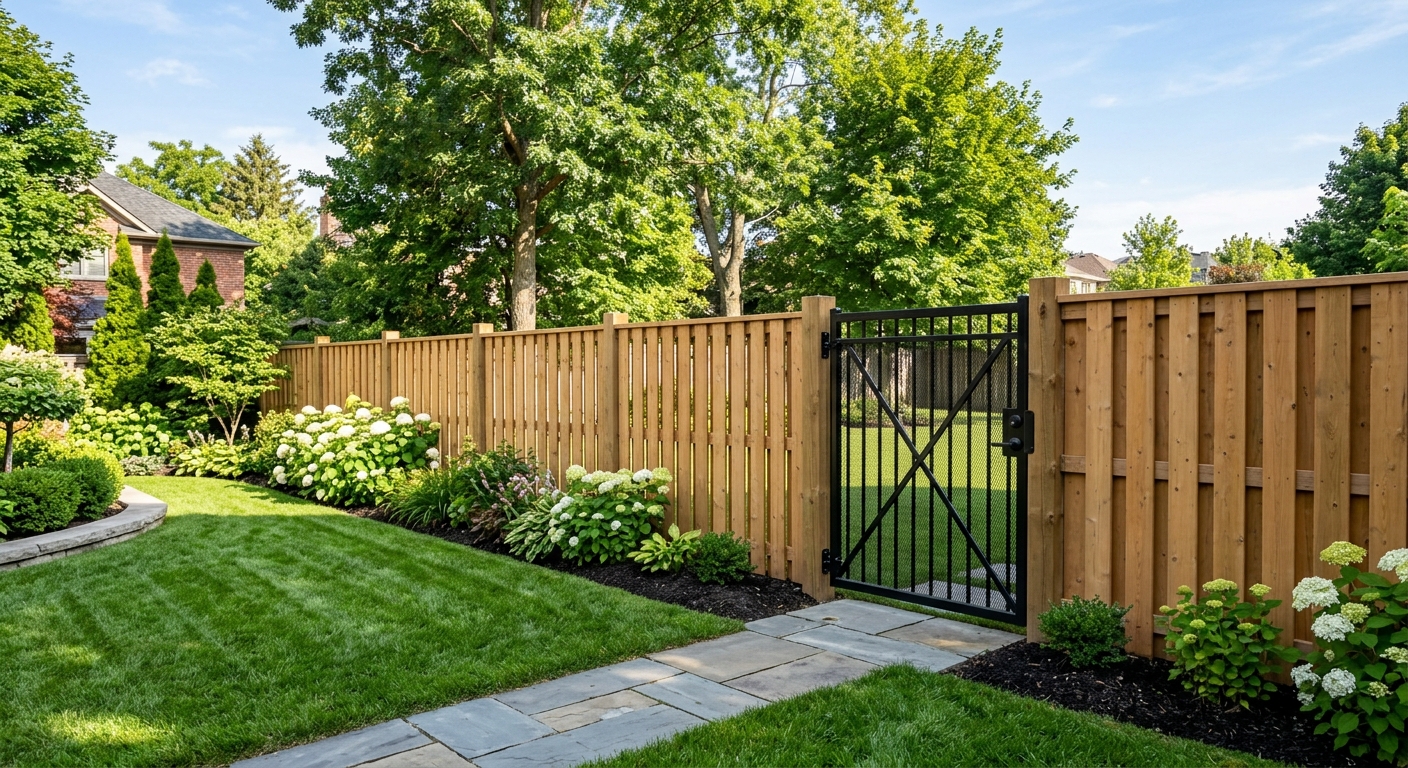
Fencing options and costs in Country Hills
In Country Hills, fencing decisions usually start with two things: how you want your yard to feel (privacy vs. openness) and how the local ground and weather will treat the materials over time. With a population of 4,821 people (Statistics Canada, 2021 Census), Country Hills is a small community—but each detached and family property is effectively a long-term customer base for fencing, upgrades, and gate work. In the Toronto economic region, where the pace of housing improvements stays steady, contractors tend to be busier in neighbourhoods with more backyard renovations and repeat landscaping installers; in Country Hills, demand is especially visible around the residential corridors where lots back onto greenspace and quieter side streets.
Pricing here is driven by Southern Ontario frost depth and Toronto-area building practices. The frost line is commonly estimated at about 42"–48", so posts for 6–8 ft privacy fences typically need to be set deeper (often about 3.5–4 ft) with concrete, especially in clay and mixed soils where frost heave is a real concern. That increases labour time and materials, but it improves long-term stability and helps avoid wobbly panels after freeze–thaw cycles. If you’re comparing options, you’ll also see differences in how wind loads are handled: taller solid fences require heavier posts and closer spacing to reduce racking and uplift.
Below are typical budget ranges homeowners use when planning a fence project in Country Hills, with a clear comparison of lifespan and maintenance expectations across common materials—then you can map your priorities to the right build.
| Material |
Lifespan |
Maintenance |
Privacy Rating |
Price per Linear Foot |
| Pressure-treated pine (standard wood) |
10–15 years |
Stain/seal every 2–3 years |
High (solid boards) |
$65 – $120 |
| Cedar (natural rot resistance) |
15–20 years |
Light staining every 2–4 years |
High (solid boards) |
$80 – $135 |
| Vinyl / PVC (no-maintenance) |
20–30 years |
Minimal—rinse occasionally |
High (solid or privacy lattice) |
$75 – $130 |
| Chain-link (galvanized steel) |
25–35 years |
Very low—wash/inspect hardware |
Low to medium (open mesh) |
$45 – $85 |
| Aluminum ornamental |
25–40 years |
Low—periodic cleaning |
Low (open pickets) |
$90 – $160 |
| Composite / recycled material |
20–30 years |
Low—no staining; occasional wash |
Medium to high (depends on slat coverage) |
$85 – $150 |
Prices are estimates only and vary by project scope, site access and material selection.
What affects the price of fencing in Country Hills
In Country Hills, you’ll often see quotes for the “same” fence come in 30–50% apart across the Toronto area because the hidden variables are where the money moves: post depth and setting method, panel style, gate count, and how difficult the yard is to access. Two yards can look similar, yet one needs full concrete-set footings because clay soils hold moisture and frost heave risk is higher, while the other can manage with a lighter installation. That’s why a realistic quote isn’t just a material choice—it’s a construction plan.
In Southern Ontario, the frost line commonly sits around 42"–48". Best practice is to set posts about 4–6 inches below the design frost depth, which pushes typical hole depths toward roughly 1.5–2.0 m (about 4.9–6.6 ft) for taller privacy fences. That usually means concrete setting rather than driven posts, increasing labour and ready-mix costs. Wind also affects design choices: while the GTA isn’t the same severe wind exposure as the Prairies, taller solid privacy fences still need heavier posts (and closer spacing) to resist racking. Coastal BC’s wet conditions aren’t your issue here, but Ontario’s freeze–thaw can still stress fasteners and joints if the base isn’t built properly.
Concrete examples: (1) A 60 ft run of 6 ft privacy fence can cost materially more if your contractor uses concrete-set posts at the required depth; you may also need extra labour to dig through heavier soils. (2) Adding a drive-through double gate increases cost beyond the “per-foot” look because hinges, latch hardware, and sometimes extra bracing demand more skilled installation. As a ballpark, wood privacy builds often land around the $65 – $120 band, while vinyl privacy frequently sits closer to the $75 – $130 band—often justified when you’re planning to avoid staining cycles.
| Price Factor |
Why It Matters |
Cost Impact |
| Fence length in linear feet — the primary cost driver |
Every additional foot adds materials and labour (posts, rails, fasteners) |
Largest driver; scales directly with total run |
| Post depth required — frost line determines post length and hole depth |
Deeper holes and longer posts reduce frost heave risk |
Can raise costs noticeably for tall/privacy fences |
| Post setting method — concrete vs. gravel pack vs. driven posts |
Concrete-set posts improve stability in clay/mixed soils |
Typically increases labour + ready-mix |
| Material choice — vinyl vs. cedar vs. chain-link |
Different post sizes, hardware, and durability affect build effort |
Often shifts project into different price bands |
| Gate count and type — walk-through vs. drive-through (double) |
Gates require stronger frames, hinges, and alignment |
Frequently adds a disproportionate premium |
| Grade and terrain — sloped yards require stepped or raked panels |
Slopes change layout, cuts, and sometimes rail height |
Extra labour and sometimes extra materials |
| Old fence removal and disposal |
Demolition, hauling, and disposal fees vary by volume and conditions |
Can add substantial time and dump costs |
| Permit fees and survey / property line locate |
Ensures compliance with setback rules and prevents encroachment |
Costs vary by project; can be a meaningful add-on |
Permits & regulations in Ontario
In Ontario, fences above a height threshold often require a building permit—commonly around 2.0 m (6.5 ft) at the rear and about 1.0–1.2 m (3–4 ft) at the front or corner. Even when a permit isn’t required, your fence must follow property line boundaries and comply with municipal setback rules. Before digging any post hole, you must complete utility locates through Ontario One Call to prevent accidental damage to buried services. For many Country Hills homeowners, the simplest way to avoid neighbour and boundary disputes is to confirm your property pins and/or obtain a survey or property-line locate before installation starts.
Shared fence ownership and boundary responsibility issues are handled under Ontario’s line-fences legislation. Practically, that means if you’re repairing or replacing a shared boundary fence, you should document the condition, agree on scope in writing, and ensure alignment with the property line—especially if your plans involve height or material changes.
How to verify your contractor before they dig: (1) Ontario licence status: check the trade/contractor listing through Ontario’s online resources where applicable for the contractor type. (2) Liability insurance: request a certificate of insurance naming you (or your property) as additionally insured if required by your agreement. (3) WSIB/WCB coverage: ask for proof of clearance or coverage documentation. Then verify the dates and coverage amounts are current, and that they match the job type (labour and installation work).
Note: Permit requirements depend on location and fence design; your contractor should confirm whether your specific fence exceeds the local threshold and whether a permit pull is included in the quote.
Choosing the right fence material for Country Hills
Choosing a fence in Country Hills is really choosing a maintenance schedule that matches your tolerance for winter-related wear. Pressure-treated pine is the budget-friendly starting point, but in Southern Ontario it typically needs staining or sealing about every 2–3 years to reduce grey weathering and protect against moisture cycling. Cedar costs more upfront and looks great, but it still benefits from periodic maintenance to keep colour and reduce surface splitting over time. Vinyl/PVC is the low-maintenance favourite—no staining, easy hose-down—but it can become brittle if installation is poor or if extreme cold stresses unsupported sections, which is why solid post spacing and proper hardware matter. Chain-link is the longest-life option for visibility and security with minimal upkeep, though it won’t provide privacy unless you add slats, a privacy screen, or landscaping.
Because Ontario’s frost line is commonly estimated around 42"–48", tall privacy fences usually need concrete-set posts set deeper to avoid frost heave. That means even “maintenance-free” materials still rely on correct footings. For wind and winter snow load considerations, solid panel styles generally need heavier posts and closer spacing to prevent racking and uplift. In open picket aluminum fences, wind passes through more easily, reducing strain on posts—but you’ll trade privacy.
Here’s where the dollars usually justify themselves: if you’re comparing wood at roughly $65 – $120 versus vinyl at about $75 – $130 for a typical installed run, the extra upfront cost can be worth it when you want to stop staining crews every few years—especially in a freeze–thaw climate where coatings age faster if they’re neglected.
| Material |
Cold Tolerance |
Lifespan |
Annual Maintenance |
Best For |
Price Band |
| Pressure-treated pine |
Good with proper post depth and sealant |
10–15 years |
Low to moderate (inspect; stain/seal every 2–3 years) |
Lower budget with privacy panels |
$65 – $120 |
| Cedar |
Very good; handles moisture cycling well |
15–20 years |
Low to moderate (light staining/maintenance 2–4 years) |
Appearance + rot resistance |
$80 – $135 |
| Vinyl / PVC |
Good when installed with correct bracing and temperature-appropriate hardware |
20–30 years |
Very low (wash/inspect; lubricate latches as needed) |
Low-maintenance privacy |
$75 – $130 |
| Chain-link |
Excellent; resistant to rot and many weather effects |
25–35 years |
Very low (check tension and hardware) |
Security and affordability |
$45 – $85 |
| Aluminum ornamental |
Excellent (won’t rust like some steels) |
25–40 years |
Low (periodic cleaning) |
Decorative look with security |
$90 – $160 |
| Composite / recycled |
Good; performance depends on product system and installation |
20–30 years |
Low (rinse/inspect for loose fasteners) |
Consistent look with reduced upkeep |
$85 – $150 |
How to choose a fencing contractor in Country Hills
When you hire a fence contractor in Country Hills, you’re not only paying for materials—you’re paying for correct depth, straight runs, and safe excavation in a frost-prone area. Start by verifying Ontario licence expectations for the contractor type, then confirm liability insurance and WSIB/WCB coverage. Ask for proof: (1) Liability insurance certificate of insurance (with coverage limits that make sense for residential property work). (2) WSIB/WCB coverage documentation or clearance letters, depending on how the contractor reports coverage for their crews. Don’t accept “we’re covered” as a statement—request documents and check expiry dates.
Next, get 2–3 written quotes that are genuinely itemised: labour line items, material list (including post size and fence style), and allowance for concrete-set posts versus any alternative method. Make sure exclusions are explicit: is permit pulling included (when required), is old fence removal included, and are dump fees covered? A quote should also specify how they’ll handle slope transitions (stepped vs. raked panels) and what happens if the buried utilities or unknown obstructions appear.
Warranty matters in Ontario’s freeze–thaw. Request the workmanship warranty length (how long your contractor stands behind installation), the manufacturer warranty for materials, and whether the warranty transfers if you sell the home. On payment, never pay more than 10–15% upfront—hold back a portion until the job is complete and cleaned. Get a start date and a completion estimate in writing, and confirm scheduling lead times in case weather affects post-hole digging.
- Verify current liability insurance and confirm it covers fencing installation and excavation work.
- Request WSIB/WCB coverage proof or a clearance letter with valid dates.
- Ask for Ontario permit responsibility: who pulls it, and is it included if required?
- Confirm post depth and setting method in writing (concrete-set vs. alternatives).
- Require an itemised quote: labour, posts, rails, panels, fasteners/hardware, gates, and concrete.
- Clarify exclusions: old fence demolition, disposal/dump fees, and restoration of disturbed ground.
- Ensure the quote includes gate hardware and whether hinges/latches are heavy-duty for Ontario wind.
- Ask how they handle slope—stepped or raked—and whether it affects privacy coverage.
- Confirm the plan for property line verification (survey locate/pins) before posts are set.
- Check warranty terms separately for workmanship and materials (and confirm transferability).
- Review payment schedule: avoid large deposits; use holdback until final completion.
- Get an estimated timeline with weather contingency for frost and soil conditions.
Red flags I see too often in Country Hills: (1) “We’ll just drive posts” for a tall privacy fence without discussing frost depth and concrete setting; (2) a quote that’s lump-sum with no post-depth or gate hardware details; (3) refusal to provide insurance and WSIB/WCB documentation; (4) vague warranty language like “materials only” or unclear workmanship coverage; and (5) pressure to pay a big deposit upfront before measurements and site layout are confirmed.
Frequently asked questions — fencing in Country Hills
What is the cost per linear foot for fencing in Country Hills?
In Country Hills and the broader Toronto region, most fencing quotes land in established per-linear-foot bands once you account for posts, labour, and typical hardware. For wood privacy installations, pricing often sits around $65 – $120 per linear foot. Vinyl/PVC privacy commonly comes in around $75 – $130, while chain-link is usually lower at about $45 – $85. The reason these numbers move is frost-related construction: in Southern Ontario, posts are typically set deep enough to reduce frost heave risk, which increases concrete and excavation time. Gates and difficult access can also push your effective per-foot cost higher than a simple “material only” calculator would suggest. (Statistics Canada, 2021 Census)
Should I repair or replace my old fence in Country Hills?
Repair makes sense when the posts are solid and upright, the fence line hasn’t pulled out of plumb, and you’re only replacing a small section of boards or rails. In Country Hills, replacement is often the better value when you notice loose footings, leaning posts, widespread rot, or repeated fastener failure after freeze–thaw cycles—those typically indicate a foundation or installation issue rather than just worn boards. If the fence is only a year or two old, ask whether the manufacturer warranty covers materials, and whether workmanship warranty covers installation. For older fences, if more than a few posts show movement, I generally advise replacement because you’ll be paying labour twice. In most cases, a proper concrete-set post install is what stops the cycle.
How do I handle a fence dispute with a neighbour in Ontario?
Start with facts: confirm your property line using a survey locate or the property pins (if you already have one). In Ontario, shared fence situations are guided by line-fences principles, but neighbourhood outcomes still depend on good documentation and clear communication. Take dated photos of the fence condition, keep copies of any written agreements, and avoid “fixing” beyond the boundary without consent. If your neighbour’s fence work impacts yours (for example, posts encroaching), insist on layout confirmation before any digging. If you can’t agree, consider mediation or legal guidance rather than escalating the work directly. A professional contractor can help by measuring, marking the proposed line, and providing an itemised scope that both sides can review.
What fence style offers the best wind resistance in Country Hills?
For wind resistance in Country Hills and the Toronto region, a fence’s resistance comes from solid construction: appropriate post size, correct spacing, and secure post footings—not just the appearance. Tall solid privacy fences (wood or vinyl) can perform very well when built with heavier posts and closer centres to reduce racking. In practical terms, using concrete-set posts to account for frost heave helps the whole system resist movement as wind loads and freeze–thaw repeat. Aluminum ornamental fences handle wind better because wind passes through the pickets, but they won’t give you privacy. Chain-link can also stand up in wind, but it offers limited privacy without additions. The “best” option is usually the one that matches your privacy needs while using the correct footing depth and hardware spec.
How much does a fence cost in Country Hills?
Fence cost depends mainly on total linear feet plus the complexity: gates, post depth/setting, removal of an old fence, and whether your yard is accessible with equipment. Using the Toronto-area bands as a guide, wood installations are often quoted in the $65 – $120 range, vinyl/PVC in the $75 – $130 range, and chain-link in the $45 – $85 range. For many homeowners, the easiest way to estimate is to measure your linear runs accurately and then expect that tall privacy fences will require concrete-set posts due to frost depth (commonly about 42"–48"), which adds labour and materials. If you have an older fence to remove or you need a drive-through double gate, your total project cost will likely exceed a simple per-foot multiplication.
How deep should fence posts be for Country Hills's frost?
For Country Hills in Southern Ontario, posts generally need to be set deep enough to reduce frost heave risk. With an estimated frost line of about 42"–48", good practice is to set posts roughly 4–6 inches below the design frost depth, which commonly translates to about 3.5–4 ft deep for many typical privacy-fence builds (and often around 1.5–2.0 m into the ground when you account for variability). For 6–8 ft fences, we usually recommend concrete-set posts rather than simple driven posts, especially in clay and mixed soils where moisture and freeze–thaw can move foundations. Your contractor should confirm post depth, hole diameter, and setting method in the quote. If they won’t discuss frost depth explicitly, that’s a warning sign.